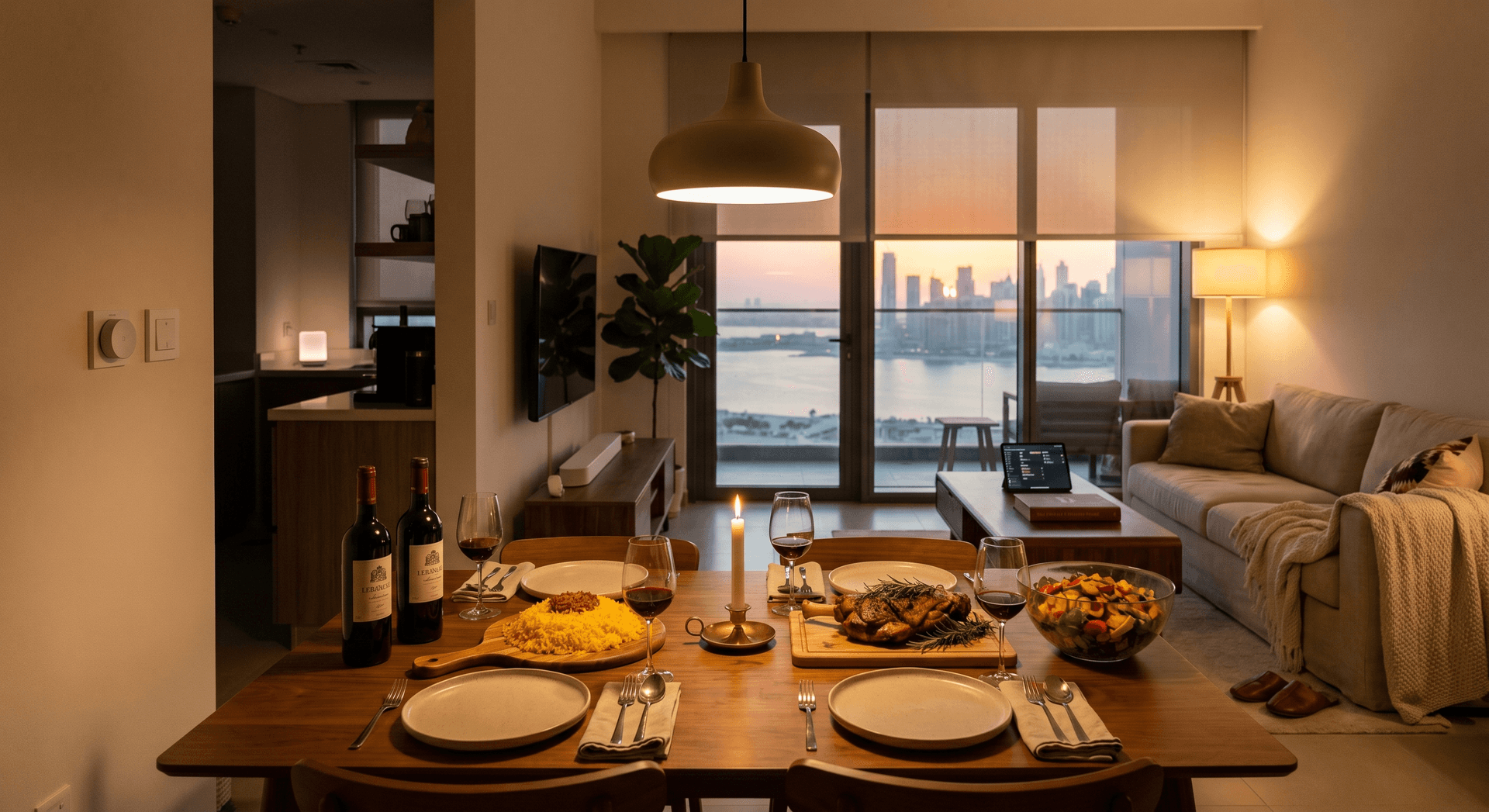
A friend in Dubai Marina told us a story over coffee in March. She had hosted four friends for dinner on a Friday in February. She had pulled it off, technically: a Lebanese spread, two bottles of wine, dessert from Maison Boulud. By 9:30pm the food was cleared and the conversation should have settled into the soft, leaning-back part of the evening where the room does the work and you stop running it.
Instead the same two LED downlights had been blasting the dining table at 4000K since 6pm. The kitchen lights were on the same circuit, so dimming the dining area meant cooking by candlelight at 8:15pm when she had to plate the second course. Her partner kept getting up to nudge the AC down because the dining table sat directly in the path of the main split. At 9pm one of the guests had to open Spotify on his phone because the apartment had gone silent and the Bluetooth speaker was in the spare bedroom on a 4% battery. By 10pm two of the four had left.
She paid AED 320 for ingredients and AED 240 for dessert. She remembers the room she was sitting in, not the food.
TL;DR: A Friday-night dinner scene for a 2-bedroom Dubai apartment costs AED 4,000-8,000 installed, fires on one tap at 6:45pm, and choreographs four moments through the evening: arrival, drinks, plated dinner, lingering. Lighting drops to a dimmed 2700K dining pendant with the kitchen downlights off, AC steps from cooling-mode 22 to a steady 24, motorized blinds catch the west-facing sunset glare, and Sonos plays a host-curated 4-hour set from Anghami or Spotify. No phones on the counter. No Bluetooth speaker dance. The room runs the evening.
Why a Dubai Apartment Dinner Goes Sideways
In our experience surveying Dubai apartments after a hosting Friday went sideways, the same five things break in the same order. The light is too bright. The kitchen lights and the dining lights are on the same circuit. The AC was set in the morning for an empty apartment and never gets adjusted for six people in a room. The blinds catch the west-facing sunset between 6:15pm and 7:30pm and the host is up nudging them. The audio dies the moment someone leaves the kitchen.
Sixty-seven percent of UAE residents say they host house parties or in-home gatherings, according to a Toluna study of 556 UAE residents aged 18-60 conducted January 30 to February 3 2026. Seventy-seven percent visit relatives, seventy-five percent visit malls, sixty-nine percent dine out. In a city where the convenience economy has solved every other friction in your life, the apartment-as-dinner-venue is the most universal lifestyle scene that nobody has the right gear for.
The week ahead makes the point sharper. Islamic New Year falls Monday June 15, confirmed by both public and private sectors as a paid holiday, giving Dubai a Saturday-Sunday-Monday long weekend at peak summer heat (Khaleej Times, 2026). Outdoor venues like Global Village and Miracle Garden closed for the summer at the end of May. The 39C-today, 75-percent-overnight-humidity Saturday you are reading this on tells you exactly where the weekend will happen: indoors, at home, with the people you would have met at a beach club a month ago.
The scene this post describes is for that Friday. Or the Friday after. The three-day-weekend version of the same logic is what a smart home does across 72 hours of staying in.
What "Restaurant Mood" Actually Means in a Room
A restaurant that runs a 7pm-to-10pm shift well does five things to your perception of the meal that you never notice on the way in. Lighting drops from arrival to plated dinner to dessert across two color temperatures and three brightness levels. Music sits at a deliberate volume below conversation threshold and shifts genre with the courses. The room temperature is one degree warmer at 9pm than it was at 7pm. The glare from the windows is dealt with by the time you sit down. Nobody at your table is operating any of it.
The research backs this up. Studies cited by Hospitality Career Profile (2024) show customers in dimly lit restaurants linger 16 percent longer than those in well-lit ones, and dynamic lighting that changes through the meal pushes dwell time up another 18 to 22 percent. The sweet spot for ambient restaurant lighting is 2700K to 3000K, according to Action Services Group (2025), because it makes food look appetizing and warm light slows the meal down. The 2026 trend that fine-dining rooms are leaning into is warm-dim, where a fixture starts at 2700K at full brightness and drops to 2200K candlelight at low dim, per Commercial Lighting Industries (2025) and Hackrea's dining-room trend report (2026).
A Dubai apartment ceiling running 4000K downlights at 100 percent is doing the opposite of all of that. It is shortening dwell time on purpose. Your dinner is fighting a setting designed for a fast-food restaurant.
The Four Moments of a Friday Dinner
We build the scene in our heads as four moments, and the smart-home setup we install in client apartments mirrors them. None of the moments are about the food. The food is the host's job. The room is the home's.
The first moment is arrival, 6:45pm to 7:15pm. The host has been moving for two hours. Guests start ringing the buzzer. The room needs to be visible, alert, and warm enough to feel like an event, but it cannot be doing dinner-mood yet because nobody is sitting down. The blinds need to be at 80 percent to soften the Marina or Business Bay sunset that is hitting the room between 6:15pm and 7:30pm in June. The AC needs to be running cool because the apartment has been at hosting-prep heat with the oven on. The audio is up at 70 percent, more chatty than mood. Lights are warm-white 2700K but bright enough for a kitchen handover between the host and the partner.
The second moment is drinks and starters, 7:15pm to 8pm. Guests have shoes off, drinks in hand, the host is plating something. The room dims gently. Living-room floor lamps step down to 60 percent, kitchen downlights go off entirely, and the dining pendant comes on at 50 percent. The blinds are at 90 percent now because the sun is below the horizon and the sky is the soft amber that Dubai does well. The AC has crept from 22 to 23 because six people have walked into a 2BR. Music shifts genre from upbeat to softer instrumental, volume drops to 55 percent.
The third moment is plated dinner, 8pm to 9:30pm. Everyone sits. The pendant over the dining table is the only direct light in the room. It comes on at 40 percent warm-white, with everything else stepped down so the food on the table is the brightest thing in the visual field. This is the restaurant trick, and it is what every fine-dining room you have eaten in does. The AC is steady at 24 because the body heat of six people plus oven residual is enough to balance it without making anyone cold. Music is at 50 percent and selected to disappear into the conversation.
The fourth moment is lingering, 9:30pm to 11pm. Dessert is served, the room slows, conversation goes long. Lights step down again. Pendant to 25 percent. Floor lamps to 40 percent. A single hidden cove or shelf lamp comes on at 2200K amber to give the room a glow that does not look like the lights are about to go out. AC nudges back to 23 because the room is cooling on its own. Music shifts to acoustic at 40 percent. This is when guests stay an extra hour without realizing it. The 16-to-22-percent restaurant dwell-time research is doing real work here.
The fifth moment we sometimes set up is all off, 11pm or later. One button on the wall by the door, pressed by the host on the way to thank the last guest at the elevator. Lights to zero, music stops, AC settles to overnight 23. The host comes back to a quiet apartment with the dishwasher already running. This last step is the same sequence as a nightly Good Night scene, which does the same thing every weeknight without any guests to send home.
What We Install in a Dubai 2BR for AED 4,000-8,000
The setup that we install most often in a Business Bay, Marina, JBR, or Downtown 2-bedroom sits in three layers.
The lighting layer is the layer that does the most work and is the easiest for a renter to install without touching the walls. We typically spec a Philips Hue Starter Kit at AED 379-449 from Sharaf DG UAE (2026), which gets you the Hue Bridge and three White Ambiance bulbs, plus four to six more White Ambiance bulbs at around AED 149-249 each. The Hue Bridge talks to up to 50 lights. We keep the dining pendant and the living-room floor lamps on Hue because those are the fixtures the scene reaches for. We do not put Hue bulbs on the kitchen ceiling downlights because those are usually on the same wall switch as the dining circuit, and putting smart bulbs behind a dumb switch breaks the scene the moment somebody flips the switch at the wall. For the kitchen we either turn the wall switch off and leave it off (renter answer), or we install a Lutron Caseta wall dimmer behind the switch with a Pico keypad on the wall as the controllable face (owner answer). The Pico is the four-button scene controller we mount by the dining-room entrance: Arrival, Dinner, Late Dinner, All Off. The kitchen itself, once you go past the dinner-only need, deserves its own four-layer build: ambient, under-cabinet task, toe-kick accent, and a pendant. We cover the standalone kitchen build in the four-layer kitchen lighting guide for Dubai apartments.
The AC layer is the layer nobody plans for and everybody notices first. The Dubai apartment AC was set in the morning for an empty room and is now fighting six bodies and an oven. We install a Sensibo Sky on the main split (AED 600-700, Noon UAE, 2026) or an Aqara IR controller if the household is already on Aqara. We do not change the AC ourselves. We let the scene tell it what to do: AC to 22 at 6pm pre-cooling, step to 24 at 6:45pm when the scene fires, hold steady at 24 through dinner, nudge to 23 at 9:30pm, settle at 23 overnight. In our experience the AC change is the one nobody plans for and the one every host notices first. The dining table stops being the cold seat at the table.
The audio layer is the layer that ends the Bluetooth speaker dance. We install one Sonos Era 100 in the kitchen at around AED 919-1,149 from Sharaf DG or PULT Electronics (2026), and we pair it with a Sonos Beam soundbar under the TV at around AED 2,500-2,899 from Sharaf DG (2026). The Beam earns its keep on movie nights and serves as the living-room dinner zone the rest of the time. We set up the host's Anghami account on Sonos. Anghami leads MENA streaming with around 58 percent market share, HQ in Abu Dhabi since 2021, and is the streaming service most Dubai hosts already pay for and curate playlists on. We also link Spotify and Apple Music for the household members who use those, because Sonos plays all of them side by side. The Friday Dinner scene calls a specific Sonos playlist, sets the volume at 70 percent during arrival, drops to 55 during dinner, and 40 during lingering. The phone goes back in the pocket.
The blinds layer is optional. If the apartment has motorized blinds already, the scene drops the west-facing window blinds to 80 percent at 6:45pm and pulls them down to 90 percent at 7:30pm. If the apartment does not have motorized blinds, the host pulls them at 6:30pm by hand and the scene works fine without them. For a Marina or JBR apartment with floor-to-ceiling west windows and a January-to-April hosting habit, we usually recommend the motorized-blind retrofit once the lighting and audio layers are in.
The brain that runs all of this can be the Hue Bridge alone for a renter who only cares about lighting, or Home Assistant on a Raspberry Pi for an owner who wants the lighting, AC, audio, and blinds talking on one scene button. We are platform-agnostic. We have built this scene on Apple HomeKit, on Home Assistant, on the Aqara M3, and on a mixed Hue-plus-Sensibo-plus-Sonos household that is held together by a Hue Tap Dial and an Alexa routine. All of them work. None of them lock you in.
The Three Pricing Tiers
The same scene fits three real budgets we walk Dubai households through every month. We are honest about the trade-offs in each one.
Renter Starter: AED 4,000-5,500
For a tenant in a 1-bed or 2-bed Business Bay or Marina apartment, no landlord approval, no wires. Hue Bridge + 6 White Ambiance bulbs (dining pendant + 2 living-room floor lamps + 2 kitchen accent + 1 hallway), one Hue Tap Dial controller on the wall, one Sensibo Sky on the main split, one Sonos Era 100 on the kitchen counter. Scene fires from the Tap Dial on the wall or from the host's phone. No motorized blinds, no Sonos Beam yet, no Pico keypad. The dining pendant has to be on a smart Hue bulb behind a switch that stays in the on position permanently. Total: AED 4,200-5,300 installed, one evening to configure.
Standard 2BR: AED 6,000-8,000
For an owner-occupied or long-term-rental 2-bedroom with a few wall changes allowed. Hue Bridge + 8-10 White Ambiance bulbs across dining, living, kitchen, and hallway, plus one Lutron Caseta wall dimmer on the kitchen downlights with a 4-button Pico keypad mounted by the dining-room entrance. Sensibo Sky on the main split, one Sonos Era 100 in the kitchen, one Sonos Beam soundbar under the living-room TV. Optional Aqara cube or button by the dining table as a guest-friendly mid-meal dim. Scene fires from Pico, from the kitchen counter touch, or from a time-of-day schedule at 6:45pm on Fridays. Total: AED 6,500-7,800 installed, two evenings.
Whole-Apartment: AED 10,000-15,000+
For a 3-bedroom or larger, or an apartment where lighting and motorized blinds are being done together. Adds one or two motorized roller blinds on west-facing windows (Aqara battery from AED 800 each, or Lutron Serena hardwired AED 1,400-2,200), Lutron Caseta dimmers on every primary circuit, Pico keypads in two or three locations (entrance, kitchen, living room), a Home Assistant brain on a Raspberry Pi for centralized scene control, and an additional Sonos Era 100 in the bedroom for after-dinner wind-down. This is the build where the scene also extends to a Saturday brunch, a Sunday movie night, and an Eid hosting cycle. Total: AED 11,000-14,500.
What Bayora Will Tell You Not To Buy
The same Foundation-stage honest-recommendation discipline applies here as it does to every other project we walk clients through. The scene works because the right four things are connected. Anything past those four is usually waste in a 2-bedroom dinner room.
The first thing we will talk you out of is a full color RGB Hue setup for the dining room. White Ambiance, which dims from 2200K candlelight to 4000K bright-cool, is everything a dinner scene needs. The colored bulbs are AED 100-150 more per fixture and the host who buys them runs the dining table on a pink-purple disco gradient for one Friday and then turns them all to warm white for the next forty Fridays. If you want color, put it on a single living-room floor lamp where it is a mood layer, not on the dining pendant.
The second is a wall-mounted touchscreen control panel. The AED 1,200-1,800 we have seen quoted for one in a Dubai 2BR is real money. The Pico keypad does the same job better in dim light, runs on a coin-cell battery for ten years, sits flush on the wall without a charger, and a guest can press it without waking a screen first. The phone runs everything when you want to dial in a custom moment.
The third is a separate dedicated speaker for the dining table. The Sonos Era 100 in the kitchen and the Beam in the living room cover a 2BR Dubai apartment dining room with no gap and no extra spend. Two more Era 100s in the bedrooms are a wind-down luxury and a Saturday-brunch indulgence, but they are not what makes Friday dinner work.
The fourth is a Hue bulb in every kitchen downlight. Six dimmable bulbs in a kitchen ceiling cost AED 900-1,500 and break the scene the day someone forgets and flips the wall switch off. A single Lutron Caseta dimmer at AED 350-450 plus a Pico keypad does the whole circuit at once and leaves the wall switch working normally. Smart switches outperform smart bulbs for any circuit that has more than two fixtures.
The fifth is separate paid music subscriptions for each household member. Sonos plays the host's Anghami, the partner's Spotify, and the kids' Apple Music account from the same app and the same speaker. Three subscriptions are a household decision, not a smart-home requirement. We have set this up dozens of times. Nobody needs an audio system that knows whose account is playing.
A Business Bay Dinner-Scene Build, Two Months In
We installed this scene in a 2-bedroom Business Bay apartment in March for a 34-year-old marketing manager and her partner, both expats, west-facing on a low floor with a Burj Khalifa skyline behind the dining table. She hosts dinner one or two Fridays a month for four to six friends.
Pre-Bayora setup: two LED downlights on the dining ceiling at 4000K, a Bluetooth speaker on the kitchen counter, AC at 22 from morning. The dining table sat in the cold-air path of the main split. The whole apartment had nine downlights on three wall switches.
What we installed: Hue Bridge plus eight White Ambiance bulbs (the dining pendant got four, the two living-room floor lamps got one each, the kitchen island got two accent bulbs). One Hue Tap Dial mounted on the kitchen wall. One Lutron Caseta wall dimmer behind the dining-room downlight switch, with a 4-button Pico keypad mounted by the entrance to the dining area. One Sensibo Sky on the main split. One Sonos Era 100 on the kitchen counter, one Sonos Beam Gen 2 under the living-room TV. Home Assistant on a Raspberry Pi 4 for the scene logic.
Total: AED 5,840 installed, one Saturday afternoon for hardware, two weekday evenings for the scene programming with the host present.
The Friday Dinner scene fires at 6:45pm on every Friday in her calendar, or manually from a Pico button. Step 1 brings the AC from 22 to 24, pendant to 40 percent, floor lamps to 60 percent, kitchen downlights to 0, Sonos plays a curated 4-hour playlist on Era 100 and Beam at 70 percent. Step 2 fires at 8pm: pendant holds at 40 percent, floor lamps step to 50 percent, music drops to 55 percent. Step 3 fires at 9:30pm: pendant to 25 percent, single cove lamp to 2200K amber, music drops to 40 percent and shifts to acoustic. The "All Off" Pico button shuts everything in three seconds.
Two months in, six dinners hosted. The host stopped checking her phone during dinner. The Bluetooth speaker is in a drawer. One guest asked who designed the apartment. She has not invited us back for a fix-it visit. She has referred two friends.
We walked her out of two things she had originally asked for: an AED 1,400 wall-mounted touchscreen by the entrance (the Pico does the same job in dim light without a charger), and color bulbs in the dining pendant (warm-white at 2700K dimming to 2200K is everything a dinner scene needs). She kept the budget for a motorized blind on the west window in phase two, which we will install in October when the hosting season starts again.
How a Renter Sets the Same Scene Up in One Evening
The renter version of this is achievable in one Saturday with no landlord call. The shortlist:
- Buy a Philips Hue Starter Kit (3 bulbs plus Bridge) at AED 379-449 and four to six additional Hue White Ambiance bulbs at AED 149-249 each.
- Put four bulbs in the dining pendant (replace whatever is in there now), one in each living-room floor lamp, and two in the kitchen accent or under-cabinet lighting that you control with a separate switch from the main kitchen downlights.
- Leave the kitchen-downlight wall switch in the on position permanently, and control the bulbs from a Hue Tap Dial mounted next to the entrance.
- Buy a Sensibo Sky or Aqara IR controller for the main split AC at AED 600-700.
- Buy a Sonos Era 100 at AED 919-1,149 for the kitchen counter.
- Set up the "Friday Dinner" scene in the Hue app (Hue bulbs and the Tap Dial), in the Sensibo app (AC step from 22 to 24), and in the Sonos app (playlist + 70 percent volume).
- Press the Tap Dial button at 6:45pm. Walk to the door.
Total renter spend: AED 2,800-4,200 depending on bulb count and Sonos model. Takeable when the lease ends. The Tap Dial sticks on the wall with adhesive and lifts off without damage.
When We Skip the Scene Build Entirely
There is a household type for whom this scene is the wrong answer, and we tell people so. A 1-bedroom studio with a kitchenette and no proper dining area is not going to gain a Friday-night dinner from any of this. Spend the money on one good Sonos Era 100 and a tunable warm-white floor lamp, and stop. A short-term Airbnb tenant who is hosting one dinner a quarter is also not the right buyer. The economics work for one to two hosted dinners a month and up.
If you do not host, the scene we describe in this post does not deliver value for you. The same hardware runs other lifestyle scenes (a Saturday morning routine, a bedroom wind-down, an Eid majlis cycle), so the AED 6-8K is not wasted, but the dinner scene specifically is not what you bought it for. We will tell you that on the first call.
How the Friday-Dinner Scene Talks to the Rest of the Home
The reason we keep recommending open-platform installs is that the Friday scene is one of a dozen scenes the same hardware ends up running. The Hue bulbs run the Saturday morning routine on the same lighting layer. The Sensibo runs an AC pre-cooling schedule every weekday morning. The Sonos runs a kids' bedtime story on the bedroom Era 100. The Lutron Caseta dimmers run the kitchen at 100 percent for cooking and at 40 percent for cleaning up. The motorized blinds, if installed, run a west-window heat-reduction schedule every summer afternoon. The same Pico keypad that fires Friday Dinner also has an "All Off" button that does the bedtime shutdown.
Every scene shares the same hardware. That is the value of building the dinner scene with open-platform components and not with a single-vendor lock-in. The dinner is the scene most clients buy the smart home for. The other twelve scenes are the reason they keep it.
Frequently Asked Questions
Do I need permission from my landlord to install this in a rented apartment?
For the renter setup, no. Smart Hue bulbs replace existing bulbs and screw out at the end of the lease. The Sensibo plugs nowhere on the wall and sits next to the AC. The Sonos Era 100 is a counter device. The Hue Tap Dial sticks to the wall with removable adhesive. The only thing that needs a landlord conversation is replacing a wall dimmer with a Lutron Caseta, and most landlords approve that in writing because it leaves the wiring better than it found it.
Can I set this up without buying a Sonos at all?
You can run the scene on a Bluetooth speaker on a counter, and the lighting and AC pieces still work. The reason we always recommend Sonos is that the Bluetooth speaker dies after two and a half hours, the host has to pick a song every fifteen minutes, and one guest always ends up taking over the queue from their phone. Sonos plays a 4-hour playlist at a steady volume, takes calls from the scene button without anyone touching it, and adds a second room (living, bedroom, kitchen) when the apartment grows into it. The audio layer is the layer that pays for itself in the second dinner.
Will the Friday Dinner scene fire if my Wi-Fi drops?
Most of it, yes. The Philips Hue Bridge runs Zigbee locally and the lighting scene works without internet. The Lutron Caseta Pico keypad runs RF locally and works without internet. The Sensibo and Sonos both need Wi-Fi for the scene to call them, so a 5-minute internet outage during dinner will leave the lights on the scene but the AC and music will hold at whatever state they were last in. We program the scene with a fail-safe so a Wi-Fi outage never leaves the AC running too cold or the lights at full brightness. The host does not notice unless they look at the Sonos app.
Does this work in a chiller-free apartment with a wall thermostat?
Yes, but the AC change goes through a different controller. The Sensibo Sky is for IR-controlled splits. A wall-thermostat apartment needs a smart thermostat (Aqara, Tado, or compatible) wired in by an electrician. We cover the distinction in our Controller-vs-Thermostat guide. The lighting, audio, and blinds layers of this scene work the same way on either AC type.
How many Fridays do I have to host before this pays back?
This is not a savings post. The lighting and audio layers do not produce a measurable DEWA savings number that pays them back like a smart AC controller does on summer cooling. The math is hours-of-stress-saved per hosted dinner, conversations-not-interrupted by Bluetooth speaker, and the number of guests who lean back and stay an extra hour. We have hosts who paid AED 6,000 in March and hosted six dinners by May. The cost per dinner is dropping every Friday. The number we hear back from clients is "one guest asked who designed it" and that is the metric we optimize for.
A Friday Worth Hosting
Dubai gives you a city in which everything between the front door of the building and the front door of every restaurant has been engineered to feel effortless. The taxi shows up before you finish a sentence. The dinner reservation is confirmed by a WhatsApp message you never had to type. The corkage at the restaurant is built into the bill. The inside of your apartment is still the only room in the city where a Friday-night dinner runs on a Bluetooth speaker and a wall switch.
The fix is one tap on a wall keypad at 6:45pm.
Curious what this would look like for your apartment? Tell us about your place and we will sketch the four-moment scene for your specific dining setup. No obligation, no surprises, and we will tell you honestly which version fits your hosting calendar.
Ready to Get Started?
Get a free consultation and we'll recommend what makes sense for your situation.
Get Free Consultation