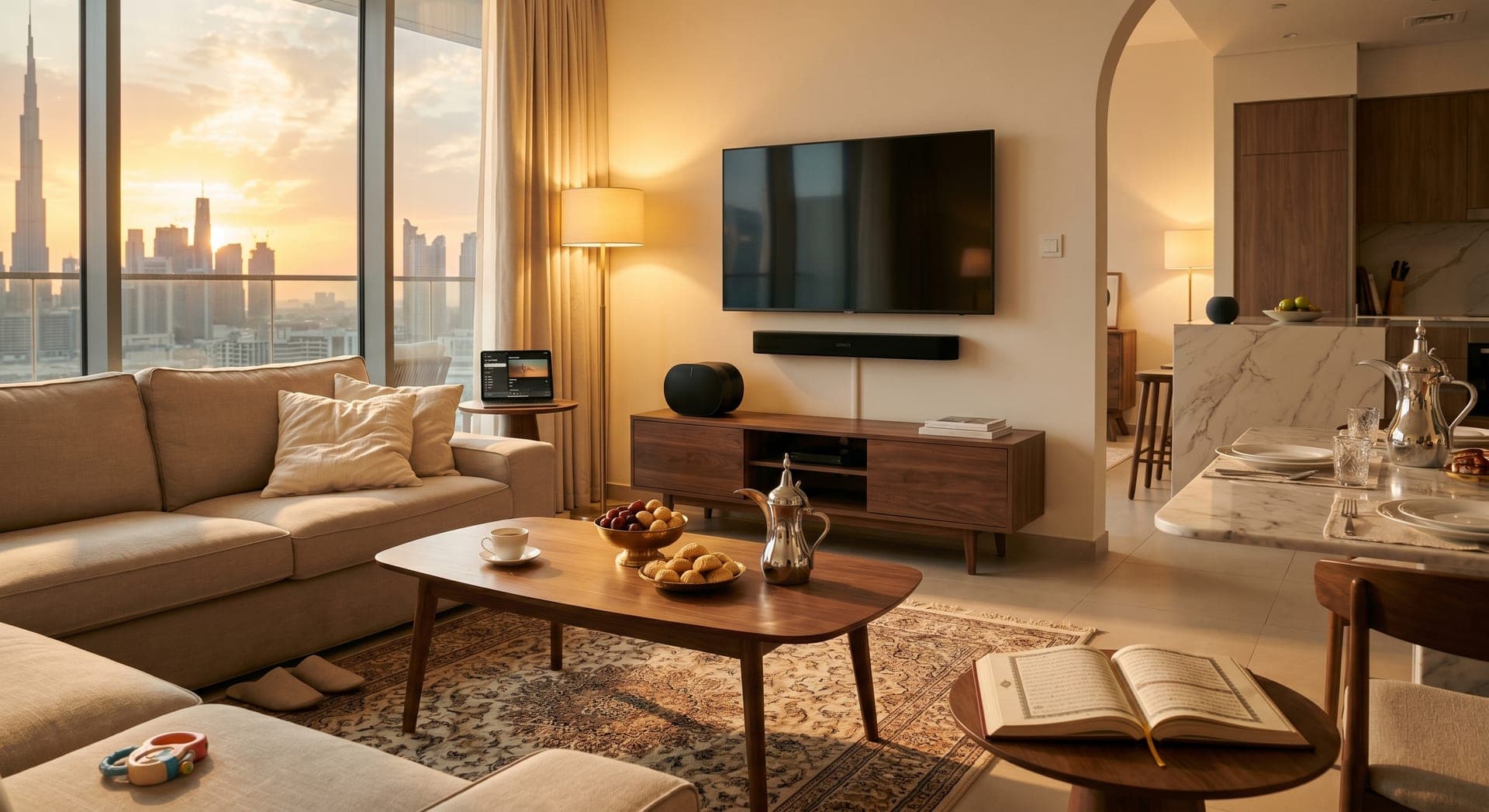
Eid Al Adha lands next Tuesday. Most Dubai apartments will host two to four separate sittings per day across six days. Morning coffee with one family at 9am, casual afternoon majlis at 2pm, dinner with cousins at 7pm, late-night dessert with friends at 10pm. Each one wants a different soundtrack. And if your apartment runs on one phone, one Bluetooth speaker, and one person carrying it from the kitchen to the living room to the dining table, the audio layer is going to die by visit number two.
TL;DR: A 4-zone multi-room audio setup handles back-to-back Eid hosting without anyone touching a phone after the morning. Quran or nasheed in the kitchen at 9am. Light Arabic instrumental in the majlis at 2pm. Dinner playlist across living room and dining at 7pm. Acoustic wind-down in one room at 10pm. Costs AED 1,499 to 8,500 for a 2-bedroom apartment depending on whether you start renter-light or build it permanent. Works with Anghami, Apple Music, and Spotify side by side.
Seventy-seven percent of UAE residents plan to visit relatives during Eid, and 67% plan to host in-home gatherings (Toluna, March 2026). With Arafat Day on Tuesday May 26 and the holiday running through Friday May 29 (with most workplaces extending through Sunday May 31), the calendar is six straight days of doorbell ringing (Gulf News, 2026). Dubai temperatures are also forecast at 40-42C through the entire Eid period (Khaleej Times, May 2026), which pushes every gathering indoors. The cooling layer handles one job. The lighting layer handles another, which we covered in our Eid lighting guide. This piece is the audio layer, which is the one most hosts skip entirely.
Why the Bluetooth Speaker Stops Working After Visit Number Two
The default Dubai apartment audio setup is one of three things. A small Bluetooth speaker someone bought at Sharaf DG three years ago. A soundbar under the TV that only plays sound from the TV. A phone on the kitchen counter playing through its own speaker. None of these survive a six-day hosting marathon.
The problem is that hosting moves around the apartment. Coffee is served in the kitchen or breakfast nook. Conversation moves to the sofa. Dinner happens at the dining table. Late-night dessert ends up wherever someone is sprawled out. A single Bluetooth speaker means the person carrying it becomes the audio engineer, and the soundtrack drops out every time it gets moved or the phone walks too far away. By the third visit of the day, someone has connected their own phone to it, the playlist has switched genres twice, and the music has been forgotten entirely.
Multi-room audio fixes this by putting a small, network-connected speaker in each zone of the apartment. Each speaker holds its own connection to the streaming service, so nothing depends on a phone being in the room. The streaming penetration in the UAE is 70%, the highest in the GCC (Realistic Optimist, 2023), and 60% of all streams on Anghami are Arabic content (Statista, 2025). The infrastructure is already in place. The speakers are the missing layer.
The 4-Zone Architecture for Eid Hosting
Think of the apartment as four audio zones, not as one big room with speakers in it. Each zone serves a different part of the hosting day and gets its own speaker. A zone can be one room or one half of an open-plan layout. In our experience, a 2-bedroom Business Bay apartment maps cleanly to four zones. A 3-bedroom villa in Arabian Ranches usually needs five or six.
Zone 1: The Kitchen / Morning Coffee Zone
This is where 9am visits start. Someone is making karak or filtering Arabic coffee, the date plate is being set, and the first guests are already in the kitchen because that is where Dubai families always end up. The audio here should be calm and low-volume. In the morning we typically play Quran recitation or nasheed at 30 to 40% volume, which sets a respectful tone for the early visit without dominating the conversation. Anghami has dedicated Quran and Eid nasheed playlists already curated (Anghami, 2025).
The speaker for this zone is a small, single unit. A Sonos Era 100 at AED 919 or an Apple HomePod mini at AED 379 (Sharaf DG, 2026) both work. The HomePod mini is the right pick if everyone in the household runs on iPhones and Apple Music. The Era 100 is the better pick if your music lives across Anghami, Apple Music, and Spotify with different people streaming from different services.
Zone 2: The Majlis / Living Room Zone
This is where the 2pm afternoon visits happen, and where most of the daytime Eid hosting energy lives. The room needs a fuller sound than the kitchen but not theatre-loud. The goal is layered Arabic instrumental, oud-based playlists, or a light vocal mix at 40 to 50% volume that fills the seating area but does not force people to raise their voices.
This is the zone that justifies a larger speaker. We typically use either two stereo-paired Sonos Era 100s on opposite sides of the room, or a single Sonos Era 300 at AED 2,099 if you want spatial audio for a single-speaker setup. The Era 300 is the right pick if your living room is large or open-plan, because spatial audio fills more of the room from a single point.
A note for renters. The whole zone setup works without a single wire run. Every speaker we have mentioned plugs into a normal wall socket and joins the home WiFi. If you move apartments in eighteen months, the system moves with you in a box.
Zone 3: The Dining Room Zone
At 7pm dinner the room transforms. Now you need quieter background sound that does not interfere with conversation across a table of eight or twelve. The volume drops to 25 to 35%. The playlist shifts to dinner-appropriate Arabic vocals, Levantine classics, or instrumental versions of well-known tracks. Anghami curates evening Arabic playlists tailored to this exact use case (Statista, 2025).
For the dining zone, we typically use either the soundbar under the TV (if your dining table is in the same open-plan area as the living room) or a single Sonos Era 100 on the dining buffet or sideboard. The Sonos Beam at AED 1,765 (Pricena, 2026) does double duty here, serving as both the TV soundbar and the dining room music speaker. This is the cleanest setup for apartments where the living and dining areas are one room.
The integration matters. With multi-room audio, the dining speaker can either play the same track as the majlis (one continuous playlist across the open-plan space) or play something different (a quieter dinner playlist while the majlis stays louder for guests still on the sofa). One tap in the Sonos or Apple Home app switches between the two modes.
Zone 4: The Wind-Down Zone
At 10pm the last guests of the day arrive for dessert and coffee. Energy drops. The light goes amber. The audio shifts again. Now the volume is 15 to 25%, the playlist is acoustic Arabic singer-songwriter, light jazz, or instrumental piano, and the zone has narrowed to one or two rooms instead of four. The kitchen speaker has gone quiet, the dining speaker has gone quiet, and only the living room is still playing.
This is where multi-room audio earns its place. Instead of physically turning off speakers, you ungroup the zones. The kitchen, dining, and bedroom speakers go silent. The majlis speaker drops to 20%. The room calms down on its own.
Three Hardware Tiers: Renter, Standard, Villa
We typically pick from one of three hardware stacks depending on the apartment, the budget, and whether the client owns or rents. Each tier covers the same four zones. The difference is how much you spend per zone and how permanent the install is.
Tier 1: Renter Setup (AED 1,499 to 2,799 for a 2-Bedroom)
Three to four Apple HomePod minis at AED 379 each, set up by zone and grouped in the Apple Home app. Total hardware cost lands between AED 1,137 (three units) and AED 1,516 (four units). Add a single Sonos Beam at AED 1,765 if you want one upgraded speaker in the majlis. Setup time is about ninety minutes. No wiring, no drilling, no landlord conversation. Best for households who already run on iPhones and use Apple Music or stream through AirPlay 2 from Anghami and Spotify.
The HomePod mini limitation is that it does not natively run Anghami or Spotify as a built-in service. You have to AirPlay from your phone, which means the phone has to be in the home WiFi range. For households where everyone streams through their own phone anyway, this is not an issue. For households where you want to leave a Quran playlist running across all speakers without a phone tethered, the Sonos route is the better choice.
Tier 2: Standard 2-Bedroom Setup (AED 2,799 to 4,999)
Three Sonos Era 100s at AED 919 each (kitchen, dining, bedroom) plus a Sonos Beam at AED 1,765 in the majlis. Total hardware lands at around AED 4,522 with VAT and minor cabling. Sonos handles Anghami, Apple Music, Spotify, Tidal, Deezer, and a dozen other services natively, which means any guest can hand over their phone for a few minutes without it breaking the system. This is the configuration we install most often for Business Bay, Marina, and Downtown apartments.
Tier 3: Standard 3-Bedroom or Villa Setup (AED 5,999 to 8,500)
For a 3-bedroom apartment or a villa, the architecture expands to five or six zones. The majlis upgrades to either two stereo-paired Era 100s or a single Era 300 at AED 2,099. The dining room gets its own Era 100 separate from the soundbar. The bedrooms each get an Era 100 or HomePod mini. Outdoor balcony or terrace zones get a Sonos Move 2 at AED 2,099 (Sharaf DG, 2026), which is IP56 rated and survives the dust and 42C heat.
What We Tell Clients Not To Buy
Honest recommendation, because the audio category is where most Dubai apartments overspend by a wide margin.
Skip whole-home in-ceiling speaker installs in a rented apartment. A proper in-ceiling architectural audio install runs AED 15,000 to 40,000 (Bayora cinema guide), requires ceiling work and amplifier wiring, and stays in the apartment when you move. The cost-to-comfort ratio does not work for any tenant on a one-year or two-year lease. We install in-ceiling audio for villa owners with a five-to-ten-year horizon, not for renters.
Skip the AED 12,000 multi-room amplifier in a 2-bedroom apartment. A Sonos Amp or Bluesound Powernode looks great on paper, but in a small apartment a Sonos Era 100 in each room does the same job for half the price with zero wiring. The amp makes sense when you have existing in-wall speakers from a previous owner, or when you are building out a villa where the ceiling cuts have already happened.
Skip portable Bluetooth speakers as your primary audio. A JBL or Bose Bluetooth speaker is the wrong layer for hosting. It runs on a battery that dies during the third visit, depends on a phone staying paired, and dies completely when someone walks into another room. Use it as a pool speaker or a beach speaker. Do not build your majlis on it.
Skip mixing brands across the same zone. We have walked into apartments running a Sonos Era 100 in the living room, a Google Nest Audio in the kitchen, and an Echo Dot in the bedroom. Each runs a different app. Each has a different volume scale. No one can group them together. Pick one ecosystem, ideally Sonos for non-iPhone households or Apple HomePod for iPhone households, and stay there.
What This Looks Like in a Real Apartment
A Business Bay client we worked with three weeks ago wanted Eid hosting solved before the holiday. The apartment is a 2-bedroom, husband and wife, one toddler, four sets of cousins visiting across the six days. We specced Tier 2: three Sonos Era 100s (kitchen, dining, bedroom), one Sonos Beam (majlis under the wall-mounted TV). Total install was AED 4,420 including delivery and setup. Setup time was two and a half hours on a Wednesday afternoon. We configured four scene groups in the Sonos app: Morning Coffee (Quran on kitchen + dining at 30%), Afternoon Majlis (Arabic instrumental on all four zones at 45%), Dinner (light vocals on majlis + dining at 30%, others off), Wind-Down (acoustic on majlis only at 20%, others off).
The client texted us on day two of Eid last year (before this install) to say their phone had been hijacked three times to play someone else's playlist and they had given up on music entirely by visit number two. This year, the four-zone setup ran for six days without anyone touching anything but the Sonos app on the host's phone. The bluetooth speaker that had carried hosting for three years went back into the cupboard.
How Audio Connects to the Rest of the System
Multi-room audio gets stronger when it talks to the other smart home layers. We integrate it with three things in most installs.
Lighting integration. When the Sunset scene runs on the lighting system at 6:30pm, it can also trigger the Dinner scene on the audio system. The lights warm to 2700K, the dining speaker fades in, the majlis volume drops slightly. One trigger, two systems. For households running Philips Hue or Lutron Caseta, this is a single automation in the smart home app.
Climate integration. When the AC kicks into Hosting mode for a 12-guest dinner, the audio system can simultaneously raise volume by 5 to 10% to compensate for the extra background noise of conversation. Most clients do not notice the volume bump, but the music stays equally audible whether the room has two people or twelve. This is a Home Assistant or HomeKit automation, not a default Sonos feature.
Door integration. When the smart doorbell rings, the audio system can pause for ten seconds and resume automatically. This avoids the moment where the host has to grab the phone to lower the music every time the bell rings, which during Eid happens twenty times a day.
We cover the cross-system architecture in more depth in our home automation guide. For hosting specifically, the lighting + audio + climate integration is what separates a smart home from a collection of smart products.
Volume, Sound Bleed, and the Neighbor Question
Two practical notes for Dubai apartments.
Dubai Municipality enforces a 55-decibel residential noise limit (The Law Reporters, 2024), and apartment buildings here are notoriously thin-walled for sound transmission. For Eid hosting, this matters because the temptation is to crank the majlis speaker for a houseful of guests. The 4-zone setup solves this. Distributed sound at moderate volume across four speakers fills a room better than one speaker at high volume, and the neighbors do not hear it because no single speaker is loud. We measure with a phone-based decibel meter during install and confirm the system stays under 55dB at the wall.
Open-plan apartments. In Business Bay, Marina, and Downtown, most 2-bedroom apartments are open-plan with the kitchen, living, and dining as one continuous space. Multi-room audio still works here because the speakers are positioned to create overlapping coverage zones, not isolated rooms. The Sonos and Apple Home apps handle the volume balancing automatically once each speaker is in the right physical spot. We typically place the kitchen speaker on the island, the dining speaker on the buffet, and the majlis speaker either on a console or under the wall-mounted TV.
Frequently Asked Questions
Can renters install multi-room audio without landlord approval?
Yes. Every speaker we have recommended in this post plugs into a standard wall socket and connects to your home WiFi. Nothing drills, nothing wires into the building electrical system. The entire setup packs into a single moving box if you change apartments. The only landlord conversation would be if you choose to do in-ceiling architectural audio, which we do not recommend for renters anyway.
Will multi-room audio work with my Anghami subscription?
Sonos supports Anghami as a native streaming service, which means it logs in directly to the speakers and plays without your phone in the room. Apple HomePods do not support Anghami natively, so you have to AirPlay from your iPhone, which keeps the phone tethered. For households where Anghami is the primary streaming service (especially Arabic-speaking households), Sonos is the better fit. For households running on Apple Music, HomePods are simpler.
How loud can the system get without breaking Dubai noise regulations?
Dubai Municipality residential limit is 55dB. A 4-zone distributed audio setup stays well under that at hosting volumes (40 to 50% on each speaker). One speaker at 80% in a single room would exceed the limit; four speakers at 45% spread across the apartment will not. The math favors more speakers at moderate volume over one speaker at high volume.
Can different rooms play different music at the same time?
Yes. This is the entire point of multi-room audio over a single soundbar or Bluetooth speaker. Quran in the kitchen at 9am, Arabic instrumental in the majlis at the same time, news on the bedroom speaker, all running simultaneously. The Sonos app lets you group and ungroup any combination with a tap. Apple Home does the same for HomePods. The only constraint is that each zone runs one stream at a time.
How long does install take for a typical 2-bedroom apartment?
Two to three hours for a Tier 2 standard install (three Sonos Era 100s plus a Sonos Beam). This includes unboxing, connecting each speaker to WiFi, setting up the host accounts on the Sonos app, creating the four hosting scene groups (Morning Coffee, Afternoon Majlis, Dinner, Wind-Down), and walking the host through the controls. For a Tier 1 renter install with HomePod minis, it is closer to ninety minutes. For a Tier 3 villa install with five or six zones plus outdoor, it is a half-day.
What Bayora Will Do
If you want this set up for the rest of Eid, we have a few slots left this weekend. The Tier 2 install (three Era 100s plus a Beam) takes two and a half hours and lands at around AED 4,420 with VAT and delivery. We bring the speakers, do the WiFi setup, build the four scene groups in your phone, and walk you and your housekeeper through the controls. If you already own one Sonos or HomePod, we can extend the system around it instead of starting from zero.
Six days of hosting is too long to spend carrying a phone from the kitchen to the dining table. Built right, the audio layer is the part of the home guests notice without being able to name. The music feels appropriate to the moment. The volume is never wrong. Nobody is asking whose phone is playing. That is the version of multi-room audio that earns its place in a Dubai apartment, the one that disappears into the experience and lets the host stay with the guests.
Tell us about your apartment and we will recommend the right tier for your hosting layout. Free consultation, no obligation, install before the weekend if we can.
Ready to Get Started?
Get a free consultation and we'll recommend what makes sense for your situation.
Get Free Consultation