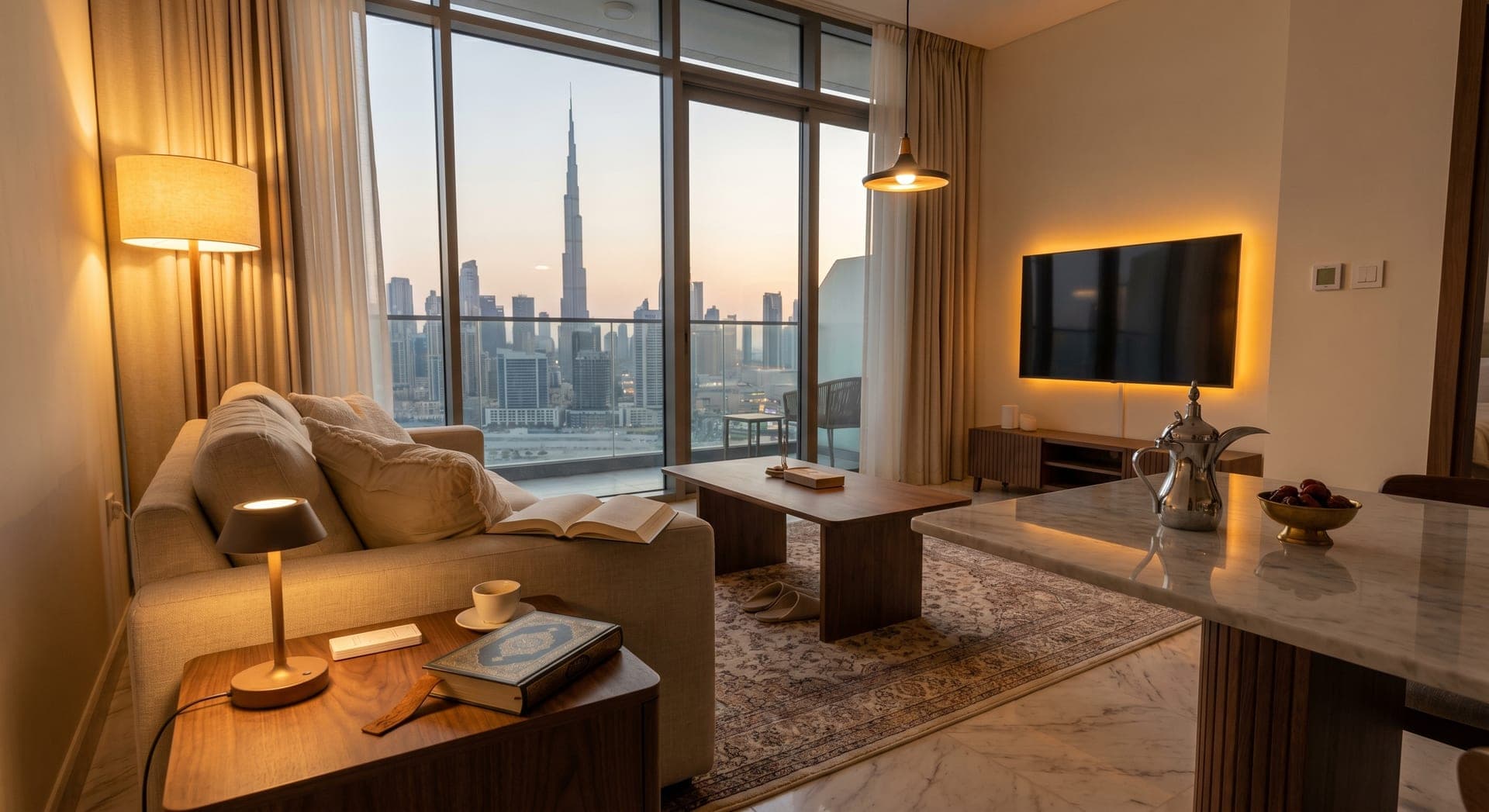
Eid Al Adha lands next Tuesday. Six days off for most of Dubai, nine for public sector and schools. If you are hosting, your apartment is about to function as four different rooms in the same day: morning brunch space at 9am, casual afternoon majlis at 2pm, dinner setting at 7pm, late-night dessert lounge at 10pm. Each one needs different light. And if you are walking around between guests dimming switches and turning lamps on and off, you are doing the wrong job during your own holiday.
TL;DR: A 4-scene smart lighting setup handles back-to-back Eid hosting without touching a switch. Welcome scene (bright, warm-white, alert) at 9am brunch, Conversation scene (75% warm, layered) at 2pm majlis, Dinner scene (40% with focused dining light, 2700K) at 7pm, Wind-Down scene (20% amber accents only) at 10pm. Costs AED 1,200-6,500 for a 2-bedroom apartment depending on coverage. No wiring needed for renters.
Seventy-seven percent of UAE residents plan to visit relatives during Eid, and 67% plan to host in-home gatherings (Toluna, March 2026). With Arafat Day on Tuesday May 26 and the holiday running through Sunday May 31 (Gulf News, 2026), most apartments in Dubai will host two to four separate sittings per day for six days straight. Dubai temperatures are also forecast at 42C across Arafat Day and the Eid period (Khaleej Times), which pushes everything indoors after 4pm. The cooling layer is one job. The lighting layer is the one most hosts skip until 6:45pm when the first guests are at the door.
Why Lighting Is the Layer Dubai Hosts Skip
In our experience, the order Dubai apartment owners prep their home for Eid is predictable. AC gets dialed down two days ahead. Floors get cleaned. Dates and Arabic coffee get stocked. Audio gets a playlist queued. And then everyone realises at 6pm that the living room ceiling lights are running at 100% brightness, the dining table has a bright cool-white pendant overhead, and there is no way to dim any of it without rebuilding the whole electrical layout.
The result is what we call majlis flatness. One brightness level. One color temperature. Same light at 11am for brunch as at 9pm for dinner. The room never quite settles into the right mood for the visit it is hosting. Guests notice it as a vague feeling that the room is too bright, too clinical, too much like an office. They will not say it out loud. They will leave earlier.
Lighting research backs this up. Warm color temperatures around 2700K produce a relaxed, social atmosphere preferred for dining and hosting (VONN Lighting research summary, 2025). Cooler temperatures above 4000K shift the brain toward focus and alertness, which is the opposite of what you want at 9pm with guests on the sofa. A Harvard Medical School study on circadian biology shows that warm evening light is also what lets your own body wind down between guest visits (Harvard Health, 2024). The hosts who sleep through their own six-day Eid are the ones whose home dims itself.
What follows is the smart-lighting architecture we install for clients hosting Eid. It runs on either Philips Hue (renter-friendly bulb-based) or Lutron Caseta (professional switch-based). The structure is the same. You build four scenes. You assign each scene to a time and a tap. The home handles the rest.
The 4-Scene Architecture for Eid Hosting
A scene is a saved configuration of which lights are on, at what brightness, at what color temperature. The trick for hosting is to design scenes around the activity, not around the room. Activities change four times a day during Eid. Rooms do not move.
Scene 1: Welcome (Morning Brunch, 9am-12pm)
Bright but warm. Most of Dubai is on Eid Al Adha morning timing this week, which means kids running around, breakfast on the table, coffee being made, and adults trying to wake up. This is the only scene where you push closer to 3000K rather than 2700K and run brightness at 80-90%.
Recipe for a 2-bedroom apartment majlis:
- Living-room ceiling lights at 85%, 3000K
- Dining pendant at 90%, 3000K
- Kitchen lights at 100%, 4000K (food prep needs cool light, this is the one room that goes cool)
- Hallway and entrance at 70%, 2700K (warm welcome at the door)
- Bedrooms and bathrooms left manual
What it solves: visitors arriving early do not walk into a dim room that feels like you woke up five minutes ago. Kids have light to play in. The kitchen is bright enough to cook in. The warm-white tone keeps the rest of the apartment from feeling like a hospital ward at 9am.
Scene 2: Conversation (Afternoon Majlis, 2pm-6pm)
The classic Dubai majlis sitting. Mid-afternoon arrival, coffee and dates, an hour or two of conversation, then guests leave or stay for dinner. With Dubai at 42C outside and the smart AC already pre-cooling, the indoor mood needs to feel like a refuge.
Recipe:
- Living-room ceiling lights at 50%, 2700K
- Floor lamps and table lamps at 75%, 2700K
- Dining pendant off
- Motorized blinds at 30% open on west-facing windows (blocks afternoon glare, still lets natural light in)
- Hallway at 40%, 2700K (gentle path-lighting, not corridor lighting)
What it solves: the ceiling lights drop, the lamps come up. This is what professional photographers call layered lighting. Each guest's face is lit from multiple soft sources rather than one harsh ceiling cone. Nobody squints. The room feels half a size larger because the corners are visible instead of falling into shadow.
If you have only ceiling lights and no lamps, this scene is the one that will reveal the gap. We tell every client prepping for Eid: buy three floor lamps before you buy more smart bulbs. The lamps matter more than the protocol.
Scene 3: Dinner (7pm-9pm)
The hardest scene to get right because most Dubai apartments were built with a single bright pendant over the dining table and no other dedicated dining-room light source. Sit twelve people under one pendant at 100% and the table looks like an interrogation scene.
Recipe:
- Living-room ceiling lights off
- Floor lamps and table lamps at 40%, 2700K (warm ambient, not the focus)
- Dining pendant at 70%, 2700K (focused on the table only)
- Wall sconces or hidden cove lighting at 50%, 2700K if you have them
- Kitchen lights at 30%, 2700K (off-stage cleanup light)
What it solves: the table becomes the brightest spot in the room and everything else falls into warm ambient. This is the lighting model used in every restaurant in Dubai that people actually want to eat in. We have set this scene up in apartments where the host owns one pendant and three lamps and the table-focus effect still works. The same lighting principle drives our Friday-night dinner scene for a regular hosting cycle, which adds the AC, audio, and blinds layers on top of the lighting layer covered here.
The food also photographs better. Twelve guests will take photos of the table. If your dining light is 4000K cool-white from a fluorescent strip, the lamb biryani in those photos looks grey. At 2700K it looks like food.
Scene 4: Wind-Down (10pm-Midnight, Between Visits)
The scene that does the hidden work of Eid hosting. Late-night guests have left, you are sitting on the sofa with one or two close family members, the kids are asleep, and you do not want to turn the lights all the way off but also do not want to keep the dining scene blazing.
Recipe:
- All ceiling lights off
- Floor lamps and table lamps at 20%, 2200K (amber, candle-like)
- Optional LED strip behind the TV at 30% amber
- Hallway nightlights at 10%, 2200K (so kids walking to the bathroom do not blind themselves)
What it solves: your circadian system gets the warm-dim signal it needs to wind down between hosting days. The room still feels alive and visible. And critically, the scene auto-transitions you back into your normal sleep routine instead of leaving the apartment running on dinner-mode lighting until 2am.
The Switch That Triggers Each Scene
Four scenes are useless if you have to open an app, find them, and tap each one. The whole point of the setup is one-tap activation per scene. We use one of three triggers depending on the apartment.
The first option is a physical scene controller on the wall by the entrance. The Lutron Caseta Pico remote (around AED 220 retail in the UAE per Sharaf DG, 2026) has five buttons. We program them as Welcome, Conversation, Dinner, Wind-Down, and All Off. Press one button, the whole apartment shifts. No phone needed. Guests can use it too without you having to explain anything.
The second option is the Philips Hue Tap Dial Switch, which gives the same four-scene-plus-off functionality and works with any Hue setup. Sits magnetically on a wall plate. About AED 320 from Philips Hue UAE, 2026.
The third option is automation by time of day. The Welcome scene fires automatically at 8:30am on Eid days, Conversation at 1:30pm, Dinner at 6:45pm, Wind-Down at 9:45pm. The host never touches anything. The downside is when guests arrive unexpectedly at 11am for an extra brunch sitting, the home does not know about it. We usually combine time-of-day automation with a physical switch as a manual override.
Hardware Options for Dubai Apartments
The question we get every week from clients prepping for Eid is which smart lighting brand to use. The honest answer depends on whether you are renting or own, and how many lighting circuits you want to control.
Philips Hue (Renter-Friendly, Bulb-Based)
You replace existing bulbs with Hue smart bulbs. Add a Bridge for full functionality. Control through app, voice assistant, or wall-mounted Hue Tap. Works with E27, GU10, and most common Dubai apartment bulb sockets. The Hue Starter Kit (3 bulbs and Bridge) runs AED 379-449 per Philips Hue UAE (2026). A full living room and dining room conversion runs AED 1,200-2,500 for a 2-bedroom apartment. Renter advantage: take every bulb with you when you move.
We pick Hue when the client is renting, when the existing wall switches are in awkward positions, or when color-changing matters (some hosts want festive color accents for Eid evenings, which only Hue handles well).
Lutron Caseta (Owner-Friendly, Switch-Based)
You replace existing wall switches and dimmers with Caseta in-wall units. Add a Smart Hub. Existing bulbs stay. Control through app, voice assistant, or Pico wall-mounted remotes. The Lutron Caseta dimmer switch runs around AED 348 on Amazon.ae (2026), and a Caseta hub bundles with two dimmers from AED 750. A standard apartment with six controlled circuits comes to AED 2,500-3,500 installed.
We pick Caseta when the client owns the apartment, when existing bulbs are already good quality (LED dimmable), and when reliability is the priority. Caseta runs on its own proprietary RF mesh, not WiFi, which means it does not drop when the router restarts. For Eid hosting reliability, this matters.
Aqara (Budget Hybrid)
Aqara wall switches sit between Hue and Lutron on price and feature set. The Aqara Smart Wall Switch H1 is AED 229 at Modo Store (2026), and Aqara Hub is around AED 220. Total for a six-circuit apartment install runs AED 1,500-2,500. The trade-off is the Zigbee network needs slightly more setup attention to stay reliable. The advantage is the same Aqara hub also handles your smart locks, motion sensors, and door sensors.
We pick Aqara when the client wants to build out broader home automation over time and lighting is the entry point, not the destination.
Pricing for a 4-Scene Setup
Three tiers based on apartment size and control depth.
Renter starter (AED 1,200-2,500): Philips Hue Starter Kit for living room and dining (4-6 bulbs), one Hue Tap or Tap Dial switch, configured for 4 scenes. Two-evening DIY install or one Bayora visit. Takes everything with you when you move.
Standard 2BR apartment (AED 2,800-4,500): Lutron Caseta or Aqara switches replacing 6-8 circuits (living, dining, hallway, kitchen, entrance), Caseta hub or Aqara hub, one Pico or Aqara wireless scene remote at the entrance, programmed for 4 time-of-day scenes plus manual override. One half-day Bayora install. Stays with the apartment.
Villa or 3-4BR apartment (AED 4,500-6,500): Caseta or Aqara across 12-16 circuits, multi-room cohesion (majlis, dining, kitchen, formal sitting, terrace), two Pico remotes (one at entrance, one in majlis), full automation schedule. One-day Bayora install plus a follow-up tuning visit after the first hosting weekend. We have done versions of this for clients in Arabian Ranches and Dubai Hills where the majlis is treated as its own scene zone separate from the family living room.
For context on whole-home pricing comparisons, the European Technical smart home guide (2026) puts entry-level smart-lighting setups at AED 3,000 for 2-3 rooms and full apartment automation at AED 10,000-20,000. Our 4-scene hosting setup is a subset of that, focused only on the lighting layer.
What We Tell Clients Not To Buy
Honest-recommendation principle, in the same shape we have used on previous posts: we have walked clients out of larger lighting orders into smaller ones more often than the other way around.
Skip wall touchscreens at this stage. AED 1,200-1,800 each, look impressive on the wall, but you will use them for the first two weeks and then never again because the Pico remote in your pocket does the same job for AED 220.
Skip color-changing bulbs in every room. Color matters in one or two accent locations (a corner lamp, an LED strip behind the TV). Pay for color there. Everywhere else, tunable warm-white (2200K-4000K) is enough and costs half as much.
Skip the AED 3,000 outdoor festive-color package. Eid hosting is indoor in Dubai because it is 42C outside. The terrace lighting matters for the photos people take walking out the door, not for the actual hosting. A single dimmable warm-white string light over the terrace is enough. We have done this with AED 150 of off-the-shelf fairy lights more often than we have done it with a wired system.
Skip the "WiFi smart bulb" multi-brand mix from Amazon. Three different smart-bulb brands in the same apartment means three different apps, three different scene definitions, and a scene that never fires reliably. Pick one platform. Spend slightly more. Stay sane during Eid.
A Real Business Bay 2BR Case Study
We set up this exact 4-scene lighting architecture in a Business Bay 2-bedroom apartment in early May 2026, in time for the Eid hosting window. Client renting (so Hue-based). Hosting plan: brunch on Tuesday May 26 (Arafat Day, family side), dinner on Wednesday May 27 (Eid day, spouse's family), drop-in afternoon on Thursday May 28, full extended-family dinner on Friday May 29.
Install summary:
- 8 Hue bulbs (4 in living room ceiling, 2 in dining pendant, 2 floor lamps)
- 1 Hue Bridge
- 1 Hue Tap Dial scene switch by the entrance
- 4 scenes programmed: Welcome, Conversation, Dinner, Wind-Down
- Time-of-day automation overlay on Eid days
Total cost: AED 2,180 including install and configuration.
What the client reported in her week-12 follow-up: she walked into the apartment after a Tuesday brunch, tapped Wind-Down once, sat on the sofa, and realised she had been hosting for four hours without thinking about a light switch once. Her mother in law mentioned the dining table looked beautiful in the photos. Her DEWA bill for May came in 8% lower than April despite hosting four times more often, because the lighting was running at 40-60% averages instead of 100% all evening.
We rebuilt the same configuration as a Lutron Caseta whole-apartment setup for an Emirates Hills villa hosting 25 guests across the same week. Same four scenes, eight zones instead of three. The host did not touch a switch from Tuesday to Friday.
How Lighting Talks to the Rest of Your Smart Home
The lighting layer gets more powerful when it triggers other things in the home. The four scenes can each carry instructions for AC, blinds, audio, and security in a single tap.
Welcome scene also drops the smart AC by 2C (the room is about to fill up with bodies, each adding around 100W of heat per person), sends the motorized blinds to their morning position at 50% open on the south and east windows, and starts the morning playlist on the Sonos at 30% volume. The blinds sequence carries the same three-visit logic as this lighting plan, and the two layers run as one system.
Conversation scene drops the AC another 1C, closes the west-facing blinds to 20% (afternoon-sun protection), and shifts the audio to a softer afternoon playlist.
Dinner scene cools the AC to its summer-peak setting (around 21C with a room full of guests), closes all blinds for evening privacy, drops audio to 25% as background, and sends an alert to your phone if the front door has been left unlocked for more than 30 seconds (because guests forget).
Wind-Down scene returns AC to overnight setpoint, leaves blinds closed, stops audio, and arms the indoor security cameras on the entrance hallway.
A scene that adjusts twelve things in a tap is the difference between a smart home and a smart lighting system. For Eid hosting specifically, the AC pre-cool inside the Welcome scene is what saves you from a 32C living room when twelve people walk in at the same time.
What This Costs to Run
The honest math: smart lighting properly dimmed and scheduled cuts apartment lighting electricity use by 24-50% (Bayora research summary, 2026). On a 2BR apartment averaging AED 80-120/month on lighting alone, that is AED 20-50/month saved. Over a year, AED 240-600. Not the headline. The headline is the convenience of Eid hosting that does not require you to walk around dimming switches between visits.
Some clients ask whether running lights at warm 2700K through eight hours of hosting per day undoes the dimming savings. The answer is no. Color temperature is a setting, not an energy draw. A bulb running at 2700K and 40% brightness uses the same energy as the same bulb running at 4000K and 40% brightness. The savings come from the dimming and scheduling, not from the color temperature.
For more on the broader DEWA math of smart lighting, see our smart lighting and DEWA bill guide. For the specific case of multi-room lighting scenes built on a budget for renters, see our 3-scene lighting routine for Dubai renters (Sunset, Nightlight, Goodnight, which we sometimes use as the base before adding Eid hosting scenes on top).
Frequently Asked Questions
Can I set up Eid hosting scenes if I am renting in Dubai?
Yes. Philips Hue is the renter answer. You replace existing bulbs with Hue smart bulbs, add a Hue Bridge, and program scenes through the Hue app or a Hue Tap remote. Nothing is wired in, nothing is permanent. You take the bulbs, the Bridge, and the remote with you when you move. A 2-bedroom apartment setup runs AED 1,200-2,500.
What is the best color temperature for hosting in a Dubai apartment?
2700K for evening hosting, 3000K for morning brunch. 2700K matches the warmth of incandescent bulbs and the candle-and-soft-light feeling preferred for dining and conversation. 3000K is slightly cooler and works for breakfast or daytime gatherings when you want alertness without going clinical. Cool white above 4000K should be limited to the kitchen for food prep and avoided everywhere else during hosting.
Do smart lighting scenes work if my WiFi is slow?
Lutron Caseta uses its own RF mesh independent of WiFi, so scenes fire reliably even when the router drops. Philips Hue uses Zigbee through the Hue Bridge, also independent of WiFi for in-home scene activation (only cloud features and remote access need WiFi). Aqara uses Zigbee through its hub similarly. For Eid hosting specifically, this matters: you do not want a scene to fail because someone is streaming a video call.
Can the same scene trigger AC, lighting, and blinds together?
Yes, on any of the three main platforms. The Lutron Caseta hub integrates with Ecobee and Sensibo for AC, with Lutron Serena and Aqara curtain motors for blinds, with Sonos for audio. Philips Hue routines integrate similarly through Apple Home or Alexa. Aqara handles all four natively through one hub. This is the right way to build Eid hosting scenes: do not only dim the lights, run the whole room.
How long does a Bayora install take for a 4-scene Eid setup?
A 2-bedroom apartment with Philips Hue takes 2-3 hours including bulb swap, Hue Bridge setup, scene programming, and Tap Dial mounting. Lutron Caseta in the same apartment takes 4-6 hours because each wall switch needs to be replaced. Aqara hub-based setups land in the middle at 3-4 hours. We can fit you in this week before Eid if you book by Thursday May 21. Configuration after install takes another 30-45 minutes for us to walk you through the scenes and how to adjust them yourself.
The Apartment That Hosts Without You Thinking About It
Eid Al Adha runs six days. Brunch, majlis, dinner, late drop-ins, repeat. You can either spend that week walking around your apartment switching lights or you can spend it with your family.
Built right, the lighting layer is the part of the home guests notice without being able to name. The room feels warm. Their faces are lit nicely in the photos. The transition between coffee and dinner happens without anyone realising the lights changed. That is the version of smart lighting that earns its place in the home, the one that disappears into the experience.
If your apartment is one ceiling-light brightness and one color temperature today, you have until Tuesday May 26 to fix it. We can be there this week.
Ready to set up your Eid hosting lighting? Get a free consultation and we will scope a 4-scene setup for your apartment in the next two working days.
Ready to Get Started?
Get a free consultation and we'll recommend what makes sense for your situation.
Get Free Consultation