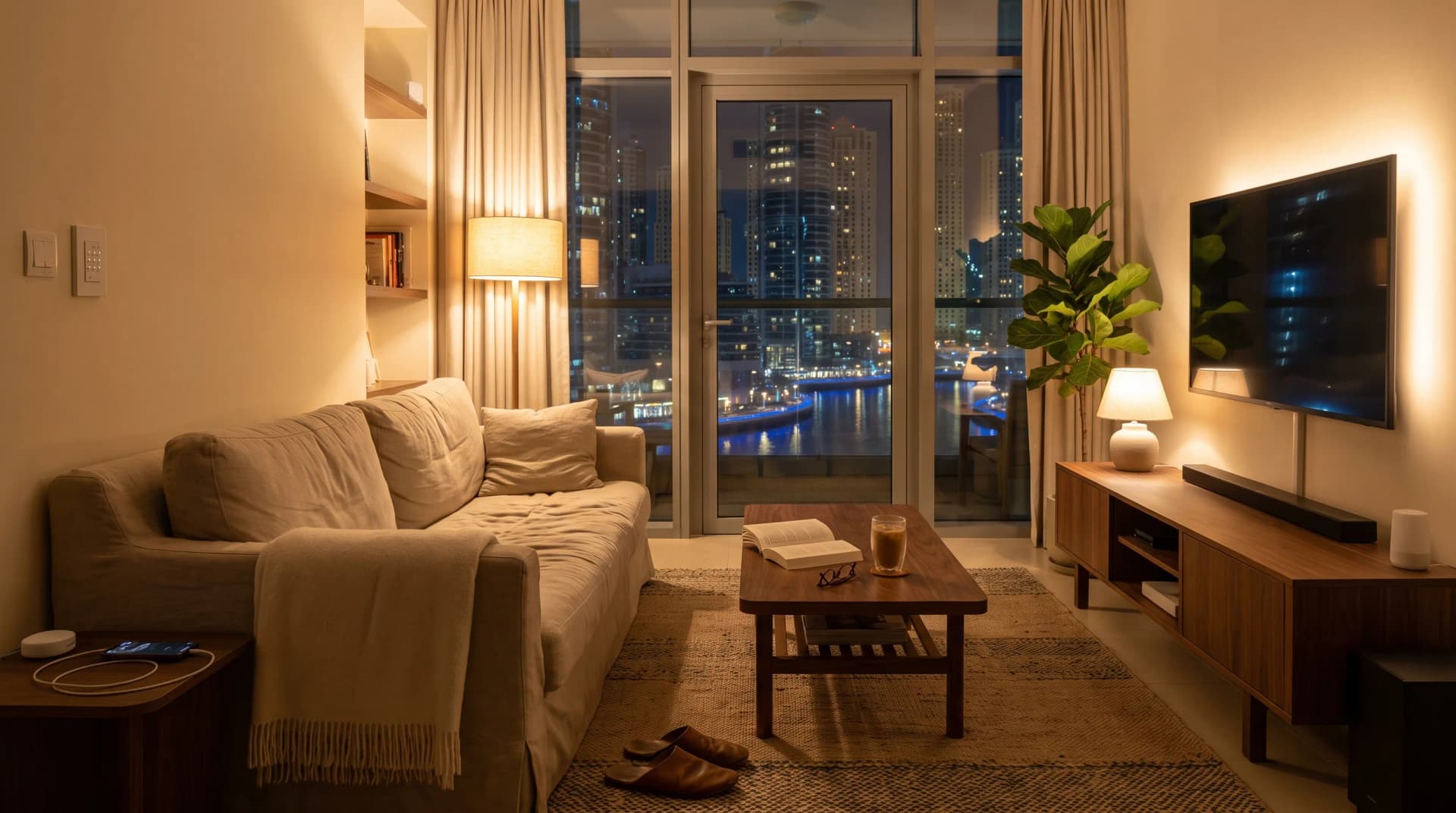
It is a Tuesday in July. You get home at half past eight, because the drive back took longer than it should have, and outside it is still forty-one degrees with no real chance of cooling down tonight. You are not going out. Nobody in Dubai is sitting on a balcony this week. The evening happens indoors, in the living room, and it will happen there most nights until October.
So you flick the switch by the door, and the room fills with one flat, bluish-white light from the ceiling panel the developer installed. It is the same light you would use to find a dropped earring. You sit under it to watch something, to read, to have a glass of tea, to do nothing. It is the wrong light for all of that, and some part of you knows it, because you keep half-closing your eyes.
TL;DR: A Dubai apartment living room is usually lit by one harsh 6,500K ceiling panel that is fine for cleaning and wrong for an evening. The fix is three or four warm, dimmable layers on one scene: a lamp or two around the seating, a strip behind the TV, and the ceiling panel dimmed low or off. A renter setup with smart bulbs and plugs runs AED 1,400-2,400. A fitted Lutron Caseta setup lands around AED 3,000-4,800. One tap at 8pm turns the room from a waiting room into a place you want to be. The lower DEWA bill is a side effect, not the point.
Most Dubai apartments are set up to fight the heat. Almost none are set up for the evening that follows, when you are finally home and the room is supposed to feel like somewhere you can exhale. This is a lighting problem, and it is one of the cheapest ones in the whole apartment to solve.
Why the Developer Ceiling Light Is Wrong for the Evening
Walk into a rented Dubai living room and count the light sources. Usually there is one: a large ceiling panel, cool-white, somewhere around 6,500 Kelvin, on a single switch. It is bright, even, and shadowless, which is exactly what you want when you are looking for keys and exactly what you do not want at nine at night.
Warm light and cool light do different jobs to your body. Lighting guidance from manufacturers and designers puts 2,700K to 3,000K warm light in living rooms and bedrooms for rest, and 3,500K to 5,000K cooler light in kitchens, offices, and garages for alertness and task work (Feit Electric, 2026). A 6,500K panel is at the cool, alert end. That cool setting has its place, which is the work day, and it is exactly what the work-from-home scene is built around. Your living room is running the office setting all evening, long after the work is done.
The effect is not only a mood one. Bright, blue-rich light in the evening pushes your body clock later and holds off sleep. In our experience walking through Marina and Business Bay apartments, this is the room where people say they feel wired at eleven and cannot work out why.
What Bright Evening Light Does to Your Body Clock
A number changed how we light living rooms. A Harvard study found that evening blue-rich light suppressed melatonin for about twice as long as an equivalent green light and shifted the body clock by twice as much, three hours against one and a half (Harvard Health, 2024). The same source notes that as little as 8 lux, a level most table lamps exceed, is enough to affect melatonin and circadian rhythm.
Your ceiling panel is not 8 lux. It is throwing something in the range of 300 to 500 lux across the whole room. Lighting-design guidance (drawing on the Illuminating Engineering Society) puts general living-room activity around 100 to 200 lux, dimmable down toward 50 lux for a proper wind-down, with 500 lux reserved for focused reading (Modern.Place, 2026). You have been sitting in reading-level brightness while trying to relax.
One thing clients always ask at this point is whether they need to give up bright light entirely. No. You want the bright, cool light available for cleaning and for finding things. You want a different light for the evening, and you want to move between the two without rewiring anything.
The Living-Room Evening Is Its Own Scene
A smart home is built out of scenes, which are named lighting states you trigger with one tap or one voice line. Most Dubai homes we set up already have a couple: a Come-Home scene for arrival and a Good Night scene for shutting the apartment down. The gap in the middle is the evening itself, the two or three hours between walking in and going to bed, when you are living in the room.
That evening state deserves its own scene. Call it Evening, or Relax, or whatever you will remember. Its job is simple: warm the room to around 2,700K, drop the brightness to a soft level, light the parts of the room you sit in, and dim or kill the ceiling panel. One tap, and the room stops being a waiting room.
This is different from the dinner-party choreography you would run when friends are over, and different again from the kitchen layers next door. The evening lounge scene is the quiet one, for the nights nobody is coming and you want the room to feel right.
The Three Layers That Make a Living Room Work at Night
A living room needs three layers of light, and the developer gave you one. The full stack looks like this.
Ambient, dimmed. This is a soft, warm base across the room. The trick is not adding a second bright fixture. It is dimming what you have and warming it. A brighter overhead only doubles the glare on the same wrong vector.
Pools around the seating. A floor lamp beside the sofa and a table lamp on a console, both warm and dimmable, do most of the work. They light the people and the surfaces you use, not the ceiling. This is the layer that makes a room feel occupied rather than lit.
Accent behind the screen. A warm light strip run behind the TV console or along a shelf lifts the darkness behind the screen so your eyes are not jumping between a bright screen and a black wall. It is the smallest layer and the one people notice most once it is in.
Each layer gets its own control, so the evening scene can run the lamps and the strip at 40 percent with the ceiling off, while a Clean scene runs the ceiling at full and everything else off.
The Renter Setup From AED 1,400
You can build the whole evening scene without a screwdriver, and take it with you when you move. Nothing here touches the wiring, so no landlord approval is needed and no back-box gets opened.
Start with the bulbs and the strip. A Philips Hue White and Colour Ambiance bulb runs about AED 199 at Amazon.ae, or you can start with the three-bulb Hue starter kit and Bridge for around AED 439 (Amazon.ae, 2026). Put those bulbs in your existing floor lamp and table lamp. Add a Hue Lightstrip Plus for the TV console at about AED 319. If you want the ceiling panel dimmable too without rewiring, that is the one part a smart bulb cannot fix on a fixed panel, so leave it on its switch and turn it off in the evening scene.
On a tighter budget, Aqara does the same job for less. An Aqara tunable-white bulb is around AED 92 and an Aqara light strip about AED 245 (Amazon.ae, 2026). To make a lamp that takes an odd bulb smart, a TP-Link Tapo smart plug at roughly AED 51 turns the whole lamp on and off on schedule. A renter evening scene, built from a couple of smart bulbs, a strip, and a plug or two, lands between AED 1,400 and AED 2,400 depending on how many lamps you are dressing.
If you are furnishing a new rental and want the shortest path, our renter-friendly smart lighting picks start here and grow with the apartment.
The Fitted Setup From AED 3,000
If you own the apartment, or you are staying a while and want the ceiling panel itself on the scene, the answer is an in-wall dimmer rather than bulbs. This is where Lutron Caseta earns its place. A Caseta dimmer swaps in behind your existing switch and brings the ceiling panel onto the same scene as everything else, so Evening can hold the panel at 15 percent instead of off.
Caseta is available in the UAE through Amazon.ae as imported US stock. A Caseta dimmer kit with the Smart Bridge Hub and a Pico keypad runs around AED 573 (Amazon.ae, 2026). Worth knowing before you buy: the Pico remote on its own is about AED 156, but it is not a standalone device. Caseta needs the Smart Bridge Hub to work, so budget for the kit, not the keypad alone.
A fitted living-room setup, with a dimmer on the ceiling circuit, warm dimmable bulbs in the lamps, a strip behind the TV, and a Pico keypad on the wall by the sofa so nobody has to reach for a phone, lands around AED 3,000 to AED 4,800 installed and configured. That is inside Bayora's Smart Home Starter range, which begins at AED 3,000. For most apartments, one well-lit living room is a better first project than a scatter of gadgets across five rooms.
How You Trigger the Scene Without Thinking
A scene that lives inside an app you have to open is a scene you will stop using. The evening scene should fire the way a light switch does, without a decision.
The three ways that stick, in our experience: a wall keypad by the sofa with an Evening button, so the person on the couch presses it the way they used to flick a switch; a voice line to Alexa, Google, or Apple Home, because these all work on open platforms and the whole smart lighting stack can run through whichever you already use; or a simple time schedule that fades the room warm and low on its own around sunset, so on the nights you forget, the room gets it right anyway.
The families who keep using their scenes are the ones with a physical button on the wall. The app is the setup tool. The wall is the daily control.
What Bayora Will Talk You Out Of
The honest-recommendation rule costs us equipment on every quote, and we hold to it because the client who feels well-advised sends three friends. These are the things we steer people away from in a living room.
Skip the big wall touchscreen. A AED 1,200 to 1,800 wall panel to control three lamps is a screen you will walk past. A Pico keypad at a fraction of the cost does the job and never needs charging.
Skip colour-changing everything. Colour bulbs are fun for a week. For an evening lounge, warm white that dims well matters far more than a purple mode nobody uses. Buy the tunable-white bulb and put the money into a second lamp instead.
Skip rewiring a rental. If you are renting, do not chase an electrician to make a fixed ceiling panel dimmable. Turn it off in the scene and let the lamps carry the room. It looks better anyway.
Skip the whole-apartment rollout on day one. Do the living room, live with it for a month, then decide what the rest of the home needs. Most people find one great room changes the evening more than five half-done ones.
A Business Bay Living Room, Honestly
A couple in a two-bedroom in Business Bay came to us because the wife said the living room "never felt like evening." The developer setup was one 6,500K ceiling panel on a single switch, a floor lamp they rarely turned on because it meant crossing the room, and a TV on a dark wall.
We did not touch the wiring beyond one dimmer. We put warm tunable-white bulbs in the floor lamp and a new table lamp, ran a warm strip behind the TV console, swapped the ceiling switch for a Caseta dimmer, and put a Pico keypad on the wall by the sofa with three buttons: Evening, Bright, and Off. Total was AED 4,150 installed and configured.
Six weeks in, they report that the ceiling panel comes on maybe twice a week now, for cleaning. The Evening button gets pressed every night. The husband started reading in the armchair again, which he had not done in the apartment before, because the room finally had a chair-side pool of warm light instead of a wash of white. Their July DEWA bill came in slightly lower than the year before, mostly because the panel that used to run all evening now sits off. The lighting change was never sold on the bill. The bill just followed.
The DEWA Bill Follows, It Does Not Lead
We do not lead with savings, because the reason to do this is the room, not the money. But since people ask: warm dimmed lighting draws less power than a bright panel run flat all evening.
LED light itself is efficient. ENERGY STAR rates LED bulbs as producing light up to 90 percent more efficiently than old incandescent bulbs (ENERGY STAR, 2026), and the US Department of Energy puts residential LED energy use at least 75 percent below incandescent. On top of that, dimming an LED cuts its draw roughly in proportion, so lamps run at 40 percent pull far less than the ceiling panel at full (PacLights, 2026).
In DEWA terms, lighting is a smaller slice of a summer bill than the AC, but every kilowatt-hour you trim keeps you lower in the slab tariff, where the rate steps up from 23 fils to 38 fils as you climb (DEWA, 2026). A living room that runs on two dimmed lamps instead of a flat panel is a small, steady saving across the four hottest months. It is a side effect. The room is the point.
The Evening the Room Should Give You
Dubai summer is an indoor season by design. The midday outdoor work ban runs from June to September, the outdoor attractions are shut for the heat, and even during Summer Restaurant Week, most Dubai evenings still land at home rather than out. Tens of thousands of residents now walk indoor malls at dawn to avoid the sun (Khaleej Times, 2026). With outdoor highs near 41 degrees and up to 48 inland (Gulf News, 2026), the living room is where the evening is, night after night, for months.
A room you spend that many hours in should be lit for those hours, not for the two minutes a week you clean it. The fix is warm, dimmable, and small. It is the kind of change you feel the first evening and stop noticing you ever lived without.
Frequently Asked Questions
What colour temperature should my living room lights be for the evening?
Around 2,700K, which is a warm, soft white. Manufacturers and lighting designers put 2,700K to 3,000K in living rooms and bedrooms for rest, and reserve cooler 4,000K-plus light for kitchens and workspaces. Tunable-white smart bulbs let you keep a cool setting for cleaning and switch to warm for the evening.
Do smart living-room lights work if I rent and can't rewire?
Yes. Smart bulbs, a light strip, and a smart plug for an odd lamp build the whole evening scene with zero wiring, zero drilling, and no landlord approval. Everything unscrews and comes with you when you move. A renter setup runs about AED 1,400 to AED 2,400 depending on how many lamps you dress.
How do I turn the scene on without opening an app every night?
Put a wall keypad by the sofa, like a Lutron Pico, so someone presses a button the way they used to flick a switch. You can also set a sunset schedule that fades the room warm and low on its own, and add a voice line through Alexa, Google, or Apple Home as a backup. The button on the wall is what makes it a daily habit.
Will warm dimmed lighting really lower my DEWA bill?
A little, and it is a side effect, not the reason. LED bulbs use far less power than old ones, and dimming cuts the draw further, so two lamps at 40 percent pull much less than a bright ceiling panel run flat all evening. Lighting is a smaller part of a summer bill than the AC, so treat the saving as a bonus and choose the setup for the room.
Can I start with just the living room and expand later?
That is what we recommend. One well-lit living room changes the evening more than five half-finished rooms. Do the lounge first, live with it for a month, then decide whether the bedroom, kitchen, or hallway is next. Everything is built on open platforms, so it all joins up later without starting over.
Where to Start
Pick one lamp beside where you sit, put a warm tunable-white smart bulb in it, and add a strip behind the TV. That alone changes the evening. When you are ready to bring the ceiling panel onto the scene and put a button on the wall, tell us about your living room and we will tell you exactly what it needs, and what it does not. No obligation, no surprises.
Ready to Get Started?
Get a free consultation and we'll recommend what makes sense for your situation.
Get Free Consultation