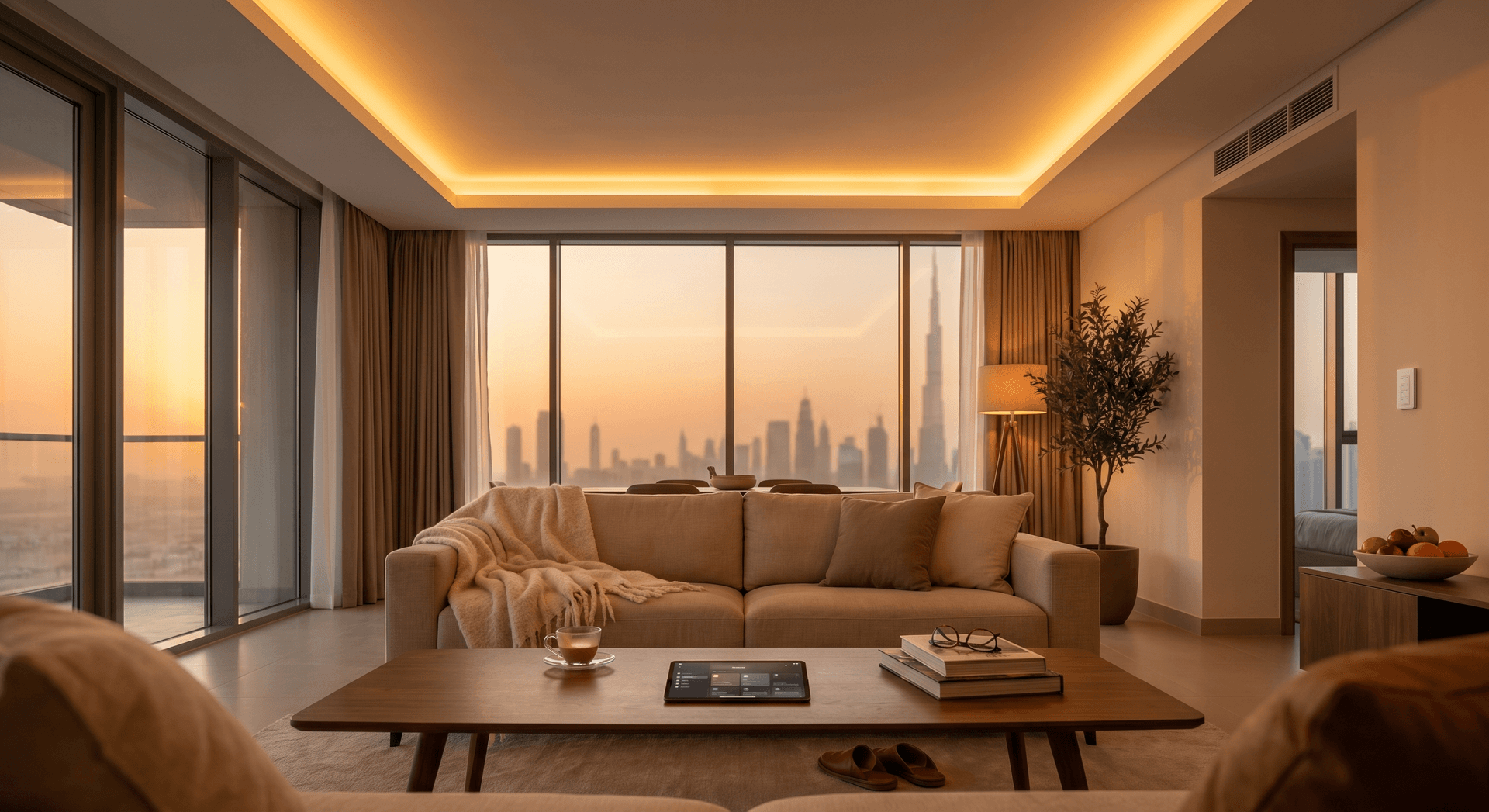
Look up in most Dubai apartments and there is already a cove in the ceiling. A clean recess running around the edge of the living room, fitted by the developer or a previous tenant, with an LED strip tucked inside it. Then look at how it gets used. One brightness. One color. A plastic dimmer switch by the door that nobody touches, because the last time someone did, the strip flickered and they left it alone.
TL;DR: A cove hides an LED strip in a ceiling recess and lights the room by bouncing off the ceiling, so you never see the source. Most Dubai apartments already have one running a cheap strip on a manual dimmer. Making it smart means a CRI 90+ dim-to-warm strip on a dimmable driver, wired into your scenes so it glows warm at sunset and dims to amber on its own. If the cove already exists, from AED 1,600.
Cove lighting is the layer most Dubai fit-outs install and then forget. The gypsum work is done, the strip is in, and the smart part, the part that makes it worth having, never happens. Here is what a cove is, why the cheap version looks cheap, and what changes when the ceiling itself becomes the light.
What Cove Lighting Is
Cove lighting is indirect light. An LED strip sits hidden inside a recess in the ceiling, points up or sideways, and bounces off the ceiling and the top of the walls before it reaches you (LedRise, 2025). You never look at the strip. You see a soft, even glow with no bright point anywhere, which is the opposite of a downlight drilling a hot spot into your eye line.
This is what makes it different from the other two ways people light a Dubai apartment. Smart bulbs in lamps light the room from a visible source. Smart switches control ceiling downlights, which also light from a visible source. A cove lights the room itself. The ceiling becomes the lamp.
In UAE apartments, the cove is built into the gypsum false ceiling as a recessed perimeter trough, the same false ceiling that already hides your AC ducts and wiring (Al Ahli Trading, 2025). That is why so many apartments here already have one. The gypsum ceiling is standard. The cove is a small detail added during the fit-out. The strip inside it is usually an afterthought.
Why the Cheap Cove Looks Cheap
A cove washes the entire room in whatever light the strip produces. So the quality of the strip becomes the quality of the room. This is the part most people get wrong.
The single spec that matters is CRI, the color rendering index. It measures how accurately a light shows real colors. Lighting designers recommend CRI 90 or higher for any home, and CRI 95 where color matters most (LedRise, 2025). The cheap strips sold on Amazon and in the souk run CRI 70 to 80. In a lamp you might not notice. In a cove that washes the whole ceiling and every wall, low CRI makes wood look flat, skin tones look grey, and the warm beige interior you paid for look slightly green.
The second giveaway is color temperature. Warm white at 2700K to 3000K is the calming range for living rooms and bedrooms (Lutron, 2024). A lot of builder-grade coves run a cold 5000K to 6500K strip, the kind meant for a workshop. In a living room that reads as harsh and clinical, the visual equivalent of fluorescent office light pretending to be ambiance.
When we survey apartments, the cove is almost always there and almost always running a cold, low-CRI strip on a manual dimmer that buzzes. The architecture is right. The light is wrong.
What Smart Cove Lighting Changes
A smart cove fixes two things the cheap one cannot: the quality of the light, and the fact that nobody ever adjusts it. The first is a hardware swap. The second is the whole point.
Most coves run on a single dimmer and one brightness, because adjusting them is a manual chore. A smart cove runs on a schedule and a scene instead. It comes up warm and low at sunset without anyone asking. It joins your Movie scene by dropping to a dim amber glow. It brightens to a clean neutral when you run a Clean scene to see the floor properly. One tap, or zero taps.
The strip itself can do more than one color of white. Dim-to-warm strips glow at 2700K to 3000K at full brightness and shift to a 1800K amber as you dim them, exactly the way an old incandescent bulb warmed as it faded (Lutron, 2024). Lutron's Lumaris tunable tape runs 1800K to 4000K and dims smoothly down to 0.1% with no flicker (Lutron, 2026). That range covers a bright morning ceiling and a candle-warm evening from the same strip.
In our experience, the moment a client sees the cove drop to amber on its own when the evening scene runs, the harsh ceiling downlights stop getting used after dark. The room has a setting it never had before.
The Part Your Eyes Notice Without You Knowing
There is a reason a room lit by a cove feels calmer than the same room lit by downlights, and it is not in your head. Indirect light bounces off the ceiling and spreads out, so there is no concentrated bright source for your eye to fight (Logos Lighting, 2024). Even luminance across a surface is what reduces glare and eye fatigue.
The ceiling does real work here. A ceiling with a reflectance of 0.89 versus 0.75 raises the light level in the room by around 25% when the lighting is indirect (ResearchGate, 2018). A white or near-white ceiling, which is what most Dubai apartments have, turns a modest strip into a soft wash of light across the whole room.
This is why hotels and good restaurants light this way. You walk in, the space feels warm and finished, and you cannot point to a single light fixture doing it. That is the effect a cove gives a living room, and it is the effect that makes guests ask who designed the place.
What It Costs in a Dubai Apartment
If the cove already exists, this is a strip-and-control upgrade, not a construction job. That is the good news for most apartments here, where the gypsum cove is already in.
The labor to install or re-strip a cove in Dubai starts from around AED 250, with the strip, driver, and dimmer billed on top (Handyman Services Dubai, 2026). A quality CRI 90+ strip runs roughly AED 50 to 100 per meter (Handyman Services Dubai, 2026). For a typical living room cove, the strip, a dimmable driver, a smart dimmer, and the scene programming land in the AED 1,600 to 3,500 range depending on length and how many rooms.
If there is no cove yet and you are doing a fit-out, the gypsum work is the bigger cost. Plain flat gypsum ceiling runs around AED 50 to 80 per square meter in the UAE, and a decorative ceiling with a cove detail runs AED 100 to 150 per square meter (Al Ahli Trading, 2025). A custom ceiling built specifically around LED cove lighting can add AED 10,000 to 15,000 to a project (Lushloom, 2025). The smart layer on top is the cheap part either way.
This is worth saying plainly. The smartest thing you can do with an apartment that already has a cove is upgrade the strip and the control, not rebuild the ceiling.
How Much Light a Cove Needs
A cove that is too dim disappears. A cove that is too bright stops being ambiance and turns into a glaring line. Getting the output right is the difference between a cove that finishes a room and one that sits there doing nothing.
The rule of thumb from lighting designers: for highlighting furniture or adding a soft accent, up to 1000 lumens per meter is enough (LedRise, 2025). For room ambiance alongside a central fixture, up to 2000 lumens per meter. For a cove that is meant to light the whole room on its own, up to 3000 lumens per meter, which for a 20 square meter living room means roughly 10 meters of high-output strip (LedRise, 2025).
Most Dubai living rooms want the middle band. The cove is the warm wash, the lamps and a few downlights handle task light when you need it. You are building a layer, not replacing every other light in the room.
Which Rooms Are Worth It
Cove lighting earns its place in the rooms where you relax and where guests gather. It is wasted in the rooms where you just need to see.
The living room is the obvious one. It is where you host, where you watch, and where a warm ceiling glow does the most work. The bedroom is the second, because a cove at low amber is the gentlest way to have light at night without a lamp in your eyes, and it pairs naturally with a wind-down routine. An entrance hall or a dining area with a feature ceiling can be worth it too.
A small bathroom, a utility room, a walk-in closet: skip the cove. You need clean task light in those, not mood, and the gypsum and strip are better spent elsewhere. We would rather put a great cove in the two rooms that matter than a mediocre one in six.
What Bayora Will Tell You Not to Buy
The honest version of this upgrade is mostly about what you leave out. A cove done right is a small number of good decisions, not a long invoice.
Skip the RGB color-changing strip if you will only ever run warm white. Almost every apartment client wants a warm living room, full stop. Pay for a quality dim-to-warm or tunable white strip, not 16 million colors you will set once and never touch again.
Skip the cheap CRI 70 strip to save a few hundred dirhams. It is the one place not to economize, because the whole room takes on the strip's quality. CRI 90 or higher is the spec that protects everything else you spent money on.
Skip the non-dimmable driver. A cove you cannot dim is a cove stuck at one mood, which defeats the point. Whether a light can dim at all is a property of its driver, not of the strip or the switch. The dimmable driver and a smart dimmer are the inexpensive parts that make the whole thing worth doing.
Skip the AED 1,200 to 1,800 wall touchscreen to control one cove circuit. A Lutron Pico keypad or the phone you already own does the same job for a fraction of that. Touchscreens make sense for a whole-home system, not a single strip of light.
A Real Business Bay Apartment
A Business Bay two-bedroom we worked on had a cove already running around the living room ceiling, fitted by the previous tenant. Inside it was a cold, cheap strip on a manual dimmer that buzzed at half brightness. The owner assumed smart lighting meant buying Philips Hue bulbs for the lamps and had not thought about the cove at all.
We left the gypsum alone, because it was fine. We swapped the strip for a CRI 95 dim-to-warm strip, put it on a Lutron Caseta dimmer with a proper dimmable driver, and wired the cove into the same scenes as the lamps and the blinds. The whole job was AED 1,640, because the cove already existed and there was no ceiling work to do.
Now the cove glows at 2700K and 25% the moment the sun sets, drops to a warm amber in the evening, and brightens to neutral when the Clean scene runs so the housekeeper can see properly. The harsh downlights have not been switched on after dark since. We also talked the owner out of two things: a second cove in the dining area, where the existing pendant already did the job, and an RGB strip, because she only ever wanted warm. The room reads as designed, and nobody touches a switch to make it happen.
How Cove Lighting Fits the Rest of the Home
A cove is one layer. It works best when it talks to the others. On its own it is a nicer ceiling. Wired into a system it becomes part of how the whole room behaves.
The cove joins your lighting scenes so it adjusts with the lamps instead of separately. It pairs with motorized blinds so the room transitions from daylight to evening glow in one move as the sun drops. It can sit in the same Movie or Goodnight routines that already control your other lights. Built on an open platform, the cove runs on the same brain as the rest, whether you favor Lutron, Aqara, or Shelly behind the driver, with no lock-in to any one vendor.
The same gypsum-trough thinking applies in the kitchen. The cove is the ceiling layer of the living room; the four-layer kitchen lighting stack is the under-cabinet, ambient, accent, and pendant layer of the kitchen. Same fit-out culture, different rooms doing different jobs. A complete Dubai apartment lighting build covers both.
If you want the bigger picture of how the layers stack, our complete guide to smart lighting in Dubai walks through bulbs, switches, and scenes, and the home automation overview covers how lighting ties into climate, blinds, and the rest.
Frequently Asked Questions
Can I add smart cove lighting if my apartment already has a cove?
Yes, and that is the easy case. If the gypsum cove is already there, the upgrade is swapping the LED strip for a quality CRI 90+ strip, fitting a dimmable driver, and adding a smart dimmer or controller, then programming it into scenes. No ceiling work is needed. In Dubai this typically runs AED 1,600 to 3,500 depending on length and rooms.
Do I need to rebuild my ceiling for cove lighting?
Only if there is no cove yet. Building a new gypsum cove during a fit-out adds real cost, around AED 100 to 150 per square meter for a decorative ceiling, or AED 10,000 to 15,000 for a custom LED cove design. If a cove already exists, you skip all of that and only upgrade the strip and the controls.
What color should cove lighting be in a living room?
Warm white, in the 2700K to 3000K range, which is the calming temperature for living spaces. A dim-to-warm strip is even better, because it glows warm at full brightness and shifts to a candle-like amber as it dims. Avoid cold 5000K and higher strips in living rooms, which read as harsh and clinical.
Is cove lighting better than downlights?
They do different jobs. Downlights give you direct task light for seeing clearly. Cove lighting gives you soft, glare-free ambiance by bouncing off the ceiling. The best rooms use both: the cove as the warm everyday wash, downlights for when you need bright task light. A smart setup lets you switch between them with one tap.
Will cheap LED strips work for cove lighting?
They will light up, but they will make the whole room look worse. A cove washes every surface, so a low-CRI strip around CRI 70 makes wood, skin tones, and warm interiors look flat and slightly off-color. CRI 90 or higher is the one spec worth paying for in a cove, because the quality of the strip becomes the quality of the room.
Want to make the cove you already have the best light in the room? Tell us about your apartment and we will tell you exactly what your ceiling can do, with no obligation and no surprises.
Ready to Get Started?
Get a free consultation and we'll recommend what makes sense for your situation.
Get Free Consultation