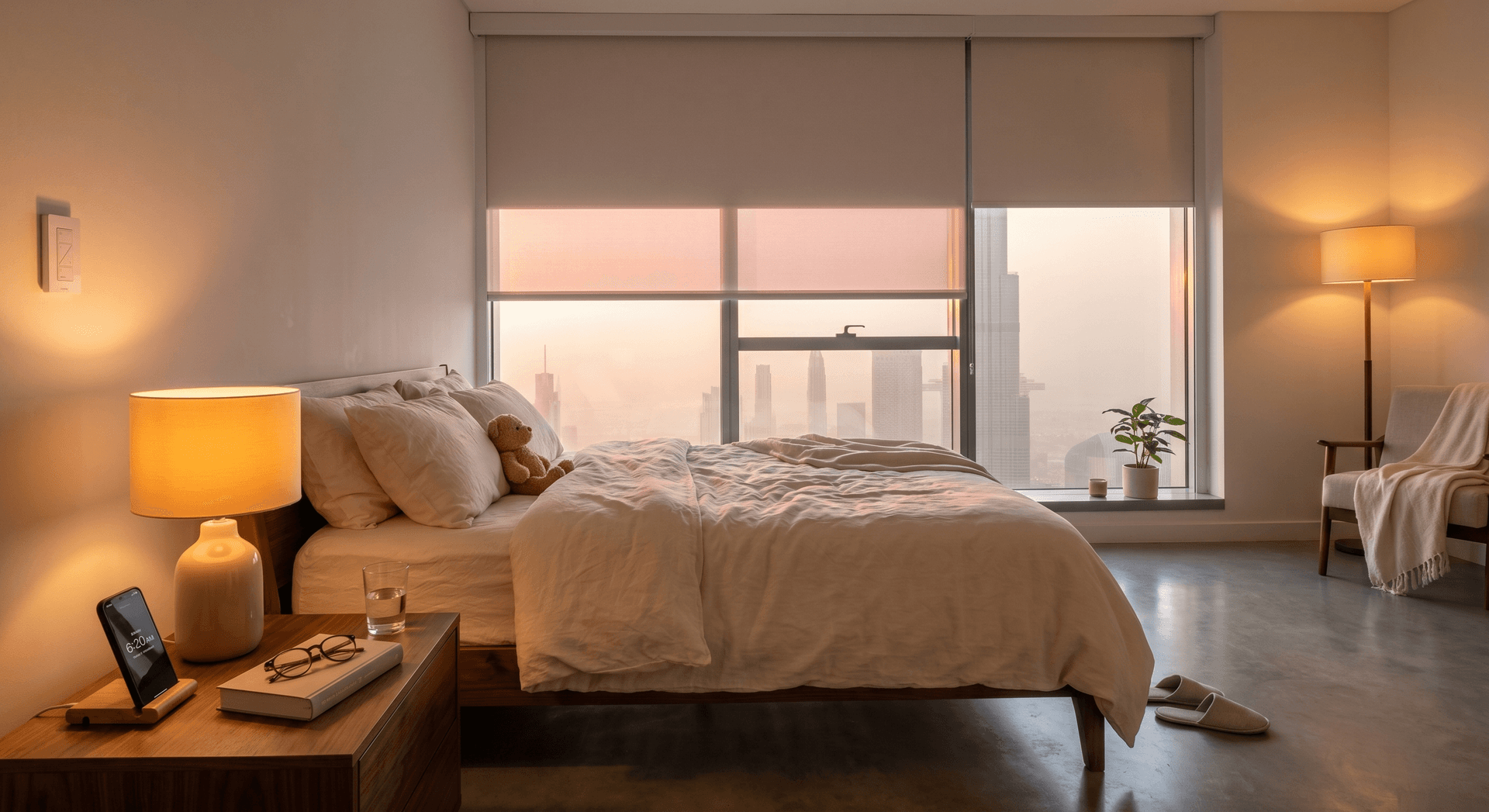
Your phone wakes you with a slow sunrise alarm that ramps over fifteen minutes. Your bedroom ceiling treats 6am and 10pm like the same room.
By late May in Dubai, the sun is over the horizon at 5:28am (sunrise-sunset.org, 2026). If you have to be awake at 7, the room has already spent ninety minutes leaking light through whatever curtain you have. Either you wake too early and stay tired, or you blackout-sleep through the natural cue and need a blaring alarm and an overhead light at full brightness to pull you out. The lighting layer in most Dubai bedrooms runs one mode for both. A wall switch from 2008.
TL;DR: Dubai's late-May sunrise at 5:28am and a single bright ceiling light are the two reasons most bedrooms feel either too bright at 6am or too harsh at 10pm. A wake-up scene that ramps warm to neutral over 20 minutes ending at 7am, and a wind-down scene that drops to 2200K amber two hours before bed, fixes both. A renter-friendly setup runs AED 850 per room. A fitted bedroom with Lutron Caseta keypads runs AED 2,400-3,800.
Bedroom lighting is the cheapest wellness upgrade in a Dubai apartment that almost nobody specs. Here is the case for the two scenes that matter, what to buy, and what the rooms look like at 6:40am and 9:40pm once they are running.
The Bedroom Lighting Problem in a Dubai Summer
A Dubai bedroom does two things to your sleep that nothing else in your apartment does. The window dumps light starting at 5:28am, and the ceiling has one switch with one setting. The blinds layer handles the first half. The lighting layer handles the second.
Sleep researchers have measured that even five to ten lux of bedroom light is enough to fragment sleep, raise wakefulness, and reduce deep sleep (Sleep Foundation, 2024). Standard bedroom curtains in a Dubai apartment let in thousands of lux by 5:45am. We have covered the window side of this in our smart bedroom blinds piece. What we missed in that post: even with the blinds perfect, the lighting layer is what tells your body it is morning, what tells it it is evening, and what stays out of the way at 3am when somebody needs to walk to the kitchen.
In our experience surveying Dubai bedrooms, the most common setup is one overhead 4000K LED on a single switch, plus one bedside lamp with a 60W warm bulb the previous tenant left behind. The ceiling light is too cool for evening and too dim for morning. The bedside lamp is too warm to read by and too bright to leave on. Neither has a schedule. Both lose to a tired hand at 11pm leaving the lights on, or a sleepy fumble at 6:30am turning everything to full brightness at once.
What "Wake-Up" and "Wind-Down" Mean in Practice
These are not branded scene names. They are the two windows in a 24-hour day where your body is most sensitive to the wrong light, and the two places where smart lighting changes how the room feels.
Wake-up runs in the 20-30 minutes before your alarm. It mimics dawn: starts at very low brightness (1-5%), very warm (2200K), and ramps over 20 minutes to a brighter, neutral 4000K-5000K. By the time the alarm sounds, the room is already at the brightness of a normal morning, and your body has been getting circadian cues for fifteen minutes. Research published in Sleep Health found that gradual-brightness wake-up lights measurably reduce sleep inertia, the foggy, slow feeling in the first hour after waking (Sleep Health Journal, 2023).
Wind-down runs in the 90-120 minutes before sleep. It does the opposite. The ceiling stays off. Two or three warm sources (bedside lamp, dresser lamp, a small floor lamp if you have one) come up to 2200-2700K at 20-40% brightness. Harvard researchers compared warm-white and blue-depleted evening light against standard fluorescent, and the warm-depleted side measurably reduced melatonin suppression and morning sleepiness (Harvard Health, 2024). At 2200K with low brightness, melatonin suppression from artificial light drops to under 1%, against 10-12% for the cool ceiling LED most apartments default to (Mudita Community, 2024).
The international CIE standard for bedroom light at night now caps melanopic exposure at 1 lux measured at the eye for the actual sleep environment, and 10 lux for the three hours before bedtime (PLOS Biology, 2022). A typical Dubai bedroom ceiling at full brightness puts out 60-90 lux at the pillow. Wind-down at 2200K and 25% brightness puts out around 8 lux. The standard is not asking for darkness. It is asking for warm and dim.
The Wake-Up Scene, Set Up
A useful Dubai wake-up scene needs four things. A start time tied to your alarm, not to a fixed clock. A ramp duration long enough to be gradual but short enough to fit before you need to be awake. A starting state that does not wake you on its own. An ending state bright and neutral enough to function in.
We typically build it like this for a Marina or Business Bay 2BR:
- Start: 25 minutes before alarm. Bedside lamp at 1%, 2200K. Ceiling off.
- First 10 minutes: Bedside ramps from 1% to 30%, color from 2200K to 2700K. Ceiling still off.
- Next 10 minutes: Bedside ramps from 30% to 80%, color from 2700K to 4000K. Ceiling fades up from 0% to 40% at 4000K.
- Final 5 minutes: Ceiling continues to 70% at 4500K. Bedside holds.
- At alarm: Room is at the brightness and color of a normal Dubai morning at 7am, before the curtain ever opens.
The first time someone in the room is woken by the scene rather than the alarm, the room has done its job. Most people report waking five to ten minutes before the alarm sounds, with no sleep inertia. The phone goes off into a room that already feels like morning.
A note for the Dubai-specific edge case. If your bedroom is east-facing in Marina or JBR, the natural 5:28am sunrise will overpower a wake-up scene set for 6:35am unless the blackout blinds are doing their job. The lighting scene and the blinds schedule have to be designed together. We start the blinds-down schedule at 04:50 and the wake-up scene 25 minutes before alarm: the room is dark at 5am, the artificial dawn runs from 6:35am, and the blinds open at the alarm itself. That is the full handshake.
The Wind-Down Scene, Set Up
Wind-down is the scene almost nobody installs and almost everybody misses once they have it. It runs in two stages.
Stage 1: 90 minutes before bed. The overhead ceiling light shuts off. Three bedroom sources stay on or come on: the bedside lamp, the dresser lamp if you have one, and a small reading or floor lamp if applicable. All three drop to 2700K at 50% brightness. Bright enough to read by, neutral enough to talk and move around, low enough that melatonin is not being suppressed.
Stage 2: 30 minutes before bed. The reading lamp drops to 2200K at 20%. The dresser lamp turns off entirely. The bedside lamp holds at 25%, 2200K. Now the room is in the under-10-lux band. Phone screens look much brighter against the warm low ambient, which is the point. Even checking the phone last thing is less disruptive when the room is already amber.
At sleep: A single tap on a keypad next to the bed runs "Goodnight": bedside off, all bedroom lights off, blinds confirmed closed, AC drops to overnight setpoint, hallway nightlight at 10% to 2200K (for anyone walking to a bathroom). The room is now at the actual CIE-recommended 1-lux melanopic floor for sleep.
The hallway nightlight is the small thing that gets noticed first. In our experience installing this in apartments with toddlers, the nightlight at 10% amber is the change that gets remembered: a 3am bathroom trip with no eye-blinding overhead, no fumbling for a switch, no waking anyone else up.
A Renter Setup: AED 850 per Bedroom
For a renter who cannot touch the wiring, the cheapest reliable wake-up plus wind-down setup runs on smart bulbs and an app or hub. We typically spec:
- 1x Philips Hue Bridge (one bridge runs an entire apartment): AED 359
- 2x Hue White Ambiance E27 bulbs (one for ceiling pendant, one for bedside lamp): AED 165 each = AED 330
- 1x Hue Smart Button or Hue Dimmer Switch (mounted on the wall next to the bed as a keypad): AED 159
- Setup, scene programming, integration with phone alarm: AED 150 (or do it yourself in an evening)
Total: AED 998 for the first bedroom, AED 639 for each additional bedroom (since the Hue Bridge only buys once). Hue Bridges and bulbs are widely available at Sharaf DG UAE and Home Centre UAE, with the Hue White and Colour Ambiance starter kit (3 bulbs plus bridge) typically AED 379-449 (Home Centre UAE, 2026).
For a Hue setup specifically, the Twilight bedside lamp is the dedicated sleep-and-wake fixture: it does the ramp and the wind-down on its own without needing the ceiling integration, runs around AED 1,099-1,299, and is the simplest single-product fix if you only buy one thing.
What this setup does not do well: the wall switch keeps working as a hard kill, which means a guest or housekeeper turning off the switch will break the schedule until someone resets the bulbs at the breaker. For a renter with a stable household, this is fine. For a household where switches get touched, the Hue Smart Button or a Lutron Aurora dimmer (which prevents accidental switch-off) is the patch.
A Fitted Bedroom Setup: AED 2,400-3,800 per Room
For an owned apartment or a villa room being refurbished, the better build replaces the wall switch with a real dimmer plus a dedicated bedroom keypad. We typically spec:
- 1x Lutron Caseta Smart Hub (one per apartment): AED 749
- 1x Lutron Caseta in-wall dimmer for ceiling: AED 449
- 1x Lutron Caseta plug-in dimmer for bedside lamp: AED 379
- 1x Lutron Pico keypad on the wall by the bed (4-button: Wake, Read, Relax, Goodnight): AED 349
- 1x Aqara T1 Pro dimmer module for the dresser lamp or reading lamp (Zigbee, color-temperature tunable): AED 285 (Microless UAE, 2026)
- 2x White Ambiance bulbs (ceiling + dresser): AED 330
- Installation, configuration, integration with home automation brain (Home Assistant or HomeKit): AED 800-1,200
Total per bedroom: AED 2,541-2,941. For a 3-bedroom apartment doing two bedrooms in one go, the per-room cost drops (the hub buys once): around AED 2,200 per room for the second one. A master bedroom with a second reading area, a vanity, and a walk-in pushes to AED 3,500-3,800.
What this build does that the renter setup cannot: the wall switch becomes a soft switch that triggers a scene, not a hard switch that kills the circuit. A housekeeper can turn the room "off" and the schedule still runs. A guest can run the room from the keypad without touching anything they do not understand. The Pico keypad has tactile buttons (Wake, Read, Relax, Goodnight) that work in the dark with no app.
What Bayora Will Talk You Out Of
The wake-up and wind-down scenes are the high-value bedroom lighting moves. There are four upgrades adjacent to them that we routinely advise people NOT to buy:
-
Full RGB color bulbs in a bedroom. Color-changing bulbs cost roughly double White Ambiance and add the option to set your bedroom to disco purple. We have never seen anyone use this option past the first week. White Ambiance (2200K-6500K tunable white only) covers everything bedroom lighting needs and saves AED 100-150 per bulb. Use color bulbs in living rooms or kids' rooms, not master bedrooms.
-
Wall-mounted touchscreen control panels in a bedroom. A AED 1,200-1,800 7-inch wall touchscreen above the bed looks great in a render and gets touched twice. The Lutron Pico keypad at AED 349 does the same job better, works in the dark with tactile buttons, has no glowing screen at night, and never needs charging. The right interface for a bedroom is a keypad, not a screen.
-
Smart bulbs and smart switches in the same circuit. If you install a Hue bulb in a fixture that has a Lutron dimmer switch, the dimmer will try to dim the bulb's power supply and the bulb will flicker, fail, or shorten its life. Pick one layer per fixture. Smart bulb plus dumb switch (with the switch locked on), or smart switch plus dumb bulb. Not both.
-
A AED 2,500-4,000 separate "wake-up light" device on the bedside. Once you have the ceiling and bedside on the same scene engine, the dedicated wake-up clock is redundant. The Hue Twilight at AED 1,099 is the exception (it bundles the lamp and the alarm into one device, which is the simplest possible starter). The premium standalone clocks duplicate something your existing lighting already does.
A Real Setup: 2-Bedroom Business Bay Apartment
A couple in their early thirties, both hybrid workers, asked us in March to fix the bedroom lighting in their two-bedroom apartment. The complaint was specific. She was waking up at 5am no matter what time she went to bed. He was watching shows on his iPad in bed until 1am and falling asleep with the ceiling on, then waking up at 5:30 when she pulled the curtain. This mismatched-schedule problem shows up constantly in a couple's first shared apartment; see our guide for newlyweds moving in together for the wider set of things that need deciding in month one.
What we installed:
- Master bedroom: Lutron Caseta hub (lives in the utility cupboard), Caseta dimmer for the existing ceiling pendant (2x White Ambiance bulbs), Pico keypad on the wall by the bed (Wake / Read / Relax / Goodnight), Caseta plug-in dimmer for the bedside table lamp, second plug-in dimmer for the reading chair lamp in the corner.
- Second bedroom: Caseta dimmer for the ceiling, single White Ambiance bulb, single Pico keypad. Lower-spec because they use it as a guest room and home office, not for daily sleep.
- Hallway: A motion-triggered Aqara nightlight at 2200K, 10% from 11pm to 6am.
- Master bedroom blinds: They already had motorized blackouts (installed last year). We wired the blinds-down schedule to 04:50 and blinds-up to the wake scene completion at 06:55.
Total cost: AED 5,840 for the full master setup plus the second-bedroom basic plus the hallway nightlight. Installation took one afternoon. Configuration plus testing the scenes took another two hours over the next two evenings.
Two months in, the master-bedroom Pico has been touched roughly 600 times. The wake-up scene at 06:35 runs every weekday. The wind-down scene runs every night around 10pm. She has not woken at 5am since the second week. He has stopped watching iPad shows past 11pm because the room is amber by then and the screen feels too bright. The ceiling has been at full brightness twice in two months: once when someone dropped a glass, and once when a houseguest did not find the Pico.
The hallway nightlight has been the surprise winner. They have a toddler who started walking to their room at 3am for water about a month ago. The nightlight at 10% amber is the thing the toddler navigates by, and nobody has to wake all the way up. The hallway light has never been turned on at 3am since.
The thing they did not buy: a wall touchscreen above the bed, an extra AED 1,400 we walked them out of. The Pico has worked for sixty days without anyone wishing they had a screen. The keypad sits next to the bed in the dark, you press the bottom button, the room goes amber. Nobody needs to read a screen to do that.
Cross-System Integration: Lighting Talks to the Rest of the Room
The wake-up and wind-down scenes get more useful once the lighting layer talks to the other systems in the bedroom.
- Blinds: Blinds-up at the end of the wake scene, blinds-down at the start of the wind-down. The room transitions visually with the lighting transition. Smart bedroom blinds in Dubai and lighting share the same scene engine, so a single button runs both.
- AC: The Goodnight scene drops the bedroom AC to your overnight setpoint (we typically run 23-24C overnight in summer). The Wake scene pre-cools the room from 4am for the morning if the bedroom is hot at 7am. See our first 40C-day routine for the AC-side detail.
- White noise or audio: For households that sleep with a fan or white noise, the Goodnight scene starts it. The Wake scene fades it out before the lights start ramping. For households with a smart speaker, the Wake scene can play a short morning audio cue (news headline, weather, calendar) once the alarm sounds.
- Door sensor: A door sensor on the master bedroom door can override the wind-down if the door is still open at the scheduled time (someone is still in the living room, hold the scene). This is the integration that makes the lighting feel like it understands the household instead of running on a dumb schedule.
What an integrated room looks like at 6:40am: blinds slowly opening, lights ramping warm to neutral, AC stepping up from 23 to 24, and the coffee machine already hot if the apartment is set up for it. Nothing happening fast, everything happening together.
What it looks like at 9:45pm: ceiling off, three lamps amber at 25%, AC dropping to 23, blinds confirmed closed, hallway nightlight already on. One button. Room is ready for sleep before anyone is.
Frequently Asked Questions
Can renters install this without their landlord knowing?
Yes. The renter setup (Hue bulbs plus Hue Bridge plus Smart Button) requires zero wiring and zero drilling. The Bridge plugs into your router with a single Ethernet cable. The bulbs screw into existing fittings. The Smart Button is held to the wall with the supplied adhesive backing or sits on a bedside table. Everything packs into a small bag when you move and works the same way in the next apartment.
Do the wake-up and wind-down scenes need WiFi to run?
Wake and wind-down scenes set on Philips Hue or Lutron Caseta run locally on the Bridge or Hub once configured. They do not need internet to run. They need internet for remote phone control, alarm-time syncing with your phone, and software updates. If your WiFi drops at 2am, the wake-up at 6:35am still runs.
Does the wake-up light replace my phone alarm?
We recommend keeping the phone alarm. The wake-up scene is a 20-25 minute ramp BEFORE the alarm. By the time the alarm sounds, your body has been waking gradually for a quarter of an hour. The alarm is the final cue, not the only cue. Most people in our installs find the alarm is much less jarring once the room is already at morning brightness.
Will this work with my existing pendant or lamp fixtures?
Smart bulbs (Hue White Ambiance) fit standard E27 sockets, which is what most Dubai pendant and lamp fittings use. Some imported fixtures use E14 (smaller candle base) or GU10 (spotlight base), and Hue makes versions for both. For unusual fittings, the plug-in dimmer route (Lutron Caseta plug-in module on the wall outlet) bypasses the bulb question entirely by dimming the entire lamp from the socket.
What about kids' bedrooms? Should I use the same scenes?
Yes, with two changes. The kids' wake-up scene should fade IN later in the morning if school is on a different schedule, and the wind-down should run earlier with a slightly warmer floor (2200K from 7:30pm onwards for younger children). The hallway nightlight matters more in households with young children. We covered the kids-room-specific setup in our smart lighting for kids' rooms post.
Where to Start
If you take one thing from this and do nothing else, the single highest-value move is the wind-down scene. The wake-up scene is great, but most people are already woken by their phone or by the 5:28am sunrise. The wind-down scene is the one that almost nobody runs and almost everybody benefits from immediately, because the alternative is fluorescent-bright ceiling LED until the moment you decide to sleep, which fights melatonin until you are in bed in the dark.
For a renter on the simplest setup: buy one Hue Twilight bedside lamp, set the bedtime mode to start at 9:30pm and the alarm to your usual wake time. That is the entire installation. AED 1,099 from Sharaf DG UAE. It runs both scenes in one device and the rest of the room can stay as it is until you decide to do the next bedroom.
For a fitted setup: book a survey. We can usually quote a master-bedroom-only or a whole-apartment build within a week. The master-only build is around AED 2,800-3,500 fitted, takes one afternoon, and runs from a 4-button keypad next to the bed. A whole-apartment build (master plus 1-2 other bedrooms plus hallway) is AED 4,500-6,500.
The bedroom is the room you spend a third of your life in. The room that decides whether the other two-thirds run on rested or tired. The lighting layer in most Dubai bedrooms is doing the absolute minimum and people pay for it in sleep quality without ever connecting the two.
Dawn at the window. Amber at the lamp. Dark for sleep. The bedroom does not have to fight you any of those three.
Get a free consultation and we will walk through what your bedroom needs and what to skip. Master-only quotes turn around in three to five working days.
Ready to Get Started?
Get a free consultation and we'll recommend what makes sense for your situation.
Get Free Consultation