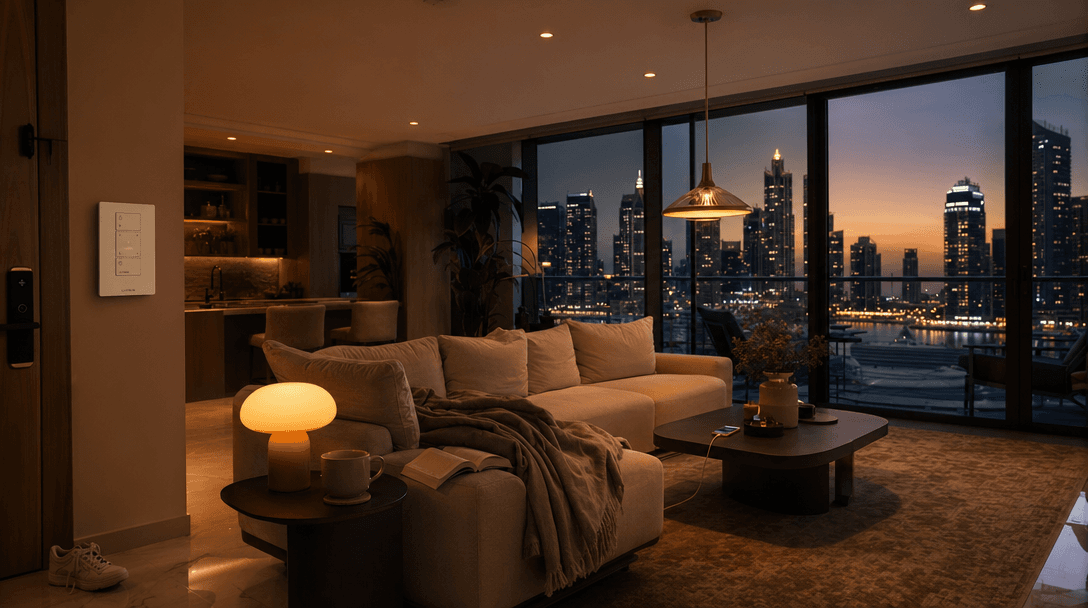
Walk through a Dubai apartment at 9pm on any evening and count the lights. Living room: ceiling lights at full brightness, two table lamps, a kitchen pendant. Bedroom: ceiling fan light. Bathroom mirror lights. The hallway. The balcony spot. All on, all at 100%, even though three of those rooms are empty and the other two only need maybe 40% of the light to feel comfortable.
This is the lighting equivalent of leaving the AC at 18 with the door open. And because lights are quiet, nobody notices.
TL;DR: Smart lighting cuts a Dubai apartment's lighting energy use by 24-50% through three things: dimming (you rarely need 100%), schedules (lights match the hour, not your forgetfulness), and presence sensing (rooms turn off when empty). On a typical 2-bedroom flat, that's AED 30-90 a month off your DEWA bill, plus an apartment that finally feels designed instead of switched-on.
Most "smart lighting" content in Dubai sells you on phone control. Phone control is the worst part of smart lighting. The real value is your apartment knowing what time it is, who's in the room, and how much light each space needs. None of that requires you to open an app.
Where Lighting Actually Costs You in a Dubai Apartment
Dubai homes don't lead the world in lighting waste because the bulbs are bad. They lead because lights run for 5-7 hours every evening at full output, in 8-15 fixtures, with most rooms unoccupied for half that time. Halogen bulbs make this worse: a single 60W incandescent or 42W halogen replaced with a 9W LED saves up to 80% of the energy (U.S. Department of Energy, 2024). But even a fully LED apartment has the same problem: running 9W LEDs at 100% when 4W would do, in rooms nobody is in.
The DEWA bill math is straightforward. Residential electricity is billed on a slab tariff: 23 fils per kWh for the first 2,000 kWh, then 28, 32, and 38 fils per kWh as you climb the slabs (DEWA Slab Tariff, 2026). A monthly fuel surcharge of about 6.5 fils per kWh sits on top. In summer, most 2-bedroom apartments are pushing into the 28-32 fils range, so every kWh of waste costs more than it did in winter.
A typical Dubai 2-bedroom with 12 LED bulbs averaging 9W each, running 6 hours a day, draws about 19 kWh a month from lights alone. Drop the average run-state to 60% with smart dimming and remove 25% of the runtime through schedules and presence, and you're looking at roughly 9-11 kWh saved a month. Small in isolation, but compounding across summer when the AC, water heater, and laundry are already pushing the slab tariff into higher tiers.
What "Smart Lighting" Means When It's Done Right
Smart lighting isn't a Philips Hue bulb in a lamp. That's a phone-controlled bulb with extra steps. Real smart lighting is three things working together: the right hardware, automated dimming, and presence-aware control. When all three are set up, you stop touching switches and the apartment just behaves.
In our experience, the biggest mistake new clients make is buying 8 smart bulbs and calling it done. They end up with the same single-mode lighting as before, only now controlled by Alexa instead of a switch. The apartment feels exactly the same. The DEWA bill barely moves. What changes the experience and the bill is putting smart switches and dimmers behind the wall on key circuits, then letting schedules and sensors run the show.
The hardware split: smart switches and dimmers (Lutron Caseta, Shelly) replace the existing wall switch and make every bulb on that circuit controllable. Smart bulbs (Philips Hue, Aqara) are best for lamps and feature lights. The full breakdown lives in our smart bulbs vs smart switches guide, but the short version: switches for the workhorse circuits (living room downlights, hallway, kitchen, bedrooms), bulbs for accent and lamp lighting.
The Three Levers That Cut Lighting Energy Use
The energy savings from smart lighting come from three control strategies, and the research is clear about which ones matter. A meta-review of lighting control studies found average savings of 24% from occupancy sensors, 28% from daylight harvesting, and 38% when both are combined (U.S. Department of Energy, 2024). A residential simulation study put the savings at over 50% with full smart-control deployment (ScienceDirect: Smart vs conventional lighting in apartments, 2021).
Lever 1: Dimming. Most fixtures in a Dubai apartment are sized for the brightest case (cleaning the kitchen, doing makeup) and run at that level for everything else (watching TV, eating dinner, having friends over). A dimmer at 50% output uses roughly 50% of the wattage on a properly dimmable LED. Personal dimming controls alone produce average lighting energy savings of 31% in real-world residential studies (DesignLights Consortium, 2023). Set scenes for evening (40%), dinner (60%), and bright (100%), and the average drops without anyone feeling under-lit.
Lever 2: Schedules. Lights that turn on automatically at sunset and off at midnight don't get left on. They don't get forgotten when you go to sleep. They don't run for an extra hour because you fell asleep on the sofa. In Dubai, sunset shifts from 5:35pm in December to 7:15pm in June, and a sun-following schedule (rather than a fixed time) keeps the lights honest year-round.
Lever 3: Presence. Hallways, bathrooms, walk-in closets, and laundry rooms are the worst offenders for lights-left-on. A AED 200 motion sensor on each of these turns lights on for 5 minutes when someone enters and off when nobody's there. We've seen 60-80% runtime reductions on these specific circuits in JBR and Business Bay apartments where we've installed them.
What This Looks Like in a Real Dubai Apartment
A 2-bedroom Marina apartment we set up earlier this year had 14 light fixtures across living, dining, kitchen, two bedrooms, two bathrooms, and a hallway. Pre-install: most lights ran 6-8 hours a day at 100% from sunset onwards, with the hallway and bathrooms hitting 12+ hours because nobody bothered to flip the switch.
Post-install (4 smart switches on the main circuits, 6 smart bulbs in lamps and feature spots, motion sensors in hallway and bathrooms, automated sunset-on/midnight-off schedule, three preset scenes): the apartment feels brighter and more intentional, not dimmer. The owner stopped touching switches almost entirely after the first week. We measured the lighting circuit draw at the panel and the average evening lighting load dropped from about 110W to about 55W, with peak runtime cut by roughly a third.
What we've found is that the experience change matters more than the savings. The savings are AED 30-90 a month, real but not life-changing. What clients love is that their apartment looks like a designed space at every hour of the day instead of one bright mode and one dark mode. Their guests notice. They notice. The bill is a side effect.
What Smart Lighting Costs in a Dubai Apartment
A starter setup for a 2-bedroom apartment runs roughly AED 4,000 to 8,000 fully installed, depending on whether you go switches-first or bulbs-first and how many circuits you cover. That includes hardware (switches, sensors, a hub if needed), professional installation, scene programming, and integration with Alexa, Google, or HomeKit if you want voice control. Renters can do a bulb-first version for AED 1,500-3,000 with no electrical work and take everything with them when they move. The UAE smart lighting market hit USD 90.7 million in 2024 and is growing 18.66% per year (IMARC Group, 2025), which means hardware availability and pricing in Dubai have improved sharply over the last 18 months.
For broader smart home costs, see our smart home cost guide. For a deeper dive into the design side, the complete smart lighting guide covers brands, scene design, and renter vs owner trade-offs.
The reason switches-first costs more upfront is the wiring labour. The reason it's worth it is that one switch makes 6 bulbs smart, the bulbs themselves stay cheap, and the install is permanent. Bulbs-first costs less but you're paying AED 50-100 per bulb across 12-20 bulbs, and most of those bulbs end up in lamps because ceiling fixtures need switch control to be useful.
Frequently Asked Questions
Does smart lighting actually save money on my DEWA bill?
Yes, but the savings depend on your starting point. If your apartment is already on LED bulbs and you mostly use them efficiently, expect AED 20-50 a month off lighting costs. If you have halogen bulbs or leave lights on in empty rooms, savings can hit AED 100+ a month. The bigger value is convenience: your apartment runs itself.
Do I need to replace all my bulbs to get smart lighting?
No. Smart switches make every bulb on a circuit smart, regardless of whether the bulbs themselves are smart. For most Dubai apartments we recommend starting with 3-5 smart switches on the high-use circuits (living room, kitchen, hallway, bedrooms) and adding smart bulbs only for lamps and accent lighting.
Will smart lighting work if my internet drops?
Yes, for the most part. Smart switches like Lutron Caseta and most Shelly devices keep working locally even when WiFi is down. Wall switches still function as normal switches. You lose remote phone control and voice assistants until WiFi is back, but schedules and scenes typically still run.
Can I install smart lighting myself in a Dubai apartment?
Smart bulbs yes: screw them in, connect to the app, done. Smart switches no, not safely, and not legally for owned properties. Switch installs require a licensed electrician in Dubai. For renters, bulbs and plug-in dimmers are the path. For owners, professional installation protects your wiring and your warranty.
Does smart lighting work with my existing dimmer switches?
Usually no. Most existing dimmer switches conflict with smart bulbs and create flickering or buzzing. The fix is to either replace the dimmer with a smart dimmer (and use regular non-smart bulbs) or remove the dimmer and use smart bulbs only. Mixing the two almost never works well.
Ready to Stop Lighting an Empty Apartment?
If you want to know what this would look like in your specific apartment, which switches matter most, what the install looks like, what it costs, and what your DEWA bill might do, book a free consultation and we'll come take a look. No pressure, no obligation, just an honest recommendation.
Ready to Get Started?
Get a free consultation and we'll recommend what makes sense for your situation.
Get Free Consultation