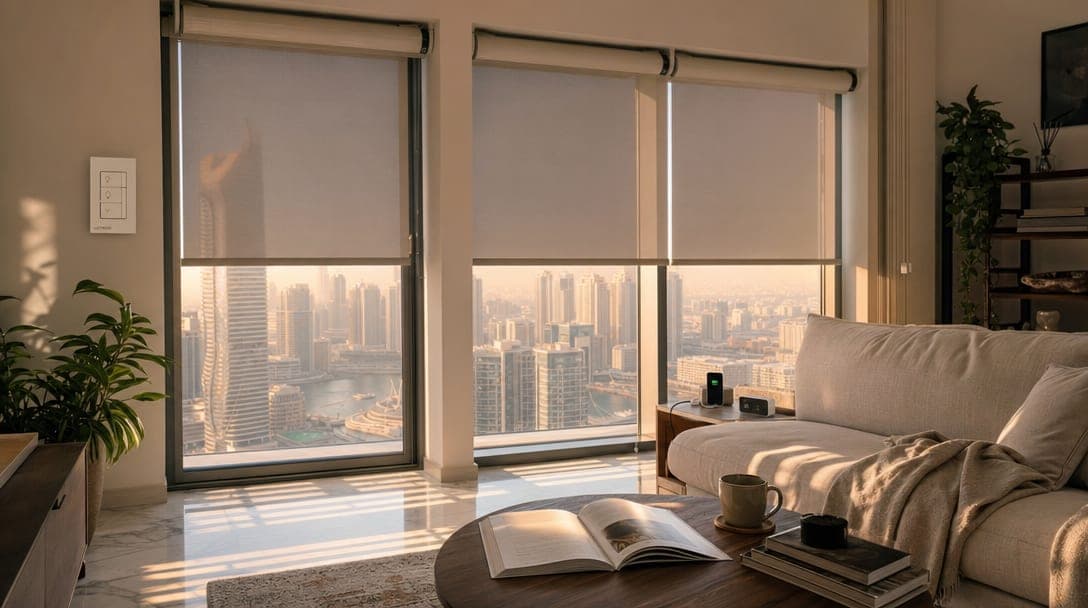
The NCM forecast for Apr 27-28 says it plainly: temperatures rising, light-to-moderate northwesterly winds gusting to 40 kph, blowing dust. Mezaira hit 44C on Apr 22. NOAA gives a 61% chance of El Nino developing May through July, which means an intense summer is more likely than not (The National, 2026).
That combination, dust plus heat, is what Dubai windows are about to face for the next five months. Most apartments treat their blinds as a manual chore: close them when you remember, open them when you wake up, leave them alone when the dust rolls in. Motorized blinds change that quietly. They handle three things at once that the heat and the dust both demand, and they do it on a schedule you set once.
TL;DR: Motorized blinds in Dubai do three jobs during dust season: they reduce solar heat gain by up to 24% on west and south windows, lower indoor PM2.5 ingress when shut before a sandstorm hits, and cut afternoon AC load by 18-24% on hot exposures (Stråla, 2026). A 2-3 window priority install runs AED 5,500-8,000 and shows up in cooler rooms, lower DEWA bills, and floors that don't need wiping every morning.
What Dubai's Dust Season Does to Your Apartment
Dubai's peak dust season runs from roughly March through September, with the strongest shamal winds and the hottest surface temperatures both peaking in June through August (WoWDeals, 2026). Even in well-sealed buildings, particulate matter from these storms infiltrates indoor spaces. Dubai Municipality and international IAQ guidelines say healthy indoor PM2.5 should stay below 35 µg/m³, and during a sandstorm that line is hard to hold without help (Indoor Sciences, 2026).
The dust does two things people underestimate. It coats your AC coils, which forces the unit to work 30-40% harder for the same cooling output (Power Group International, 2026). And it gets pulled into your apartment every time someone opens a window or balcony door, settles on every surface, and triggers a daily floor-wiping cycle that nobody enjoys.
In our experience surveying apartments across Marina, Business Bay, and Downtown, the worst dust ingress always shows up in the same places. The west-facing balcony door that gets opened in the late afternoon. The bedroom window that someone cracked overnight to let in cooler air. The kitchen window left ajar to vent cooking smells. Manual blinds don't help because nobody is home, or awake, or paying attention at the moment the dust front arrives.
Solar Heat Gain Is the Quiet Cost on West and South Windows
Before we get to the dust, the heat itself is the bigger DEWA story. Solar heat gain coefficient (SHGC) is the fraction of solar heat that passes through a window and turns into indoor heat. The lower the SHGC, the less heat your AC has to fight (Security Film, 2026).
Dubai's south and west elevations face solar irradiance of around 1,000 W/m² on summer afternoons. Unshaded west-facing windows in commercial buildings add 25-35% to the cooling load on peak summer days, and residential windows behave similarly when there's no shading in front of them (Stråla, 2026).
The fix is mechanical, not magical. Quality blackout blinds reduce window heat gain by up to 24%. Solar screen fabrics with an SHGC below 0.35 can reduce solar heat gain by up to 75%. Most importantly for Dubai: a motorized and automated blind system on a south or west exposure delivers 18-24% HVAC cooling load reduction during summer months (Stråla, 2026).
Translate that into a Dubai DEWA bill. AC accounts for around 70% of household energy use in UAE summer months (Gulf News, 2026). If motorized blinds cut your peak afternoon cooling load by 18-24% on the windows that matter, that's roughly AED 250-400 off your monthly DEWA bill in July and August on a 2-bedroom apartment with two or three exposed afternoon windows.
The Dust Job: Closing Before the Storm Arrives
Here is what motorized blinds add that manual blinds cannot. They close on a trigger. The trigger can be a schedule (every weekday at 1pm, when the western sun starts to bake the living room). It can be a forecast (your home assistant pulls a dust advisory from the NCM and closes the blinds 30 minutes ahead). It can be a sensor (a PM2.5 monitor on the balcony reads above a threshold, blinds drop, AC switches to high-circulation mode).
Window blinds and shades act as a physical barrier and reduce dust accumulation indoors compared to heavy curtains, which trap and release particles back into the air (Love Is Blinds, 2026). Closed blinds also slow the airflow that drives dust deeper into the apartment when the wind is strong outside and your AC is running on circulation mode inside.
Integrated home systems that combine motorized shading, smart HVAC, and air quality sensors can reduce indoor PM2.5 levels by over 80% during sandstorm events compared to manual intervention (Indoor Sciences, 2026). That number assumes you've also got a properly filtered AC and a few good seal points on doors and windows. Blinds alone don't deliver 80%, but they're the cheapest, most reliable trigger point for the rest of the system.
When we installed a motorized blind setup in a 38th-floor Marina apartment last summer, the homeowner kept a small Awair air quality monitor on the dining table. The first dust event after the install, indoor PM2.5 stayed under 25 µg/m³ while outdoor readings spiked above 200. The blinds had closed automatically at the schedule we set, the AC was on high-circulation mode, and the bedroom door (with its under-door gap) was the only place dust really pushed through. Manual blinds wouldn't have done any of that, because the homeowner was at the office.
What Three Windows Cost and Which Ones to Pick
You don't need to motorize every window in your apartment. The math says only the 2-3 windows that get the most direct afternoon sun move the DEWA needle. If you've read our priority guide on which windows in your apartment need motorized blinds first, the same logic applies during dust season: west and south first, then large east-facing morning windows, then everything else.
Hayat Interiors and other Dubai installers price motorized roller blinds at around AED 800-2,000 per window in 2026, depending on fabric, motor type, and width (Hayat Interiors, 2026). For a typical 2-bedroom apartment, a priority install of 3 windows lands around AED 5,500-8,000, including motors, hub or bridge, and configuration.
Two installation paths exist:
The renter-friendly path uses battery-powered roller motors (SwitchBot, Aqara, Ikea Fyrtur) with rechargeable batteries that last 4-6 months between charges. No drilling beyond the existing curtain bracket, and you can take them with you when you move. Total kit per window: around AED 700-1,200 if you self-install, AED 1,400-2,000 if we do it. Charge cycle is the only ongoing chore.
The owner path uses hardwired motors and proper roller mechanisms with a DC power feed inside the wall. Quieter, more reliable, and they integrate with KNX, Lutron, or Home Assistant the moment they're installed. Cost is higher (AED 1,200-2,500 per window installed), but the system is invisible and lasts 10+ years.
Both paths integrate with the Matter standard, which over 75% of new smart devices sold in Dubai now support (Gulf News, 2026). That means whichever ecosystem you use (Apple Home, Google Home, Home Assistant), the blinds will work with it without bridge-fighting.
The Schedule That Handles Both Heat and Dust
A motorized blind setup in Dubai earns its cost on the schedule, not on the hardware. After setting up dozens of these schedules across Marina, Business Bay, and JBR apartments, here's the setup we use as a starting point on summer-facing units. Adjust for your orientation and lifestyle.
6:30 AM - East-facing blinds open to a position that lets in soft morning light without baking the room. Roughly 50-70% open is usually right.
10:30 AM - East-facing blinds close to about 25%. South-facing blinds drop to 50% as the sun rotates.
1:00 PM - West-facing blinds close fully. South-facing blinds drop to 25%. This is the start of the heat-blocking window, which runs through 5pm.
5:30 PM - All blinds reopen as the sun moves past the horizon. The apartment cools naturally, AC runs lighter, and the views come back.
9:00 PM - Bedroom blinds close to blackout for sleep. Living areas stay open or partial depending on preference.
Override: dust advisory - If a sandstorm warning appears in the NCM feed (which Home Assistant can pull automatically), all blinds close to full regardless of time, AC switches to recirculation mode, and a notification goes to your phone.
This schedule cuts the cooling load on the heat-exposed windows for the four hours that matter most, blocks dust during the times you're most likely not paying attention, and still lets the apartment feel like an apartment with views, not a sealed box.
Where Blinds Slot Into a Wider Smart Home
Motorized blinds work best as one piece of a 4-piece summer setup. The other three are a pre-cooling AC schedule (so the apartment is already cool when the heat-block window starts), a smart AC controller (so the schedules talk to each other), and the indoor air quality build with PM2.5 sensors and HEPA on smart plugs (so the dust override has data to trigger on).
The full 4-piece setup runs around AED 8,500-13,000 for a 2-bedroom apartment, depending on which path you take on each piece. That's the same range as a single mid-spec sofa. The DEWA savings during the worst summer months (June, July, August) typically run AED 350-550 per month, which means the system earns back its cost in 2-3 summers and then keeps paying after.
If you're a renter, the playbook is similar but lighter: battery blinds on 2 priority windows, a Sensibo or Tado smart AC controller, and a portable air quality monitor. Same logic, lower cost, all of it portable. We've covered the full renter playbook for summer DEWA bills separately if that's where you're starting.
What This Looks Like When It's Running
The honest part: most of our clients with motorized blinds don't talk about energy savings. They talk about not noticing the heat anymore. The bedroom that used to be 28C at 4pm is 24C. The living room marble doesn't burn under bare feet at 3pm in July. The throw blanket on the sofa doesn't get a layer of fine dust every Friday morning. The afternoon nap nobody could take because the western sun was too aggressive becomes possible again.
The DEWA bill drops as a side effect, not as a headline. The apartment stops fighting the weather, because something else is doing that work, on a schedule, every day, whether anyone is home to notice or not.
That's the real product. The hardware is the boring part.
Frequently Asked Questions
Do motorized blinds work without WiFi?
Most motorized blinds run their schedules locally on the motor or hub, so they continue to open and close on time even if WiFi drops. You lose the ability to override them from your phone or trigger dust alerts from a forecast feed, but the daily schedule keeps running. Voice control and remote app control stop working until WiFi returns.
Can I install motorized blinds in a rental apartment?
Yes. Battery-powered roller motors from SwitchBot, Aqara, or Ikea Fyrtur attach to the existing curtain rod brackets without drilling, run for 4-6 months on a charge, and come with you when you move. They cost AED 700-1,200 per window installed and need no landlord approval. Hardwired motors require landlord approval because they involve a DC power feed inside the wall.
How much do motorized blinds reduce dust inside the apartment?
On their own, modest. As part of an integrated setup with an air quality sensor and a smart AC, indoor PM2.5 can stay 80% lower than outdoor levels during a sandstorm event (Indoor Sciences, 2026). The blinds reduce dust ingress through the window itself by acting as a physical barrier. The AC and seal points do the rest.
Which windows should I motorize first?
West and south-facing first, since they take 25-35% of your peak summer cooling load. Then large east-facing morning windows. Skip north-facing windows entirely unless privacy is the goal. We covered the priority framework in detail for apartments and villas across Dubai.
Will motorized blinds save me money on my DEWA bill?
On a 2-bedroom Dubai apartment with motorized blinds on the 2-3 most heat-exposed windows, expect AED 250-400 off the monthly DEWA bill during peak summer (June through August), based on 18-24% cooling load reduction on those windows (Stråla, 2026). The savings are smaller in shoulder months and negligible in winter. The apartment's comfort improves year-round.
Dust season has already started. The first 44C day landed on Apr 22, the NCM forecast is calling for blowing dust this week, and El Nino odds for the May-July window are above 60%. The cheapest way to make a Dubai apartment behave through this is to give the windows a schedule.
Tell us about your apartment, including your orientation and which rooms get the worst afternoon sun, and we'll come back with a 2-3 window priority install plan, exact pricing, and a schedule that fits your day. Get a free quote. No obligation, no surprises.
Ready to Get Started?
Get a free consultation and we'll recommend what makes sense for your situation.
Get Free Consultation