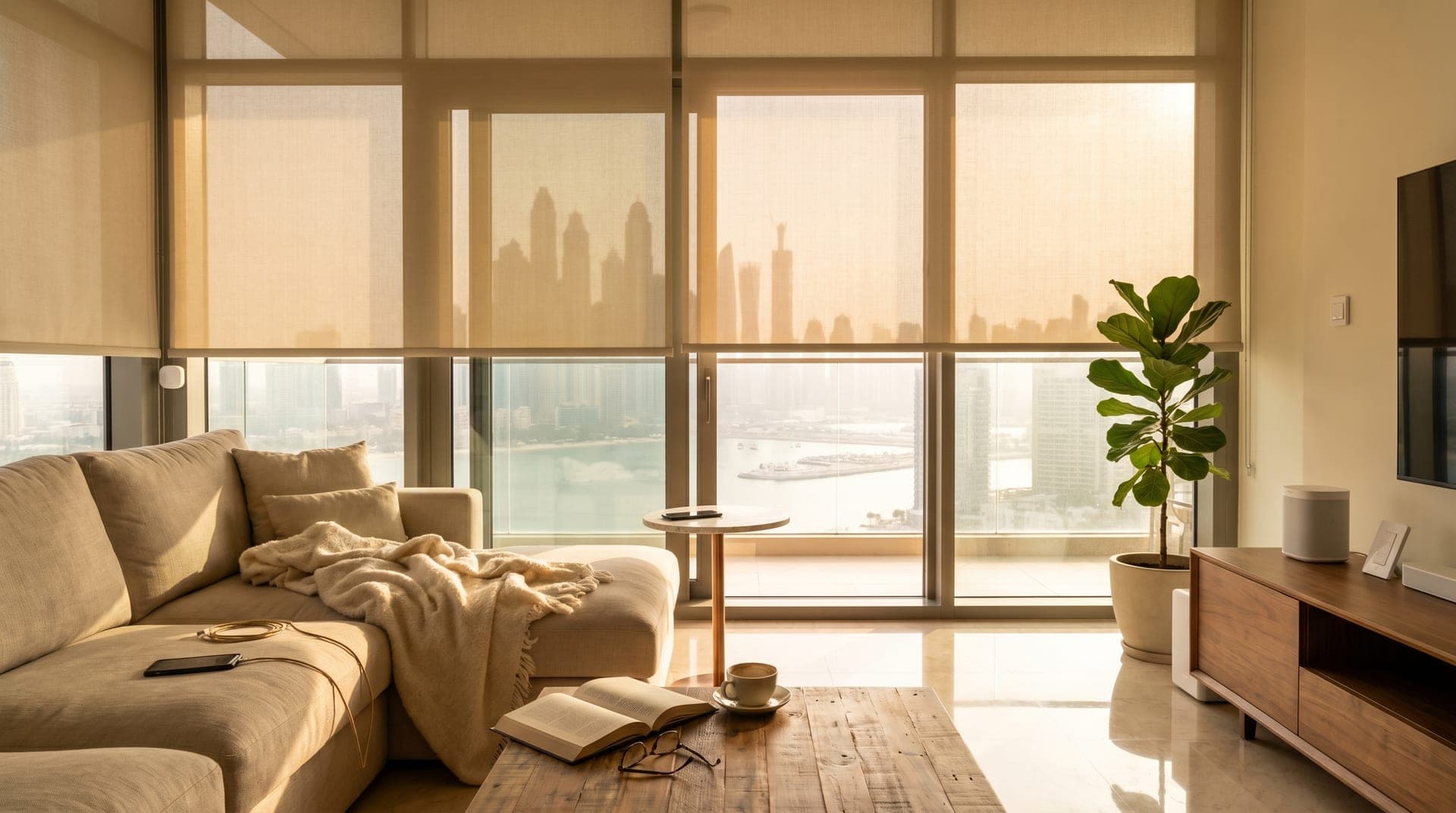
You Don't Need Motorized Blinds on Every Window
Here's a thing most blinds companies in Dubai will never tell you. If you have eight windows in your apartment, you probably need motorized blinds on two of them. Maybe three.
The rest can stay exactly as they are. A manual pull, a basic curtain, or nothing at all. You'll still get 80% of the cooling benefit for 30% of the cost.
The reason is simple: solar heat gain is not evenly distributed across your apartment. One wall does most of the damage. The other three are mostly along for the ride. The question isn't "should I automate my blinds?" It's "which windows are actually costing me money, and which ones aren't?"
TL;DR: West and south-facing windows drive 70-80% of afternoon heat gain in a Dubai apartment. Start motorized blinds on those first, usually 2-3 windows. East-facing windows matter for bedrooms. North-facing and shaded windows rarely need automation. Expect to spend AED 800-2,000 per window and cut AC load by 25-35% once the priority windows are covered.
What Solar Heat Gain Actually Looks Like in a Dubai Apartment
Before you decide which windows to automate, you need to understand what they're doing to your apartment. Most people picture heat as something that slips through the walls. It doesn't. The walls are concrete. The windows are the problem.
In our experience surveying apartments across Dubai Marina, Business Bay, and JBR, west-facing windows contribute the largest single source of afternoon solar heat gain, as much as 120-160 BTU/hr per square foot (US Department of Energy, 2025). A typical 2-bedroom apartment has 40-60 sq ft of west-facing glass. That is up to 9,600 BTU/hr pouring into one wall between 2pm and 6pm, the exact window when your AC is already working hardest.
And most of that energy is invisible. Infrared rays form around 53% of the solar heat hitting your window, visible light is 44%, and UV is under 3% (mypdh.engineer, 2024). Which means even tinted glass that looks dark still lets in the heat that matters. You need something that physically blocks the sun, not something that just darkens the view.
Untreated glass in a Dubai apartment can raise indoor temperatures by 4-6 degrees on a summer afternoon. That is the number we keep seeing in real smart AC zone control projects. Your west-facing living room sits at 28 degrees while your north-facing bedroom sits at 22, and the AC has no idea which one to listen to.
How to Figure Out Which Way Your Windows Face
You can do this in 60 seconds with your phone. Open the compass app, stand in front of a window, and point the top of your phone at the glass. The direction shown is the direction that wall faces.
Here is what each orientation means for solar heat gain in Dubai:
West-facing (270°): The worst offender from 2pm to 6pm. This is the window that turns your living room into a greenhouse. Peak solar radiation hits here when outdoor temperatures are also at their peak, so the cooling load stacks. If you have one direction to prioritize, this is it.
South-facing (180°): Heats up from late morning through mid-afternoon. In a Dubai summer the sun tracks high in the sky, so south-facing windows take direct hits for 5-6 hours a day. Second priority after west.
East-facing (90°): Strong heat between 7am and 11am. In a bedroom, this is the window that wakes you up at 6:30am and heats the room before your AC catches up. For bedrooms specifically, east-facing deserves priority equal to west.
North-facing (0°): Rarely a problem. North-facing windows in Dubai get almost no direct sun. Manual blinds or basic curtains are fine. Do not spend AED 1,200 automating a window the sun barely touches.
What a Dubai apartment often looks like after this check: 2 west-facing living room windows (top priority), 1 east-facing bedroom window (second priority), 1 north-facing kitchen window (skip), 2 south-facing bedroom windows (moderate priority), 2 interior/shaded windows (skip). You automate 3, skip 5, cover the heat problem.
The 3-Priority Framework for Motorized Blinds
Use this order when budgeting and planning installation. This is how we scope blinds projects for Dubai Marina and JBR apartments when clients want the minimum effective setup.
Priority 1: West-facing living and main rooms. This is where the AC fight is loudest. Automate first. Even a single 1.8m x 2.4m west-facing window that closes at 1:30pm every day takes meaningful load off the AC. One Business Bay apartment owner we worked with cut their living room temperature from 29°C to 24.5°C at 4pm just by automating the two west-facing blinds. The AC setpoint never changed.
Priority 2: East-facing bedrooms. Different problem, same solution. Bedroom blinds need to do two jobs: block the 7am heat and keep the room dark enough to sleep in until your actual alarm. A motorized blackout blind handles both on a schedule. Opens 7 minutes before your alarm so the sunlight eases you awake instead of assaulting you.
Priority 3: South-facing rooms you actually use during the day. If you work from home and your office is south-facing, automate it. If the south-facing room is a spare bedroom nobody sits in, do not. Motorized blinds only make sense where heat gain meets human occupancy. A window nobody sits in front of is just a window with a higher electricity bill.
Notice what is not on the list. North-facing windows, interior balcony-shaded windows, windows that already sit in permanent shadow from the building next door. These do not need automation. They get basic curtains, manual blinds, or nothing.
Room Type Decides the Fabric, Not the Motor
Once you know which windows to automate, the next decision is which kind of blind. Most motorized blind setups in Dubai use roller blinds, but the fabric matters more than the mechanism. The mechanism is still worth getting right, so it helps to know what actually sits inside the motor, and how the motor is powered is a decision in its own right. Here is how room type should drive the fabric choice.
Living rooms with west-facing views: Solar screen fabric with an openness factor of 3-5%. This blocks 95% of UV and cuts heat while still letting you see the Marina or Downtown skyline (La Cortina, 2024). Blackout fabric in a living room wastes the view you paid for.
Bedrooms (any orientation): Blackout fabric. Period. Blackout roller blinds block light completely and are the go-to for bedrooms with strong sun exposure. The blackout-lined fabric also blocks the most heat by stopping direct sun entirely, which is what makes them the right answer for west or south-facing bedrooms (Stråla, 2025).
Home offices with screens: Dual-fabric rollers if your budget stretches. One roll of solar screen for daytime glare control, one roll of blackout for calls where you need zero window reflection on camera. This is a rental-friendly install because the motor and the brackets go on together.
Kitchens and bathrooms: Usually not worth motorizing at all. These rooms get used in short bursts and the blinds rarely need to change during the day. Manual blinds or fixed frosted glass do the job.
What the Wrong Priority Order Looks Like
Here is a pattern we see in Dubai apartments that started their smart blinds project in the wrong order. Someone automates every window in the apartment. Eight motors, AED 12,000 total. Proud of the setup. Two weeks later they notice the bedroom is still hot at 4am (wrong fabric on the west-facing bedroom), the north-facing kitchen closes itself for no reason (automation schedule applied to a window that did not need one), and the AED 3,000 they spent on the guest bedroom blind was wasted because the guest bedroom has been used twice this year.
The same AED 12,000, spent on 3-4 priority windows with the right fabric and a simple schedule, cuts the cooling load by the same 25-35% that studies of Dubai installations report (AESG Dubai thermal studies, 2023). Plus AED 7,000 in your pocket for the lighting or AC controller upgrades that actually deserve it.
What we tell clients during a discovery call: start with the 2-3 windows that drive the most heat gain, see how the apartment feels for a month, then add more if you actually want them. This is the same logic we use for AC zone control. Fix the cause first, then fine-tune.
The Schedule That Makes Priority Windows Actually Work
Motorized blinds with no schedule are just expensive curtains. The schedule is what turns them into a DEWA-cutting system. Here is a simple Dubai summer schedule we set up for priority windows.
West-facing living room blinds: Close 60% at 12:30pm, close 100% at 2pm, open 50% at 6pm, open 100% at 7:30pm. This catches the heat gain before it builds, holds through the 3pm peak, and reopens for the sunset view. Pair with your AC pre-cooling schedule so the AC runs hardest before the blinds close, not while the sun is fighting the AC.
East-facing bedroom blinds: Fully closed overnight. Open 25% seven minutes before your alarm. Open 100% after you leave for work (so the room actually airs out in natural light). Close 100% at 10am to keep the afternoon out.
South-facing windows: Close at 10am, open at 5pm. Simpler, because the sun angle is more consistent through the day than the west.
North-facing windows: No schedule needed. Or a single "open at 8am, close at 10pm" schedule for privacy, not heat. Basic curtain motors cost a fraction of full solar-screen roller setups.
In our experience, the priority windows running on this schedule drop AC runtime by 3-4 hours a day in peak summer. On a 2-bedroom Dubai apartment that is roughly AED 250-400 off the DEWA bill per month in July and August (DEWA tariff data, 2025). The unautomated windows in the same apartment contribute almost nothing to that saving. It is the 3 priority windows doing 90% of the work.
Cost Expectations for a Priority-First Setup
Motorized blinds in Dubai start at AED 800 per window for basic roller motors and climb to AED 2,000+ for solar-screen or blackout fabric on tall floor-to-ceiling windows (Hayat Interiors, 2026). Installation takes 1-2 days for a typical apartment.
A priority-first setup for a standard 2-bedroom Dubai apartment typically lands in this range:
- 2 west-facing living room windows with solar screen fabric: AED 2,400-3,600
- 1 east-facing master bedroom window with blackout fabric: AED 1,200-1,800
- 1 south-facing second bedroom window with blackout fabric: AED 1,000-1,500
- Smart hub + app integration with your existing AC controller: AED 400-800
Total for the priority-first setup: AED 5,000-7,700 installed. Covering the same apartment fully would run AED 11,000-15,000 and most of that spend goes to windows that contribute under 10% of the actual heat gain.
For renters, battery-powered motors over existing roller blinds cost less (from about AED 1,000 per window installed) and come with you when you move. The priority logic is the same. Two or three windows, not all of them. You can read more in our renter-friendly smart home guide.
Pairing Priority Blinds With Your Smart AC
Motorized blinds on priority windows double the value of your smart AC controller because they change what the AC has to fight. With priority blinds closing at 2pm, your west-facing living room stays 3-4 degrees cooler than it would otherwise. The AC stops cycling aggressively to hold 22°C against a greenhouse. It holds 22°C against a shaded room.
This is where the 25-35% AC load reduction we keep citing actually comes from. It is not the blinds themselves. It is the combination of motorized blinds on the right windows plus a smart AC that knows when to ramp up and when to idle. One without the other leaves money on the table.
If you are setting up a new apartment this year, start with the smart AC controller and priority motorized blinds in the same project. They share installation, they share configuration, and they deliver the cooling benefit together. A full home automation project builds on top of that foundation.
Frequently Asked Questions
Should I put motorized blinds on every window in my Dubai apartment?
No. Motorized blinds only pay back on windows that drive significant solar heat gain, usually west and south-facing living rooms plus east-facing bedrooms. Putting them on every window in a typical 2-bedroom apartment wastes AED 5,000-7,000 on windows that contribute less than 10% of total heat gain. Start with 2-3 priority windows, add more only if the apartment still feels uneven.
How do I know which way my windows face without a compass?
Use your phone. Every iPhone and most Android phones have a built-in compass app. Stand facing the window with your phone flat, and the compass reading tells you the direction. You can also check what time the room gets direct sun: if it heats up in late afternoon (2-6pm), it's west-facing. Morning heat means east-facing. Midday to early afternoon means south-facing.
Do motorized blinds work without drilling holes in my apartment?
Yes. Battery-powered blind motors designed for renters slide onto your existing roller blind brackets and pair with your phone. No drilling, no wiring, no landlord approval needed. They last 6-12 months on a single charge depending on usage, and you take them with you when you move. Installation takes about 30 minutes per window.
What's the difference between solar screen blinds and blackout blinds for Dubai apartments?
Solar screen blinds filter 85-95% of UV and solar heat while keeping the view visible, which makes them the right fabric for west-facing living rooms where you want to see the skyline. Blackout blinds block all light and are best for bedrooms that need to stay dark and cool for sleep. Use solar screens where you sit during the day, use blackout where you sleep at night.
How much will motorized blinds actually cut my DEWA bill in summer?
On priority windows with the right schedule, motorized blinds cut AC runtime by 3-4 hours per day in peak summer, which lands roughly AED 250-400 per month off a typical 2-bedroom DEWA bill in July and August. The full 25-35% AC load reduction only happens when the blinds are paired with a smart AC controller and a pre-cooling schedule. Blinds alone save less; blinds plus smart AC is where the real number shows up.
Ready to Pick Your Priority Windows?
Every Dubai apartment has 2-3 windows doing most of the solar damage. Once you know which ones, the blinds project gets smaller, cheaper, and more effective. You end up with an apartment that stays cool from 2pm to 6pm without the AC redlining, and a DEWA bill that stops climbing with the temperature.
Not sure which windows in your apartment qualify? Book a free survey. We walk through the apartment with you, flag the 2-3 priority windows, and come back with a proposal that fits the actual heat load, not a quote for every window in the place.
Ready to Get Started?
Get a free consultation and we'll recommend what makes sense for your situation.
Get Free Consultation