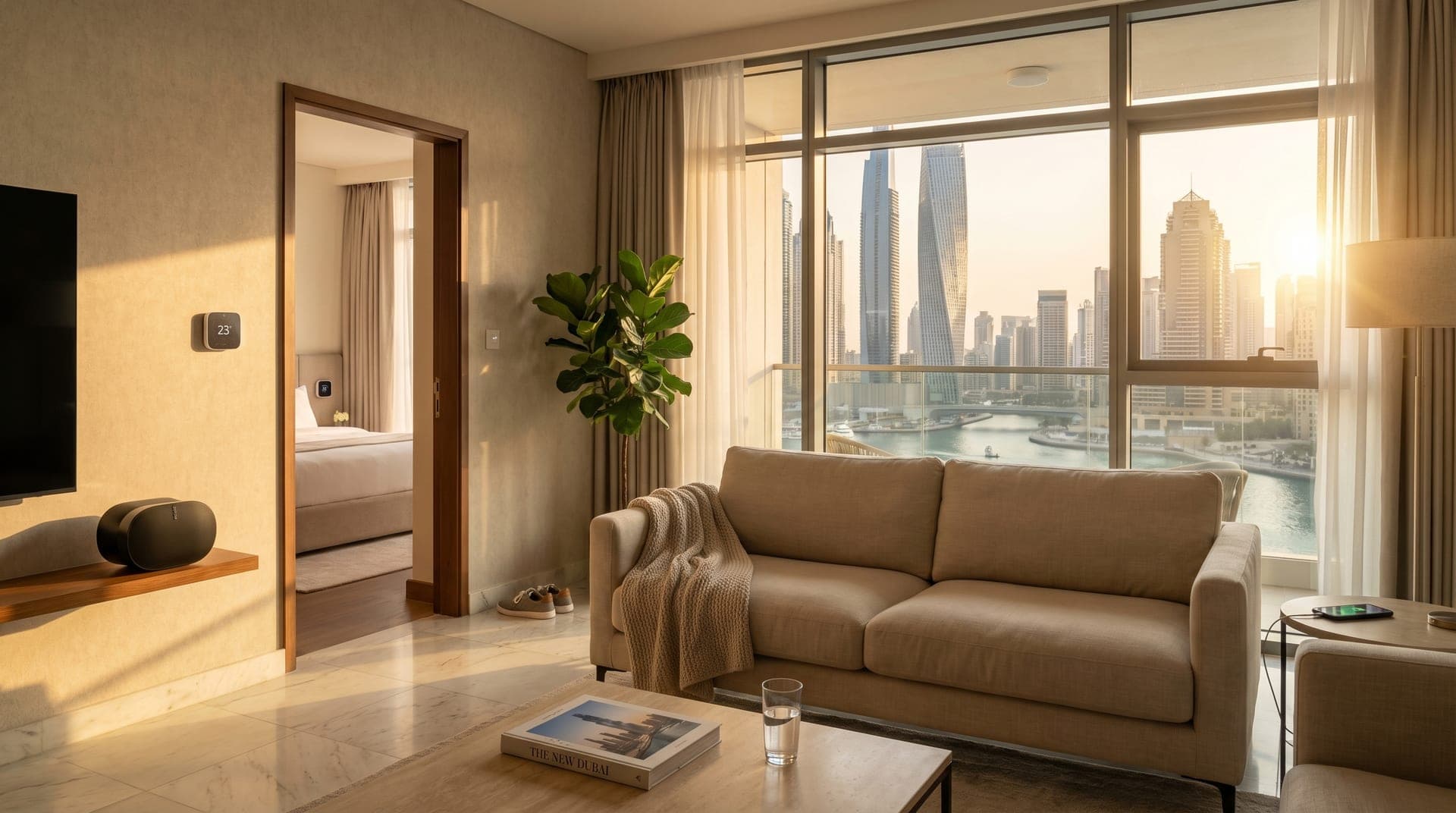
How Big Is the Temperature Difference Between Rooms in a Dubai Apartment?
In a typical 2-bedroom Dubai apartment during summer, the difference between the coolest and warmest room can reach 4-8 degrees. We've measured this across surveys in Business Bay, Dubai Marina, and JBR. A north-facing bedroom might sit comfortably at 23 degrees while the west-facing living room reads 29, even with the same AC system running all day. These gaps exist because of sun exposure, floor materials, ceiling height, and how your building handles heat, not because your AC is broken.
Most people respond by setting the thermostat lower and running the AC harder everywhere. That approach costs you money without fixing the root cause. Zone control gives each room its own temperature target so you stop freezing the bedroom to make the living room bearable.
TL;DR: Dubai apartments commonly see 4-8 degree temperature gaps between rooms due to sun orientation, thermal mass, and uneven duct distribution. Smart AC zone control addresses each room independently, cutting summer cooling costs by 20-30% and ending the cycle of over-cooling one room to compensate for another. Setups start from AED 3,000 installed with no wiring needed.
Why Are Some Rooms So Much Hotter Than Others?
Three factors combine to create significant temperature variation across your apartment. Understanding each one explains why a single thermostat can never solve the problem.
Sun orientation hits different rooms at different times
Building orientation contributes 16.6% to the variance in cooling loads across a UAE structure (iasks.org, 2024). West-facing rooms take the worst hit because they absorb afternoon sun at peak outdoor temperatures. When we installed smart AC controllers in a Dubai Marina 2-bedroom last summer, the west-facing living room peaked at 31 degrees by 3PM while the east-facing bedroom held steady at 24. Same apartment, same AC system, seven degrees apart.
North-facing rooms stay the coolest year-round. South and west exposures carry the heaviest cooling burden. If your apartment wraps around a corner with mixed orientations, you're dealing with rooms that behave like they belong in different climate zones.
Thermal mass turns your walls into heaters
Dubai apartments are built with concrete walls and marble floors. These dense materials absorb solar energy all morning and release it hours later, a process called thermal lag. A concrete wall can delay heat transfer by 4-12 hours depending on thickness (The Concrete Centre, 2025). In practical terms, the sun that hits your wall at 10AM starts warming the room's interior around 2PM. Your AC fights this stored heat on top of the current outdoor temperature.
In our experience, we consistently measure a 3-5 degree difference between air temperature and sun-exposed wall surface temperature at 3PM in Dubai apartments. Your AC cools the air, but the walls radiate heat right back. This is why rooms feel stuffy even when the thermostat reads a reasonable number.
Ductwork distribution wasn't designed for your life
Most apartment AC systems use a single thermostat and one set of ducts split across all rooms. The thermostat sits in the hallway or living room, reads that single temperature, and decides for the entire apartment. If the hallway is 24 degrees, the system is satisfied. It doesn't know your bedroom is 27 or the guest room is 20 because nobody opened the blinds.
What we've found is that older Dubai buildings, especially those built before 2010, often have poorly balanced duct systems where 60% of the cooling capacity goes to the living area and 40% splits between bedrooms. Some rooms get too much cold air, others not enough. You can't fix this with a single thermostat.
What Is Smart AC Zone Control?
Smart AC zone control gives each room its own temperature sensor and control point. Instead of one thermostat deciding for the whole apartment, each room communicates its actual temperature and adjusts its cooling independently. You set the living room to 23 and the bedroom to 22, and each room maintains its target without affecting the other.
For split AC apartments (common in older towers in Downtown, JBR, and Business Bay), zone control means placing a wireless IR controller on each indoor unit. Each controller reads the room temperature, adjusts the AC output, and reports back to a single app. You already have the infrastructure for zone control because each room has its own split unit.
For centralized or district cooling apartments (common in newer Dubai Marina and Business Bay towers), zone control works through smart thermostats on each fan coil unit, plus motorized dampers in the ductwork that open and close to direct airflow where it's needed. This is a more involved setup, but the energy savings are proportionally larger because you're controlling one shared system more intelligently.
How Much Can Zone Control Save on Your DEWA Bill?
Zoned heating and cooling reduces energy consumption by up to 30% depending on apartment size and usage patterns (U.S. Department of Energy, 2025). In a Dubai 2-bedroom where summer DEWA bills run AED 800-1,200 per month (Khaleej Times, 2025), that translates to AED 160-360 saved per month during the four peak months.
The savings come from two places. First, you stop cooling rooms nobody is in. A guest bedroom running at 22 degrees while you're at work costs roughly AED 120 per month for nothing. Second, you stop over-cooling the whole apartment to compensate for one hot room. When the living room is the problem, zone control fixes the living room. Without it, you drop the entire system to 20 degrees and freeze the bedroom to make the living room tolerable.
Air conditioning accounts for 60-70% of total electricity consumption during peak months in Dubai (SolarisKit, 2024). Each degree below DEWA's recommended 24 degrees increases energy consumption by 4-5% (DEWA, 2025). Zone control lets you keep the bedroom at 22 for sleeping without dragging the entire apartment to 22.
Can Renters Install Zone Control Without Landlord Approval?
Yes. Wireless smart AC controllers sit on the wall with adhesive tape, connect to your WiFi, and communicate with your AC via infrared, the same technology as your existing remote control. No drilling, no wiring, no modifications to the unit. You take them with you when you move.
For a split AC apartment, you need one controller per unit. A 2-bedroom typically has 3-4 split units (living room, master bedroom, second bedroom, sometimes kitchen). Each controller costs from AED 800 installed, meaning a full apartment zone control setup starts from approximately AED 3,000 for three rooms.
If you're renting in JBR or Dubai Marina, these controllers need no landlord permission because they don't touch the AC hardware. They replace your existing remote control with something that has a brain. After setting up smart AC control, every room runs its own schedule, turns off when you leave, and pre-cools before you get home.
What Does a Zone Control Setup Look Like Room by Room?
Here's how zone control plays out in a typical Dubai 2-bedroom apartment, based on setups we've done across Dubai Hills, Arabian Ranches, and Marina.
Living room (west or south-facing)
The hardest room to cool and the one where zone control makes the biggest difference. Set the target to 23 degrees during occupied hours, 28 degrees when empty. Schedule pre-cooling to start 30 minutes before you usually get home from work. Pair with motorized blinds that close automatically between 1PM and 5PM to cut solar heat gain by 40-60% before the AC has to compensate for it.
Master bedroom
Keep at 22 degrees for sleeping comfort between 10PM and 7AM. Raise to 26 during the day when nobody's in the room. If you work from the bedroom, add a weekday schedule that maintains 23 during work hours. This single automation, raising the bedroom temperature by 4 degrees during 10 empty daytime hours, saves approximately AED 50-80 per month on that room's cooling alone.
Guest bedroom or second bedroom
The biggest source of wasted cooling in most apartments. Guest bedrooms often run at the same temperature as the rest of the apartment 24 hours a day, seven days a week, whether anyone is sleeping there or not. Set a baseline of 28-30 degrees (enough to prevent humidity buildup) and drop to 22 only when you have guests. For rooms that double as home offices, schedule cooling during work hours only.
Kitchen and entrance
If your kitchen has its own split unit, set it 2 degrees warmer than the living area. Cooking generates heat that the AC will fight regardless, and the kitchen is typically occupied for short periods. The entrance hallway rarely needs active cooling below 26 degrees.
Does Zone Control Work With District Cooling?
Yes, but the setup is different. District cooling apartments (common in newer Business Bay, Marina, and Palm Jumeirah towers) don't have individual split units in each room. They have fan coil units connected to a centralized chilled water system from Empower or Tabreed.
Smart thermostats designed for fan coil units replace the basic dial thermostat on the wall. Each room gets its own smart thermostat that controls the fan speed and water valve position, adjusting how much chilled water flows through that room's coil. The result is the same: independent temperature control per room, schedules, and remote access.
One thing clients always ask about district cooling is whether zone control actually reduces their chiller bill. The answer is yes, because Empower and Tabreed charge based on consumption (measured in Refrigeration Ton-hours), not flat rate. When you reduce cooling in unused rooms, your consumption drops and the bill follows. Typical consumption charges run approximately AED 0.568 per RT-hour (Dubai Realty Trends, 2025).
What About Rooms That Stay Hot No Matter What?
Some rooms resist cooling because the problem is heat gain, not insufficient AC. Zone control helps, but combining it with other measures eliminates the problem entirely.
A related case is the room that no longer needs cooling at all, because nobody is in it. In a home where the children have moved out, zone control is what stops you paying to cool bedrooms that stay shut, and we cover that setup in smart home for Dubai empty-nesters.
Motorized blinds scheduled to close before peak sun hours block direct solar gain through windows. This single automation reduces the heat load your AC has to fight by 40-60%, which means the AC reaches your target temperature faster and cycles less.
Smart lighting matters more than you'd expect. Halogen and older CFL bulbs produce substantial heat. A living room with six halogen downlights generates the equivalent thermal output of a small space heater. Switching to LED and automating lights to turn off in empty rooms removes that heat source entirely.
After setting up zone control, blinds automation, and LED lighting in a 3-bedroom Dubai Hills villa, we measured a 6-degree reduction in the living room peak temperature compared to the previous summer. The homeowner's DEWA bill dropped from AED 2,100 to AED 1,450 in July, a 31% reduction.
Frequently Asked Questions
How many degrees can vary between rooms in a Dubai apartment?
During summer, we typically measure 4-8 degrees between the coolest and warmest rooms. The biggest gaps occur between north-facing bedrooms and west-facing living rooms in the afternoon. Older buildings with single-zone AC systems and poor duct balancing tend to show the widest differences.
Does zone control work with any AC brand?
Wireless smart AC controllers work with any split AC unit that has an infrared remote control, regardless of brand or age. They learn your remote's signal codes during setup. For centralized systems, compatibility depends on the thermostat interface, but most fan coil units in Dubai accept standard smart thermostats.
Can I install zone control myself or do I need a professional?
Single-room smart AC controllers are straightforward to install yourself. They mount with adhesive and connect via WiFi. A full multi-room zone control setup with coordinated schedules, automation rules, and integration with blinds or lighting works better with professional configuration. We handle the full setup, testing, and training for every user in the household.
How quickly does zone control pay for itself?
A 3-room zone control setup starting from AED 3,000 typically saves AED 200-400 per month during Dubai's four peak summer months (June-September). That's AED 800-1,600 in savings during the first summer alone. Most setups pay for themselves within the first summer or early into the second.
Will zone control make my apartment feel drafty or inconsistent?
No. Zone control maintains your chosen temperature more consistently than a single-thermostat setup because each room responds to its own conditions. Without zone control, the bedroom over-cools while the living room under-cools. With it, both rooms hold their individual targets within 1-2 degrees.
Your Apartment Has Different Climates. It Should Have Different Controls.
Every Dubai apartment is a collection of microclimates. The bedroom faces north, the living room faces west, the guest room sits in shadow all day. Treating them all the same wastes energy and leaves someone uncomfortable.
Zone control matches each room's cooling to its actual conditions. The result is lower DEWA bills, consistent comfort in every room, and an AC system that works with your apartment's layout instead of against it.
The uneven cooling covered here is a physical problem, sun exposure and duct balancing. When a household spans three generations under one roof, the differences between rooms are physiological too. See how that changes the setup in smart home for a multi-generational Dubai household.
Get a free consultation and we'll tell you exactly which rooms in your apartment need independent control, what the setup involves, and what it costs. No obligation, no surprises.
Ready to Get Started?
Get a free consultation and we'll recommend what makes sense for your situation.
Get Free Consultation