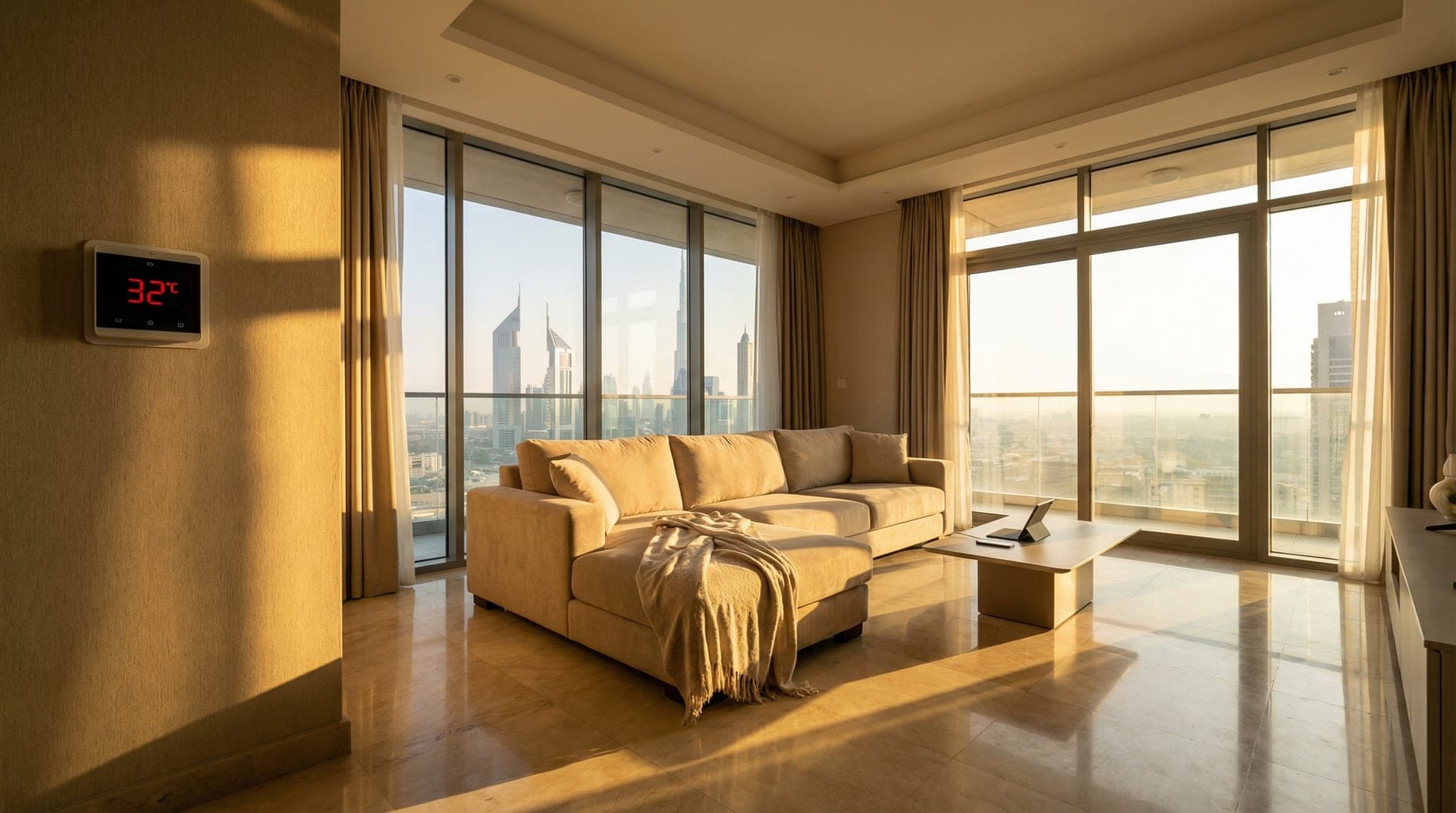
The sun is highest at noon. Your apartment is hottest at 3.
You've probably noticed this without knowing why. The morning feels manageable. You leave for work and the apartment is warm but fine. By lunchtime, the sun is directly overhead. But the real heat, the kind that turns your sofa into a radiator and makes the bedroom wall warm to the touch, that doesn't hit until 2:30 or 3PM.
This isn't random. It's physics. And once you understand why it happens, you can stop it from happening.
TL;DR: Your Dubai apartment hits peak indoor temperature around 3PM because concrete, marble, and glass absorb solar heat all morning and release it with a 2-4 hour delay. This thermal lag means your AC fights the hardest between 2PM and 5PM. Pre-cooling with a smart AC schedule starting at 1:30PM keeps the apartment comfortable and cuts DEWA costs by avoiding the emergency blast later.
Why Does Peak Heat Come 2 Hours After Peak Sun?
The hottest outdoor temperature typically falls between 3PM and 5PM, not at solar noon when the sun is highest (Penn State METEO, 2025). This happens because the earth absorbs more energy than it radiates back for several hours after noon. Temperature only peaks once the outgoing energy matches the incoming energy, and that balance point lands in the mid-afternoon.
Inside your apartment, the effect is even more pronounced. Your building is made of concrete, which has high thermal mass. Thermal mass describes a material's ability to absorb, store, and release heat slowly. The thermal lag through a concrete wall ranges from 4 to 12 hours depending on thickness (The Concrete Centre, 2025). In practical terms, the morning sun that hits your east-facing wall at 8AM starts warming the interior surface around noon. The afternoon sun hitting your west-facing wall at 1PM pushes indoor temperatures highest by 3PM.
What Is Thermal Mass and Why Does Dubai Make It Worse?
Thermal mass is the rate at which a material absorbs and re-releases heat. Dense materials like concrete, marble, and glass have high thermal mass, which means they soak up heat slowly and hold onto it for hours (Wikipedia - Thermal Lag, 2025). In cold climates, this is a benefit. Buildings stay warm longer after sunset. In Dubai, where outdoor temperatures push 40-48 degrees for four months, high thermal mass works against you.
Your apartment is a thermal battery. The concrete walls, marble floors, stone countertops, and floor-to-ceiling windows all charge up with solar energy through the morning and early afternoon. By 3PM, every surface in the apartment is radiating stored heat back into the room. When we survey apartments in Dubai Marina and Business Bay, we consistently measure a 3-5 degree difference between the air temperature and the surface temperature of sun-exposed walls at 3PM. Your AC cools the air, but the walls keep warming it back up.
How Much Does This Afternoon Spike Cost You?
Air conditioning accounts for 60-70% of a typical Dubai apartment's electricity during summer months (SolarisKit, 2024). The 2PM-5PM window is the most expensive part of your cooling day because your AC compressor runs at maximum capacity for three straight hours while fighting stored heat from every surface.
DEWA uses a progressive slab tariff that charges more per kilowatt-hour as your consumption increases (DEWA, 2026). The first 2,000 kWh costs 23 fils each. From 2,001-4,000 kWh, you pay 28 fils. Cross 4,000 kWh and you're at 32 fils, and above 6,000 kWh you hit 38 fils per unit. A 2-bedroom apartment running AC at full load every afternoon through July easily pushes into the third or fourth slab, which means the most energy-intensive hours of your day are also the most expensive per unit.
The average summer DEWA bill for a 2-bedroom apartment in Dubai runs AED 800-1,200 between May and September, compared to AED 400-500 in winter (Khaleej Times, 2025). A significant chunk of that difference comes from the afternoon heat spike your building has been storing all morning.
Why Does Your AC Struggle Most Between 2PM and 5PM?
Your AC doesn't cool faster when you set it lower. The compressor runs at the same speed whether you set 18 or 24. DEWA recommends 24 degrees, and each degree below that increases energy consumption by 4-5% (DEWA, 2025). At 3PM, when stored heat is radiating out of every wall and the outdoor temperature is still above 40, your AC has to overcome both the ambient heat gain through windows and the delayed heat release from the building itself.
In our experience, west-facing apartments in JBR and Palm Jumeirah are the worst hit. The afternoon sun comes in at a low angle, bypasses any overhead shading, and hits the floor directly. That solar energy gets absorbed by the marble and concrete below, and the room temperature keeps climbing even as outdoor temperatures start dropping after 4PM. One client in a west-facing JBR 2-bedroom told us the living room thermostat would read 34 degrees at 3:30PM despite the AC running since morning. The AC was cooling the air, but the floor and walls were heating it right back.
Can Blinds and Curtains Fix the 3PM Problem?
Partially. Motorized blinds that close automatically before the sun reaches your windows can reduce solar heat gain by 40-60%. That's significant. If the sun never hits the marble floor, the floor stores less heat, and the 3PM spike is smaller.
But blinds only address direct solar gain through windows. They don't stop heat conducting through concrete walls and the building structure itself. Even with blinds closed, the exterior walls of your building absorb heat and transfer it inward over hours. Blinds cut the peak, but the thermal lag from the structure still pushes afternoon temperatures higher than morning temperatures.
The most effective approach combines automated blinds with smart AC scheduling. The blinds reduce how much heat enters, and the AC schedule handles the heat that gets through anyway.
What Is Pre-Cooling and Why Should It Start at 1:30PM?
Pre-cooling means running your AC before the peak heat arrives, so the apartment never reaches the temperature spike in the first place. A smart AC controller connects to your existing split unit and lets you build schedules from your phone.
Research from the California Energy Commission found that pre-cooling strategies in residential buildings reduced energy costs by 28-51% on hot summer days compared to reactive cooling (ScienceDirect, 2020). The principle is simple: it takes less energy to maintain a temperature than to recover from a spike.
Starting your AC at 1:30PM, about 30-60 minutes before the thermal lag catches up, keeps the indoor temperature steady at 24 degrees through the entire afternoon. The compressor runs at moderate, efficient load instead of hitting maximum capacity at 3PM and staying there until 5PM. What we've found with clients across Downtown Dubai and Dubai Hills is that the total electricity used by a 1:30PM pre-cool is less than a reactive blast at 3PM, because the compressor never enters full-load emergency mode.
Does Pre-Cooling Work for Renters?
Yes. Smart AC controllers are wireless devices that work with any split AC that has a remote control, regardless of brand or age. No wiring, no drilling, no landlord approval. You plug it in, connect it to WiFi, and set your schedule. The controller sends the same infrared signals your remote does, so your AC unit doesn't know the difference.
Setup takes about 15 minutes. Most people set a pre-cool schedule for the afternoon and a separate one for the evening arrival. When you move apartments, the controller comes with you. We cover this in detail in Smart AC for Renters: No Landlord Approval Needed.
The ENERGY STAR program reports that smart thermostats save an average of 8% on heating and cooling bills (ENERGY STAR, 2025). In Dubai, where cooling dominates your bill and runs 18 hours a day in peak summer, the percentage savings tend to be higher because there's more waste to eliminate. Our clients typically see 20-30% DEWA reductions after adding smart AC scheduling. On a summer bill of AED 1,000, that's AED 200-300 back every month.
What Does a 3PM-Optimized AC Schedule Look Like?
Here's the schedule we recommend for a Dubai apartment with afternoon sun exposure:
Morning (Sunday-Thursday):
- 6:00AM: AC on at 24 degrees
- 7:30AM: Temperature shifts to 28 degrees as you leave
- 8:00AM: AC off
Afternoon pre-cool:
- 1:30PM: AC on at 25 degrees (gentle pre-cool before the thermal lag catches up)
- 2:30PM: Temperature shifts to 24 degrees (full comfort before peak heat)
Evening:
- 5:30PM: Temperature holds at 24 degrees (you arrive to a cool apartment)
- 10:30PM: Temperature shifts to 26 degrees (sleep mode)
The 1:30PM start catches the thermal lag before it peaks. By the time the walls start dumping their stored heat at 3PM, the apartment is already cool and the AC is running at a steady, efficient pace. Compare this to the alternative: you come home at 6PM, the apartment has been baking since noon with no AC, and you blast it to 18. That reactive approach uses more electricity, takes longer, and costs more on your DEWA bill. We broke down the full cost comparison in What Happens to Your DEWA Bill When You Add Smart AC Scheduling.
Frequently Asked Questions
Why is my apartment hotter at 3PM than at noon?
Concrete, marble, and glass in your building absorb solar heat through the morning and release it with a 2-4 hour delay. This thermal lag means your indoor temperature peaks 2-4 hours after the sun is highest. The building structure acts as a thermal battery that charges all morning and discharges in the afternoon.
Does turning AC on earlier use more electricity?
Running the AC from 1:30PM at 24 degrees uses less total electricity than starting at 3PM or later and blasting to 18. A moderate pre-cool avoids the compressor running at maximum load for hours. Pre-cooling strategies reduce energy costs by 28-51% compared to reactive cooling on hot days.
Do smart AC controllers work with my existing AC unit?
Yes. Smart controllers work with any split AC that uses a remote control, regardless of brand, model, or age. They send the same infrared signals your remote does. No wiring or modification needed, and renters can install them without landlord approval.
How much can a pre-cooling schedule save on my DEWA bill?
Most clients see a 20-30% reduction in summer DEWA costs after adding smart AC scheduling. For a summer bill of AED 1,000, that translates to AED 200-300 saved each month. The savings come from the AC running at steady, efficient loads instead of emergency max-capacity sprints.
Which apartment orientations are worst for the 3PM heat spike?
West-facing apartments get hit hardest. The afternoon sun enters at a low angle that bypasses overhead shading and heats floors directly. South-facing apartments with floor-to-ceiling windows are a close second. East-facing units have cooler afternoons since their direct sun exposure is in the morning.
Stop the Spike Before It Starts
The 3PM problem is built into your building. Concrete walls and marble floors will keep storing and releasing heat every single afternoon from April through September, and the effect is at its sharpest during Jamrat Al Qayth, the hottest 40 days of the year. You can fight it every day with reactive blasts and higher DEWA bills, or you can get ahead of it with a schedule that pre-cools before the thermal lag catches up.
A smart AC setup starts from AED 3,000 installed, including the controller, configuration, and app setup. Tell us about your apartment and we'll recommend the right schedule for your layout and sun exposure. Free consultation, no obligation.
Ready to Get Started?
Get a free consultation and we'll recommend what makes sense for your situation.
Get Free Consultation