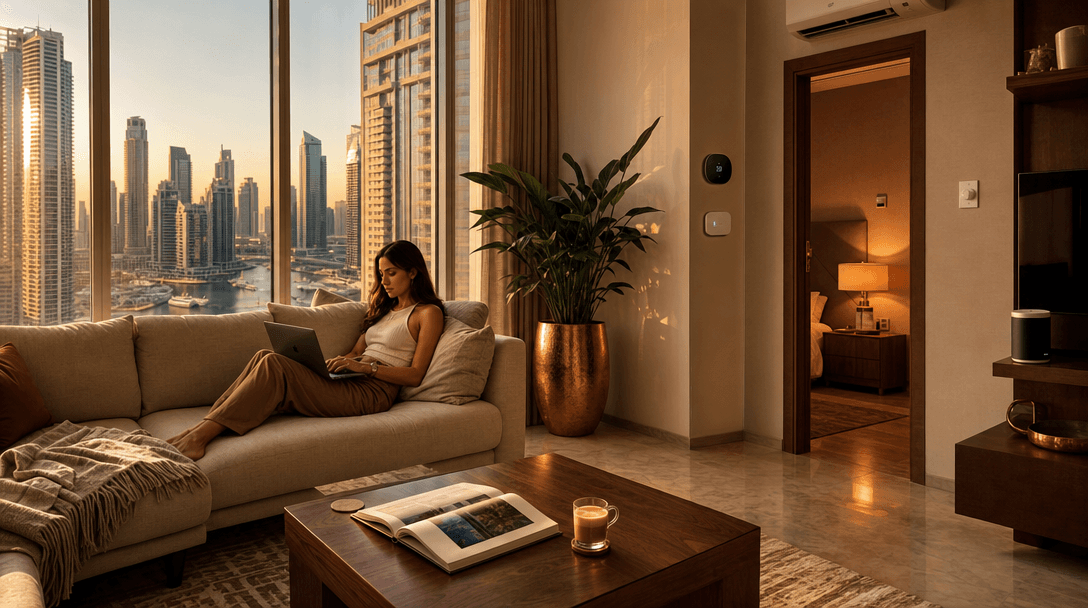
Global Village closes Sunday. Schools are halfway through a remote-learning week. The first 41C afternoon already landed, and your AC is starting to run the long shifts it will run until October.
For the next six months, your apartment is your life. It's your office between calls. It's your kids' afternoon, every afternoon. It's where you eat, host, work out, and recover from going outside. From May through October, Dubai families spend what the data describes as "four to five months where outdoor life becomes largely inaccessible during daylight hours" (Pearlshire, 2026). The mall is the park. The living room is the playground. The kitchen is where everyone ends up by 8pm because nobody wants to be near a window.
That's a lot of pressure on a space that, in most apartments, is still being managed with a remote control and a guess.
TL;DR: From May to October, Dubai apartments run AC 12-18 hours a day across rooms that cool unevenly. A smart AC setup (controller + schedule + geofencing + per-room targets) costs AED 1,500-3,500 installed, cuts the worst surprises out of your DEWA bill, and stops the 4pm "why is it 28 degrees in the bedroom" arguments. The goal isn't savings. It's making 6 months indoors actually bearable.
What "the indoor season" actually looks like
The numbers are blunt. By June, afternoon temperatures across Dubai sit between 41°C and 43°C, with overnight lows around 26-29°C (Gulf News, 2026). Most Dubai homes from April through October run their AC eight or more hours a day, and many run it nonstop through the worst weeks (Pearlshire, 2026).
Inside a Marina or Business Bay tower, that translates to a few specific frustrations everyone recognises. The bedroom is 22 degrees and the living room is 28. Whoever wakes up first sets the AC at 18 and forgets about it. By 4pm the kitchen feels like a different climate from the bedroom because of one west-facing window. The AC was off all day, you walk in at 6:30, and the apartment takes 45 minutes to feel like a place again.
In our experience surveying apartments across Dubai Marina, Downtown, and Business Bay, the same pattern shows up almost every time: a perfectly good split AC controlled with an old remote and a habit. The hardware works fine. The control layer doesn't exist.
What a smart AC setup actually changes
A smart AC controller sits in front of your existing split unit. No replacement, no rewiring, no landlord conversation in a rental. It learns the IR codes from your remote and gives you four things the remote cannot: a schedule, a phone, a sensor, and the ability to talk to the rest of your home.
WiFi-connected AC controllers save 15-30% on cooling costs through scheduling, geofencing, and automated temperature rules (Sensibo, 2026). In a Dubai summer, on a 2-bedroom apartment averaging 700-900 kWh a month from cooling alone, that's a real number. But that's the side effect. The reason to do it is that the setup ends the manual scrambling you do twelve times a day from May to October. If you are deciding what to set up before the heat peaks, our guide to what to upgrade during Dubai Summer Surprises covers the order to do it in, and what to skip.
The four parts of the setup, in the order they pay back:
1. The controller. A Sensibo Air or Tado V3+ runs AED 750-1,100 per zone. Plug it in, connect it to your WiFi, point your phone at it, and your AC now lives on a schedule. Two-zone setup for a typical 2-bedroom: AED 1,500-2,200.
2. The schedule. Pre-cool the bedroom from 5pm so it's at 23 by the time you walk in. Drop the living room to 22 from 6:30pm to 11pm. Step the bedroom up to 24 overnight (most people sleep better at 24 than 18, and the compressor stops short-cycling). This single change tends to do most of the work — the rest is fine-tuning.
3. Geofencing. When the last phone leaves the building's geofence, AC goes to 26. When the first phone re-enters from work or school pickup, the apartment starts cooling 10 minutes before anyone arrives. You stop coming home to a hot box. You also stop running the AC for an empty apartment, which is what the 9pm DEWA-bill-shock emails on Reddit are usually about.
4. The room sensor. A AED 100-200 temperature sensor in the room that lies (the one with the west window, or the one furthest from the AC unit) gives you the actual ground-truth temperature. The schedule then runs against the room, not against the AC's own sensor sitting in the cold air right next to it.
After setting up dozens of these, the conversation we have with clients in October is consistent. They don't talk about the bill. They talk about not thinking about the AC anymore.
Pre-cooling: the one habit that fixes the 6:30pm scramble
The single biggest win in any Dubai summer setup is pre-cooling, and the reason most people don't do it is that it requires a schedule, not a remote.
Here's the physics. Your apartment's walls, marble floors, and concrete slab absorb heat all day. By the time the sun sets, those surfaces are radiating that heat back into the room for hours. If you turn the AC on at 6:30pm, you're not cooling air. You're cooling a few thousand kilograms of warm marble. That's why the apartment takes 45 minutes to feel right.
Pre-cooling flips the problem. You start the AC at 5pm at 22 degrees in the bedroom and 5:30pm at 22 in the living room. By 6:30pm, the surfaces are already cool. When you walk in, the AC has nothing left to fight. It cycles down to maintenance mode and stays there.
What we've found is that families with kids see the biggest behaviour change here. The 6:30pm "everyone's hot, everyone's annoyed, baby won't settle" window just disappears. The room is already 22 when the door opens.
Zone control: the fix for the bedroom-vs-living-room gap
Every Dubai apartment has at least one room that cools differently from the rest. Usually it's the room with the most glass, or the one furthest from the AC's air handler, or the kitchen because of cooking heat. The standard response is to drop the central setpoint by two or three degrees and freeze the rest of the apartment to keep one room comfortable.
Smart AC controllers paired with per-room temperature sensors fix this without overcooling everywhere else. The schedule reads the actual room temperature and adjusts the AC output to hit a target in that room specifically. Bedroom target 23, living room target 24, both met independently.
For families on a school-from-home week, this matters more than usual. The kid doing online lessons in a corner of the bedroom needs that room steady at 23. The parent on calls in the living room wants 24 and quiet. Both are happening at the same time on the same day, and a single setpoint can't serve both.
When we installed a two-zone setup in a JBR 2-bedroom this April, the family reported the first thing they noticed wasn't the bill — it was that the kids' room and the master bedroom finally agreed on a temperature.
Smart AC and your DEWA bill: the honest version
Smart AC is not primarily a savings product. We say that everywhere. But in May 2026, with the El Nino summer projected and the fuel surcharge holding at roughly AED 0.065 per kWh on top of the slab tariff (23 fils up to 2,000 kWh, then 28, 32, and 38 fils as you climb the slabs), savings happen anyway as a side effect (DEWA, 2026).
Here's the math on a typical Business Bay or Marina 2-bedroom that pushes 1,800-2,400 kWh in July without smart control. Pre-cooling instead of after-cooling cuts cycling losses. Geofencing eliminates 1-2 hours a day of empty-apartment cooling. Per-room targets remove 1-2 degrees of overcooling. Together, that's 12-20% off the cooling load.
On an 1,800 kWh month at the second-slab tariff plus surcharge, that's roughly AED 95-160 saved per month from June through September. AED 400-650 across the four worst months. The setup covers its install cost inside one summer, and from there it just runs.
Residents keeping AC at 20°C year-round spend AED 18,000-24,000 annually, while those adapting seasonally spend AED 12,000-16,000 (Pearlshire, 2026). Smart control is the cheapest way to land in the second group without thinking about it every day.
The 20-minute installation order for May
If you're starting from zero and the first 41C day already happened, the order to tackle this in:
Day 1 (this week). Buy one AED 750-1,100 smart AC controller for the most-used room (usually the bedroom or the main living area). Plug it in, install the app, connect to WiFi. Set up two schedules: a weekday schedule that pre-cools from 5pm and a weekend schedule that pre-cools from 4pm. This is 20 minutes of setup and it covers the worst hour of the day from June onwards.
Week 2. Add a second controller for the other most-used zone. Now both your bedroom and your living room are running on schedules instead of remotes.
Week 3. Add a temperature sensor in the room that always feels off. Tie it to the controller for that zone. The schedule now reads the actual room, not the AC's sensor.
Week 4 (optional). Add geofencing using your phone's location. The AC now adjusts itself based on whether anyone's home, with no input from you. For what a fully-set-up indoor-season apartment feels like across a long stretch at home, see our 3-day Hijri weekend walkthrough.
That's a four-week build that lands you in mid-June with a system that handles the worst three months on autopilot. Total install: AED 1,500 to 3,500 depending on whether you go with two zones or three, with or without sensors, controller-only or fully integrated.
What this looks like for renters
None of this requires landlord approval. None of this involves wiring. The controllers plug into a power socket and use IR to talk to your existing AC. The sensors are battery-powered and adhesive. The whole setup unplugs and goes with you when your lease ends.
We've covered the renter playbook in detail in our guide to summer DEWA bills for renters, and most of what's there applies here. The short version: a portable smart AC setup is one of the few smart home upgrades that actually makes financial sense over a 2-3 year rental, because the hardware moves with you and the savings start the same week.
Where this fits in a wider smart home
Smart AC is the entry point for almost every Dubai household, and there's a reason for that. It's the system everyone in the home interacts with most, the one that costs the most to run wrong, and the one whose problems get worse the longer summer runs.
It also happens to be the foundation that makes everything else worth adding. Once your AC is on a schedule, motorized blinds on the west-facing windows close at 1pm to cut the solar heat gain that's otherwise spiking your AC load. Smart lighting drops to evening warm tones at the same time the AC steps to night mode. Whole-home automation just becomes "the apartment knowing what time it is and what we want."
The order matters: AC first, blinds second, lighting third. Each layer makes the previous layer work better.
Frequently Asked Questions
Will a smart AC controller work with my existing split AC in Dubai?
Yes, in nearly every case. Smart AC controllers like Sensibo, Tado, and Aqara work with any split AC that has an infrared remote, regardless of brand or model year. The controller learns the codes from your remote during setup. We've installed these on AC units from Carrier, Daikin, Gree, LG, Samsung, and General — all the major brands sold in Dubai. The only ACs that need a different approach are central FCU systems in some villas, which use a different control standard.
How much does a smart AC setup cost for a Dubai apartment?
A single-zone smart AC controller costs AED 750-1,100 installed, depending on the brand and whether you add a separate room sensor. A typical 2-bedroom 2-zone setup runs AED 1,500-2,200. A larger 3-bedroom apartment with three zones and per-room sensors lands at AED 2,500-3,500. Whole-villa setups with central thermostats cost more and need a survey. There are no monthly fees for the basic features.
Does smart AC really save money on my DEWA bill?
In a Dubai summer, yes — typically 12-20% off cooling costs through scheduling, geofencing, and zone targeting (Sensibo, 2026). On a 2-bedroom apartment running 1,800-2,400 kWh a month in July and August, that translates to AED 95-160 in monthly savings during the worst months. The savings come from eliminating overcooling (running the AC at 20 when 23 would be fine) and ending empty-apartment cooling (geofencing). Savings are not the headline reason to install this, but they cover the system inside one summer.
What temperature should I keep my AC at in a Dubai summer?
DEWA recommends 24°C as a balance between comfort and efficiency. We tell clients 23 in the bedroom, 24 in the living room, 25-26 when nobody's home, and 24 overnight while sleeping. Every degree below 24 adds roughly 6-8% to your cooling load. Most apartments that complain about high bills are running at 20-21 around the clock without realising it. A smart controller makes the right setpoints automatic.
Do I need new AC units to use smart features in my Dubai apartment?
No. The whole point of smart AC controllers is that they work with the equipment you already have. The controller is a small box that plugs into a power socket, connects to your WiFi, and talks to your AC the same way your remote does. Your AC stays exactly the same. The controller just sits in front of it and runs schedules, reads sensors, and listens to your phone or voice assistant.
If you've been away and are returning to your apartment, read what three weeks of summer does to an empty Dubai apartment - and how a smart setup handles the return.
Six months is a long time to be uncomfortable
The honest reason to build this setup right now isn't the DEWA bill. It's that you're about to spend the next half-year mostly indoors. The apartment doing its job — quietly, on its own, without anyone fiddling with a remote at 6:30pm — is what makes 6 months indoors not feel like 6 months indoors.
Bayora installs and tunes smart AC setups across Dubai, from single-zone renter-friendly upgrades to full multi-zone integrations with blinds and lighting. Every project starts with a free survey of your apartment, your AC layout, and your routines.
Want to know what this would look like for your place? Get a free consultation and we'll walk you through what fits, in writing, with no obligation.
Ready to Get Started?
Get a free consultation and we'll recommend what makes sense for your situation.
Get Free Consultation