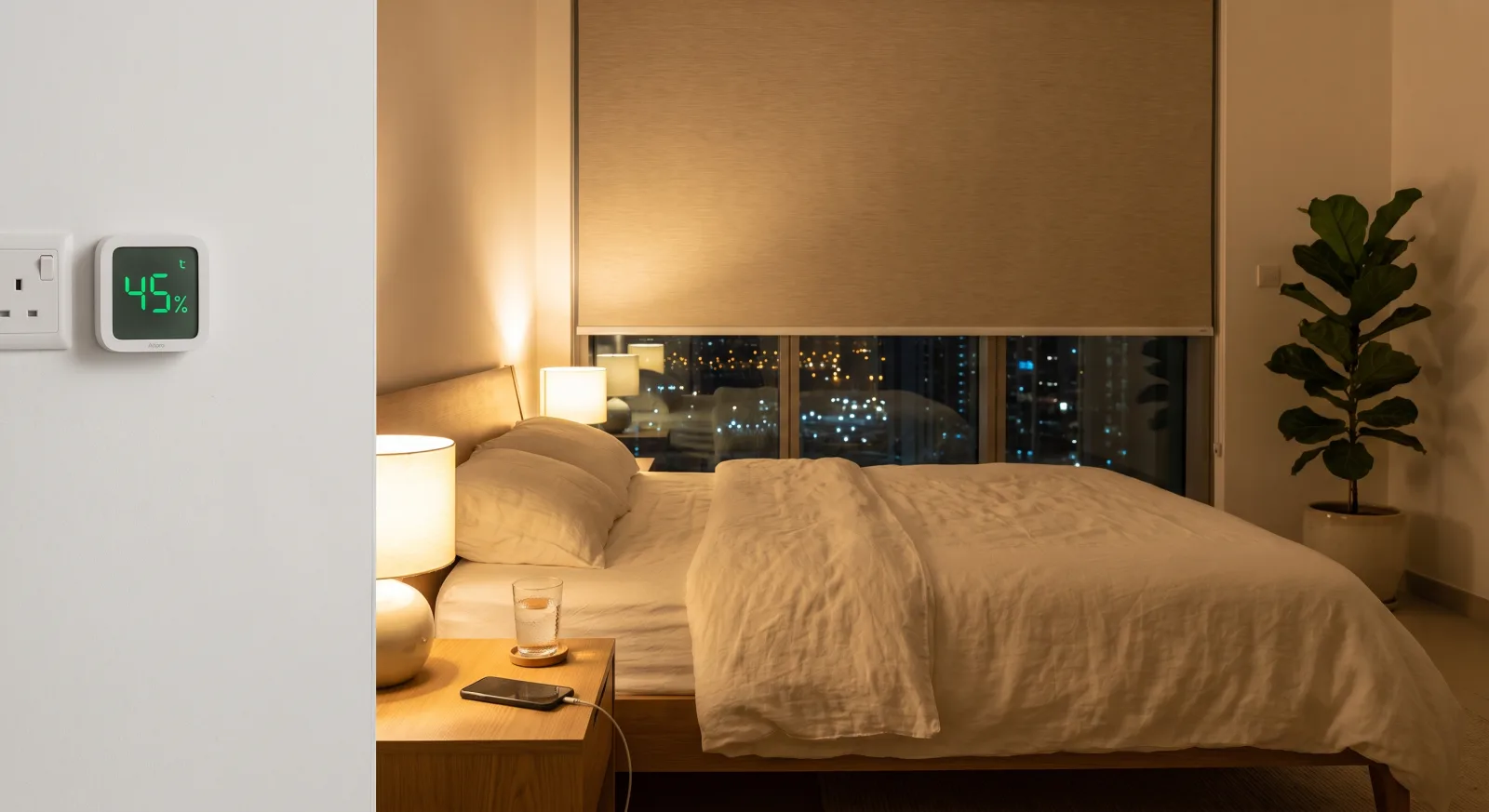
You wake up at 3am in a Business Bay apartment and something feels off. The AC is running. The temperature is fine. But the air feels heavy - dense in a way that the thermostat reading does not explain.
That is humidity. And from July through September, it is the second problem in a Dubai summer, after the heat, that most apartments are not set up to handle.
TL;DR: Dubai's coastal overnight humidity hits 80-90% in summer, especially under El Nino conditions (98% probability July-November 2026). Sustained humidity above 60% indoors causes condensation, mold risk, corrosion on smart device contacts, and 15-20% accuracy drift on air sensors. The fix starts with an Aqara humidity sensor (AED 99-110), a Sensibo controller using your AC's dry mode, and a simple automation that kicks in when the reading climbs past 60%. Total renter setup from scratch: AED 696-818.
Dubai's overnight coastal humidity regularly reaches 80-90% in summer months. This year the National Centre of Meteorology has flagged persistently humid nights as a recurring feature through July, with El Nino at a 98% probability of persisting July through November (Gulf News, 2026). The same Gulf News July 2026 forecast named humidity specifically as the key factor that could push the felt heat higher than the thermometer reading suggests (Gulf News, 2026).
Most Dubai apartments are set up to fight the heat. Fewer are set up to fight the moisture.
What Humidity Does Inside a Dubai Apartment
High indoor humidity has three concrete effects on the apartment beyond the obvious discomfort.
Condensation on cold surfaces. When humid air meets a surface cooler than the dew point - a bathroom mirror, a bathroom wall behind pipes, a cold drink left on the counter - condensation forms. Sustained condensation in the same spots leads to surface mold within 24-48 hours. According to a survey of over 2,000 Dubai properties by indoor environment specialists, 73% of mold issues originate from HVAC condensation points rather than visible water damage (Indoor Sciences UAE, 2026). The mold is in the walls before anyone sees it. Condensation is the slow version of a water problem; the sudden version is a burst hose or a failed water heater, which is where smart water-leak detection earns its place.
Sensor drift. Humidity interference causes 15-20% measurement errors in common air quality sensors (Indoor Humidity, 2025). If your AC's built-in sensor is drifting high due to humidity, it may cycle off before the air is properly dehumidified. This is a different problem from the dust and PM2.5 that indoor air quality sensors track, though they often happen in the same room. The room feels cool but heavy. You turn the set point lower. The compressor runs harder. The DEWA bill goes up. Before you touch the set point at all, check the free thing first: the fan speed on the remote changes how much water your AC removes, and most people have it pointing the wrong way.
Corrosion on device contacts. Above 60% indoor humidity sustained over weeks, moisture begins to work into electronics through ventilation slots. Metal contacts corrode slowly. It does not kill devices overnight but it shortens lifespans, particularly on devices that run constantly - smart sensors, hub controllers, cameras in bathrooms or kitchens (Rika Sensor, 2024). The higher-end devices are designed for it. Budget sensors in exposed positions are not.
The Humidity Numbers That Matter
Indoor humidity should stay between 40-55% for comfort and device longevity, according to building environment standards (Indoor Sciences UAE, 2026). Above 60%, condensation risk rises. Above 70%, sustained mold growth becomes likely within 24-48 hours on any persistently cool surface. Those are all room numbers. The figure that decides whether growth starts is the one at the surface, which is why mould turns up on new furniture in a flat the AC never stopped cooling.
Dubai's outdoor overnight humidity in summer typically ranges from 70-90% in coastal areas including Dubai Marina, JBR, Business Bay, and Jumeirah (Climate Dubai - Wikipedia, 2026). In apartments with windows cracked, bathroom ventilation running, or AC cycling off overnight, indoor humidity tracks outdoor humidity closely. The apartment that was 45% humidity at midnight can be 72% by 5am.
In our experience installing in Business Bay and Marina apartments, the readings that surprise people most are overnight ones. Daytime makes sense: AC is running, humidity is down. The 4am readings, when the AC has cycled to a lower-effort mode, are where problems accumulate.
The Three-Level Setup
Level 1: Know Your Numbers (AED 99-110)
An Aqara Temperature and Humidity Sensor gives you temperature accuracy within ±0.3°C and humidity accuracy within ±3%, reading continuously and logging to the Aqara Home app (Aqara, 2026). Place one in the bedroom, one in the bathroom. You will get readings on your phone. Most people are surprised what 4am looks like.
The sensor works standalone via Zigbee with an Aqara hub, or integrates with Home Assistant without any hub. It does not control anything by itself. It tells you what is happening so you can decide what to do about it.
Available from UAE retailers including Sharaf DG and Modo Store for AED 99-110, this is the lowest-cost meaningful addition to a Dubai summer apartment. It works without any other smart home setup.
Level 2: Let Your AC Handle the Humidity (AED 350-450 existing Sensibo + 0 extra)
If you already have a Sensibo Sky or Air Pro on your smart AC control setup, you already have the tool to manage humidity. Most Dubai split AC units have a Dry Mode - a setting that reduces humidity without aggressively lowering temperature. It slows the fan and cycles the compressor in short bursts, pulling moisture from the air while keeping the temperature relatively stable (Sensibo, 2026).
Sensibo can automate this by humidity reading. You set a trigger: when humidity exceeds 60%, switch to Dry Mode. When it drops below 55%, return to Cool or off. You set this once in the Sensibo app. It runs without you touching anything.
This is what we've found makes the most difference for overnight comfort: not a lower temperature set-point, but an automatic shift to Dry Mode at 2am when outdoor humidity is peaking and the AC would otherwise be running Cool when the room is already at 22 degrees.
For a Sensibo-equipped apartment, this costs nothing extra. It takes about four minutes to set up in the app.
Level 3: Add a Dedicated Dehumidifier for Problem Spots (AED 600-1,400)
Some apartments have structural humidity problems that an AC in Dry Mode cannot fix: bathrooms with improperly terminated exhausts venting into ceiling voids, storage rooms with no air circulation, or rooms far from the AC that never get properly conditioned.
For these spots, a portable dehumidifier set to maintain 50-55% handles what the AC cannot reach. Dehumidifiers suited for Dubai conditions should handle ambient temperatures up to 40°C, which eliminates most consumer-grade units. Look for units rated for tropical or high-humidity environments. The Frigidaire 35-pint and the Midea MAD35C1QWT (available from UAE retailers) are both rated for high ambient temperatures.
In apartments with a whole-home automation setup, the dehumidifier plugs into a smart plug with energy monitoring. It runs when the Aqara sensor in that room shows humidity above 65%, and stops at 50%. You never think about it.
What to Skip
Running the AC colder to fight humidity. Dropping the set point to 18°C to dehumidify the room wastes energy and overcools the space. Dry Mode on a standard split unit pulls moisture out of the air without the compressor working as hard as it does in full Cool mode. If Dry Mode is available on your remote, it is the right tool. If it is not - some older units do not have it - a Sensibo Sky adds the control layer on top of the existing unit without touching the wiring.
Cheap plug-in sensors from Amazon. AED 15 sensors from generic brands claim ±5% humidity accuracy. When you are trying to detect whether you are at 57% or 63%, that margin makes the reading useless. The Aqara T1 sensor at ±3% is the practical floor for useful monitoring. The Sensibo Air Pro includes a built-in sensor with temperature and humidity, which consolidates the measurement to one device if you are buying from scratch.
Leaving bathroom exhausts running overnight unmonitored. Many Dubai apartments have bathroom exhaust fans venting into the ceiling void rather than outdoors. Professional inspection will confirm whether your exhausts are correctly terminated. If they are not, running them moves moisture from the bathroom into a sealed ceiling space - exactly the wrong direction.
The Renter's Total Setup
If you are renting in Business Bay, JBR, or Marina and want humidity under control for the summer months without any permanent changes to the apartment:
- Aqara Temperature and Humidity Sensor T1 x 2 (bedroom + bathroom): AED 198-220
- Aqara M2 Hub (if you don't already have one): AED 149
- Sensibo Sky (if you don't already have one): AED 349-449
- Total: AED 696-818 depending on what you already have
The sensor plugs into a power outlet on the wall - no drilling, no adhesive strips. The Sensibo clips to the AC's infrared receiver and connects to WiFi. Both take with you when you move.
One thing clients always ask is whether this works with district cooling. It does. Sensibo Sky works with any split AC unit that has an infrared remote control, including fan coil units connected to district cooling systems. For the full breakdown of which setup works for which building type, the smart AC control guide for UAE covers the three cooling system types across the Emirates. The Dry Mode function varies by unit - some fan coil units in district-cooled buildings have a limited feature set - but most support it. We've set this up in Empower-cooled buildings in Business Bay and it works.
When to Call a Professional
If humidity readings in your bedroom regularly exceed 70% even with AC running and windows closed, there is likely a structural moisture source that a smart setup cannot fix. Common causes in Dubai apartments include:
- Poorly sealed window frames (common in older buildings and some newer developments)
- Bathroom exhaust fans terminating into ceiling voids rather than externally
- HVAC condensate drainage problems
- Water ingress from adjacent units
A professional assessment can locate the source. For home security setups that include cameras in kitchens or bathrooms, the same assessment should confirm those locations are humidity-safe before installation.
Frequently Asked Questions
What is a safe humidity level for a Dubai apartment in summer?
Keep indoor humidity between 40-55%. Above 60%, condensation risk rises on cool surfaces. Above 70%, sustained mold growth can start within 24-48 hours. Dubai's outdoor overnight humidity regularly hits 80-90% in summer, so active management with AC dry mode or a dehumidifier is needed if you want to stay in the comfortable range.
Does Dry Mode on my AC reduce humidity?
Yes, but only effectively at moderate indoor humidity levels (60-75%). In Dry Mode, your split AC slows the fan and cycles the compressor in short bursts, pulling moisture from the air without dropping the temperature as aggressively as Cool mode. For very high humidity (above 80%), a dedicated portable dehumidifier is more effective for rapid reduction.
Can I monitor humidity without a smart home setup?
Yes. Any digital hygrometer shows live readings. The Aqara sensor adds logging, phone notifications, and automation triggers if you want them. But a standalone non-connected sensor from a pharmacy or hardware store gives you the number for AED 15-30. For active management based on that reading, you need either to set your AC to Dry Mode manually or add a Sensibo Sky.
Will humidity damage my smart home devices?
Consumer smart home devices are generally designed to handle indoor humidity up to 70-80%. Problems appear when humidity is sustained near condensation point (where moisture forms on surfaces), particularly in bathrooms or kitchens, or when devices are near ventilation gaps in high-humidity rooms. Outdoor-rated devices carry an IP rating (IP54 or higher) for exposed locations. For indoor use in standard rooms, most current smart devices tolerate Dubai's summer humidity without problems. Devices in bathrooms or near external walls should have at least IP44 rating.
How do I know if my apartment has a humidity problem?
Three signs: condensation on windows or mirrors that does not clear quickly after waking up, a musty smell in closed rooms or wardrobes, or an uncomfortable "sticky" feeling in the air even when the temperature is at 22°C. An Aqara sensor placed overnight will give you the number. Readings above 65% sustained through the night indicate active humidity management is worth setting up.
The heat is the obvious Dubai summer problem. The humidity is the one that quietly works on the apartment for three months while nobody watches.
The Aqara sensor costs less than a dinner out. The Sensibo Dry Mode automation takes four minutes. Together they turn an invisible problem into a managed one.
If you want a full assessment of what your apartment needs - humidity management, AC setup, and the wider smart layer - get a free consultation. No obligation, no surprises. We will tell you exactly what is worth doing.
Ready to Get Started?
Get a free consultation and we'll recommend what makes sense for your situation.
Get Free Consultation