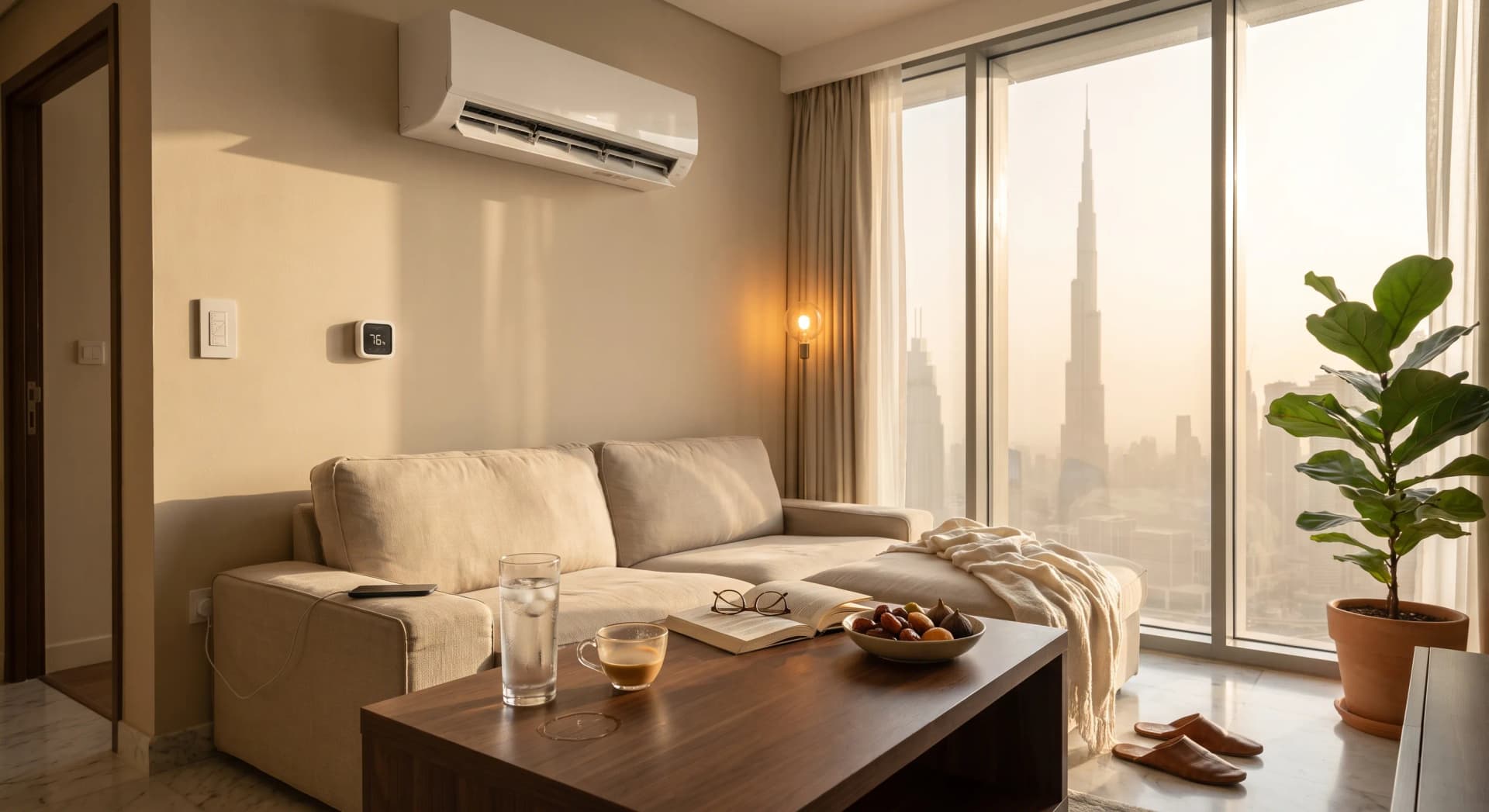
The room reads 22 degrees. It has read 22 degrees for the last hour. You are still sitting there in a shirt that feels faintly damp, so you pick up the remote and push the fan up to full, because more air has to mean more cooling.
That is the one move that makes it worse.
TL;DR: Set the fan speed low, and use Dry mode when the room is already cool. An air conditioner dries a room by condensing water onto a cold coil, and slower air lets that coil run colder and pull out more water. ENERGY STAR's advice for humid days is the opposite of most people's instinct. It costs nothing and takes ten seconds.
What the Fan Speed Is Actually Changing
Fan speed sets how fast room air is dragged across the cold coil inside your indoor unit. That coil is the only part of the machine that removes water. Air touches cold metal, moisture condenses on it, and the water runs out through the drain line. Slow the air down and the coil runs colder. HVAC School spells out why: at reduced airflow, "coil temperature decreases because less overall heat is being picked from the air," and the "coil drops further below the dewpoint, causing more moisture to be removed from the air, increasing dehumidification" (HVAC School, 2023).
ENERGY STAR's guidance for room air conditioners puts the practical version in one sentence: "On humid days, set the fan speed low. Slower air movement removes more moisture" (ENERGY STAR, 2019). The coil in a wall-mounted split does the same job the same way.
None of this shows on the temperature display, which is why the setting stays invisible. The only place it shows is the drain line.
Why Almost Everyone Turns It the Wrong Way
Sticky feels like not cool enough. More air on your skin is the quickest way to feel cooler, so the hand goes to the fan button. Moving air genuinely does make you feel cooler, which is why the instinct survives.
It does not make the room drier. It makes it wetter, slightly, and then you sit in it.
In the apartments we have walked this summer, in Business Bay and JLT, the fan is almost always on full. Almost none of those tenants had been told the setting matters, because the remote came with the flat and nobody ever explained it.
Dry Mode Is the Setting Built for Exactly This
Dry mode holds the room temperature roughly where it is and goes to work on the water instead. On many residential splits, Daikin's included, the unit also takes the fan out of your hands while it does it. Its manual for the FTXF range says so in one line: "When using drying operation mode, you CANNOT adjust the airflow rate setting" (Daikin, 2021).
That lockout is worth noticing. On the setting built specifically to remove water, the airflow is not yours to raise. Use dry mode on the evenings where the number on the wall is fine and the air is not. If your unit does let you choose a fan speed in dry mode, keep it low.
Fan-Only Mode Is Not a Dehumidifier
Fan mode runs the blower with the compressor off. No compressor means no cold coil, and with nothing cold in the path there is nothing for water to condense onto. You get room air, moved around. Worse, if the coil is still wet from the last cooling cycle, the blower dries it into the room. Daikin's own manual uses exactly that effect on purpose: before a long idle period, "operate the unit in fan only mode for several hours to dry the inside of the unit" (Daikin, 2021).
This earns a mention because the fan icon sits next to the dry icon on most remotes, and the two get confused constantly. Check which one you are on before you decide the unit is failing.
Anyone who has reached for fan mode on a heavy evening and got nothing out of it now knows why, and it was not a fault.
The Number You Are Trying to Stay Under
Sixty per cent is the line, and Dubai Municipality puts it in the same place as the Americans do. Its indoor air quality guidance says "mold thrives in the presence of water" and that "the secret to controlling mold is to control moisture and relative humidity," then gives the number: "Keep relative humidity below 60% (50%, if feasible, to control dust mites)" (Dubai Municipality, DM-HSD-GU119-IAQ Version 3, 2024). The US Environmental Protection Agency gives the same figure, "below 60 percent (ideally between 30 and 50 percent)" (EPA).
You do not need a lab to know when you are over it. Condensation that sits on the window, the mirror or a cold pipe and does not clear is the room telling you. So is a wardrobe that smells closed-up when you open it.
Why August Is the Month You Stop Getting Away With It
Nothing about your apartment changed this month. The air arriving at it did, and a setting that was invisible in February now decides whether your living room is comfortable or clammy.
Forecasters at the National Center of Meteorology expect August humidity to run slightly above July, particularly through the second half of the month, with maximum relative humidity generally between 63 and 80 per cent and conditions feeling least comfortable in the morning and evening hours (Gulf News, 2026).
Those are outdoor numbers, and your apartment is not open to the sky. What they tell you is how much water is queued up against your windows and door seals, waiting for a gap.
What the Fan Speed Cannot Fix
A room that drops to temperature within a few minutes and still feels heavy has a problem above the remote's pay grade. Your unit is likely oversized for the room, and an oversized unit satisfies the thermostat on temperature long before it has done anything useful about the water.
ENERGY STAR is direct about the consequence: oversized air conditioners short-cycle, and "short-cycling reduces the amount of condensation that drains off the coils and even allows some moisture to evaporate back into the air. Air that is not properly dehumidified can be uncomfortable and promotes the growth of mold and mildew indoors" (ENERGY STAR, 2005).
We wrote about what short cycling costs you separately. It is a sizing problem, and it belongs to your landlord rather than to anything you can install.
What Bayora Will Talk You Out Of
Buying a dehumidifier first. It is the reflex, and it treats a symptom while the machine already bolted to your wall sits on the wrong setting. Change the free thing first, then give it a week before you decide. Some apartments genuinely need one, often where a bathroom extract vents into the ceiling void instead of outside, so the moisture never really leaves.
Buying a smart AC controller to fix this. A controller cannot make your coil colder. If humidity is your only complaint and your fan is on full, you have a ten-second fix and nothing to buy. A controller earns its keep on scheduling and pre-cooling, which is a different problem from the one you have.
Assuming your building is the problem. In a district-cooled tower the chilled water arrives from a central plant rather than an outdoor compressor of your own, so the sizing story above is not a like-for-like fit and we are not going to pretend it is. What we can tell you is that the billing is what district cooling changes. If you are on a fan coil unit, run the same free experiment with the fan speed and tell us what you see.
The One Thing Here Worth Automating
The settings are not worth automating. The measurement is.
Nobody is going to walk over and read a remote display at 3am, which is the only hour the number would tell you something you did not already know. A humidity sensor on the wall turns a vague feeling into a reading, and once there is a reading, the switch between Cool and Dry can happen on its own at a threshold you set once. An Aqara temperature and humidity sensor was listed at AED 110 at Modo in early August 2026. It is the smallest spend in this entire article and the only one that changes anything. The sensor is the piece worth paying for, and the full build is in our Dubai summer humidity guide.
If you want the hardware comparison before that, the difference between a controller and a thermostat decides which route your apartment can take. Our smart AC and climate work starts from AED 3,000 installed.
Where to Start
Pick up the remote tonight and put the fan on its lowest setting. Leave it there for a week and notice whether the 9pm version of your living room feels different. One remote, one setting, and the first step is done.
If it helps and you want the room to handle it without you, tell us about your apartment and we will tell you whether a sensor and a controller are worth it for your place, or whether you have already got what you needed.
Frequently Asked Questions
Does low fan speed make the room cool more slowly?
Slightly, yes. You are trading a little speed for drier air. On a humid Dubai evening we think that is the better trade, and most people who try it find a drier room at 24 degrees sits better than a damp one at 22. If you want the room cold fast after coming in, run high fan for the first ten minutes, then drop it.
Is Dry mode more expensive to run than Cool mode?
Treat it as roughly comparable rather than as a saving. Nobody publishes a clean running-cost figure for dry mode on residential splits, so treat any number you are quoted as a guess. What it will not do is cool a hot room down, so it is a mode for holding a comfortable room comfortable, not for rescuing one already at 30 degrees.
Why is my apartment humid when the AC has been on all day?
Most often the unit reaches your set temperature quickly and then stops, which leaves the coil dry and idle for most of the hour. Set the fan speed low so the running time you do get removes more water, and check whether condensation is forming anywhere.
Do I need a humidity sensor or is my AC's display enough?
Most split AC displays show temperature only, and the units that read humidity read it at ceiling height next to their own cold coil, which is not where you sit. A separate sensor at seating height gives you a number you can act on.
Should I keep the windows and balcony door shut?
Yes, while the AC is running. Warm outdoor air holds far more water than the cooled air inside, so every minute the balcony door is open you are re-loading the room your AC has just spent an hour drying. If the flat feels stuffy in the evening, that is a ventilation question, and opening the door at 9pm in August is an expensive way to answer it.
Can I change any of this if I am renting?
All of it. Fan speed and Dry mode are already on the remote, and a small humidity sensor sits on a shelf or a wall and comes with you when you move. None of it needs a landlord conversation. The only part you cannot change as a tenant is the size of the unit itself.
Ready to Get Started?
Get a free consultation and we'll recommend what makes sense for your situation.
Get Free Consultation