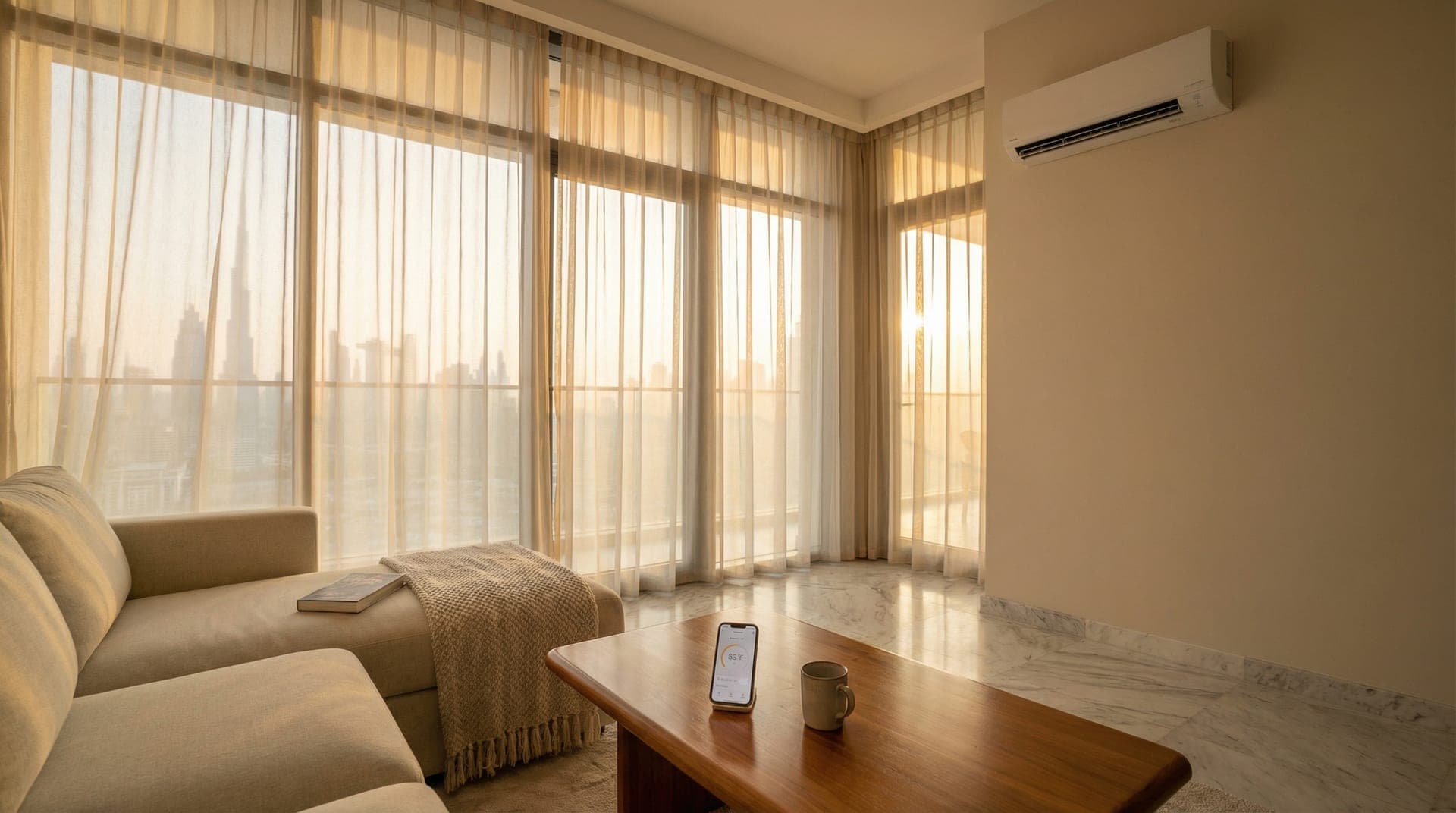
You hear that click every 15 minutes. It's your compressor restarting, and it's expensive.
That sound your AC makes when it kicks back on? That's your compressor starting a new cycle. In a Dubai apartment running AC for 16+ hours a day during summer, that happens roughly 200 times every 24 hours. Each restart draws 5-7 times the normal running power for a brief surge (HVAC School, 2024). The surge only lasts a second or two, but across 200 daily cycles, the wasted energy adds up to real money on your DEWA bill.
Air conditioning accounts for 60-70% of residential electricity in the UAE (SolarisKit, 2024). Most of that cost feels unavoidable. But a surprising chunk of it comes from how your AC cycles on and off, not from how long it runs.
TL;DR: Your AC compressor restarts roughly 200 times a day during Dubai summer. Each startup pulls 5-7x normal power. Frequent cycling wastes 20-30% of cooling energy and shortens your compressor's life from 12 years to 7-8. Smart AC scheduling reduces cycling by keeping temperatures steady, cutting summer DEWA bills by AED 150-350 per month. Setup starts from AED 3,000, works in rentals, no wiring needed.
What Is Compressor Cycling and Why Does It Happen So Often?
Compressor cycling is the on-off pattern your AC follows to maintain a set temperature. Your thermostat reads the room, turns the compressor on when it's too warm, and shuts it off when the target is reached. A healthy AC system cycles 2-3 times per hour, with each cycle lasting 15-20 minutes (Cool Care HVAC, 2025).
In Dubai, the math gets aggressive. When outdoor temperatures sit at 40-48 degrees for months, your AC bridges a massive gap between outside and inside. The compressor works harder, cycles faster, and rests less. During peak summer, a typical split unit in a Dubai Marina or Business Bay apartment might cycle 8-12 times per hour instead of 2-3. Over 16-18 hours of daily operation, that's 130-216 cycles per day.
How Much Does Each Startup Actually Waste?
Each compressor startup draws what engineers call locked rotor amps (LRA), a surge of current 5-7 times higher than normal running power. A 1.5-ton split unit that runs at around 7 amps continuously will pull 35-50 amps for the first half-second to two seconds of each cycle (HVAC School, 2024).
One surge is tiny. But 200 surges per day, across a five-month summer, is a different story. The startup phase also runs at lower efficiency because the refrigerant hasn't reached optimal pressure yet. The first 2-3 minutes of every cycle produce less cooling per watt than the middle of the cycle. When your AC short-cycles (runs for 7-10 minutes instead of 15-20), a larger percentage of each cycle is spent in that low-efficiency startup window.
What Does Excessive Cycling Cost on Your DEWA Bill?
A short-cycling AC system wastes 20-30% of cooling energy compared to one running steady, longer cycles (Envigilance, 2026). In severe cases, the waste reaches 50%. For a 2-bedroom apartment in Dubai paying AED 900-1,200 per month in summer electricity, with cooling driving 60-70% of that total, the cycling-related waste alone adds AED 100-250 per month.
DEWA's slab tariff makes it worse. Residential electricity rates in Dubai start at 23 fils/kWh for the first 2,000 kWh, then jump to 28 fils, 32 fils, and 38 fils at higher consumption tiers (DEWA, 2026). Cycling waste pushes your total consumption higher, and those extra kilowatt-hours get billed at the most expensive rate. An apartment using 2,500 kWh per month pays 28 fils for those last 500 units. Add 300 kWh of cycling waste and some of it hits the 32-fil tier.
Does Cycling Damage Your AC System Too?
Yes, and the repair costs dwarf the electricity waste. Every compressor startup creates mechanical stress. The motor goes from standstill to full speed in under a second. Bearings wear. Electrical contacts degrade. Refrigerant pressure spikes.
A normally-cycling system starts 6-8 times per day. A short-cycling system can hit 30-50+ starts per day (Energy One, 2025). That difference cuts a compressor's lifespan from 10-12 years down to 7-8 years in Dubai's climate. When we survey apartments across JBR, Downtown, and Dubai Hills, the units with the most cycling wear are always the ones running without any scheduling or temperature management.
Replacing a residential split AC compressor in Dubai costs AED 1,500-4,000 depending on the brand and tonnage (AirChill AC, 2025). Replacing the entire unit runs AED 3,000-6,000. If excessive cycling shaves 3-4 years off your system's life, that's AED 1,500-4,000 in premature replacement costs on top of the monthly electricity waste.
Why Do Dubai Apartments Cycle More Than Normal?
Three factors unique to Dubai make compressor cycling worse than in milder climates.
The temperature gap is the biggest factor. When your AC is set to 24 degrees and the outdoor temperature is 45, the compressor has to bridge a 21-degree difference. At night, when outdoor temperatures drop to 30-35, the gap shrinks and cycling slows. But during the 10+ hours of peak heat, cycling runs at maximum frequency.
Oversized units are the second problem. Many Dubai apartments have AC units sized for worst-case cooling loads, which means they're oversized for 80% of the operating hours. An oversized unit cools the room too quickly, shuts off, lets the temperature climb back up, and restarts. This pattern, called short cycling, creates 5-10 minute cycles instead of the 15-20 minute cycles that run most efficiently.
Solar heat gain through windows is the third factor. Apartments with west or south-facing floor-to-ceiling windows absorb massive solar heat during afternoon hours. The AC fights against the incoming heat, temperature fluctuates, and the compressor cycles more frequently. We've written about how blinds work together with AC to reduce this effect.
How Does Smart AC Scheduling Reduce Cycling?
Smart AC control reduces compressor cycling by keeping temperatures stable instead of swinging between extremes. A smart AC controller maintains a consistent target temperature through programmed schedules, so the compressor runs longer, steadier cycles instead of constantly restarting.
In our experience setting up smart AC in apartments across Dubai Marina and Arabian Ranches, the difference in cycling frequency is noticeable within the first week. A schedule that pre-cools before you arrive home, holds a steady 24 degrees while you're there, and raises the temperature while you sleep eliminates the biggest cycling triggers. You stop blasting 18 degrees when you walk in from the heat, and the compressor stops fighting to recover from a 35-degree apartment.
Smart thermostats reduce cooling energy use by 15-23% according to manufacturer studies, with ENERGY STAR certifying average savings of 8% (ENERGY STAR, 2025). In Dubai's extreme climate, where AC runs far more than in temperate regions, the savings from reduced cycling tend toward the higher end of that range.
Can Renters Fix the Cycling Problem?
Yes. Smart AC controllers are wireless, plug-and-play devices that need no wiring and no landlord approval. They connect to your home network and communicate with your split AC unit using infrared, the same way your remote does. You mount the controller on the wall with adhesive, download the app, and start scheduling.
When you move, you peel it off the wall and take it with you. We cover the full renter setup in our smart AC for renters guide. For renters in areas like JBR or Business Bay, this is the single highest-impact change you can make to your DEWA bill without touching anything permanent in the apartment.
What Else Can You Do to Reduce Cycling?
Beyond smart scheduling, a few simple changes reduce compressor cycling frequency.
Keep your AC filters clean. Clogged filters restrict airflow, which causes the evaporator coil to ice up and the compressor to short cycle. In our experience, dirty filters are the most common fixable cause of excessive cycling in Dubai apartments. Clean or replace them monthly during summer. If the room still will not reach its setting after a clean, run the setpoint test before booking a service.
Close blinds during peak sun hours. West and south-facing windows can add 4-6 degrees to room temperature between 1pm and 5pm. Motorized blinds that close automatically at peak heat hours reduce the thermal load your AC has to fight against, which means longer, steadier cycles instead of constant restarts. We break down the full impact in our post on the 3PM problem in Dubai apartments.
Avoid setting extreme temperatures. When you drop your AC to 18 degrees, the compressor runs flat out until the room reaches that temperature, then cycles rapidly as the room warms back up. Setting 24 degrees (DEWA's recommendation) gives the compressor enough headroom to run steady, efficient cycles. We wrote about how much that temperature gap costs in a separate post.
Frequently Asked Questions
How many times does an AC compressor cycle per day in Dubai?
During summer, a typical split AC in a Dubai apartment cycles 130-200+ times per day, depending on unit size, room insulation, and thermostat settings. A properly functioning system should cycle 2-3 times per hour, but high outdoor temperatures and temperature swings push that to 8-12 times per hour during peak heat.
Does turning AC on and off waste more electricity than leaving it running?
Yes. Each compressor startup draws 5-7 times normal running power, and the first few minutes of each cycle run at lower efficiency. Frequent on-off cycling wastes 20-30% of cooling energy. A smart AC controller with scheduling keeps the system running steady, longer cycles that use less total electricity.
How much can smart AC save on DEWA bills in Dubai?
Smart AC scheduling typically saves AED 150-350 per month on summer DEWA bills for a 2-bedroom apartment. That's a 20-30% reduction in cooling costs. The savings come from eliminating cooling of empty rooms, reducing compressor cycling waste, and maintaining efficient temperature targets.
Can excessive cycling damage my AC compressor?
Yes. Excessive cycling can cut a compressor's lifespan from 10-12 years down to 7-8 years. Each startup creates mechanical stress on bearings, electrical contacts, and refrigerant pressure. A short-cycling system may start 30-50+ times per day compared to 6-8 starts for a normally operating system.
Do smart AC controllers work with any split AC brand?
Smart AC controllers work with any split AC unit that has a remote control. They use infrared signals to communicate with your AC, the same way your remote does. Brand, model, and age don't matter. The controller connects to your WiFi and lets you set schedules, automate temperature changes, and monitor energy use from your phone.
Curious what cycling is costing your apartment? Get a free consultation and we'll walk through your AC setup, check your cycling patterns, and show you exactly where the waste is. No cost, no obligation.
Ready to Get Started?
Get a free consultation and we'll recommend what makes sense for your situation.
Get Free Consultation