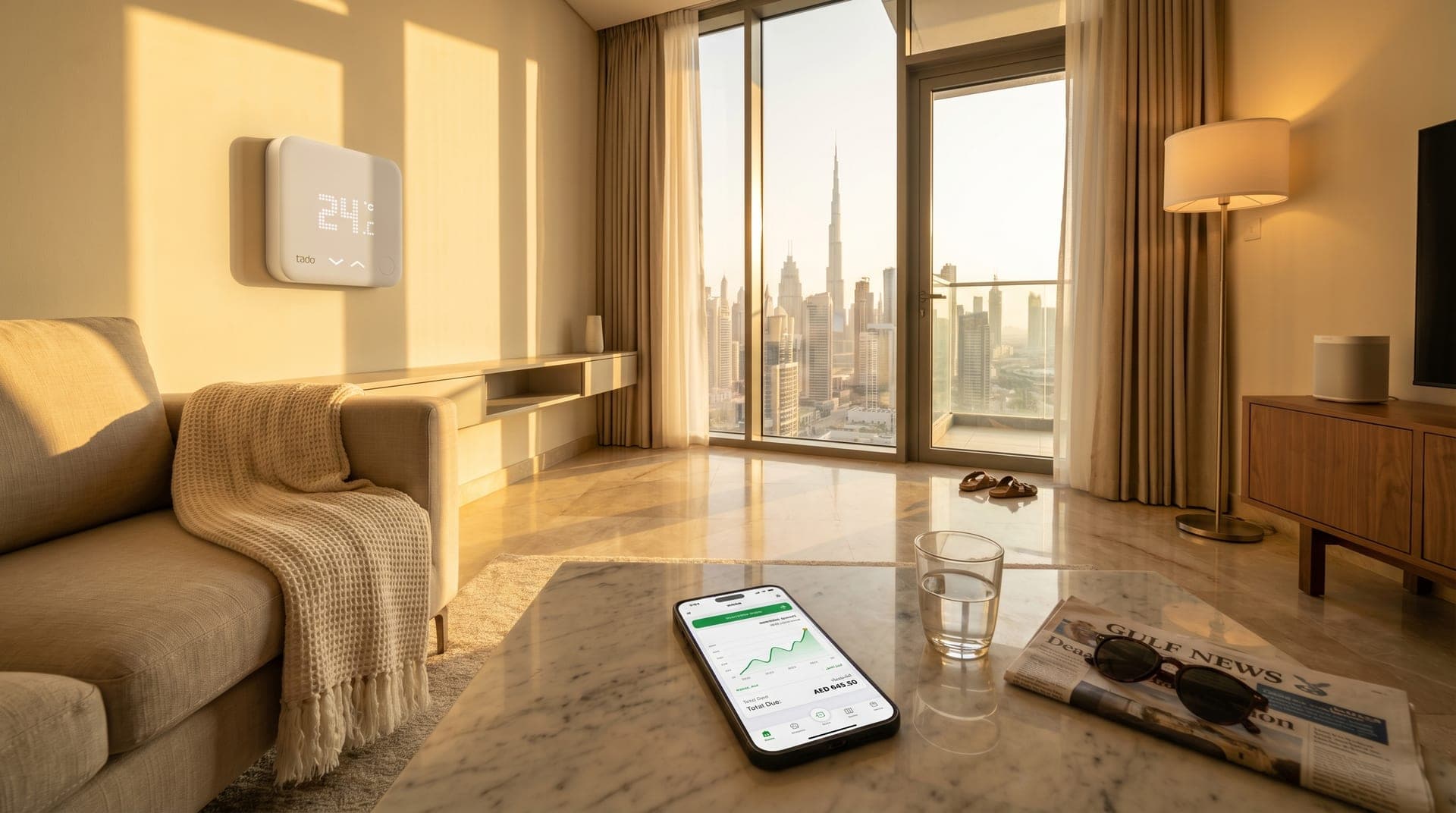
April bills feel fine. May bills do not.
You are about to see the first real summer number of 2026. Your April DEWA bill probably arrived looking normal. Maybe AED 450, maybe AED 600, whatever your baseline usually is. Nothing alarming. Life continues.
Then May happens. Temperatures cross 38 degrees and stay there. Your AC stops taking breaks. Your apartment absorbs heat all day and holds it overnight. Your consumption quietly doubles. And the DEWA bill that lands late May or early June is the one that makes you do a double take.
If you have not changed anything since last summer, the math is already moving against you. Here is what the May bill is likely to say, why it says that, and what you can still change in the two to three weeks you have left.
TL;DR: Dubai apartment DEWA bills typically jump 60-90 percent between April and May as daytime highs push past 38 degrees and AC runs 14-18 hours a day (Climate-Data.org, 2026). A 2-bedroom apartment that pays AED 450-600 in April usually pays AED 750-1,100 in May, and the number accelerates into June. You have about three weeks to make changes that show up on that bill. Smart AC scheduling, automated blinds, and a handful of small habit shifts can cut the May number by 20-30 percent before it prints.
Why May Is the Tipping Point
April in Dubai averages daytime highs of around 33 degrees. May averages 38 degrees, and the last third of the month climbs toward 40 degrees with overnight lows holding above 25 degrees (Climate-Data.org, 2026). That 5-degree jump sounds small on paper. Inside an apartment with floor-to-ceiling glass, it changes everything.
Your AC does not respond to temperature in a linear way. Each degree below DEWA's recommended 24 degrees increases consumption by 5-8 percent (Daikin MEA, 2025). When outdoor temperatures climb, the AC also runs longer to remove heat that is constantly leaking back in through walls and windows. So a building hitting 40 degrees outside forces your 20-degree indoor setting to run more cycles, for more minutes, every hour.
The second thing that shifts in May is overnight recovery. In April, your apartment cools naturally once the sun goes down. In May, it does not. Overnight lows stay above 25 degrees, so your AC keeps cycling through the night to hold whatever temperature you sleep at. That adds 6-8 hours of compressor time that April never charged you for.
What Your May Bill Will Likely Look Like
Based on what we see across apartments in Dubai Marina, Business Bay, and JBR, a typical May bill lands in these ranges:
- Studio or 1-bedroom: AED 500-800 (up from AED 300-500 in April)
- 2-bedroom apartment: AED 750-1,100 (up from AED 450-600 in April)
- 3-bedroom apartment: AED 1,000-1,500 (up from AED 600-850 in April)
- Villa (4-5 bedroom): AED 1,800-3,000 (up from AED 900-1,500 in April)
These are electricity-only estimates. Add water, sewerage, and the housing fee and the total can be 15-25 percent higher. The numbers vary based on your AC habits, how many people live in the apartment, and how much sun your unit gets. But the jump itself is consistent. Almost every Dubai apartment sees a 60-90 percent increase from April to May.
The slab tariff makes it worse. DEWA charges 23 fils per kWh for the first 2,000 kWh, 28 fils for the next 2,000, 32 fils for the next band, and 38 fils per kWh for anything above 6,000 kWh (DEWA, 2026). If your April usage sat comfortably in the first slab, May can push you into the second or third slab, which means every extra unit costs 22-65 percent more than it did last month.
June gets worse. July and August get significantly worse. We did the full 12-month math in What 24 Hours of Electricity Costs in a Dubai Apartment: July vs January, and July runs roughly 3-4 times the January cost for the same household.
Why the May Number Sneaks Up On People
Three things catch Dubai residents off guard every year, and they are the same three things every time.
The first is thermal lag. Your apartment is made of concrete, marble, and glass. These materials absorb heat all morning and release it back into the rooms during the afternoon, which is why most apartments hit their hottest point around 3PM rather than noon (The Concrete Centre, 2025). In May, that delayed heat is high enough to force the AC into emergency mode every afternoon. We broke this down in detail in The 3PM Problem.
The second is AC cycling. Your AC does not run continuously. It starts and stops in short bursts, and each start draws a spike of electricity. A typical Dubai apartment AC cycles 150-200 times per day in summer, and the compressor accounts for 85 percent of cooling electricity use (US Department of Energy, 2025). In April, cycles are shorter and less frequent. In May, they get longer and come back sooner, and the electricity cost climbs faster than the hours on the clock would suggest. Full breakdown in Your AC Compressor Cycles 200 Times a Day. Here's What That Actually Costs.
The third is habit. Most people have not changed a thing since last May. Same thermostat setting. Same schedule of leaving the AC on all day because they do not want to come home to a 34-degree apartment. Same afternoon blast to 18 degrees when it feels unbearable. If the habits are the same, the bill is going to be the same, only higher, because the tariff brackets have shifted up into more expensive territory.
What You Can Still Change Before the May Bill Prints
You have about three weeks. That is enough time to make changes that show up on the May DEWA bill, not the June one. Here is what works, ordered by how much it changes the number.
1. Stop Leaving the AC Running in an Empty Apartment
This is the single biggest lever you have, and it costs nothing to start doing today. A smart AC controller connects to your existing split unit over WiFi and lets you schedule when it runs. Instead of leaving the AC at 20 degrees all day because you do not want to return to a 35-degree apartment, you schedule pre-cooling to start 30 minutes before you arrive home.
In our experience across rentals in Business Bay and Downtown Dubai, this one change saves AED 150-300 per month during summer. The apartment is comfortable when you walk in, and the AC is not working through 8-10 empty hours. A controller mounts on the wall near your unit, uses the same infrared signals as your existing remote, and requires no wiring, no landlord approval, and no holes. Basic setup starts from AED 3,000 installed.
2. Block the Afternoon Sun Before It Arrives
Solar heat gain through untreated windows raises indoor temperatures by 4-6 degrees in the afternoon. Window coverings reduce that heat gain by up to 77 percent (US Department of Energy, 2025). For a west-facing or south-facing apartment, that translates to 10-15 percent lower cooling costs on top of whatever scheduling saves.
Battery-powered motorized blinds close automatically at 2PM and open again after sunset. They work in rentals with no wiring and no holes in the wall. You do not have to be home. You do not have to remember. The blinds close before the heat hits, and the AC has less work to do all afternoon.
3. Raise Your Overnight Setting by 2 Degrees
If you sleep at 20 degrees, try 22. If you sleep at 22, try 24. This is the single cheapest change you can make, and the math is simple. Each degree up from your current setting cuts AC consumption by 5-8 percent (Daikin MEA, 2025). Two degrees across eight overnight hours, across 31 nights in May, usually shows up as AED 80-150 less on the bill.
Most people sleep fine at 23-24 degrees. The reason they sleep at 20 is because they set it once in March when it felt cold, then never changed it. Habit, not preference.
4. Close Off Rooms You Are Not Using
If you live alone in a 2-bedroom, the second bedroom does not need to be cooled. Shut its door and close its AC vent. A zone control setup automates this more precisely, but even a manual version saves meaningful electricity. Cooling one room instead of two drops that room's portion of your bill by 40-50 percent for the hours nobody is in there.
The same logic applies to guest rooms, home offices, and formal living rooms that sit empty most of the day. If nobody is in a room, it does not need to be at 22 degrees.
What This Looks Like If You Do Not Change Anything
Let us be concrete. Say you live in a 2-bedroom in Dubai Marina. Your April bill was AED 500. You leave the AC on all day at 21 degrees. You do not close blinds. You do not schedule anything.
Your May bill is likely to land at AED 850-1,050. Your June bill climbs to AED 1,100-1,400. July and August push AED 1,300-1,600. Over May through September, that is AED 5,500-7,500 in summer DEWA costs for that one apartment.
Now say you install a smart AC controller in the next two weeks, pre-cool instead of run-all-day, and raise your overnight setting from 21 to 23 degrees. The same apartment usually lands at AED 650-800 in May, AED 850-1,050 in June, AED 1,000-1,200 in July. Over five months, the savings come to AED 1,200-2,000. That is enough to cover the AED 3,000 setup cost within a single summer, and the system keeps running for the next 5-10 years.
The full breakdown of which automations stack together, and in what order, is in The Summer DEWA Bill Survival Guide. That guide walks through the five automations that matter most and roughly how much each one saves.
What the First Summer in Dubai Teaches You
Every first-year Dubai resident gets the same lesson from their first May DEWA bill. The lesson is that you cannot run a Dubai apartment the way you ran your home in London, Mumbai, or Cairo. The climate does not allow it. The electricity structure does not allow it. Your habits have to adjust to the environment, or your wallet does it for you.
What we have seen is that residents who make small changes before May usually do not even notice the summer bill. Their June total comes in at AED 750 instead of AED 1,200, and the contrast between their neighbors' complaints and their own bill becomes its own conversation piece. We wrote about one of those conversations in Your First Summer DEWA Bill Is Coming. Here's How to Not Panic, which covers what a prepared first summer looks like versus an unprepared one.
Dubai built the future on every street corner. Inside your apartment, the story is still mostly manual. Your AC runs when you forget to turn it off. Your blinds stay open all afternoon because nobody closed them. Your bedroom stays at 19 degrees overnight because nobody changed the setting. A smart home changes who is in charge of those decisions, which changes what the bill looks like in late May.
Frequently Asked Questions
When does the May DEWA bill actually arrive?
DEWA bills are issued monthly based on your meter reading cycle. Most Dubai residents receive their May bill between the last week of May and the first week of June. You can check your bill at any time through the DEWA app or website without waiting for the paper bill. The bill reflects consumption from around the 20th of the previous month to the 20th of the current month.
How much should a 2-bedroom apartment budget for DEWA in May 2026?
A typical 2-bedroom apartment in Dubai Marina, Business Bay, or JBR should expect AED 750-1,100 in May for electricity alone, plus water, sewerage, and the housing fee. Total bills usually land around AED 900-1,350 depending on AC habits, apartment size, sun exposure, and number of occupants. Villas run higher because of larger cooled floor area.
Can I still make changes that affect the May bill?
Yes, if you act in the next two to three weeks. Smart AC controllers can be installed within a few days and start showing savings immediately. Battery-powered motorized blinds work the same way. Habit changes like raising the thermostat setting work from the moment you change them. The earlier in the billing cycle you make changes, the more days of savings land on the May bill rather than the June one.
Does setting my AC to 24 degrees actually make a difference?
Yes. DEWA specifically recommends 24 degrees as the optimal setting for comfort and efficiency (DEWA, 2026). Each degree below 24 increases consumption by 5-8 percent, and the jump from 20 to 24 degrees typically reduces cooling costs by 20-30 percent. Most people cannot distinguish 22 from 24 degrees after a night of adjustment. The savings are real and immediate.
Why does my bill jump so much more than outdoor temperatures suggest?
Three reasons. First, your AC works exponentially harder as outdoor temperatures climb, not linearly. Second, overnight lows above 25 degrees force the AC to run through the night, which April did not charge you for. Third, DEWA's slab tariff charges more per kWh as your consumption climbs, so higher usage means each extra unit costs more. A 40 percent consumption jump can turn into a 60-90 percent bill jump once slab pricing is factored in.
Ready for Your May Bill to Be Different?
If you have been looking at your April bill and bracing for May, you do not have to take the hit. A smart AC controller, a few motorized blinds on your sun-facing windows, and a schedule that matches how you actually use your apartment can change what lands in the DEWA app next month.
Get a free consultation and we will tell you exactly what your apartment needs, what it would cost, and what the May bill is likely to look like after. No obligation, no pressure, no surprises.
Ready to Get Started?
Get a free consultation and we'll recommend what makes sense for your situation.
Get Free Consultation