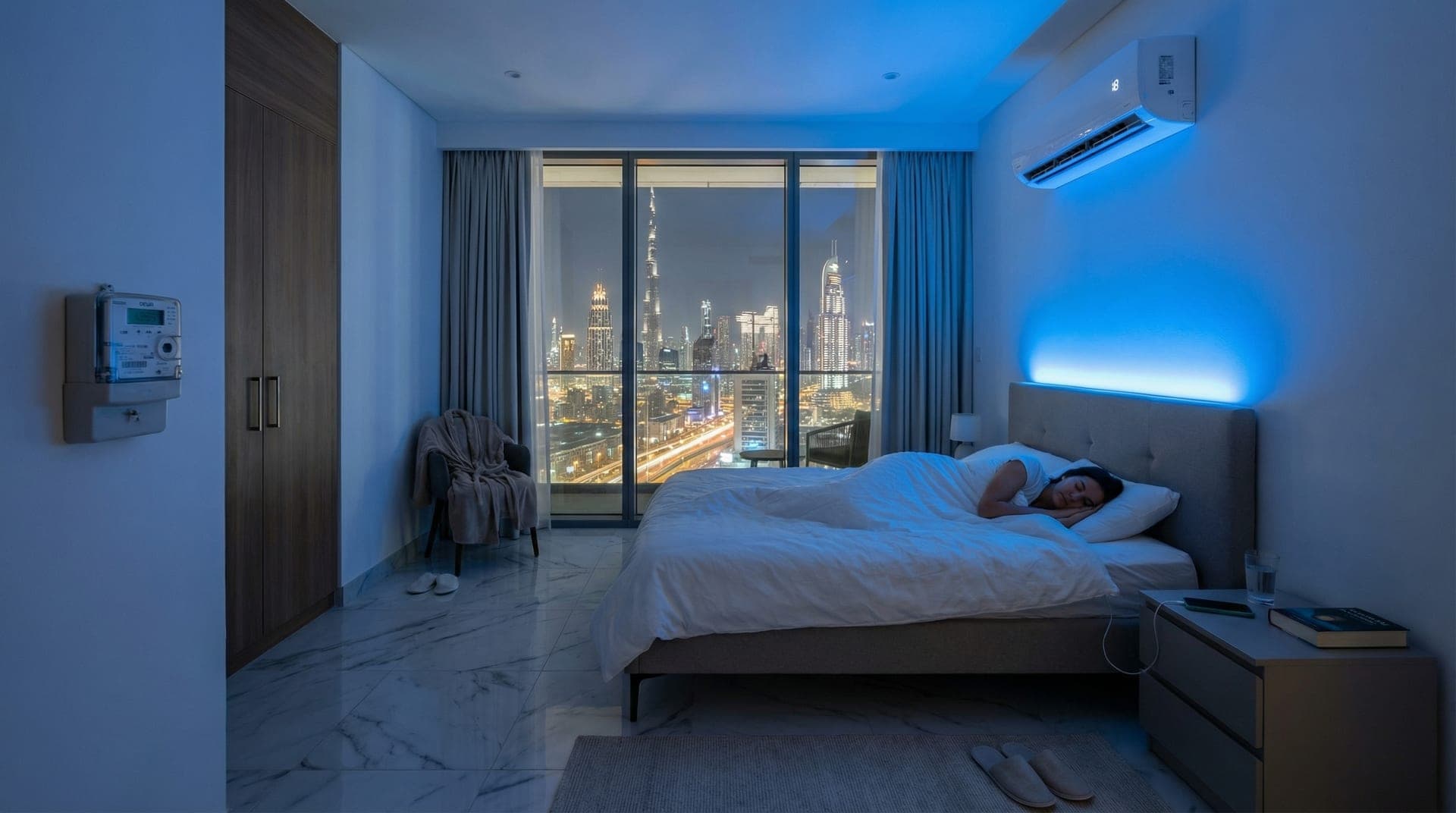
Every night, you're running a science experiment on your DEWA bill.
You come home from work. The apartment feels like it's been slow-cooking all day. You grab the remote, punch it down to 18 degrees, and leave it there until morning. Eight hours of your AC compressor working as hard as it possibly can, pushing your split unit to a temperature it was never designed to maintain in a city where nighttime lows still hover around 30-35 degrees from May through September.
You're not alone. In our experience working in apartments across Dubai Marina, Business Bay, and JBR, we see this pattern constantly. The remote is always set to 18 or 16. The DEWA bill is always a surprise.
TL;DR: Running your AC at 18 degrees overnight costs AED 150-250 more per month than sleeping at DEWA's recommended 24 degrees. Each degree below 24 adds 5-8% to your cooling costs. A smart AC controller can start at a cool temperature to help you fall asleep, then gradually raise it while you're deep in sleep - cutting costs without waking you up.
How Much Does Running AC at 18°C Overnight Actually Cost?
A typical 1.5-ton split AC in a Dubai bedroom draws about 1.2-1.5 kW when running at 24 degrees with normal cycling. At 18 degrees, the compressor barely cycles off at all. It runs continuously for most of the night because the gap between your target temperature and the outdoor temperature is so large.
Here's the rough math. At 24 degrees, your bedroom AC cycles on and off, averaging about 0.8 kW over 8 hours of sleep. That's 6.4 kWh per night. At 18 degrees, the compressor runs almost continuously, pulling closer to 1.4 kW for 8 straight hours. That's 11.2 kWh per night.
The difference is about 4.8 kWh per night. Over a month, that's 144 extra kWh from one bedroom AC alone. At DEWA's higher slab rates of 28-38 fils per kWh (DEWA Slab Tariff, 2026), you're looking at AED 40-55 extra per month from that single unit. Run two or three ACs at 18 degrees and the numbers multiply fast.
Why Does 6 Degrees Make Such a Big Difference?
Each degree you lower your AC increases energy consumption by roughly 5-8% (DEWA, 2026). Going from 24 to 18 means six degrees of extra work. That's a 30-48% increase in cooling costs compared to the recommended setting.
But it gets worse at night. Your AC compressor is designed to cycle - run until the room hits the target temperature, then shut off until the temperature drifts back up. At 24 degrees in a reasonably insulated Dubai apartment, the compressor might run 40-60% of the time overnight. At 18 degrees during a summer night with outdoor temperatures still at 30-35 degrees, the compressor runs 85-95% of the time. Some units never cycle off at all.
That constant running wears out the compressor faster too. When we set up smart AC control in a Dubai Hills villa last year, the owner mentioned their bedroom unit needed a compressor replacement after two summers. The unit was only three years old. They'd been running it at 16 degrees every night.
What Does DEWA Recommend for Nighttime AC?
DEWA recommends 24 degrees as the optimal temperature for comfort and energy efficiency (DEWA, 2026). For sleeping, they suggest raising it slightly to 25-26 degrees, since your body temperature naturally drops while you sleep and you need less cooling than you think.
This lines up with sleep research too. The National Sleep Foundation recommends a bedroom temperature of 18-22 degrees Celsius (Medical News Today, 2025), but that's the room temperature, not the AC setting. In Dubai, setting your AC to 24 degrees typically brings the room temperature to about 22-23 degrees once the unit has been running for an hour. Setting it to 18 usually brings the room to about 19-20, which is colder than most sleep research recommends.
Does Sleeping in 18°C Even Help You Sleep Better?
This is the part people don't expect. Setting your AC lower doesn't necessarily improve your sleep quality. Research shows the ideal sleeping temperature range is 18-22 degrees room temperature (Medical News Today, 2025). Going below 18 can cause restless sleep because your body has to work to stay warm.
We've heard this from clients before. They blast the AC to 18, then pull the duvet up to their chin. Then they add socks. Then they wake up at 3am because they're cold but too tired to find the remote. The AC runs at full power all night keeping the room at a temperature they don't even want to be in.
The other issue is dry air. AC systems pull moisture out of the room as they cool. Running at 18 degrees all night leaves you with very dry air by morning, which is why so many people in Dubai wake up with a dry throat and congestion during summer.
How DEWA's Slab Tariff Makes Overnight Cooling More Expensive
DEWA uses a progressive slab tariff system. The more electricity you use, the more you pay per unit (DEWA Slab Tariff, 2026).
The first 2,000 kWh cost 23 fils each. The next 2,000 cost 28 fils. From 4,001 to 6,000, you pay 32 fils. Anything above 6,000 kWh costs 38 fils per unit. There's also a fuel surcharge of roughly 6 fils per kWh on top.
For a typical 2-bedroom apartment, running two ACs at 18 degrees overnight during summer easily pushes monthly consumption from 1,500 kWh into the 2,500-3,500 kWh range. That bumps a significant portion of your bill from the 23 fils slab into the 28-32 fils slab. You're paying more per unit for the privilege of overcooling your apartment while you sleep.
A Gulf News report on UAE summer electricity costs confirmed that AC accounts for 60-70% of total residential electricity consumption during summer months. Your overnight setting has an outsized impact because it runs for 7-8 consecutive hours.
What Smart AC Controllers Do About This
Smart AC controllers solve the overnight problem without making you sleep warm. The approach is simple: start cool, then gradually adjust.
A smart AC controller connects to your existing split unit and replaces the need for a remote control. You set up a sleep schedule through an app. A typical sleep schedule starts at 22 degrees when you get into bed, holds that for an hour while you fall asleep, then gradually raises to 24-25 degrees over the next two hours. By the time you're in deep sleep, you don't notice the 2-3 degree increase - but your compressor does. It starts cycling normally and your electricity consumption drops significantly.
When we installed this for a couple in a Downtown Dubai apartment, their summer DEWA bill dropped by about AED 200 per month. They'd been running both bedroom and living room ACs at 18 degrees from 10pm to 7am. The sleep schedule brought the overnight AC cost down without them noticing any comfort difference.
Can Renters Use Smart AC Controllers?
Yes. Most smart AC controllers are wireless and portable. No wiring changes, no landlord approval needed, no tools required. You attach the controller near your AC, connect it to your WiFi, and control everything from an app.
If you move apartments, you take it with you. When we set up smart AC for renters, this is one of the first things we explain. The controller works with any split AC that has an infrared remote, which covers virtually every unit installed in Dubai apartments.
Starting price for a basic smart AC setup is AED 3,000 installed, including the controller, installation, configuration, and app setup. For a single bedroom unit, the controller itself costs significantly less.
A Better Overnight AC Strategy (That Costs Nothing)
Even without a smart controller, you can reduce your overnight electricity cost tonight. Here's what works:
Set your AC to 22-23 degrees instead of 18. The room will still feel cool. Use a light blanket instead of a heavy duvet. If your AC has a sleep mode or timer, use it - most modern split units have a built-in timer that can raise the temperature by 1-2 degrees after a set period.
Close your bedroom door to keep the cooled air contained. Make sure your AC filter is clean - a clogged filter forces the unit to work harder and use more electricity to reach any temperature. DEWA's conservation tips emphasize regular filter cleaning as one of the simplest ways to reduce cooling costs.
The combination of a slightly higher set temperature and a clean filter can cut your overnight cooling costs by 20-30% with zero investment.
Frequently Asked Questions
Is 18 degrees too cold for sleeping with AC?
For most people, yes. Sleep research suggests the ideal room temperature for sleeping is 18-22 degrees Celsius. But an AC set to 18 in Dubai usually cools the room to 19-20 degrees, which is on the colder end. Many people end up pulling blankets over themselves, which defeats the purpose of running AC that cold.
How much does it cost to run AC at 18 degrees all night in Dubai?
Running a 1.5-ton split AC at 18 degrees for 8 hours overnight costs roughly AED 3.5-4.5 per night during Dubai's summer. At 24 degrees, the same period costs about AED 1.8-2.5. Over a full summer month, the difference adds up to AED 50-60 per bedroom unit, or AED 150-250 for a typical apartment running multiple ACs.
What temperature should I set my AC to at night in Dubai?
DEWA recommends 24 degrees for general use and 25-26 degrees for sleeping. If you find 24 too warm for falling asleep, try setting it to 22 for the first hour and then raising it to 24. Smart AC controllers automate this with sleep schedules that adjust temperature gradually through the night.
Does running AC at 18 degrees cool the room faster?
No. Setting your AC to 18 instead of 22 does not cool the room faster. Your AC compressor runs at the same speed regardless of the temperature you set. The only difference is that at 18, the compressor keeps running long after the room is already comfortable, wasting electricity to push the temperature below what you need.
Stop Paying Extra to Sleep Cold
Your AC remote makes it easy to punch in 18 and forget about it. But every night you do that, you're running your compressor at full capacity for hours, pushing your DEWA bill into higher tariff slabs, and sleeping in a room that's colder than sleep science recommends.
The fix is straightforward. Raise your overnight temperature to 22-24 degrees. If you want the automation to handle it for you, a smart AC controller with a sleep schedule does the work while you're asleep.
Curious what this would cost for your apartment? Get a free consultation and we'll walk you through the options for your specific setup. No obligation, no surprises.
Ready to Get Started?
Get a free consultation and we'll recommend what makes sense for your situation.
Get Free Consultation