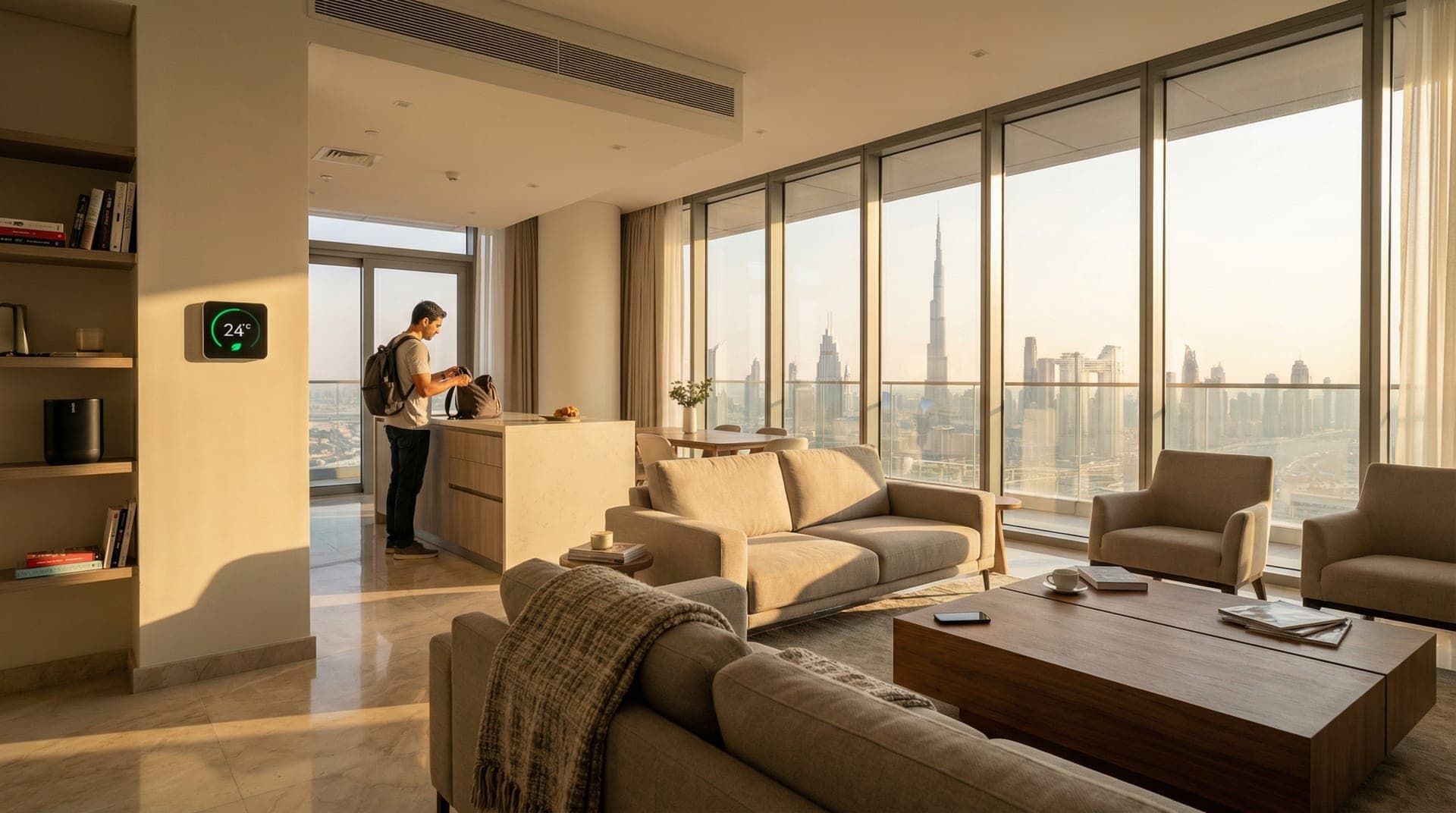
You already know the feeling.
You leave work at 5:30. You walk through your door at 6. The apartment hits you like a wall. Every surface is warm. The sofa, the countertops, the floors. You grab the remote, crank the AC to 18, and stand in front of it for 10 minutes waiting for something to happen. Forty-five minutes later, the living room is finally comfortable. The bedroom is still catching up.
This is the default experience for anyone renting or owning in Dubai Marina, Business Bay, Downtown, or pretty much anywhere in the city between May and September. And it's not because your AC is broken or undersized. It's because of what happened to your apartment all day while you were gone.
TL;DR: Your apartment takes so long to cool down because concrete walls, floors, and furniture absorb heat all day and release it back into the room even after you turn the AC on. Pre-cooling with a smart AC schedule starts cooling 30-45 minutes before you arrive, so the apartment is already at 24 degrees when you walk in. No waiting, lower DEWA bills, and the AC runs at steady efficiency instead of emergency mode.
Why Does a Dubai Apartment Hold Heat Like an Oven?
Your apartment is built from concrete. Concrete has high thermal mass, which means it absorbs heat slowly and releases it slowly (The Concrete Centre, 2025). In cooler climates, that property helps - buildings stay warm longer at night. In Dubai, where outdoor temperatures sit at 40-48 degrees for four months straight, it works against you.
During a workday, your empty apartment soaks up solar heat through the windows. The concrete walls, marble floors, and furniture all absorb that heat over 8-10 hours. By 6pm, indoor temperatures in an unoccupied apartment reach 35-38 degrees (Time Out Dubai, 2025). When you turn on the AC, it's not cooling air. It's fighting the stored heat radiating out of every surface in the room.
That's why the air feels cool near the AC unit but the room still feels warm for 30-45 minutes. The AC has to pull heat out of the concrete and furniture, not the air. And at 45 degrees outside, fresh heat keeps pushing through the windows while the AC tries to catch up.
How Long Should It Actually Take to Cool Down?
A properly sized split AC can drop a room by about 10 degrees Celsius in 30-60 minutes under normal conditions (Aquarius Home Services, 2025). But "normal conditions" means a starting point of maybe 28-30 degrees with moderate heat gain from outside. A Dubai apartment in summer doesn't qualify.
When your starting point is 35-38 degrees and you want 24, you're asking the AC to bridge a 14-degree gap while the walls and floors are still dumping stored heat back into the room. That pushes actual cool-down to 40-60 minutes for the living room, and longer for rooms with west-facing windows that caught the afternoon sun.
In our experience, the apartments that take the longest are the ones with floor-to-ceiling windows facing south or west - common in JBR, Dubai Marina, and high floors in Downtown Dubai. Those windows turn the apartment into a greenhouse between 1pm and 5pm, and the stored heat takes the longest to clear.
What Happens When You Blast the AC to 18 Degrees?
Most people do the same thing. Walk in, feel the heat, set the AC to 18. This feels logical. You want it cold fast, so you set the lowest number. But it backfires.
Your AC doesn't cool faster at 18 than at 24. The compressor runs at the same speed either way. The only difference is that at 18, it runs longer and never cycles off. You get the same initial cooling rate, but the system keeps pushing well past comfortable, your electricity consumption spikes, and the compressor runs under maximum load for over an hour.
DEWA recommends 24 degrees for a reason. Each degree below 24 increases energy consumption by 5-8% (Daikin MEA, 2025). Running at 18 for an hour instead of 24 costs roughly 30% more electricity for that session. Across a full summer, the habit of blasting to 18 every evening adds AED 100-200 to your monthly DEWA bill on top of what you'd pay with a steady 24-degree setting.
What Is Pre-Cooling and How Does It Work?
Pre-cooling means starting your AC before you arrive so the apartment is already at your target temperature when you walk in. A smart AC controller connects to your existing split unit and lets you set schedules from your phone. You tell it to start cooling at 5:15pm. By 5:45, the apartment is at 24 degrees. You walk in at 6 and never feel the heat.
The ENERGY STAR program found that smart thermostats save an average of 8% on heating and cooling bills in moderate climates (ENERGY STAR, 2025). In Dubai, where cooling is 60-70% of your total electricity and runs 18 hours a day in peak summer, the percentage impact is higher because there's more waste to eliminate.
Pre-cooling works because your AC runs at a steady, efficient pace instead of an emergency sprint. Starting 30-45 minutes early at 24 degrees uses less electricity than starting at 6pm and blasting to 18. The compressor cycles normally, the temperature drops gradually, and the stored heat in the walls gets absorbed before it builds up further.
Does Pre-Cooling Actually Save Money or Cost More?
This is the question everyone asks. If the AC turns on 30 minutes earlier, don't you just pay for 30 more minutes of electricity?
No. And here's why. A pre-cool session at 24 degrees brings the apartment down from roughly 32 to 24 over 30-45 minutes. The compressor does moderate work. An emergency blast from 38 to 18 keeps the compressor at maximum load for 60+ minutes, uses more electricity per minute, and cools the apartment past comfortable just because you set it too low in a panic.
Research from the California Energy Commission found that pre-cooling strategies in residential buildings reduced energy costs by 28-51% on hot summer days compared to reactive cooling (ScienceDirect, 2020). A separate field study across 11 buildings showed peak-period electricity demand reductions of 15-30% through pre-cooling schedules (ScienceDirect, 2024).
When we set up smart AC scheduling in apartments across JBR and Downtown Dubai last summer, the average monthly DEWA reduction was 20-30%. For a summer bill of AED 1,200, that's AED 240-360 back every month. We covered the full before-and-after numbers in What Happens to Your DEWA Bill When You Add Smart AC Scheduling.
Can Renters Set Up Pre-Cooling Without Landlord Approval?
Yes. Smart AC controllers are wireless devices that sit on the wall or on a shelf near your AC unit. They work with any split AC that has a remote control, regardless of brand or age. No wiring, no drilling into walls, no permanent changes. You take it with you when you move.
Setup takes 10-15 minutes. You plug in the controller, connect it to your WiFi, pair it with your AC, and build your schedule in the app. Most people set a pre-cool for when they get home from work and a sleep schedule for bedtime. The controller sends the same infrared signals your remote does - your AC doesn't know the difference.
We've installed these in rental apartments across every major area in Dubai. Landlords never need to know because nothing about the apartment changes. For a deeper look at how this works for renters, see Smart AC for Renters: No Landlord Approval Needed.
What Does a Pre-Cooling Schedule Look Like?
A practical pre-cooling schedule for a Dubai professional looks like this:
Morning (Sunday-Thursday):
- 6:00am: AC turns on at 24 degrees (wake-up comfort)
- 7:30am: Temperature shifts to 28 degrees (you're heading out)
- 8:00am: AC turns off (apartment empty)
Afternoon pre-cool:
- 5:15pm: AC turns on at 24 degrees (45 minutes before you arrive)
- 6:00pm: You walk in to a comfortable apartment
Night:
- 10:30pm: Temperature shifts to 26 degrees (sleep mode)
- 6:00am: Cycle restarts
Weekends (Friday-Saturday):
- AC maintains 24-25 degrees while you're home
- Shifts to 28 if you leave for errands (GPS-triggered on some controllers)
The key detail: during the 8am-5:15pm window, the AC is off instead of running all day. That's 9 hours of zero electricity for cooling. Even with the pre-cool session added, you're running the AC roughly 5-6 fewer hours per day than someone who leaves it on 24/7 - the approach many residents default to because they hate coming home to a hot apartment.
What Else Can You Do About the Heat Buildup?
Pre-cooling solves the arrival experience, but the real savings come from reducing how much heat enters the apartment in the first place. Two upgrades pair well with smart AC.
Automated blinds close before the sun hits your windows. A schedule that closes west-facing blinds at 1pm and south-facing blinds at 11am blocks the thermal gain before it starts. We covered this in detail in Why Motorized Blinds Are the Most Underrated Smart Home Upgrade in Dubai. Combined with smart AC, blinds reduce the pre-cool time because the apartment starts from a lower temperature.
Zone control is the other piece. If you have a 2-bedroom apartment, the guest room doesn't need to be cooled until someone is in it. Smart scheduling can pre-cool your living room at 5:15pm and your bedroom at 10pm. The guest room stays off until the weekend. We broke down the zone control savings in What 45C Outside Does to Your Electricity Bill.
Frequently Asked Questions
Does pre-cooling work with central AC or only split units?
Smart AC controllers work with any split unit that has an infrared remote. Central AC systems with a wall thermostat can also be automated, but the approach is different - you'd use a smart thermostat replacement instead of an IR controller. Both achieve the same result: scheduled cooling before you arrive.
How much does a smart AC controller cost in Dubai?
A basic smart AC setup starts from AED 3,000 installed, which covers the controller, professional installation, WiFi configuration, and a custom schedule built around your routine. Additional zones cost from AED 1,500 each. The setup typically pays for itself in 2-3 months of DEWA savings during summer.
Will pre-cooling work if my apartment has bad insulation?
Pre-cooling works in any apartment, but poorly insulated apartments lose the benefit faster. If your apartment heats up quickly after the AC turns off, you may need to start the pre-cool earlier (60 minutes instead of 30) or combine it with automated blinds to reduce solar heat gain. The controller adjusts over time based on how your apartment performs.
Can I control the pre-cool schedule from my phone if I leave work late?
Yes. Every smart AC controller has a phone app that lets you adjust the schedule on the fly, trigger cooling manually from anywhere, or set location-based triggers that start the AC when your phone detects you're heading home. If you leave work at 7pm instead of 5:30, the AC waits until you tell it to start.
Stop Waiting for Your Apartment to Cool Down
The 45-minute cool-down ritual is a solved problem. A smart AC schedule turns it into something you never think about again. You walk in, the apartment is comfortable, and your DEWA bill is lower than it would be if you kept blasting to 18 every evening. The pre-cool is the core of a full Come-Home scene, where the lights, blinds, and music come up at the door too.
Get a free consultation and we'll set up a pre-cooling schedule for your apartment. No obligation, no wiring, and you keep it when you move.
Ready to Get Started?
Get a free consultation and we'll recommend what makes sense for your situation.
Get Free Consultation