At 45 degrees, your apartment becomes a full-time electricity project.
There's regular Dubai summer. And then there's the stretch from mid-June through August when the temperature crosses 45 and stays there for weeks. That's when everything changes. Your AC shifts from running most of the day to running all of it. Your compressor cycles harder because the gap between outdoor and indoor temperature doubles. Your windows turn into radiators. And your DEWA bill stops being a line item and starts being a second rent payment.
The average 2-bedroom apartment in Dubai Marina or Business Bay pays AED 800-1,200 per month during a normal summer. When temperatures push past 45 for sustained periods, those numbers climb to AED 1,200-1,800 (Khaleej Times, 2025). Air conditioning drives 60-70% of that total (SolarisKit, 2024). Villa residents in Arabian Ranches or Dubai Hills see bills push past AED 3,000 during peak weeks.
Most people respond by adjusting the thermostat a couple of degrees and accepting the damage. There's a better approach, and it involves three things working together instead of one thing working alone.
TL;DR: When Dubai hits 45C, DEWA bills spike 2-3x because AC runs 18+ hours daily and DEWA's slab tariff charges more per unit at higher consumption. The fix: smart AC scheduling (stops cooling empty apartments), zone control (stops cooling empty rooms), and automated blinds (stops the sun from heating your apartment in the first place). Together, they cut summer bills by 30-40%, saving AED 400-700 per month. Setup starts from AED 3,000 installed, works in rentals, and pays for itself by August.
Why Does 45C Hit So Much Harder Than 38C?
The relationship between outdoor temperature and your DEWA bill is not linear. At 38 degrees outside with your AC set to 24, the compressor bridges a 14-degree gap. At 45, it's bridging a 21-degree gap. That 50% increase in temperature differential means your AC runs longer cycles, more frequently, with less rest time between them.
DEWA's own data shows peak electricity demand in Dubai reached 10,550 megawatts during Q2 2025, a 2.95% increase over the previous year (DEWA, 2025). Peak demand hours fall between 12pm and 6pm, exactly when your apartment absorbs the most solar heat through its windows (DEWA, 2026).
And then the slab tariff kicks in. DEWA charges 23 fils per kWh for your first 2,000 units. Cross 4,000 kWh and you're paying 32 fils. Past 6,000, it's 38 fils per unit, a 65% increase over the base rate (DEWA, 2026). At 45 degrees, your consumption pushes deep into those higher slabs. Every additional kWh costs more than the last.
What Does 18 Hours of AC Per Day Actually Cost?
A 1.5-ton split AC running 18 hours daily consumes roughly 810 kWh per month per unit (Utility Bill UAE, 2025). A 2-bedroom apartment with two split units and a smaller unit in the hallway or kitchen area is looking at 1,800-2,200 kWh per month on cooling alone. Add your water heater, refrigerator, lighting, and laundry, and total consumption easily crosses 3,000-4,000 kWh during peak summer.
At DEWA rates with the slab tariff applied, that translates to AED 900-1,400 in electricity charges alone, before water, sewage, housing fee, and municipality charges. The total DEWA bill for a 2-bedroom at 45-degree peak can reach AED 1,500-1,800.
In our experience, most residents we talk to during their first Dubai summer are shocked by the July bill. They expected the increase. They didn't expect the number to be three times what they paid in February.
What's the Fix Nobody Talks About?
Everyone knows about setting the thermostat to 24 instead of 20. DEWA runs campaigns about it every summer. Each degree below 24 increases consumption by 5-8% (Daikin MEA, 2025). That advice is good. But at 45 degrees, it's not enough.
The fix that moves the needle is three systems working as one automated layer: smart AC scheduling, zone control, and automated blinds. Most people think of these as separate products. They're not. They're one system that attacks the problem from three angles at the same time.
Here's why each piece matters, and why the combination is what makes the real difference.
How Does Smart AC Scheduling Cut Waste?
Smart AC scheduling eliminates the single biggest source of wasted cooling: running AC in an empty apartment. A smart AC controller programs your AC to pre-cool 30 minutes before you arrive home, shift to a sleep temperature at night, and turn off when you leave in the morning. You stop forgetting to turn it off, and you stop coming home to a 36-degree apartment and blasting it to 18.
When we installed smart AC scheduling in apartments across JBR and Downtown Dubai last summer, the average cooling cost reduction was 20-30%. For a summer DEWA bill of AED 1,200, that's AED 240-360 back every month from this one change alone.
The ENERGY STAR program in the US found that smart thermostats save an average of 8% on heating and cooling bills (ENERGY STAR, 2025). But that's for moderate climates. In Dubai at 45 degrees, where cooling is 60-70% of your bill and runs 18 hours a day, the percentage impact is higher because there's more waste to eliminate.
A basic smart AC setup starts from AED 3,000 installed, covering your main living areas with controllers, configuration, and a custom schedule built around your routine. We covered the full before-and-after numbers in What Happens to Your DEWA Bill When You Add Smart AC Scheduling.
Why Does Zone Control Matter at 45 Degrees?
Zone control means each room's AC runs independently based on whether that room is occupied. Without it, every AC unit in your apartment runs on the same schedule whether someone is in the room or not.
A 2022 study published in Energy Conversion and Management found that zoned cooling systems in residential buildings deliver energy savings of 21-42%, depending on climate and usage patterns (ScienceDirect, 2022). The U.S. Department of Energy puts the figure at up to 30% through zone control rather than whole-home conditioning (DOE, 2024).
In a typical Dubai apartment, the guest bedroom runs all night for nobody. The living room stays cool while everyone sleeps in the bedrooms. The kitchen AC runs through dinner prep and keeps running long after. What we've found is that turning off AC in unoccupied rooms saves 2-4 hours of compressor time per day across the apartment. At 45 degrees, those saved hours translate to AED 100-200 per month.
Zone control pairs with scheduling. Your living room cools down at 5:30pm when you get home. Your bedroom starts cooling at 10pm when you head to bed. The living room shuts off at 11pm. The guest room only runs when the occupancy sensor detects someone. Each room gets exactly what it needs, nothing more.
How Do Automated Blinds Reduce Your AC Load?
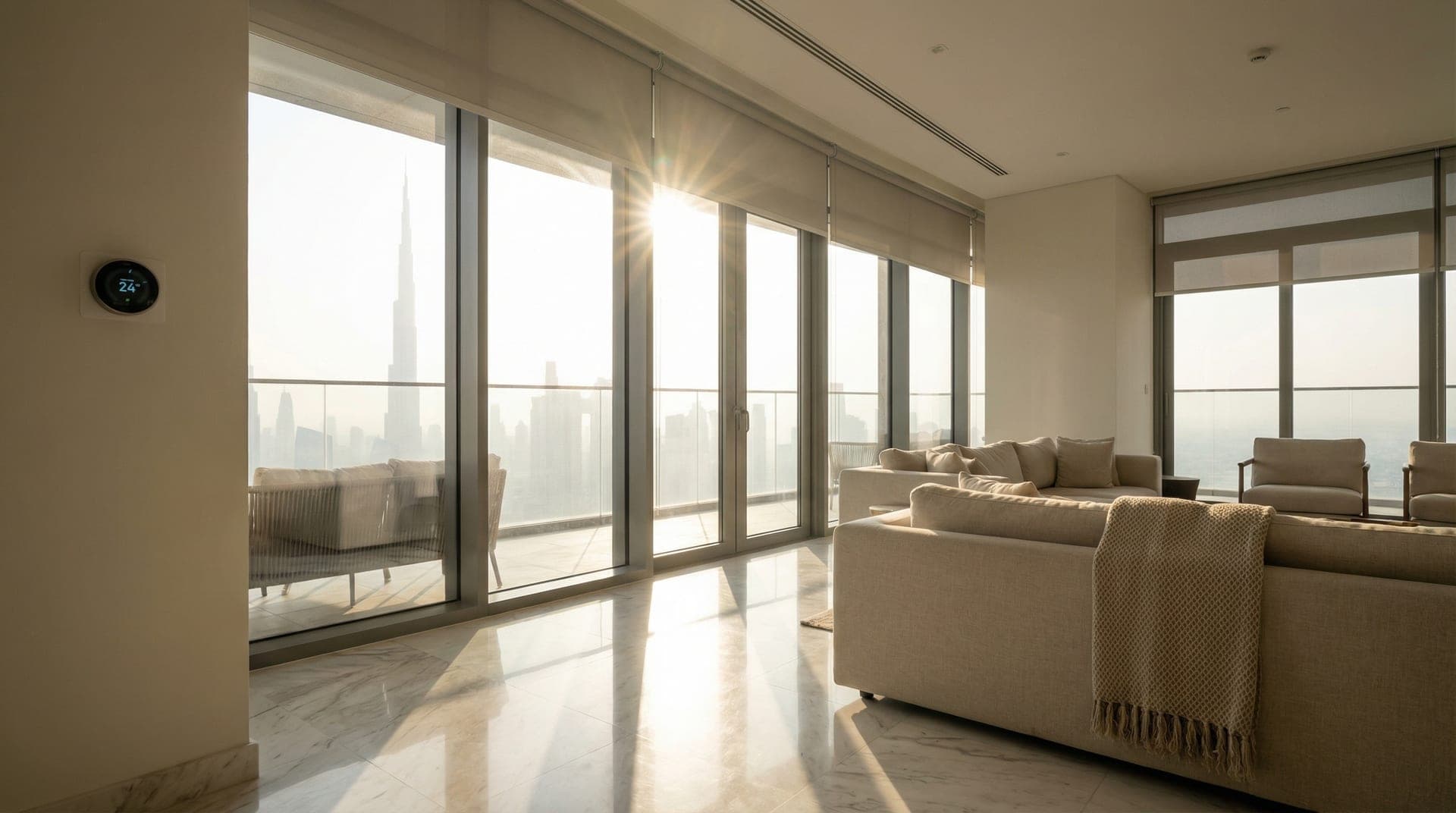
Your windows are working against your AC. Floor-to-ceiling glass in a west-facing or south-facing Dubai apartment lets in enough solar radiation to raise indoor temperatures by 4-6 degrees during peak afternoon hours. Your AC fights that heat gain constantly, running longer cycles to compensate for heat your blinds could have blocked.
Automated blinds that close at noon and open again after sunset prevent solar heat from entering in the first place. Independent studies of Dubai installations show cooling cost reductions of 25-35% when automated shading blocks peak sun hours (Serial UAE, 2025). One JLT penthouse owner cut peak summer cooling loads by 22% after installing eight automated blinds, saving roughly AED 2,100 per year.
When we set up automated blinds alongside smart AC control in apartments, clients consistently report that the combination delivers more savings than either system alone. The blinds reduce the heat your AC has to fight. The scheduling ensures your AC only runs when needed. The zone control ensures it only runs where needed. Together, they stack.
Battery-powered motorized blinds work in rentals with no drilling and no landlord approval. They cost AED 800-2,000 per window depending on size, and the energy savings from blocking afternoon sun typically cover the cost within one summer.
The Combined Savings: All Three Working Together
Here's a realistic comparison for a 2-bedroom apartment during peak 45C weeks, based on patterns we've seen across Dubai Marina, Business Bay, and JBR:
| No Smart Control | Smart Scheduling + Zone Control + Blinds | |
|---|---|---|
| AC hours per day | 18+ hours, all rooms | 10-12 hours, occupied rooms only |
| Solar heat gain | Unblocked, +4-6 degrees | Blocked 12pm-6pm |
| Monthly summer DEWA bill | AED 1,200-1,800 | AED 750-1,100 |
| Monthly savings | - | AED 400-700 |
| Summer savings (May-Sep) | - | AED 2,000-3,500 |
The numbers vary by apartment size, floor, window orientation, and personal comfort preferences. But the pattern holds: the three-system approach consistently outperforms any single fix by a wide margin. A 2022 study on residential zoning showed that combined scheduling and zone strategies achieved savings at the upper end of the 21-42% range (ScienceDirect, 2022).
Can Renters Install All Three Without Landlord Approval?
Yes. Every component is wireless, non-permanent, and removable.
Smart AC controllers communicate with your existing split unit using infrared signals, the same technology as your remote. They mount with adhesive or sit on a shelf. Battery-powered blind motors clip onto existing roller blind tubes without tools. Smart plugs and occupancy sensors plug into standard outlets.
When you move, everything comes with you. We've installed this full setup in rentals across JBR, Palm Jumeirah, Dubai Marina, and Downtown Dubai. Not a single landlord issue. For the full renter playbook, see our smart home guide for Dubai renters.
How Long Does the Full Setup Take?
A combined smart AC and blinds installation typically takes 2-3 days from survey to working system. The process starts with a free discovery call, followed by an on-site survey where we check your AC units, window sizes, WiFi coverage, and daily routine. We come back with a proposal that includes exact pricing for every component. No surprises.
If you're reading this before May, you have time to get everything set up before the heat peaks. If you're reading this in July with a AED 1,500 DEWA bill on your counter, the setup still pays for itself before summer ends.
Frequently Asked Questions
Does smart AC zone control work with Dubai's split AC units?
Yes. Smart controllers work with any split AC that has an infrared remote, regardless of brand or age. Each room gets its own controller, and you manage all of them through one app. The controllers learn your remote's signals during setup and replicate them on independent schedules per room.
How much can I save combining all three systems vs smart AC alone?
Smart AC scheduling alone typically saves 20-30% on cooling costs. Adding zone control pushes that to 25-35% by eliminating cooling in empty rooms. Adding automated blinds further reduces AC load by blocking solar heat gain. The combined approach saves 30-40% on total summer DEWA bills, compared to 15-20% from scheduling alone.
Do automated blinds work on all window types in Dubai apartments?
Battery-powered blind motors are compatible with most standard roller blind tubes found in Dubai apartments. For floor-to-ceiling windows, custom-size motorized rollers are available. During the on-site survey, we measure your windows and recommend the right motor type. Most 2-bedroom apartments need 4-6 motorized blinds for full coverage.
What's the minimum setup that makes a difference at 45C?
Start with smart AC scheduling for your main living areas. That single change stops the biggest source of waste: cooling an empty apartment all day. A basic setup starts from AED 3,000 installed. Add blinds for west-facing and south-facing windows as the next step, starting from AED 800 per window. You can expand to full zone control later.
Your DEWA bill at 45 degrees is a math problem with three variables: how long your AC runs, how many rooms it cools, and how much heat your windows let in. Most people only address one. The savings come from addressing all three at once.
Ready to see the numbers for your apartment? Get a free consultation and we'll survey your AC units, windows, and daily routine, then give you a complete recommendation with pricing. No obligation, no surprises.
Ready to Get Started?
Get a free consultation and we'll recommend what makes sense for your situation.
Get Free Consultation