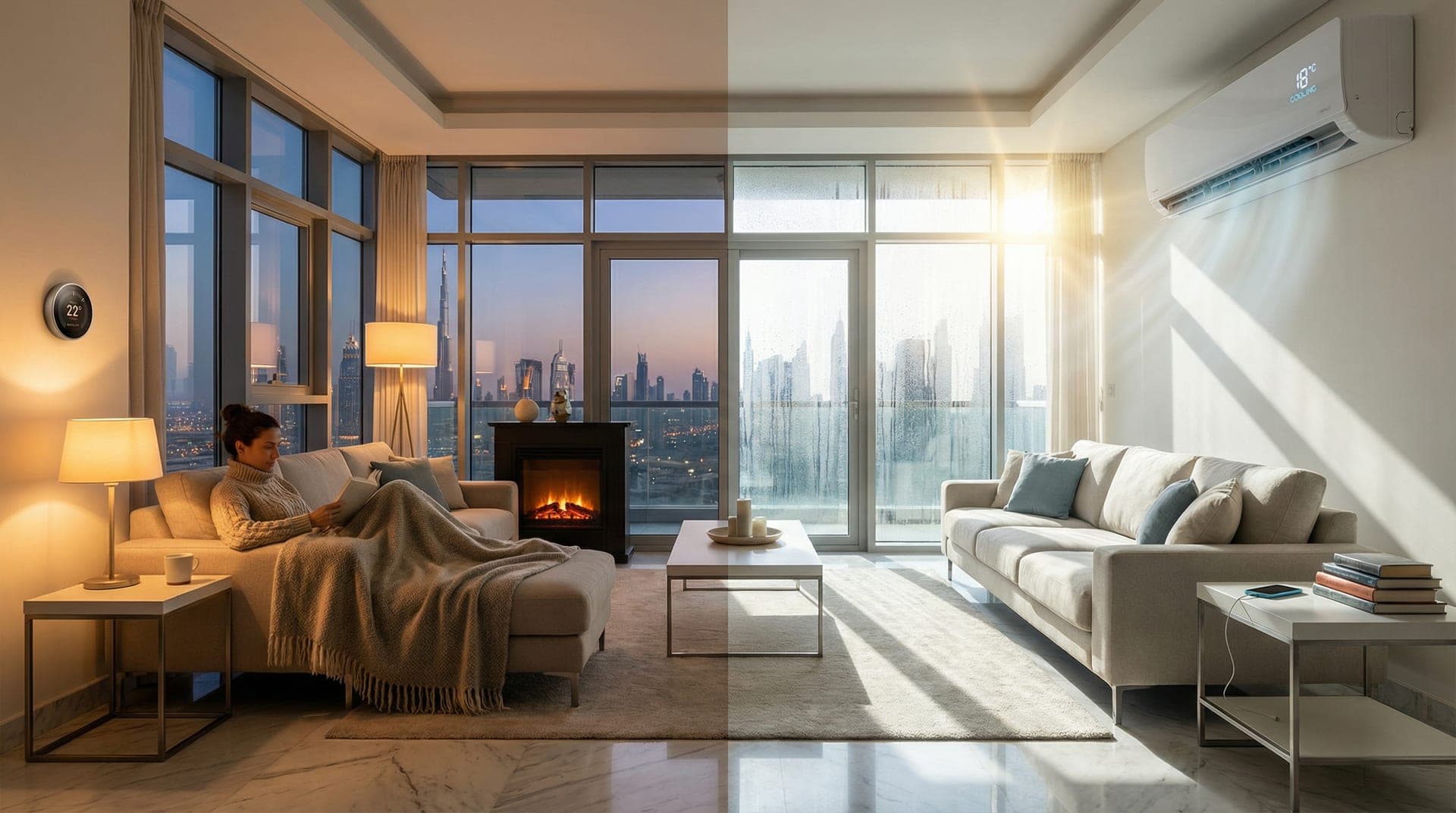
Your apartment runs two completely different electrical lives depending on the month.
In January, a 2-bedroom apartment in Dubai Marina or Business Bay uses around 20-25 kWh per day. The AC barely turns on. Lights run for a few evening hours. The fridge and water heater do their quiet background work. Your DEWA bill lands somewhere between AED 300-500 for the month (Utility Bill UAE, 2025).
In July, that same apartment consumes 55-65 kWh per day. The AC runs 16-18 hours. Your compressor cycles constantly to bridge the gap between 42 degrees outside and 24 degrees inside. The DEWA bill hits AED 900-1,400 (Khaleej Times, 2025). Some months, it climbs higher.
That's a 2.5-3x difference in daily electricity between the two months. And most of it comes down to one thing: how hard your AC has to work.
TL;DR: A typical 2-bedroom Dubai apartment uses 55-65 kWh per day in July versus 20-25 kWh in January. Air conditioning drives 60-70% of the summer total. The biggest waste happens during working hours when the AC cools an empty apartment. Smart AC scheduling eliminates 6-8 hours of unnecessary cooling per day, and smart thermostats cut cooling costs by 15-23% overall.
What Does a January Day Look Like, Hour by Hour?
A January day in Dubai is mild. Daytime highs reach about 24-25 degrees, and overnight lows dip to 14-16 degrees (Weather Spark, 2025). Most residents open windows or simply leave the AC off for weeks at a time. The apartment stays comfortable on its own.
Here's where the electricity goes on a typical January weekday in a 2-bedroom apartment:
Midnight to 6am (sleeping): The fridge runs its compressor cycle. The water heater holds temperature on standby, drawing about 80 watts averaged over the hour. Total draw: roughly 0.4-0.6 kWh per hour.
7am to 9am (morning routine): Lights on, kettle boiled, hair dryer, phone chargers. A brief spike to 1.5-2 kWh per hour, then back down as you leave for work.
9am to 5pm (apartment empty): Back to baseline. Fridge, water heater standby, maybe a router and a standby TV. About 0.3-0.5 kWh per hour. The sun heats the apartment through the windows, but at 24 degrees outside, it stays comfortable.
6pm to 11pm (evening at home): Lights, TV, cooking, laundry. Draw climbs to 1-1.5 kWh per hour. You might turn the AC on for an hour after cooking heats up the kitchen. That adds another 1.5 kWh.
Daily total: roughly 20-25 kWh. Monthly: 600-750 kWh. At DEWA's first slab rate of 23 fils per kWh (DEWA, 2026), the electricity portion of your bill stays under AED 175.
What Changes When July Arrives?
Everything. July in Dubai means 40-42 degree highs and 31-33 degree lows (Weather Spark, 2025). The temperature never drops below 30 degrees, even at 4am. Humidity pushes past 80% some nights. Opening a window makes things worse.
Your AC shifts from an occasional appliance to the primary system running your apartment. And it drags everything else with it.
Midnight to 6am (sleeping): AC runs continuously. A 1.5-ton split unit draws about 1.4-1.7 kWh per hour at steady state (Utility Bill UAE, 2025). With two bedrooms and a living area unit on standby, total AC draw is 1.5-2.5 kWh per hour. Add fridge and water heater and you're looking at 2-3 kWh every hour while you sleep.
7am to 9am (morning routine): AC still running. Morning appliances stack on top. Total draw: 3-4 kWh per hour. You leave for work.
9am to 5pm (the expensive window): This is where July and January diverge most. In January, the empty apartment barely draws power. In July, the AC keeps running in an empty apartment because nobody turned it off, or because people leave it on to avoid the 45-minute cool-down when they get home. Eight hours of AC cooling nobody, at 1.5-2.5 kWh per hour across units. That's 12-20 kWh burned on an empty apartment.
And between 12pm and 4pm, when outdoor temperatures peak, the compressor works hardest. DEWA's own data shows peak electricity demand falls between 12pm and 6pm (DEWA, 2026). Your apartment is part of that peak.
6pm to 11pm (evening at home): AC plus lights, cooking, entertainment. Draw hits 3-4 kWh per hour. If guests come over and you're cooling the living room extra, add more.
Daily total: roughly 55-65 kWh. Monthly: 1,650-1,950 kWh. At this consumption level, you've crossed into DEWA's second slab (28 fils/kWh above 2,000 kWh) and you're close to the third (32 fils/kWh above 4,000 kWh). The electricity portion alone hits AED 450-600. Add water, housing fee, sewerage, and municipality charges, and the total DEWA bill reaches AED 900-1,400.
Where Does the Extra 35-40 kWh Per Day Go?
Air conditioning accounts for 60-70% of a Dubai apartment's electricity during summer (SolarisKit, 2024). In a 2-bedroom apartment consuming 60 kWh per day in July, roughly 36-42 kWh is AC. In January, AC might account for 0-3 kWh.
The rest of the increase comes from three places:
Water heater works harder. In January, incoming water temperature from the mains is around 20-25 degrees, and the heater doesn't cycle as often. In July, ironically, tap water can run warm on its own from pipe heat, but storage heaters still maintain their set point and cycle whenever the thermostat triggers. The net difference is small, maybe 1-2 kWh extra per day.
Fridge works harder. Kitchen temperatures run warmer in summer, so the compressor runs more frequent cycles to maintain the same internal temperature. Add 0.5-1 kWh per day.
Lighting stays roughly the same. January has shorter days, so lights might run slightly longer. This factor nearly cancels out between seasons.
The AC is the story. It's responsible for 33-40 of those extra daily kWh.
How Does DEWA's Slab Tariff Make Summer Worse?
DEWA uses a progressive slab system that charges more per unit as consumption rises (DEWA, 2026). This means summer electricity is more expensive per kWh, not just in volume.
The four residential slabs:
- 0-2,000 kWh: 23 fils/kWh
- 2,001-4,000 kWh: 28 fils/kWh
- 4,001-6,000 kWh: 32 fils/kWh
- 6,001+ kWh: 38 fils/kWh
In January, a 2-bedroom apartment consuming 700 kWh pays 23 fils for every unit. Straightforward.
In July, the same apartment consuming 1,800 kWh still stays within the first slab. But a 3-bedroom apartment, a villa, or anyone with older AC units can push past 2,000 kWh and start paying 28 fils for every additional unit. That's a 22% premium on top of already using three times the electricity.
Residents in villas across Arabian Ranches or Dubai Hills regularly consume 4,000-6,000 kWh in summer months, pushing into the 32-fil slab. Their bills can exceed AED 2,500-3,500 for electricity alone.
Can You Actually Reduce the July Number?
Yes, and most of the opportunity sits in one place: those 8 daytime hours when the AC cools an empty apartment.
When we survey apartments in Downtown Dubai and JBR, we find the same pattern. People leave for work between 7am and 9am and come home between 5pm and 7pm. During those 8-10 hours, the AC runs in every room because turning it off means coming home to a 35-degree apartment that takes 45 minutes to cool down.
Smart AC scheduling solves this differently. Instead of running all day or shutting off completely, a smart AC controller turns off the AC after you leave and turns it back on 30-45 minutes before you get home. Your apartment is 24 degrees when you walk in. The AC ran for 30 minutes instead of 8 hours.
That's 7-8 hours of cooling eliminated per day. At 1.5-2.5 kWh per hour across units, that's 10-20 kWh saved daily. Over a July billing cycle, that's 300-600 kWh, or AED 70-170 per month in electricity charges alone.
ENERGY STAR data shows smart thermostats save 8-15% on cooling costs on average (ENERGY STAR, 2025). Independent studies of real users show savings of 15-23% depending on usage patterns and climate (Consumer Reports, 2024). In Dubai's climate, where cooling dominates the bill, the percentage tends toward the higher end because there's simply more waste to cut.
Do Blinds and Zone Control Make a Difference?
Two other changes compound the savings.
Automated blinds block solar heat gain before it hits. Between 10am and 4pm, sun streaming through floor-to-ceiling windows can raise room temperature by 3-5 degrees, forcing the AC to work harder even when you're home. Motorized blinds that close on a schedule during peak sun hours reduce the cooling load without you thinking about it. In our experience setting up automated shading in Palm Jumeirah apartments with west-facing windows, clients notice the AC cycles less frequently in the afternoons.
Zone control stops cooling rooms nobody is in. In a 2-bedroom apartment, the living room AC might run all night while you sleep in the bedroom, and the bedroom AC runs all day while you're in the living room. Smart zone control keeps the active room comfortable and lets unused rooms drift. That can cut cooling by another 20-30% in apartments with multiple split units.
When we've installed all three, the combined effect is significant. Smart scheduling removes the biggest block of waste. Blinds reduce the load during peak hours. Zone control eliminates room-by-room waste. Together, a July day that would have drawn 60 kWh can drop to 38-45 kWh. That brings your summer monthly consumption closer to the first DEWA slab, where every unit costs 23 fils instead of 28 or 32.
What Would a "Smart" July Day Look Like?
Same apartment, same July heat, same 42 degrees outside. But with smart AC control, automated blinds, and zone scheduling:
Midnight to 6am: Bedroom AC runs at 24 degrees. Living room and guest bedroom AC are off. Draw drops from 2-3 kWh to 1.5-2 kWh per hour.
7am to 9am: You leave. AC turns off automatically 15 minutes after the last person exits (motion sensor or phone geofence).
9am to 4:30pm: AC is off. Blinds close at 10am to block solar gain. The apartment drifts to 32-34 degrees, but nobody is there to care.
4:30pm: AC turns on automatically. Blinds open. By 5:15pm, the apartment is 24 degrees.
5:15pm to 11pm: Normal evening. AC runs in occupied rooms only.
Daily total: roughly 38-45 kWh. That's 15-25 kWh less than the unmanaged version. Over a month, that's 450-750 kWh saved, or AED 100-215 in electricity charges.
The January version of this same apartment doesn't change much with automation because there isn't much waste to eliminate. The AC was barely running in the first place. Smart home automation earns its keep in summer.
Frequently Asked Questions
How much electricity does AC use per hour in Dubai?
A typical 1.5-ton split AC unit consumes 1.4-1.7 kWh per hour during continuous operation. Inverter models are 30-50% more efficient, drawing 0.7-1.2 kWh per hour. A 2-ton unit draws 1.8-2.2 kWh per hour (Utility Bill UAE, 2025). Actual consumption depends on the temperature gap between indoor and outdoor, insulation quality, and unit age.
Why is my DEWA bill so much higher in summer than winter?
Air conditioning drives the difference. AC accounts for 60-70% of a Dubai apartment's summer electricity (SolarisKit, 2024). In winter, the AC barely runs, so your bill reflects only baseline appliances. DEWA's slab tariff also charges more per unit at higher consumption levels, compounding the increase.
Can renters install smart AC control without landlord permission?
Yes. Smart AC controllers like Sensibo or Cielo Breez attach externally to your existing split unit. They connect via WiFi and control your AC through infrared, the same way your remote does. No wiring changes, no wall modifications, no landlord approval needed. Take them with you when you move.
What is the cheapest DEWA electricity rate in Dubai?
The lowest residential slab is 23 fils per kWh for the first 2,000 units consumed per month (DEWA, 2026). Above 2,000 kWh, the rate jumps to 28 fils. Above 4,000, it's 32 fils. Above 6,000, it's 38 fils per unit. Keeping consumption in the first slab saves you 22-65% per unit compared to higher tiers.
Does smart AC control work with central cooling systems?
Smart AC controllers work with any split AC unit that has an infrared remote. Central cooling systems in Dubai (common in some older buildings and district cooling areas) require a different approach. For centrally cooled apartments, smart thermostats that connect to the existing HVAC system provide similar scheduling and automation benefits.
Your July DEWA bill doesn't have to be a surprise.
The difference between January and July electricity in Dubai is predictable. It happens every year, in the same months, for the same reasons. And the biggest chunk of waste, cooling an empty apartment for 8 hours every workday, is the easiest part to fix.
A smart AC setup starts from AED 3,000 installed, works with your existing split units, and needs no wiring or landlord approval. Most of our clients see the difference on their first summer DEWA bill.
Curious what this would look like for your apartment? Get a free consultation and we'll walk through your specific setup, rooms, and schedule.
Ready to Get Started?
Get a free consultation and we'll recommend what makes sense for your situation.
Get Free Consultation