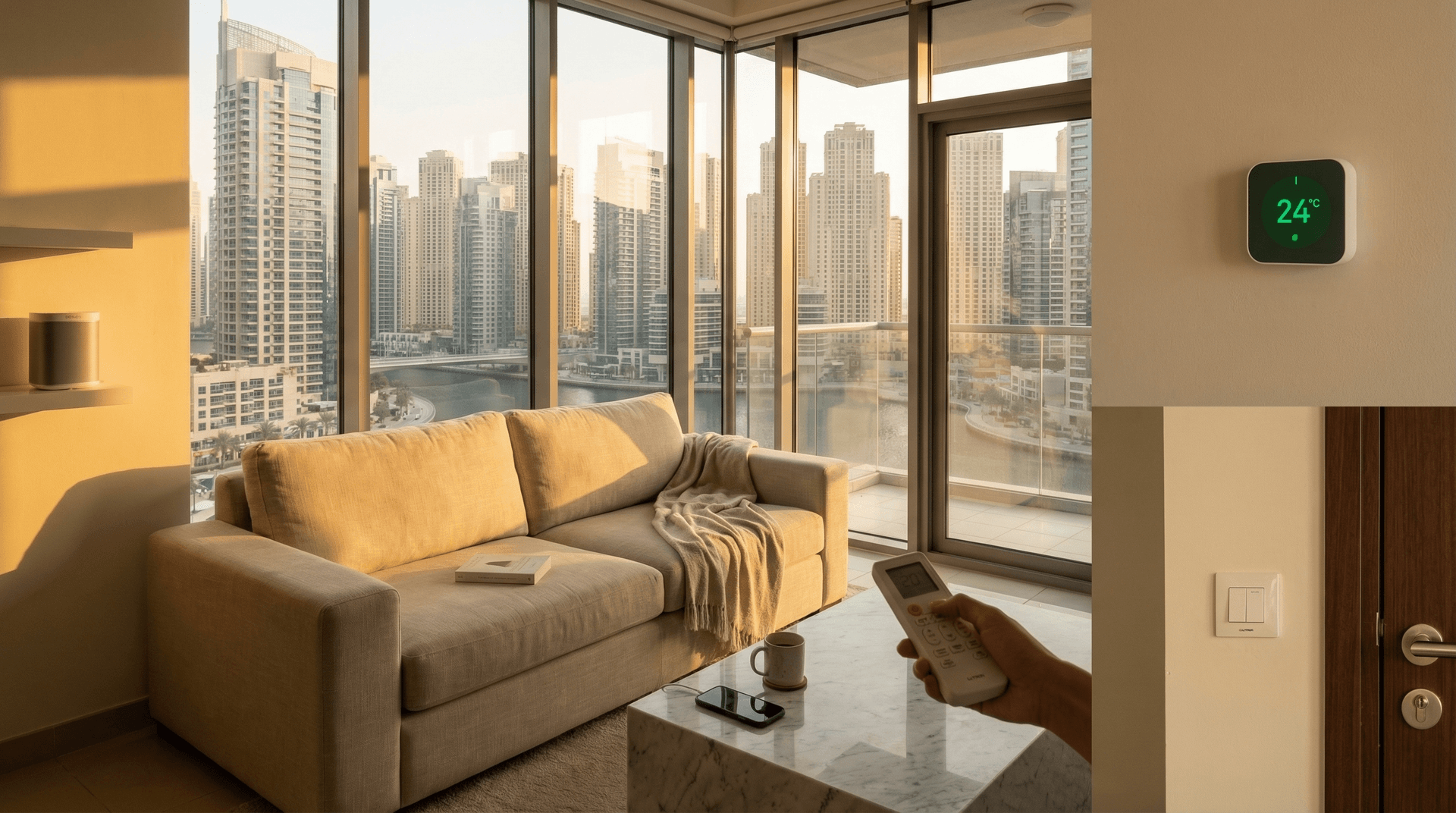
You're probably running your AC 4 degrees colder than you need to.
Walk into most apartments in Dubai Marina, Business Bay, or Downtown during summer and check the AC remote. You'll see 20 degrees. Sometimes 18. A few people go all the way to 16 because they want their apartment cold fast after walking in from 45-degree heat outside.
DEWA recommends 24 degrees (DEWA, 2026). That's not some arbitrary comfort guideline. It's the temperature where your AC runs efficiently without burning through electricity. The gap between where most people set their thermostat and where it should be is costing real money. Across a full Dubai summer, that gap adds up to roughly AED 3,000.
TL;DR: Every degree below 24 on your AC increases electricity consumption by 5-8%. Running at 20 instead of 24 adds AED 500-600 per month to your summer DEWA bill. Over five months (May through September), that's AED 2,500-3,000. A smart AC controller with scheduling and pre-cooling eliminates the urge to blast cold air, keeping you comfortable at 24 while cutting costs.
Why Does Every Degree Cost So Much?
Each degree you lower your AC temperature increases energy consumption by 5-8% (Daikin MEA, 2025). That percentage compounds fast when you're running multiple degrees below the recommended setting for months at a time.
Here's the math for a typical 2-bedroom apartment with two split AC units. At 24 degrees during summer, you're looking at roughly AED 600-700 per month in cooling costs, which represents 60-70% of an average summer DEWA bill of AED 900-1,100 (SolarisKit, 2024). Drop the thermostat to 20 degrees and those cooling costs jump by 20-32%. That's AED 120-225 extra per month on cooling alone.
But it gets worse. DEWA's slab tariff means you pay more per unit the more you consume (DEWA, 2026). The first 2,000 kWh costs 23 fils per unit. Cross 2,000 kWh and you're at 28 fils. Past 4,000 kWh, it jumps to 32 fils. Running your AC colder pushes your total consumption into higher slabs, so you're paying premium rates on every extra unit of electricity. The combined effect of higher consumption and higher per-unit rates is what turns a 4-degree difference into AED 500-600 per month.
What Makes People Set Their AC So Low?
The problem is behavioral. Nobody wakes up and decides to waste AED 3,000 on electricity. It happens through a pattern that repeats in almost every apartment we've surveyed.
You leave for work at 8am. The AC turns off (or you forget and it runs all day). You come home at 6pm to a 34-degree apartment. The marble floors have absorbed heat all afternoon. The windows have been letting in solar radiation for eight hours. So you grab the remote, set it to 18, and wait for the apartment to cool down. By the time it's comfortable, you might adjust up to 22. Maybe you forget to adjust at all and it runs at 18 for the next four hours.
In our experience, this cycle repeats 4-5 times per week across a typical Dubai summer. The apartment overheats, the resident overcorrects, and the AC runs at maximum output for hours.
The overnight version of the same problem
People set the AC to 20 before bed because they want the bedroom cold. But at 3am your body temperature drops naturally, and 20 degrees becomes uncomfortably cold. You wake up, pull a blanket over yourself, and the AC keeps running at full power against a room that's already too cold. DEWA recommends 25 degrees for sleeping (DEWA, 2026), and most sleep research agrees that 24-26 is the range where your body recovers best.
How Does Pre-Cooling Fix This?
Pre-cooling is the single change that breaks the overcooling cycle. Instead of walking into a hot apartment and blasting the AC to 18, your apartment is already at 24 when you open the door.
A smart AC controller sends a signal to your AC unit 30-45 minutes before you arrive home. It starts cooling to 24 degrees while you're still at work. By the time you walk in, the apartment is comfortable. There's no urge to crank it lower because the temperature is already where it should be. You never touch the remote.
When we set this up for clients in JBR and Dubai Marina, the feedback is always the same: they stopped thinking about the AC entirely. The apartment is cool when they arrive, adjusts to a comfortable sleep temperature at night, and turns off when they leave in the morning. The thermostat stays at 24-25 because there's no reason to go lower.
That behavioral shift, from reactive cooling to scheduled cooling, is what saves the AED 3,000. You're not sacrificing comfort. You're removing the moment where discomfort leads to overcooling.
What Does AED 3,000 in Savings Actually Look Like?
Let's break down a real summer scenario. Two people sharing a 2-bedroom apartment in Dubai Hills, both working office hours, current habit of setting AC to 20 degrees.
Without smart control (May through September):
- AC runs at 20 degrees from 6pm to 8am (14 hours daily)
- Forgotten and left running at work 3 days per week (8 extra hours)
- Guest bedroom AC runs overnight despite being empty
- Average monthly summer DEWA bill: AED 1,200
With smart control at 24 degrees:
- Pre-cools to 24 at 5:30pm, 30 minutes before arrival
- Shifts to 25 at midnight for sleeping
- Off at 8am automatically
- Guest bedroom only runs when occupied
- Average monthly summer DEWA bill: AED 780
That's AED 420 per month. Over five summer months, that's AED 2,100 in direct savings. Factor in the slab tariff benefit, where lower total consumption means cheaper rates on every unit, and the real savings push toward AED 2,500-3,000.
A smart AC setup starts from AED 3,000 installed, including controllers, configuration, and custom scheduling built around your routine (Bayora). The math works out to full payback in the first summer, with every following summer being pure savings.
Can Renters Do This Without Landlord Approval?
Yes. Smart AC controllers work with any split AC that has a remote. They communicate using infrared, the same technology as your existing remote. The controller sits on the wall with an adhesive strip or on a shelf near the AC unit. No drilling, no wiring, no changes to the apartment's electrical system.
When you move, you take it with you. It works with your next apartment's AC regardless of brand. We've installed these in rentals across JBR, Business Bay, Dubai Marina, and Downtown Dubai without a single landlord issue. Our renter's guide covers the full setup if you want more detail.
What About Combining Temperature Control With Other Fixes?
Temperature setting is the biggest lever, but it works even better alongside a couple of other changes.
Automated blinds that close during peak sun hours (12pm-5pm from May through September) reduce solar heat gain by blocking radiation before it heats your apartment. Research from a UAE-based study found that passive cooling measures like shading can reduce AC demand by up to 40% (The National, 2024). When your apartment stays cooler naturally, your AC at 24 degrees runs shorter cycles because there's less heat to fight.
Scheduling your water heater off during summer saves another AED 100-160 per month. We covered this in detail in our post on the 3 appliances running 24/7 in every Dubai apartment. And our full breakdown of why DEWA bills spike in summer covers the other hidden factors beyond AC temperature.
Frequently Asked Questions
Is 24 degrees actually comfortable in a Dubai apartment?
Yes. The discomfort people associate with 24 degrees usually comes from walking into a hot apartment and waiting for it to cool down. When your apartment is already at 24 before you arrive, it feels comfortable immediately. Humidity plays a role too. If your AC is properly maintained and dehumidifying effectively, 24 degrees feels cool and dry. Most clients who switch from 20 to 24 with pre-cooling tell us they don't notice a difference in comfort.
How much does each degree below 24 actually cost?
Each degree increases cooling consumption by 5-8%. For a 2-bedroom apartment spending AED 650 per month on summer cooling, dropping from 24 to 22 adds roughly AED 65-105 per month. Going to 20 adds AED 130-210. Going to 18 adds AED 195-315. The cost compounds because DEWA's slab tariff charges higher rates as total consumption increases.
Does turning AC off during the day and blasting it cold later save money?
No. Cooling a 34-degree apartment down to 20 uses more energy than maintaining 24-25 degrees with scheduled pre-cooling. The AC compressor works at maximum output for 45-60 minutes to bring a hot apartment down, which is the most energy-intensive mode. Pre-cooling to 24 degrees from a 30-degree apartment (after being off most of the day) is far less work for the compressor.
Can I set different temperatures for different times of day?
Yes. Smart AC controllers support multiple schedule blocks per day. A typical setup runs off from 8am to 5:30pm, pre-cools to 24 at 5:30pm, shifts to 25 at midnight for sleeping, and turns off at 8am. Weekends get a separate schedule. Some controllers also adjust based on occupancy or outdoor temperature automatically.
Will this work with my older AC unit?
Smart controllers work with any split AC that uses an infrared remote, regardless of brand, model, or age. If your AC has a remote control, it can be made smart. The controller learns your remote's signals during setup and replicates them on schedule. We've set these up on units ranging from brand new to over 10 years old.
Your AC remote has been costing you AED 3,000 every summer. Replace it.
The fix is straightforward. Stop cooling reactively and start cooling on a schedule. Set 24 degrees as your baseline. Let pre-cooling handle the transition from work to home. Let night mode handle the temperature shift while you sleep. The comfort stays the same. The DEWA bill drops by AED 400-600 per month.
Curious what this looks like for your specific apartment? Get a free consultation and we'll map out a cooling schedule for your routine, estimate your DEWA savings, and give you a complete recommendation with pricing. No obligation, no surprises.
Ready to Get Started?
Get a free consultation and we'll recommend what makes sense for your situation.
Get Free Consultation