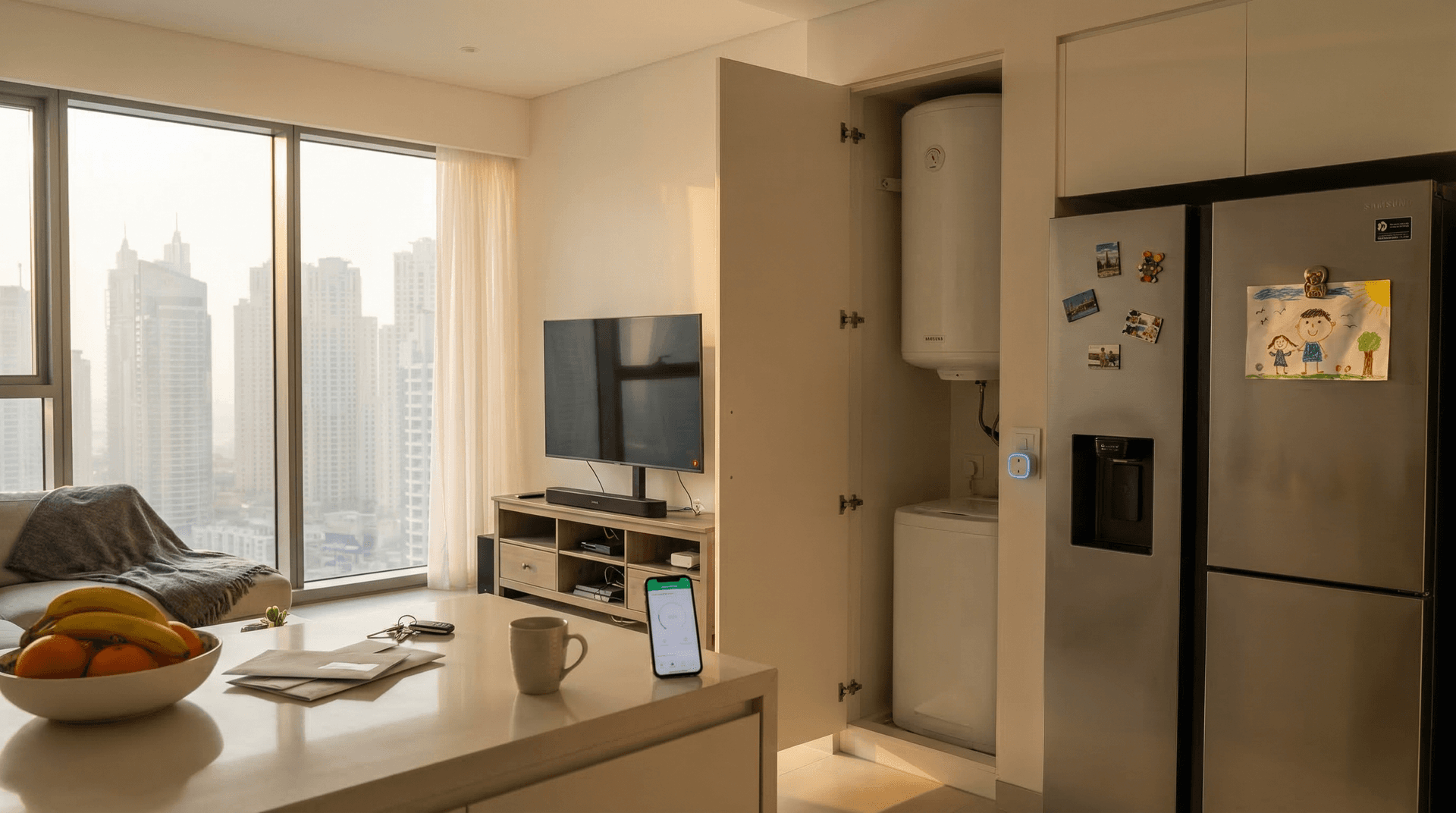
Everyone blames the AC. The real culprits are quieter.
Walk into any apartment in Dubai Marina, Business Bay, or Downtown and three appliances are silently drawing power right now. Not occasionally. Not when you're home. Around the clock, whether you're sleeping, at work, or on a weekend trip to Oman.
Your air conditioning gets all the attention when DEWA bills arrive. We've written about how smart AC control cuts cooling costs by 20-30% and why summer bills spike beyond just the AC. But the three appliances in this post are different. They run year-round, winter and summer, and most people never think twice about them.
TL;DR: Your storage water heater, refrigerator, and always-on electronics (TV, router, gaming console, set-top box) run 24/7 and quietly add AED 250-450 to your monthly DEWA bill. Simple fixes like smart plugs, heater scheduling, and fridge placement changes can cut that by 30-50% without changing your daily routine.
How Much Is Your Water Heater Costing You?
More than you think. A standard 2,000-watt storage water heater cycles on and off throughout the day to keep its tank hot, even when nobody is using a single drop. That standby cycling consumes roughly 360 kWh per month (Utility Bill UAE, 2025). At DEWA's rates, that's AED 100-160 added to your bill every month, depending on which tariff slab you're in.
In our experience, this is the number that shocks clients the most. The water heater sits behind a cupboard door, makes zero noise, and quietly burns through electricity to keep 50-80 litres of water hot for the 15-20 minutes someone actually runs a tap.
During summer in Dubai, you barely need it at all. Tap water naturally reaches 35-40 degrees because of pipe temperatures underground (Utility Bill UAE, 2025). Plenty warm for a comfortable shower. That means your heater spends five months a year maintaining a tank temperature you don't even notice.
What to do about it
Put your water heater on a timer or smart plug. Schedule it to run for one hour before your typical shower time and stay off the rest of the day. A basic smart plug costs AED 50-80 and pays for itself in the first month. If you want to understand what is going on inside that little box before you buy one, we broke down how smart plugs actually work, and what you should never plug into one. During summer (May through September), turn it off entirely. Most people don't notice any difference.
Is Your Fridge Quietly Draining Your DEWA Bill?
Yes, and in Dubai it's worse than in most places. Your refrigerator is the one appliance that genuinely needs to run 24/7. You can't schedule it or turn it off. But the amount of electricity it uses varies wildly based on two factors most people overlook: the ambient temperature around it and how old the unit is.
A modern energy-efficient double-door fridge (300-400L) uses about 30-45 kWh per month in normal conditions. A larger side-by-side or French-door model consumes 48-75 kWh per month (Utility Bill UAE, 2025). That translates to roughly AED 15-35 per month at DEWA's lower tariff slabs.
Here's the part specific to Dubai: refrigerators work harder when the surrounding air is warmer. UAE's hot climate increases fridge consumption by 15-25% compared to cooler regions (Emirates Appliances, 2025). If your fridge sits next to the oven, near a window catching afternoon sun, or in a kitchen that's not air-conditioned during the day, it's running overtime. A 3-star rated model in a warm Dubai kitchen can consume double what a 5-star model uses in an air-conditioned space.
What to do about it
Keep your fridge away from heat sources. Make sure there's at least 10cm of clearance behind it for airflow. If your kitchen heats up during the day while you're at work, automated blinds on kitchen windows reduce the ambient temperature your fridge has to fight. When we installed blinds in a JBR apartment last year, the client's kitchen stayed 4-5 degrees cooler during afternoon hours, which made a measurable difference on the fridge compressor's duty cycle.
If your fridge is more than 8-10 years old, replacing it with a 4-5 star rated model cuts consumption by up to 50%. That's one of the highest-return appliance swaps you can make.
What Are Phantom Loads and Why Should You Care?
Every plugged-in device in your apartment draws power, even when you think it's off. Your TV on standby. The set-top box with its clock display. The gaming console in sleep mode. The WiFi router. The microwave with its digital clock. The washing machine waiting for its next cycle.
Individually, each device pulls 1-15 watts. But add them all up across a typical Dubai apartment and standby power accounts for 5-10% of total household electricity use, according to the U.S. Department of Energy (DOE, 2024). The NRDC found that "idle load electricity" from always-on devices accounts for up to 23% of power consumption in some households (NRDC, 2024).
For a Dubai apartment with a monthly DEWA bill of AED 600-900, that's AED 30-90 per month going to devices that aren't doing anything useful. Over a year, you're looking at AED 360-1,080 spent powering things you're not using.
When we set up smart home systems in apartments across Dubai, the entertainment centre is always the worst offender. A TV, soundbar, streaming box, and gaming console together can draw 40-60 watts on standby. That's like leaving a light bulb on in a room nobody enters.
What to do about it
A smart power strip (AED 80-150) lets you cut power to your entire entertainment centre with one tap or on a schedule. Your WiFi router needs to stay on, but almost everything else can be fully powered down when you're asleep or at work. Smart plugs with energy monitoring show you exactly which devices are the worst offenders, so you can target the biggest wins first.
How Do These Costs Add Up on Your DEWA Bill?
Here's a realistic monthly breakdown for a 2-bedroom apartment in Dubai:
- Storage water heater (standby cycling): AED 100-160
- Refrigerator (24/7 operation): AED 15-35
- Phantom loads (TV, set-top box, console, microwave, washer): AED 30-90
- Router and modem (24/7, but necessary): AED 5-10
That's AED 150-295 per month before your AC even turns on. In summer, when your total bill climbs to AED 800-1,200 (Khaleej Times, 2025), these "background" appliances represent a larger share than most people realize.
And because DEWA uses a progressive slab tariff - 23 fils/kWh for the first 2,000 kWh, jumping to 28 fils, then 32 fils, then 38 fils as consumption increases (DEWA, 2026) - every extra kWh from always-on appliances pushes your remaining usage into more expensive territory. Cutting 200 kWh of background waste doesn't save you just AED 46-64 on those units. It can also pull the rest of your bill into a cheaper slab, saving even more.
What Does a Full Fix Actually Cost?
For most apartments, the total investment is surprisingly small:
- Smart plugs for water heater and entertainment centre (3-4 plugs): AED 150-300
- Smart power strip for entertainment area: AED 80-150
- Energy monitoring plug (to identify worst offenders): AED 60-100
That's AED 290-550 for the full setup. If it saves AED 80-150 per month (conservative estimate from water heater scheduling alone plus phantom load reduction), the payback period is 2-4 months. After that, every month is pure savings.
For a more complete approach, combine this with smart AC control and automated blinds to address the full picture. We covered the complete summer setup and costs in our summer-proofing guide.
Frequently Asked Questions
Can I just turn off my water heater completely in summer?
Yes. During Dubai's summer months (May through September), tap water runs at 35-40 degrees naturally because of underground pipe temperatures. Most residents don't notice any difference with the heater off. Turning it off saves AED 100-160 per month with zero effort.
How much electricity does a TV use on standby in Dubai?
A modern TV draws 1-5 watts on standby. But the real cost comes from the full entertainment setup: a TV plus set-top box, soundbar, streaming device, and gaming console can pull 40-60 watts combined on standby, costing AED 10-20 per month. A smart power strip cuts all of them at once.
Will a smart plug actually reduce my DEWA bill?
A smart plug on your water heater alone typically saves AED 60-120 per month by eliminating standby heating. On entertainment systems, savings run AED 10-25 per month. The plug costs AED 50-80 and pays for itself in 1-2 months. It's one of the highest-return purchases in any Dubai apartment.
Does my fridge use more electricity in summer?
Your fridge works harder when the surrounding air is warmer. In Dubai's climate, this increases consumption by 15-25% compared to cooler environments. Keep the fridge away from heat sources, ensure proper ventilation behind it, and consider automated blinds on kitchen windows to reduce afternoon heat buildup.
What's the easiest first step to lower my always-on electricity costs?
Put your water heater on a timer or smart plug. It takes 5 minutes to set up, costs under AED 80, and saves AED 60-160 per month depending on season. No other single change delivers that kind of return.
Your DEWA bill has a background noise problem. Fix it for under AED 300.
Most people try to lower their electricity bill by adjusting the AC thermostat or turning off lights. Those help. But the three appliances running 24/7 in your apartment are costing you AED 150-295 per month whether you're home or not. A few smart plugs and one afternoon of setup cuts that by a third or more.
Curious what your specific apartment is wasting? Get a free consultation and we'll walk through your space, check your water heater setup, identify your phantom loads, and recommend exactly where to start. No obligation, no surprises.
Ready to Get Started?
Get a free consultation and we'll recommend what makes sense for your situation.
Get Free Consultation