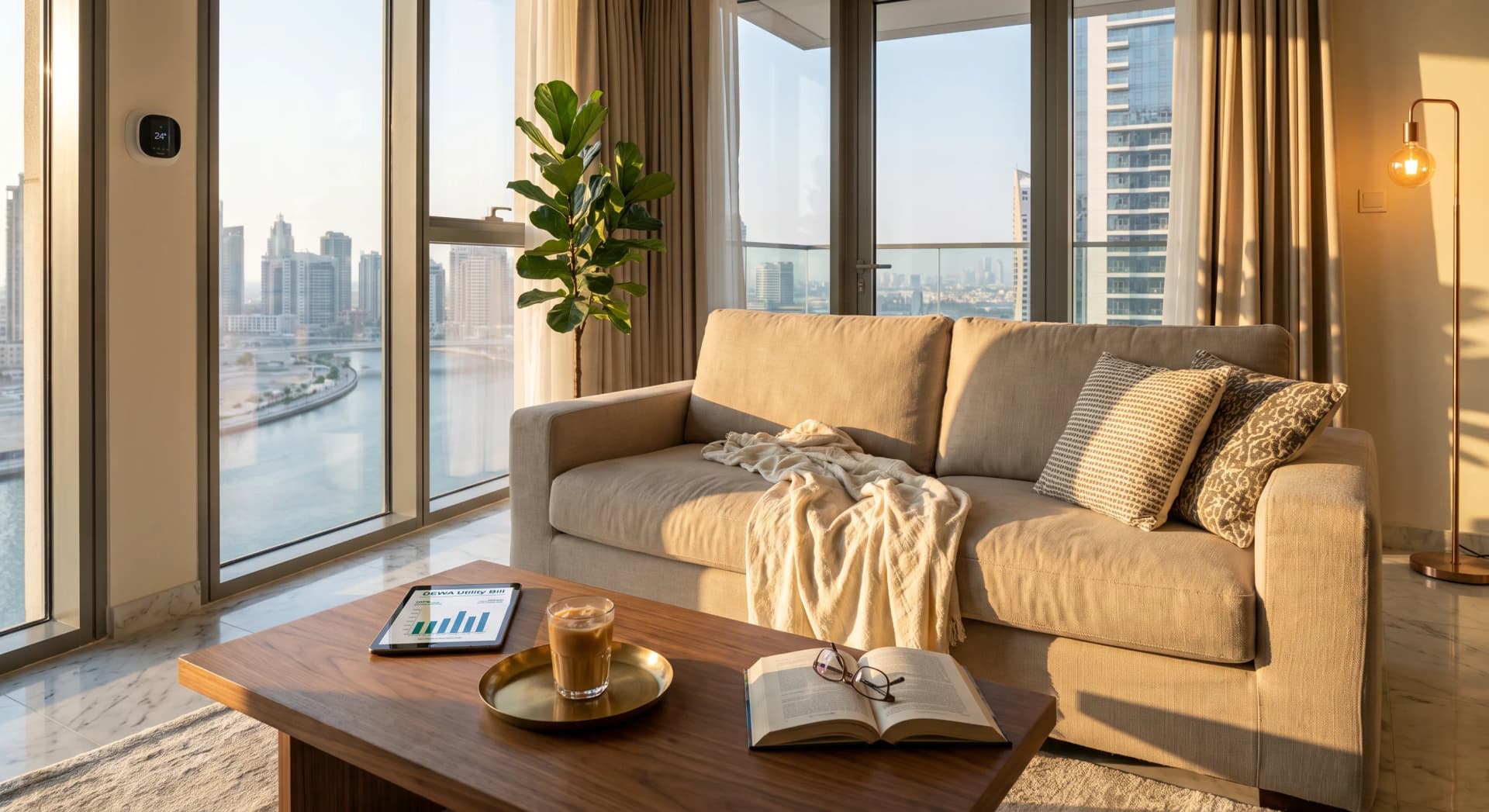
You moved into a tower in Business Bay, set up your DEWA account, and waited for the summer bill everyone warned you about. It came, and it was smaller than you expected. Then a second bill arrived, from a company called Empower, and that one was the real one. It had words on it you had never seen before. Consumption charge. Demand charge. RT. And a line you still pay in a month you spent mostly at the office.
This is the part of a Dubai apartment nobody explains before you sign the lease. In a large share of the city's towers, your cooling does not come from DEWA at all. It comes from a district cooling provider, on its own invoice, with its own rules. And the reason your neighbour in a low-rise building can cut their cooling bill by a third while you cannot is not that they are smarter. It is that their bill and yours are built completely differently.
TL;DR: In district-cooled buildings like most of Business Bay, Downtown, and JLT, your AC comes from Empower or Emicool, not DEWA, on a separate bill. That bill has two parts: a consumption charge you can move by using less cooling, and a fixed capacity charge set by your apartment's size that you pay even when the flat sits empty. A smart thermostat on your fan coil unit lowers the consumption part. Nothing lowers the capacity part. Knowing which is which is the whole game.
We install smart AC control across Dubai, and the first thing we do when someone in a district-cooled tower asks us to cut their cooling bill is show them their own invoice. Half the time they have never looked past the total. Here is what is on it, why it is shaped the way it is, and the honest limit of what any smart home can do about it.
Your Cooling Comes From a Chiller Plant, Not Your AC
In a district-cooled building, there is no compressor humming on your balcony. Cold water is made at a central plant somewhere in the district, pumped through insulated pipes to your tower, and run through a small unit inside your apartment called a fan coil unit. A wall thermostat tells that unit how fast to blow and how much cold water to let through. That is your entire climate system: a thermostat, a fan, and a valve. It still has a filter and a drain to keep clean, which is most of what AC servicing means in a district-cooled flat.
Empower is the largest of these providers. It connects over 1.6 million refrigeration tons of cooling capacity across 1,684 buildings in Dubai (Dubai Media Office, 2025). Its Business Bay plant alone holds a Guinness World Record for serving 201 buildings from one site (Dubai Media Office, 2024). Emicool runs the same model across Dubai Investment Park, Motor City, Sports City, and DAMAC Hills, with six plants and more than 330,800 tons of capacity (Emicool, 2025). If you live in Business Bay, Downtown, JLT, JBR, DIFC, Bluewaters, or on the Palm, there is a strong chance your cooling is district-supplied (Bayut, 2025).
The practical effect is simple. You are not paying DEWA to run a machine. You are buying cold water from a utility, and that utility bills you like one.
The Two Charges on a District Cooling Bill
A district cooling bill splits into two very different numbers, and telling them apart is the single most useful thing you can learn about your apartment.
The first is the consumption charge. This is metered, like electricity. Empower bills it at AED 0.568 per refrigeration ton-hour, about 57 fils, and Emicool at a similar rate (Utility Bill UAE, 2026; Gulf News, 2024). You will see that rate written as "0.568 fils" in a lot of UAE coverage, including Empower's own charges page. That is a units slip that has been copied around. The charge is AED 0.568, not half a fils. The more cooling you pull, the more this line grows. Run the flat at 19 degrees with the balcony door open and it climbs. Hold it at 24 and let it rest while you are out and it drops. This is the part of the bill that responds to you.
The second is the capacity charge, sometimes called the demand charge. Empower sets it at AED 750 per refrigeration ton per year, billed monthly in advance (Bayut, 2025). It is based on the cooling load your apartment was designed for, not on what you use. A flat rated at six tons pays around AED 4,500 a year in this charge before it has cooled a single room (Gulf News, 2024). On top of both sits a small meter fee, around AED 30 a month, plus five percent VAT (Bayut, 2025).
One of these two numbers moves with your behaviour. The other one does not. Everything else in this article follows from that.
Why You Pay the Capacity Charge Even When You Are Not There
The capacity charge is the part that catches people off guard, because it is charged whether the apartment is occupied or empty. Leave for the summer, switch the thermostat off completely, and the consumption line drops to almost nothing. The capacity line keeps arriving every month at the same amount (Gulf News, 2024). A two-bedroom owner can be paying around AED 6,000 a year in capacity charge alone, on a flat that used no cooling for weeks.
The logic behind it is that the provider has to build and hold enough plant capacity to cool your apartment on the hottest day of the year, whether you use it or not. That reserved capacity costs money to keep ready, so you pay for it as a standing charge. Whether that is fair is a separate conversation, and one the regulator handles. In Dubai, district cooling is overseen by the Regulatory and Supervisory Bureau, which licenses providers, approves tariffs, and runs a dispute process for customers who think a charge is wrong (Khaleej Times, 2021). Only charges the Bureau has authorised are allowed on the bill (RSB Dubai, 2021).
For our purposes, the takeaway is blunt. No thermostat, no schedule, no automation, and no smart home of any kind touches the capacity charge. It is fixed by your apartment's size. Anyone who tells you a device will lower it is selling you something.
What a Smart Home Changes Here
Here is the honest version, because it is not the version most companies lead with. A smart home in a district-cooled apartment works on the consumption charge only. That is the metered part, and on an occupied summer flat it is the bigger of the two lines, not the smaller. Across Empower's whole book, the fixed demand charge accounts for roughly AED 1.3 billion of AED 3.42 billion in 2025 revenue (Dubai Media Office, 2026). What no thermostat touches is the capacity charge, and pretending otherwise would be dishonest.
Your fan coil unit already has a thermostat on the wall. A smart thermostat replaces it and gives you three things that a basic dial does not. It holds a schedule, so the flat is not cooling hard at three in the afternoon when nobody is home. It lets you set the temperature from your phone before you get back, so you stop the habit of blasting it cold the second you walk in to catch up. And it stops the quiet waste, the bedroom held at 21 all day for a room used at midnight. Fan coil units are built to work with smart thermostats and scheduling, so this is a straight swap, not a renovation (Finpower, 2025). What the swap does need is the right converter between the thermostat and your fan coil, which is the line most quotes leave out.
In our experience, the residents who overpay on the consumption line are almost never doing it through one dramatic mistake. They are doing it through a setpoint that never changes and a flat that cools empty rooms all day. A schedule fixes both without asking you to feel warm. If you want the full picture of what smart control does to a metered cooling bill, our guide to smart AC control in the UAE walks through the setup for both district-cooled and chiller-free homes.
District-Cooled or Chiller-Free: How to Tell, and Why It Decides Everything
Before you spend a dirham, find out which kind of building you are in, because it changes the entire strategy. If you get one monthly bill from DEWA and no separate cooling invoice, you are in a chiller-free building, your AC runs on metered DEWA electricity, and smart AC scheduling can move your summer cooling cost meaningfully, often by twenty to thirty percent (US DOE, 2024). If a second invoice arrives from Empower or Emicool, you are district-cooled, and the split above applies.
The confusion runs both ways, which is why we wrote a companion piece on why your DEWA bill jumped this summer for chiller-free readers trying to find the culprit inside a single DEWA bill. District-cooled residents have the opposite problem: the cooling is not hiding inside the DEWA bill, it is a whole separate bill they were never taught to read. Both start the same way, by looking past the total to the lines underneath.
If you are choosing between apartments and you value control over your cooling cost, a chiller-free building hands you more of it. That decision has its own guide: what to check before you sign a Dubai lease covers what "chiller free" actually means on a listing and the questions worth asking at the viewing, while this page is for reading the bills once they start arriving. We also cover what it looks like in practice in our guide to Business Bay apartments, where both models exist within a few streets of each other.
Where a Smart Home Still Earns Its Place in a District-Cooled Flat
If cooling is only half the argument, the rest of the case for a smart home in a district-cooled apartment is the part that has nothing to do with the chiller bill. And that part is often the stronger one.
Your lighting, your blinds, your security, and your entertainment all run on DEWA electricity and your own devices, exactly as they would in any building. Motorized blinds that drop before the afternoon sun hits the glass reduce the heat load your fan coil unit has to fight, which nudges the consumption line down as a side effect. Smart lighting, a video doorbell, leak sensors near the water heater, and one-tap scenes are all yours to build regardless of who supplies your cold water. For most of our clients in towers, the honest recommendation is to put a smart thermostat on the fan coil unit for the schedule, then spend the rest of the budget on the whole-home layer where it delivers comfort and peace of mind rather than chasing a capacity charge that will not move. If you want us to look at your setup and tell you plainly what is worth doing, tell us about your apartment and we will give you an honest recommendation, no obligation.
Frequently Asked Questions
Is district cooling cheaper than a normal AC in Dubai?
Not necessarily, and the comparison is not straightforward. District cooling removes the compressor and its maintenance from your apartment, but adds a fixed capacity charge you pay year-round based on your flat's size (Gulf News, 2024). A chiller-free flat gives you more control over the cost through how you run the AC. Which works out cheaper depends on your building and your habits.
Do I still get a DEWA bill if my building has district cooling?
Yes. DEWA still bills you for electricity and water, which cover your lighting, appliances, water heater, and everything except the cooling. The district cooling provider, usually Empower or Emicool, sends a separate invoice for the cold water that runs your fan coil units. Most district-cooled residents pay two bills every month.
Can a smart thermostat lower my Empower or Emicool bill?
It lowers the consumption part, not the fixed capacity charge. A smart thermostat on your fan coil unit holds a schedule and stops the flat cooling empty rooms, which reduces the metered ton-hours you use. The capacity charge is set by your apartment's cooling load and does not change no matter how you run the thermostat.
Why am I charged when my apartment is empty?
The capacity charge pays for the provider holding enough plant capacity to cool your flat on demand, so it continues whether you are there or not (Gulf News, 2024). Consumption drops to near zero in an empty flat, but the standing capacity charge keeps arriving. If you think a charge is wrong, the Regulatory and Supervisory Bureau handles district cooling disputes in Dubai.
Which Dubai areas use district cooling?
Much of Business Bay, Downtown, JLT, JBR, DIFC, Bluewaters, and the Palm are served by Empower, while Emicool covers Dubai Investment Park, Motor City, Sports City, and DAMAC Hills (Bayut, 2025). Many mid-range and low-rise communities are chiller-free and run on DEWA-metered electricity instead. Check whether a second cooling invoice arrives to know which one you are in.
Ready to figure out your own two bills? Get a free consultation and we will read your invoice with you and tell you exactly what is worth changing, and what is not.
Ready to Get Started?
Get a free consultation and we'll recommend what makes sense for your situation.
Get Free Consultation