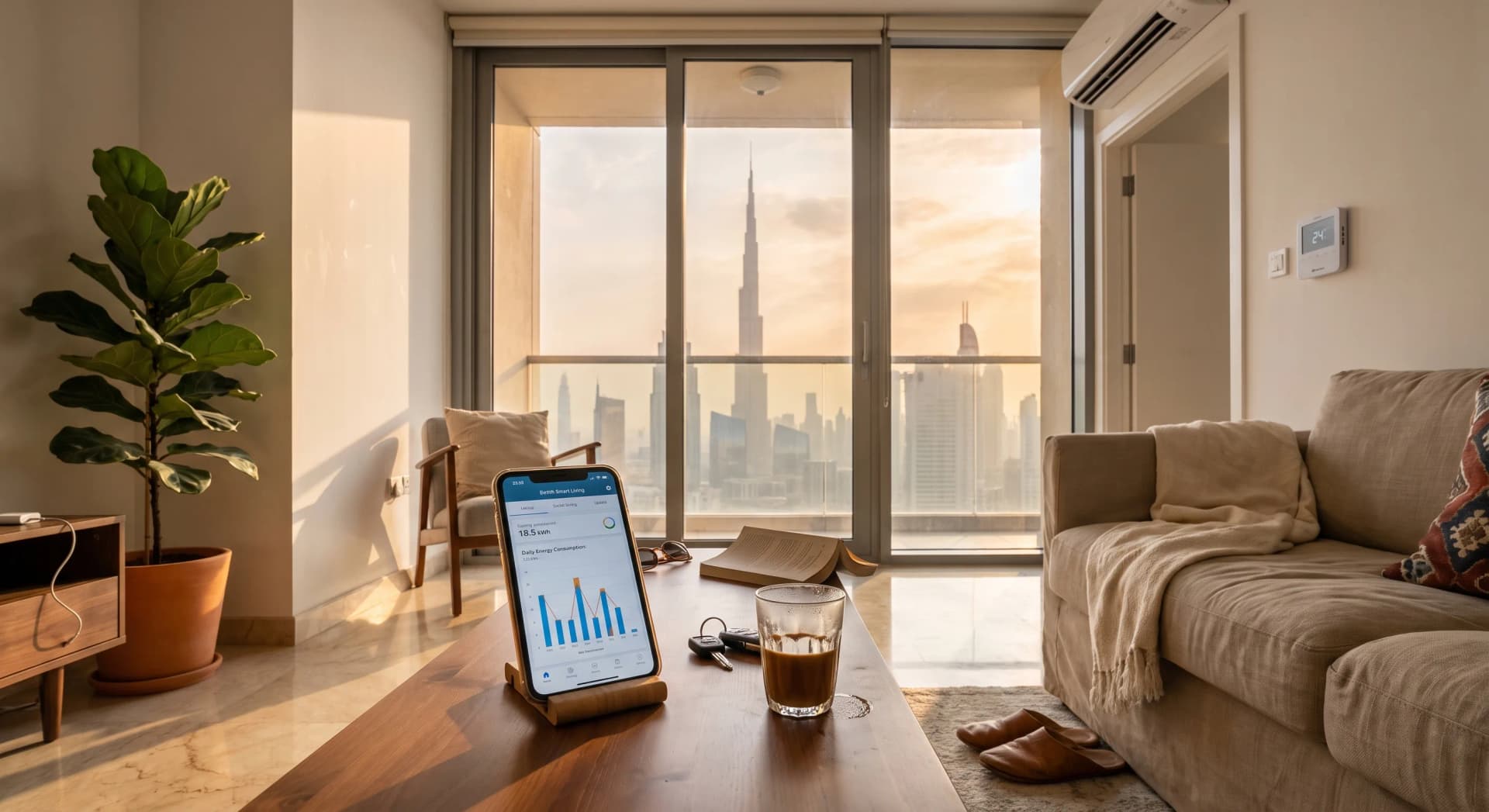
You opened the DEWA app, saw the number, and did the thing everyone does. You read it twice. Then you tried to remember whether you left something on.
That is the whole problem. Your bill went up by a few hundred dirhams and you have no way to know what did it. Was it the AC? The water heater nobody turns off? The spare room you cool for no reason? You run your entire life from that phone. You can see where every Careem went and what every Deliveroo cost. But the biggest recurring bill in your home is a single mystery number once a month, and the only advice you can find online is "service your AC" from the company that wants to service your AC.
TL;DR: Your summer DEWA bill jumped because cooling is 60 to 70 percent of it, and small changes to how your AC runs move the number more than any gadget. Before you buy anything, open the DEWA Smart Living app to see your hourly usage, separate the electricity charge from the housing fee that rides on the same bill, and find the one room or setting doing the damage. Fix the habit first. Buy hardware only for what a habit cannot fix.
We are a smart home company. We install smart AC control for a living. And the first thing we tell people staring at a scary DEWA bill is to spend nothing until they know what they are fixing. Most summer bill shocks come down to two or three specific things, and one of them usually is not even electricity. Here is how to find yours.
First, Cooling Is Almost the Whole Bill
Air conditioning is 60 to 70 percent of a typical Dubai home's electricity in summer (Khaleej Times, 2025). Cooling is where roughly 70 percent of the whole emirate's power goes at the summer peak, so inside your own apartment the story is the same: the AC is the bill (The National, 2025).
That single fact reshapes the whole search. If cooling is two thirds of the bill, then the lights, the chargers, the TV, and the "energy vampires" every generic article tells you to unplug are the small stuff. When we walk into an apartment where the owner has switched every bulb to LED and is still shocked at the bill, the LED swap was worth doing, but it was never going to move a number that AC controls. Start where the money is. The money is in how your AC runs.
The Bill Is Higher Than It Feels Because of the Slab
DEWA does not charge one flat rate. It charges in slabs that get more expensive the more you use (DEWA via egsh.ae, 2026). The first 2,000 units cost 23 fils each, the next band to 4,000 costs 28 fils, then 32 fils, then 38 fils past 6,000. The rates stack, so you are never charged the top rate on everything, only on the units above each line.
Here is why that matters for a summer shock. In winter a two-bedroom apartment might sit comfortably inside the first slab. In July the same home runs the AC for eighteen hours a day, sails past 2,000 units, and every extra unit now costs more than the ones before it. Nothing changed about your habits. The rate underneath them did. A summer that "feels the same" bites harder because you crossed into a pricier slab without noticing. This is also why cutting a bit of usage in a high month is worth more than cutting the same amount in a low-usage month. You are shaving units off the top, expensive band.
Part of Your High Bill Is Not Even Electricity
Before you blame the AC for all of it, separate two numbers on the statement. Your DEWA bill carries the Dubai Municipality housing fee, which is 5 percent of your annual rent, split across twelve months (DEWA via egsh.ae, 2026). On an AED 80,000 rent that is about AED 333 every single month, and it has nothing to do with how much you cool your home.
So a chunk of what you read as "my electricity is out of control" is a fixed municipal charge that would be there if you switched everything off and left for the summer. And if you live in a tower in Business Bay, Downtown, or JLT, your cooling might not be on this bill at all. It arrives separately from a district cooling provider like Empower or Emicool, on its own two-part invoice. Add the fuel surcharge of around 6 fils per unit and 5 percent VAT on top, and the real question is not "why is my bill AED 900." It is "how much of that AED 900 is actual cooling I can change." One thing clients always ask is why the bill did not drop when they travelled. Usually it is this: the housing fee never left. Find the electricity consumption line, in units, and work with that number. Ignore the rest for diagnosis.
Open the App You Already Have
Dubai has installed around two million smart meters across the city (Time Out Dubai, 2024). If yours is one of them, you already own the best diagnostic tool in this article and it costs nothing. The DEWA Smart Living app shows your consumption by the hour, with daily and monthly graphs, and it compares you against your own past months and against similar homes (DEWA, 2024).
Open it and look at the shape of a normal day. You are looking for the answer to one question: when does my usage climb, and does it climb when nobody is home. If the graph shows a wall of consumption from 9am to 6pm on a weekday while the apartment is empty, you have found your culprit. The AC is cooling an empty home at full effort. If the line spikes hard every evening, that is your occupied-hours setpoint. The app turns a mystery number into a timeline, and the timeline points at the fix. We have sat with clients over this graph and watched the moment land, when they see the flat plateau of a machine cooling nobody, all day, every workday.
The Setpoint Is a Setting, Not a Fault
Here is the culprit people least want to hear about, because it is not a broken part. It is a number they chose. Every degree lower on the thermostat raises cooling energy by roughly 3 to 8 percent, and the US Department of Energy points to 25 degrees as the comfort and efficiency balance (US Department of Energy, 2025).
Run an apartment at 20 degrees all summer instead of 24 and you are not paying for a fault. You are paying for four degrees, invisibly, on the most expensive slab, for four months. In our experience this is the single most common reason a bill looks worse than a neighbour's identical flat, and we see it constantly in the tower apartments around Business Bay. Same building, same size, same sun. One runs at 24 and pre-cools before people get home. The other runs at 20 around the clock because someone set it once in May and never touched it again. The fix here is free. Nudge the setpoint up two degrees and let the room hold it. If the room cannot hold a sensible temperature, that is a different culprit, and now you know to look at the room, not the number.
If you are not sure whether it is the setting or a tired unit, one afternoon with a thermometer tells you which to fix first.
The Empty-Room Problem
Walk your apartment at 3pm on a workday and count the rooms being cooled that nobody is in. The spare bedroom. The study. The guest room that hosts someone twice a year. In a Dubai summer, cooling a closed, unused room is money leaving the building for no return, because that room is fighting 45 degrees on the other side of the glass whether you are in it or not.
This is where zones matter more than gadgets. If your whole apartment cools as one block, you cannot spare the empty room without cooking yourself in the occupied one. If the rooms you use can hold a comfortable temperature while the unused ones drift, the bill follows the people, not the floor plan. You can test the idea for free first. Close the vents and doors on one unused room for a week, watch the Smart Living graph, and see if the daily total drops. If it does, you have proof that zoning is worth solving properly rather than a hunch.
Where a Gadget Actually Earns Its Place
Everything above is free or nearly free. Read the app, move the setpoint, close a door. Do those first. A smart home only earns its cost where a habit cannot solve the problem, and there are exactly two places it does.
The first is the empty home. You cannot remember to pre-cool before you leave the office, and you should not have to. A smart AC controller lets the apartment cool itself in the half hour before you arrive and back off while you are out, so you stop paying to cool an empty room without lifting a finger. That is a real fix for a real gap, and it starts from AED 3,000 installed. The second is visibility you cannot get from DEWA alone. An energy-monitoring smart plug on a suspect appliance, around AED 60 to 90 and fully removable when you move, tells you what that old fridge or that media cabinet actually draws, so you stop guessing. Leave that plug out of your schedules, and take it off again once you have the number. If you rent, both of these come with you. Neither needs a landlord's permission or a single hole in the wall.
One exclusion: not the AC. It pulls too much to run through a plug at all, meter or no meter, which is why the cooling side gets the controller above instead. We explain the limit in how smart plugs actually work.
What We Will Talk You Out Of
Being a smart home company that tells people to spend less sounds backwards, so here is the honest version. If your summer jump is the setpoint, we will not sell you a system. We will tell you to move the number and check the app in a month. If it is one empty room, that is a controller and maybe a sensor, not a whole-home project.
We will talk you out of a wall-mounted touchscreen that does nothing an app does better. We will talk you out of chasing phantom load first, because standby power is only 5 to 10 percent of a home's electricity while your electronics idle for about 6,500 hours a year (Lawrence Berkeley National Laboratory, 2024). Worth tidying, never the reason your July bill doubled. And we will talk you out of replacing a working AC because a maintenance company told you to, until you have ruled out the free fixes first. If the AED 3,000 starter solves it, we are not pitching AED 25,000. Find the culprit, match the fix to it, and stop there.
What Changes
The point of all this is not a lower number, although the number does come down. The point is that the bill stops being a monthly ambush. You open the app, you know what your home is doing and why, and you decide what it costs instead of finding out after the fact. Your home should know your schedule better than you do. The bill is just the place you notice when it does not.
For a full walk-through of the cooling side once you have found your culprit, our smart AC control guide for the UAE covers the controller-versus-thermostat question for apartments and villas, and our DEWA summer conservation guide goes deeper on the settings that move the graph. If the room cannot hold temperature at all, a smart ceiling fan lets the AC do less work for the same comfort.
Frequently Asked Questions
Why is my DEWA bill so high in summer when nothing changed?
Because cooling is 60 to 70 percent of a Dubai summer bill, and DEWA charges in slabs that get more expensive as you use more. Running the AC for eighteen hours a day pushes you into a pricier rate band, so a summer that feels identical to last month costs more per unit. The habit did not change. The rate underneath it did.
How can I see what is actually using my electricity in Dubai?
Open the DEWA Smart Living app if you have a smart meter, which most Dubai homes now do. It shows consumption by the hour with daily and monthly graphs and compares you to similar homes. Look for when your usage climbs, especially any wall of consumption while the apartment is empty during work hours.
Does part of my DEWA bill have nothing to do with electricity?
Yes. Your bill carries the Dubai Municipality housing fee, 5 percent of your annual rent split over twelve months, plus a fuel surcharge and 5 percent VAT. On AED 80,000 rent the housing fee alone is about AED 333 a month and stays the same no matter how little you use. For diagnosis, work only with the electricity consumption line in units.
How do I lower my AC bill in a Dubai apartment without buying anything?
The free fixes first. Nudge the thermostat up two degrees, since each degree lower adds roughly 3 to 8 percent to cooling energy. Stop cooling empty rooms. Check the Smart Living graph for waste during work hours. Only after that does a smart AC controller, from AED 3,000, earn its place by cooling an empty home for you automatically.
Should I unplug appliances to reduce my Dubai electricity bill?
Not as your first move. Standby power is only 5 to 10 percent of a home's electricity, so unplugging chargers will not explain a summer bill that doubled. Cooling is where two thirds of the money goes. Fix how the AC runs first, then tidy up phantom load as a small extra, not the main event.
Not sure which culprit is yours? Tell us about your apartment and we will help you read the bill and tell you honestly whether it is a free fix or worth a controller. No obligation, and no pressure to do the whole place at once.
Ready to Get Started?
Get a free consultation and we'll recommend what makes sense for your situation.
Get Free Consultation