A family of three in an older one-bedroom in JVC posted their DEWA bill in a Dubai residents' forum in early September. AED 1,360 one month, AED 1,480 the next. Under it sat the question that turns up again and again in some form: is this normal?
The replies did what replies do. The top one said the bill could be right if the AC runs all day and night. Others said to check for a water leak, to ask whether the chiller is billed separately, to get the AC serviced because it is probably working too hard. None of the replies we read asked the question that sorts those answers into the right pile. When the AC is on, does the room actually reach the temperature you set?
That question matters because two common causes of a high cooling bill look identical on paper. Either the machine has lost capacity and runs longer to do the same job, or it is working perfectly, doing exactly what it was told, for hours when nobody needed it. Only the first is a job for an AC technician, and paying for a service when the real fault is the schedule leaves the bill where it was.
TL;DR: Set the room to 24°C for a hot afternoon and watch a thermometer. If it gets there and holds, the AC is probably fine, and the bill is about how long and how cold it runs. If it stalls even with the blinds shut and you have split units, book a service: filters, coil, drain and a leak check, because a gas top-up without a leak repair is money you will spend again. In a district-cooled flat, clean the filter, then call building management.
Two Problems That Look the Same on a Bill
A dirty split AC and a badly scheduled one both show up as more kilowatt hours on a DEWA bill. The bill cannot tell you which one you have, and neither can a stranger replying to your post.
Dust on the filter and the coil means less air moves across the cold surface, so the unit runs longer to pull the same heat out of the room. ENERGY STAR's maintenance checklist, written for central systems, says dirty coils "reduce the system's ability to cool your home and cause the system to run longer, increasing energy costs and reducing the life of the equipment" (ENERGY STAR).
If the unit is healthy, the extra hours come from demand. It is cooling a bedroom nobody is in, holding a setting that crept down to 20°C over the summer, or running from the moment the last person leaves in the morning. We walk through that side room by room in why your DEWA bill jumped this summer.
Plenty of homes have a bit of both. The test below tells you which to fix first.
How to Tell If Your AC Needs a Service: The Setpoint Test
- Pick a hot afternoon and the room that bothers you most.
- Put a basic digital thermometer at sitting height, away from the vent and out of direct sun.
- Leave the AC off for an hour so the room is properly warm.
- Set it to cool at 24°C with the fan on high, and note the time.
- Check the thermometer every half hour for three hours. If it reads within a degree of 24°C, count the room as having reached its setting.
If the room has a wall thermostat that shows the room temperature, not just the setting, that will do for a first pass.
One of three things happens.
The room gets within a degree of 24°C and stays there. Your AC has the capacity it needs. If the bill is still high, look first at when and where it runs, and keep the filters clean anyway.
The room gets close and stalls more than a degree above the setting through the hottest part of the afternoon. Often that is the sun rather than the AC. West-facing glass in the late afternoon can outrun a perfectly clean unit, which is the 3pm problem. To tell which, run the test again the next day with the blinds or curtains fully closed. If the room now reaches its setting, the sun was the problem, and shading fixes it better than a service does. If it still stalls, treat it as the next case.
The room is still well above the setting three hours in, even with the blinds shut, and the AC has blown hard the whole time. That is a capacity problem. On a split unit, book a service. On district cooling, read that section below first, because the fix may not be the coil.
While you are standing under the unit, look for the other signs a technician should see. Water dripping from the indoor unit, or a stain spreading on the wall below it, usually means a blocked drain, and ENERGY STAR notes that "a plugged drain can cause water damage in the house and affect indoor humidity levels." A musty smell when the AC starts, or weaker airflow than you remember, points at the filter and coil.
What an AC Service in Dubai Actually Includes
The U.S. Department of Energy's basic homeowner list starts with three jobs: clean or replace filters routinely, check the evaporator coil every year and clean it as necessary, and keep the drain channels clear. It adds a few outdoor-unit chores, such as clearing debris from a split system's condenser, and says to hire a certified professional when the unit needs more than basic maintenance (U.S. Department of Energy, Home Cooling 101).
On the day we checked, 10 September 2026, Urban Company listed split AC cleaning in Dubai from AED 149 per unit, described as filter, vent and coil cleaning, and a one-hour AC inspection at AED 49, marked down from AED 99 (Urban Company). Ducted and central systems have their own menu on the same page, from AED 119 per unit for a basic filter-and-vent clean, with the coil included from AED 399. If your AC is ducted, blowing from ceiling grilles fed by a hidden unit, those ducted tiers are the ones to compare. Hausfits, a Dubai home-services company, puts a deep clean (coil, drain and blower) at AED 300 to 500 per unit in its 2026 price guide, and a gas refill at AED 250 to 600 (Hausfits).
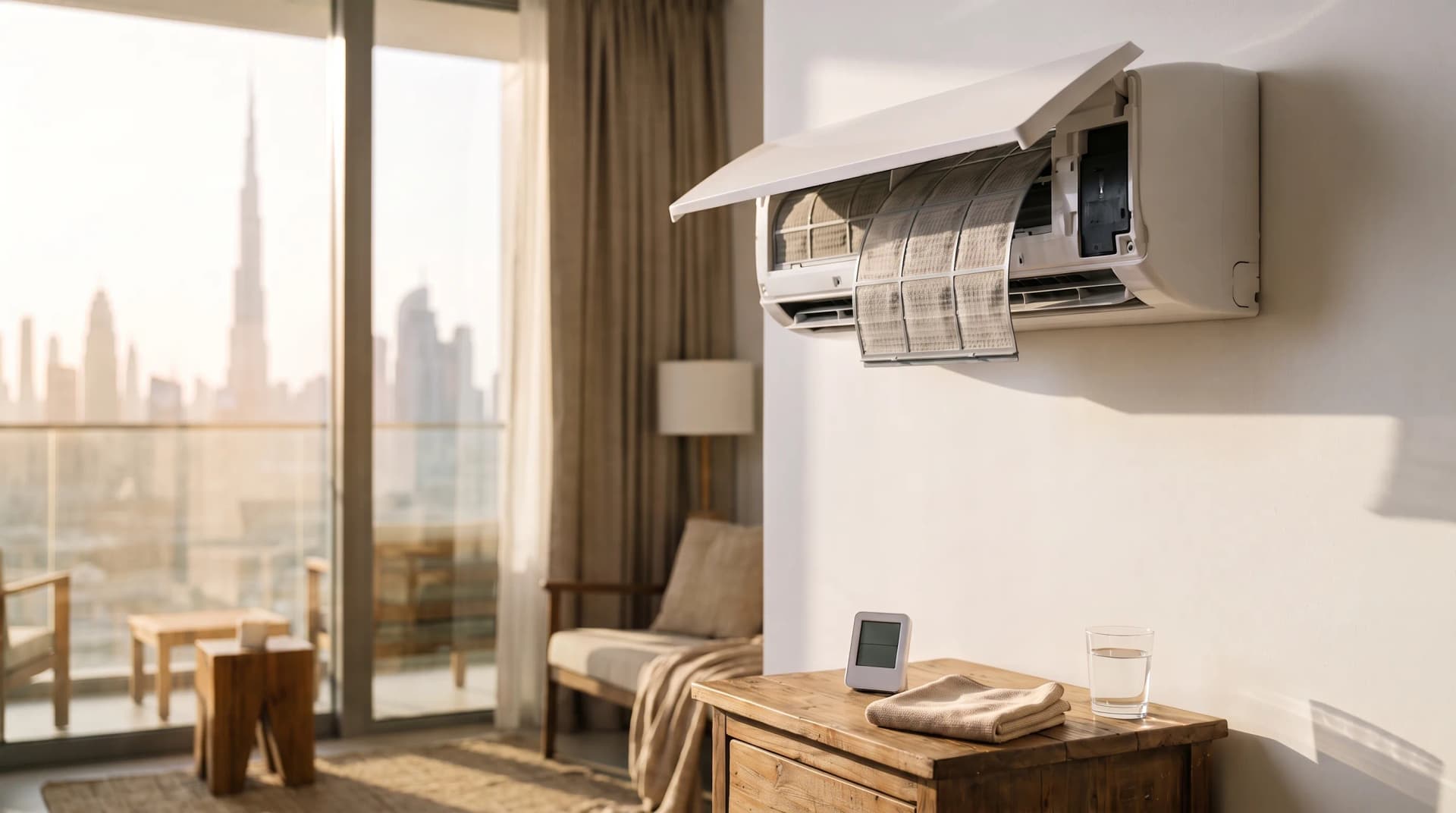
The filter is the part you can do yourself, and it has the clearest payoff. DOE says routinely replacing or cleaning your filters "can lower your air conditioner's energy consumption by 5-15 percent." On most split units the filters are mesh panels behind the front cover. They lift out, rinse under a tap, and slide back in once they are completely dry. A few minutes of work plus drying time, and no technician. Or show your cleaner once and add it to the monthly list.
If you do book a deep clean, ask for photos of the coil before and after. A Dubai resident asking for recommendations in early September wanted exactly that, a company that sends before-and-after photos of the ducts and coils. Good instinct. It is the easiest proof you will get that anyone touched the coil.
The Gas Top-Up Question
Refrigerant, the "gas" in Dubai AC talk, runs in a sealed loop. Carrier puts it plainly: your AC "is a closed-loop system, meaning it does not consume refrigerant like a car consumes gas. If the refrigerant level is low, a leak is absolutely present" (Carrier).
So a top-up on its own treats the symptom. DOE's advice for low refrigerant is to "call a trained technician to repair the leak and recharge the system," in that order. ENERGY STAR adds that too much or too little refrigerant makes the system less efficient, which is why a technician guessing at the charge is its own problem.
When someone tells you the unit needs gas, ask two things. What pressure did you read? Where is the leak? A unit that needs gas every summer has a leak that keeps getting topped up instead of fixed, and you pay for that every year.
If Your Flat Is District Cooled, the Rules Change
In a tower on district cooling, the unit in your ceiling is a fan coil. It has a fan, a filter, a coil and a valve, and it runs on chilled water that Empower describes as "delivered via an underground insulated pipeline" from a central plant (Empower). There is no compressor in your flat and no refrigerant in your unit, so an offer to regas a fan coil should end the conversation. The filter and the drain are still yours to keep clean.
One of the stranger district-cooling faults sits in the valve. Someone with two fan coil units in a district-cooled home messaged us in June: when they switched the AC off, the Empower meter still showed consumption. With that symptom, the first suspect is the chilled-water valve on the fan coil, which is meant to close when the thermostat stops calling for cooling. Stuck open, it lets cold water keep flowing through the coil whatever the thermostat says. In that home the fix was simpler than a new valve. Their own maintenance team checked the actuators and found none of them faulty, though one was not actually sitting on the chilled-water pipe. The valve quote we had sent, which listed coil cleaning as an exclusion, went unused.
The setpoint test reads a little differently here. If your room fails it, clean the filter first, since that part is yours, and ask building maintenance to show you where it is if you are not sure. If it still fails, report it to your building management or landlord before you pay for a deep clean. In a fan-coil flat the cause can be a valve that won't open fully or a weak chilled-water supply into the apartment, and cleaning a coil fixes neither.
The two charges on a district cooling bill behave differently too, and only one of them responds to anything you do. We explain both in how to read a district cooling bill.
Where a Smart Controller Helps, and Where It Does Nothing
A smart AC controller will not clean a coil, find a leak or unblock a drain. Put one on a unit that fails the setpoint test and you get a very convenient way to run a tired AC.
What it does well is the other half, the part of the bill a technician cannot touch. It stops cooling the empty rooms on a schedule and starts the living room twenty minutes before you get home instead of running all day. It can also hold the setting at 24°C, so it cannot drift down to 20°C unless someone decides it should. That is what smart AC control is for.
A controller with a room sensor, or a smart thermostat on a fan coil, also keeps the history the setpoint test needs. Instead of a thermometer and a notebook, you can see for any afternoon last week whether the room reached its setting and how long it took. When that curve gets slower from one month to the next, the unit is telling you it wants a service before it tells you with a bill.
The system we build on can also count cooling hours and prompt a filter clean after a set number of them, rather than on a calendar date. A unit that ran fourteen hours a day in August needs its filter sooner than the same unit in February.
Why We Send You to an AC Company First
Servicing air conditioners, cleaning coils and regassing are outside what we do. On one job this July, the client booked a separate AC team to fix and clean every unit during the days our crew was on site, and asked us to coordinate with them so the two crews stayed out of each other's way. We were glad to. That half of the job is theirs.
Our work is the layer on top: controllers, sensors, schedules, and the automations that start the AC when someone is on the way home and switch it off when a room empties. If your rooms fail the setpoint test, a controller is the wrong first purchase, and we would rather say that on the survey than sell you one.
One more distinction, if you are comparing annual contracts. In Dubai an AC company's contract and a smart home support plan both get called an AMC, short for annual maintenance contract. The AC company's is about the machine itself, while a smart home support plan covers the controllers and automations, and we explain what that should include in support after installation. Check which one a quote means before you sign.
Frequently Asked Questions
How often should a split AC be serviced in Dubai?
Clean the filters yourself about once a month through the hot months, which is ENERGY STAR's interval (written for central systems), and have the indoor coil checked once a year and cleaned as needed, as DOE advises. A unit that runs most of the day, or a flat that collects a lot of dust, can need a professional clean sooner.
How much does AC servicing cost in Dubai?
On 10 September 2026, Urban Company listed split AC cleaning from AED 149 per unit and a one-hour inspection at AED 49, marked down from AED 99. Ducted systems have their own menu: the same day, Urban Company listed a ducted filter-and-vent clean from AED 119 per unit and a ducted clean that includes the coil from AED 399. Hausfits, a Dubai home-services company, puts a deep clean (coil, drain and blower) at AED 300 to 500 per unit and a gas refill at AED 250 to 600 in its 2026 price guide. Ask what the price covers before you book.
Does a district-cooled apartment still need AC servicing?
Yes, but less of it. There is no refrigerant and no compressor in your flat, so a gas top-up never applies. The filter and the drain on the fan coil still collect dust and water, so keep the filter clean and have the drain and coil checked once a year. If the cooling itself is weak, start with your building management.
Is it normal to top up AC gas every year?
No. Refrigerant runs in a sealed loop and is not used up, so a unit that needs gas every year is leaking. Ask for the leak to be found and repaired before any recharge, and for the pressure reading.
Does my landlord pay for AC servicing in Dubai?
It depends on your contract. Dubai's tenancy law, Law No. 26 of 2007, makes the landlord responsible for maintenance and for repairing defects that affect your use of the property unless the parties agree otherwise (Dubai Legislation Portal). That last clause means your contract can move routine servicing onto you, so read its maintenance clause before you book.
Fix the Right Thing First
The family in JVC asking whether AED 1,480 is normal could learn more about the AC's share of that bill from one afternoon with a thermometer than from any thread. If your rooms pass the setpoint test and the bill still stings, that part is ours. Tell us about your home and we will help you work out where the cooling hours are going. If they fail it, call an AC company first, or your building management if your flat is district cooled. We will still be here when the cooling is sorted.
Ready to Get Started?
Get a free consultation and we'll recommend what makes sense for your situation.
Get Free Consultation