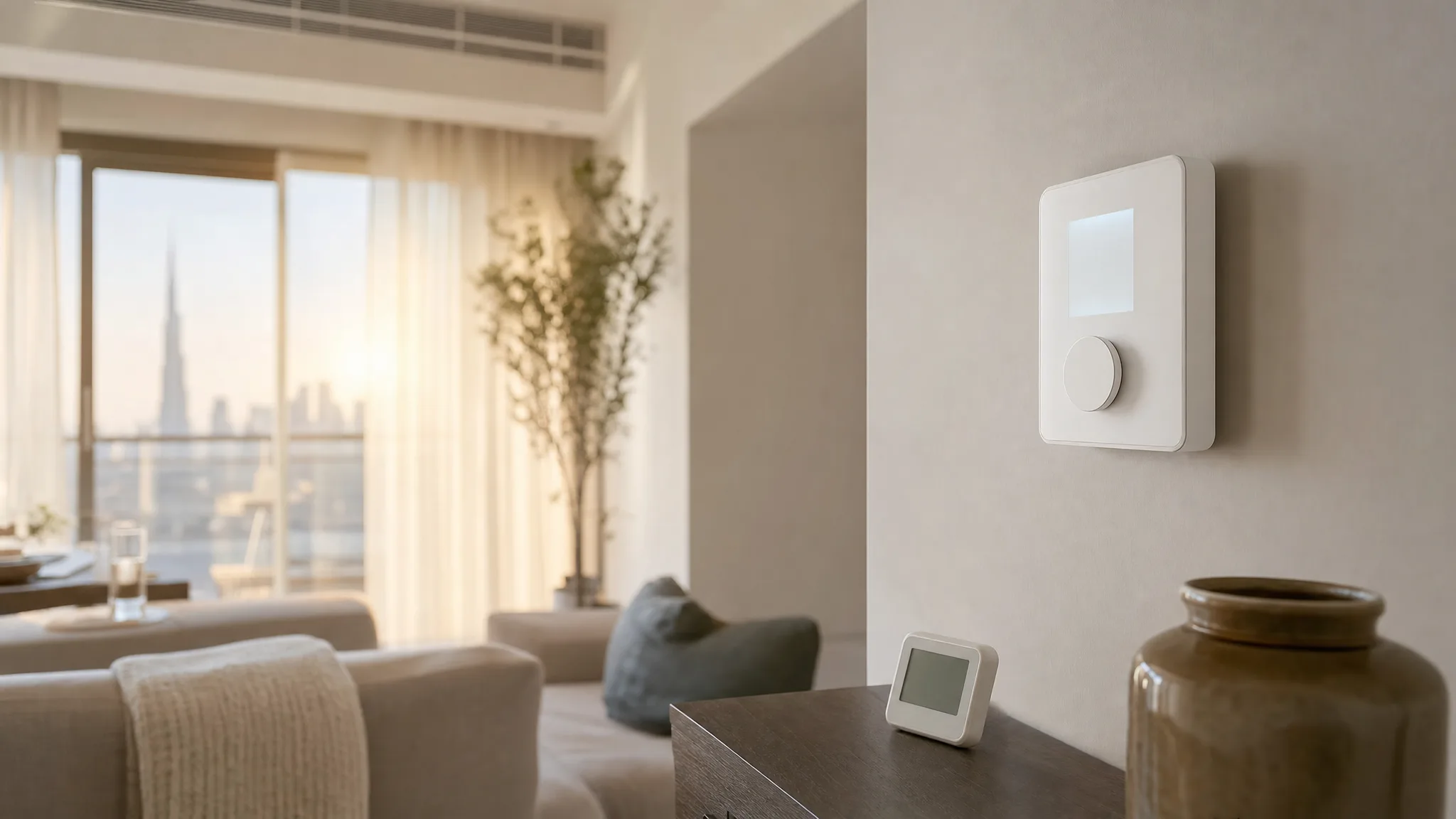
If a room in your flat isn't cooling and a smart thermostat or smart AC controller sits between you and the AC, there are three places the fault can be: the smart device, the AC unit itself, or, in a district-cooled tower, the chilled water the building sends to your unit. Each of those is a different person's job.
Measure the room with something that isn't the thermostat
A smart thermostat judges the room by its own reading, and so does a smart AC controller if it's set to run the AC off its own room sensor. If that reading is off, it can stop cooling while you're still hot.
Put a cheap digital thermometer where you actually sit, at about chest height, out of direct sun, away from windows and out of the AC's airflow. Leave it ten minutes and compare it with what the thermostat shows.
Height matters because air is generally warmer near the ceiling and cooler near the floor, so a sensor fitted too high or too low responds to the wrong temperature. Google says the same in its setup help for the Nest room sensor.
If your thermometer reads close to what you set and you still feel warm, it may be humidity rather than temperature. If your AC lets you pick a fan speed, try it on low, because slower air lets the coil pull more water out. If a wall thermostat reads 22 while your thermometer reads 27, the reading is the problem. That's the installer's job: moving the thermostat, or adding a separate sensor where people actually sit. A plug-in controller in its normal mode is different, because the AC is still steering by the sensor inside the indoor unit, so a gap there points at the AC.
Clean the filter too, if you haven't lately. In most flats it's yours to keep clean, and a blocked one cuts airflow on any system. There's a simple test for whether the unit itself needs a service in our AC servicing guide.
Take the smart part out of the loop
What you can test depends on the system. A long unit high on the wall with its own remote is a wall split. Ceiling grilles with a thermostat on the wall mean a ducted split or, in most district-cooled towers, a fan coil. If you can't tell, the signs are in this 30-second check.
With a plug-in controller on a wall split, the test is easy. Find the original remote, point it at the indoor unit and set Cool at a low temperature. If the unit beeps and the air from the vent turns cold within a few minutes, the AC is working and the controller isn't getting through. The usual culprits are a box that can't see the unit's receiver or a remote code that was learned wrong, and how an IR blaster talks to your AC explains both. If the remote can't get cold air out of it either, the controller is off the hook.
A wired smart thermostat is harder to bypass, because there's often no second control to try. Check the screen first: Cool mode rather than Fan, and a setpoint below the room temperature. A schedule or away mode can also hold it warmer than you'd expect. Then set the fan to Auto, because on some thermostats a fan set to On keeps running when nothing is cooling. If it still blows warm while the screen says it's cooling, ask whoever fitted it to put the old thermostat back for a day, if it was kept. That's a clean test. Thermostats here are commonly mains voltage, so don't open one up yourself.
Fan coils: the valve and the building's water
A typical fan-coil thermostat switches a three-speed fan and an on/off valve on the coil (here's one maker's version). When it opens the valve, chilled water from the building's supply runs through the coil and the fan blows across it.
So if the fan runs and the air comes out at room temperature, the fan is the only thing you've proved. The thermostat could be failing to signal the valve, or the valve could be stuck, and a technician can tell those apart by checking the valve while the thermostat calls for cooling.
Then there's the water reaching your flat, and you can narrow that one down yourself. Weak chilled water usually hits more than one flat at a time, so ask a neighbour on the same riser. If they're warm too, report it to building management. If they're fine, look to your own flat first, and the list below says who to call for which part.
Who to call for each part
Whoever you call, give them your readings: the thermometer next to the thermostat, and what happened with the remote or at the vent.
- The smart device: whoever sold or fitted it. A reading that's off, a controller that can't reach the AC, or a thermostat that won't call for cooling is theirs to look at first. Have any warranty to hand when you call, because it decides whether the fix is free.
- The AC unit in a rented flat: your landlord. Dubai's tenancy law makes the landlord responsible, during the lease, for maintenance and for "repairing any defect or damage that may affect the Tenant's intended use" (Law No. 26 of 2007, Article 16). The article opens with "Unless otherwise agreed by the parties", though, so check the maintenance clause in your contract.
- The chilled water: building management, and copy your landlord if you rent.
- The filter: usually you.
If you own the flat, the AC line is yours too, and the AC company is the call.
Not sure which system you have? Send us a photo of the thermostat or remote.
Ready to Get Started?
Get a free consultation and we'll recommend what makes sense for your situation.
Get Free Consultation