A friend of ours moved into a 2-bedroom in Marina last year. He had read three blog posts about smart thermostats, watched a Nest video on YouTube, and ordered an Ecobee from Amazon. The day it arrived he texted us a photo. The Ecobee in its box, sitting on his coffee table, with a question: "where do I install this?"
His apartment did not have a wall thermostat. His AC was a Daikin split with the cracked-screen remote on the kitchen counter. The Ecobee is a wall thermostat. There was nothing to replace. He had bought the wrong product.
This happens a lot in Dubai. Most of the smart home content people read is written for homes that do not exist here. Nest and Ecobee are designed for ducted central air with a wall thermostat. That is not what most Dubai apartments have. Some Dubai villas have it. Most district-cooled apartments have a version of it. And inside one building you can have all three.
TL;DR: A smart AC controller (Sensibo, Aqara P3, Tado) sits next to your indoor unit and learns your remote, starting from around AED 800 installed. A smart thermostat (Honeywell, Ecobee, Aqara wall) replaces an existing wall thermostat and starts from around AED 1,600 installed. The pick depends on whether your AC is a split with a remote or a central system with a wall thermostat, not on which is "better."
Two Products Solving Two Different Problems
Smart AC controllers and smart thermostats both end up doing similar things from your phone: schedules, geofencing, voice control, and a temperature graph. But the way they get there is different, and so is what they need from your home.
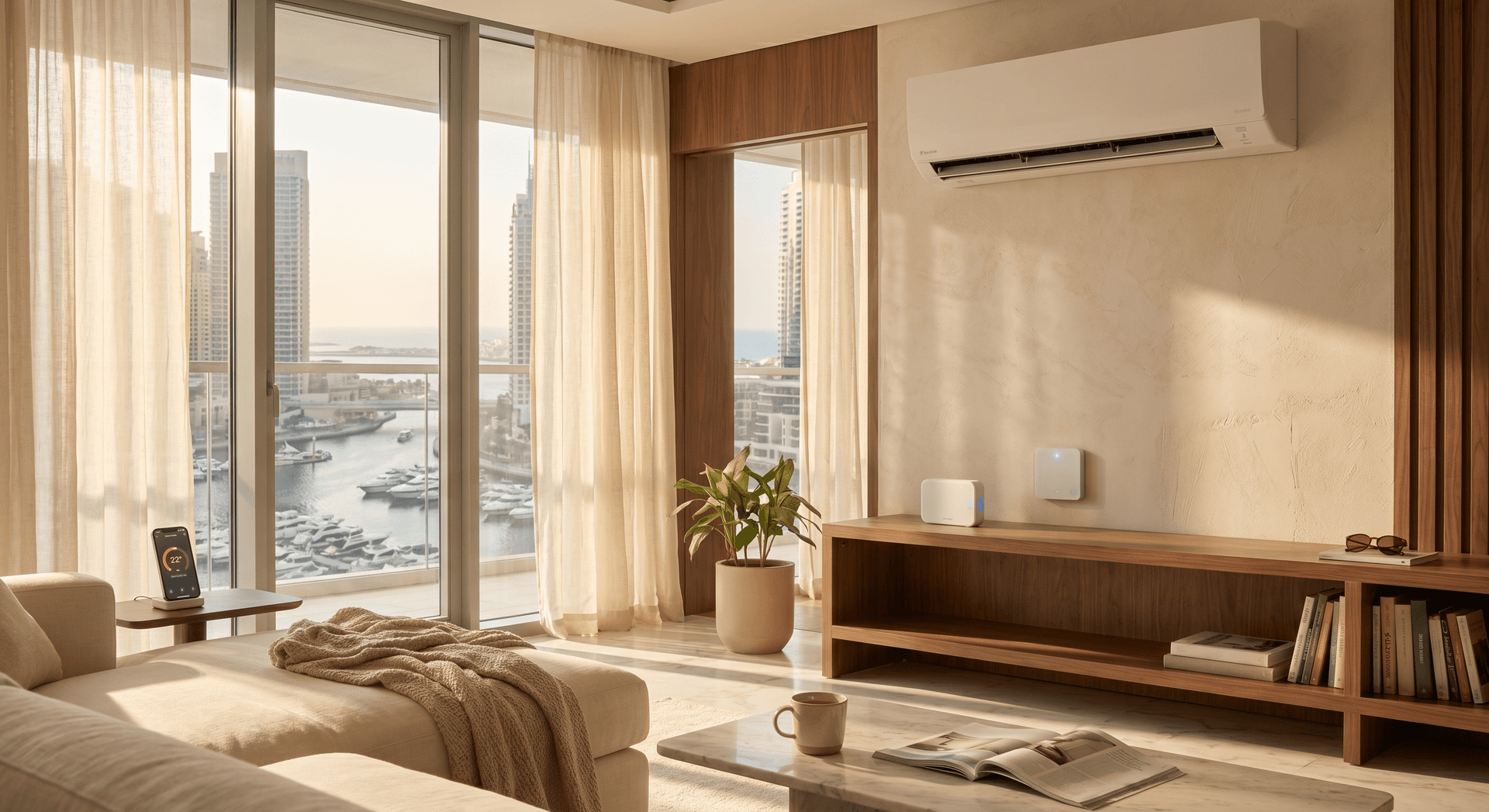
A smart AC controller is a small device that sits in the same room as the AC indoor unit. It plugs into a regular power outlet. It learns the IR codes from your existing remote and from then on, it pretends to be a remote. When you tap "cool to 22" in the app, the controller blasts the same infrared signal your remote does, and the AC obeys. The AC unit itself does not know anything changed. If you want the full picture of what "learns your remote" means, and where to place the controller so it works, we broke down how a smart AC controller actually works in its own guide.
A smart thermostat replaces the existing thermostat on your wall. It speaks the same language as the AC system (a 24V control wire, usually) and directly tells the compressor and blower what to do. There is no IR signal. There is no remote in the middle.
If you do not have a wall thermostat already, a smart thermostat has nothing to replace. If you do have one, a controller is the wrong shape for the problem. That is the entire decision tree in one paragraph, but the reason it matters is that Dubai homes are split across three different cooling systems and most owners do not know which one they have. If you are still earlier in the research, the broader smart AC control guide for UAE apartments and villas walks through what the term means before getting to the controller-versus-thermostat fork.
The Three Cooling Systems in Dubai Homes
In the UAE, 60 to 70 percent of household electricity in summer goes to cooling (DEWA, 2025). The system doing that cooling falls into one of three buckets.
The first is the split AC with a remote control. Most apartments built before 2015 have these. You can see them: a long horizontal indoor unit mounted high on the wall, an outdoor compressor on a balcony or in a service shaft. The temperature sensor is built into the indoor unit. There is no thermostat anywhere else. You control it with the cracked-screen IR remote. Common in JBR, Marina (older towers), JLT (some), Discovery Gardens, Greens, Tecom, the older parts of Springs and Meadows.
The second is central ducted AC. One outdoor unit feeds ducts hidden in the ceiling to multiple rooms. There is a wall thermostat (usually a basic local-brand or Honeywell digital screen) that controls the whole system. Most older villa communities use this: Arabian Ranches 1, Springs, Meadows, parts of Emirates Hills, Mirdif villas. Some newer villas also do this when the developer skipped per-room zoning.
The third is district cooling with fan-coil units. The building does not have its own outdoor compressor. Instead, chilled water is piped in from a district plant (Empower, Emicool, or Tabreed). Each room or zone has its own fan-coil unit and its own wall thermostat. Empower alone serves over 110,000 customers across 1,400 buildings in Dubai, including most of Business Bay, DIFC, JBR, JLT, Bluewaters, Discovery Gardens, and parts of Palm Jumeirah (Empower / Dubai Holding, 2025). If you live in a tower built in the last decade in any of those areas, you almost certainly have a fan-coil system. The fan-coil unit is part of your AC, not to be confused with a ceiling fan, which is a separate comfort device you can also make smart to hold a higher setpoint (our guide to smart ceiling fans in Dubai covers that).
In our experience, when we walk a new client through their apartment for a survey, this is the first thing we identify. About 60 percent of the apartments we see are splits with remotes. About 30 percent are district-cooled fan-coil. The remaining 10 percent are villa ducted or mixed (an apartment with a split in the lounge and fan-coils in the bedrooms is common in older Marina towers).
Smart AC Controller: When It Is the Right Answer
A smart AC controller is the right answer if your AC is a split with a remote. Which means: most apartments, all rentals where the landlord said no to electrical work, any home where the AC is a Daikin, Mitsubishi, LG, or Carrier split with a horizontal indoor unit and a remote.
The popular options are Sensibo Sky, Sensibo Air, Aqara P3, and Tado Smart AC Control. They all work the same way. They learn your remote. They add an app. They add schedules. They add geofencing (the apartment cools when you are 15 minutes away and shuts off when you leave). They add Alexa, Google Assistant, and Apple HomeKit. The Aqara P3 also doubles as a Zigbee hub, which is useful if you plan to add Aqara sensors or buttons later.
For an installer to put one of these in correctly, four things matter. The controller has to have a clear line of sight to the IR receiver on the indoor unit (which is usually under the front grille, on the right side, behind a small black dot). It has to be on the same WiFi network as your phone. It needs power, which usually means USB-A from a charger or a dedicated wall socket nearby. And the temperature sensor inside the controller should sit roughly at sofa height, not on a shelf 2 meters above your head where the air is 4 degrees hotter.
Per-room cost ranges from AED 800 to AED 1,100 installed, including the device, configuration, and a tested schedule. A 2-bedroom apartment with two splits typically lands at AED 1,800 to AED 2,400 total. A renter can have all of this done in an afternoon and take the controllers with them when they move. The renter case is covered in more depth in our smart AC for renters guide.
Smart Thermostat: When It Is the Right Answer
A smart thermostat is the right answer if you already have a wall thermostat. Which means: most villas with central ducted AC, most district-cooled apartments with fan-coil units, and apartments where the developer installed a wall thermostat that controls the splits indirectly (rare, but happens in newer high-end towers).
The mainstream options here split into three families. For villa ducted AC, Honeywell T5/T6 Pro is the durable workhorse, Ecobee SmartThermostat adds room sensors that solve the "downstairs is 22, upstairs is 28" problem, and Nest is fine but does not play as well with the local Carrier and Trane systems we see in older Dubai villas. For Aqara installs, the Aqara Smart Wall Thermostat E1 is a solid Zigbee option and integrates cleanly with the rest of the Aqara line.
For district cooling fan-coil units, the choice narrows. Aqara has fan-coil-compatible thermostats. Honeywell sells fan-coil units under the Centra Line label. KNX-based thermostats (Zennio, Theben, Jung) are the proper choice if the building is wired for KNX, which a surprising number of newer Downtown and Business Bay towers are. We see KNX wiring in maybe one in five new apartments and most owners never knew it was there.
Installation is more involved than a controller. The existing wall thermostat has to be removed, the wiring confirmed (especially the "C-wire," which is the common power wire some smart thermostats need to stay powered), and the new unit configured for the specific AC system. A C-wire is the line that gives the thermostat continuous low-voltage power so it can run a screen, WiFi, and a relay without draining a battery. Some older Dubai thermostats do not have one, and adding it means pulling new wire from the AC unit to the thermostat location. We add the C-wire in maybe 30 percent of the villa thermostat installs we do.
Smart wall thermostats in Dubai run AED 1,600 to AED 2,200 installed for a Honeywell or Aqara in a villa, AED 2,000 to AED 2,800 for an Ecobee with room sensors, and AED 2,500 to AED 4,500 per zone for a KNX-integrated fan-coil thermostat in a district-cooled apartment.
District Cooling: The Dubai-Specific Case
District cooling is the case that catches everyone out, because it does not appear in any American smart home guide. The chilled water comes in through pipes you do not control. The compressor is in a building somewhere else. The only thing you can change in your apartment is the wall thermostat and the fan-coil's valve.
Empower charges a fixed capacity charge for your apartment size plus a consumption charge for what you use (MyBayut Empower guide, 2025). Most residents pay AED 400 to AED 1,200 per month depending on the unit. Setting the thermostat to 24 degrees instead of 20 to 22 can cut consumption by 15 to 20 percent. A smart thermostat that holds the schedule at 24 when you are out and steps it to 22 when you arrive home pays for itself in one summer for most clients we have set up.
The trap here is that most off-the-shelf US smart thermostats (Nest, Ecobee) are not designed for fan-coil units. They expect a heating-and-cooling forced-air system. Installing a Nest on a fan-coil thermostat can work if the wiring matches, but it often does not, and the valve control logic the fan-coil expects is not always there. We recommend Aqara, Honeywell Centra Line, or KNX-native options for fan-coil apartments. If the building has a centralized BMS (building management system), the choice may already be made for you, and the building's facility manager may need to approve any change. About a third of the district-cooled apartments we work in have a BMS lock on the thermostat type.
What It Costs in a Typical Dubai Home
For a 2-bedroom apartment with two splits and a remote, smart AC controllers in both rooms land at AED 1,800 to AED 2,400 fully installed.
For a 3-bedroom apartment with district cooling, replacing three fan-coil thermostats with Aqara or KNX units runs AED 6,000 to AED 9,000 if no BMS lock is in place. With BMS, the cost can be lower because the controls integrate at the BMS layer instead of at every wall thermostat.
For a 4-bedroom villa with central ducted AC and one wall thermostat, a single smart thermostat upgrade is AED 1,600 to AED 2,500, but the upstairs-downstairs heat split that most villa owners want fixed needs zone control, which adds dampers and per-zone sensors. A full zone-control setup in a Springs or Arabian Ranches 1 villa is AED 6,500 to AED 12,000, depending on how many dampers and sensors are involved. We walked through this in the Springs villa zone-control post and the Arabian Ranches 1 version if you have one of those villas.
The Bayora Smart Home Starter at AED 3,000 covers a smart AC controller in your main room plus basic automation (a hub if needed, a couple of schedules, app setup), and is the most common entry point we see for renters in apartment buildings.
The Savings Question (Same Answer Either Way)
A common question is whether a smart thermostat saves more than a controller, or the other way around. The honest answer is neither. They save the same amount, because the savings come from the schedule, not the hardware. A controller running a 24-degree schedule with a 27-degree setback when you are out saves the same percentage of the cooling bill as a smart thermostat doing the same thing. We have measured this across enough installs to be confident: the pick is about your AC type, not about which delivers better savings. We dig into the savings numbers in detail in the smart thermostat savings post.
That said, smart thermostats can do a few things controllers cannot, and some of them quietly matter. They can read humidity and run the AC against a humidity target rather than a temperature one, which matters in June when Dubai humidity climbs above 60 percent. The blower on its own does not dry anything, and the fan speed you leave it on makes more difference than almost anyone expects. They can manage multi-stage cooling (where the AC has a low and high power mode). They can talk to room sensors and balance temperature across a villa.
Controllers can do things thermostats cannot too. They can override your AC schedule based on whether your phone is in the apartment. They can learn the IR codes for older fan-only modes that thermostats do not have access to. And they can be removed and taken to your next apartment.
The savings math is the same. The features differ. The pick is still about your AC type, not about money.
A 30-Second Self-Check: Which System Do I Have?
Walk over to your AC. If you see a long horizontal indoor unit mounted high on the wall and there is no thermostat on a wall anywhere, you have a split AC with a remote. A smart controller is what you need.
If you see a wall thermostat next to your bedroom or living room door and the AC vents come down from the ceiling, you have central ducted (villa) or fan-coil (district-cooled apartment). A smart thermostat is what you need. Whether it is ducted or fan-coil depends on the building, and the difference matters because the thermostat model is not the same. If your service charges include a monthly bill from Empower, Emicool, or Tabreed, you are district-cooled and have fan-coils.
If you have a mix (a split in the lounge and a wall thermostat in the bedroom), you need both. We see this in older Marina and JBR towers where the developer added splits later. The fix is one controller per split plus one smart thermostat per fan-coil. We can survey and price the whole apartment in 30 minutes.
If you genuinely cannot tell, that is exactly what our free on-site survey is for. We bring our own equipment, identify the system, and tell you what you actually need before we propose a price. The most common outcome is that the answer is simpler than the client expected.
Frequently Asked Questions
Can I install a Nest or Ecobee in a Dubai apartment with a split AC?
No. Nest and Ecobee are wall thermostats. They replace an existing wall thermostat. If your AC is a split unit controlled by an IR remote (no wall thermostat in your home), there is nothing for the Nest to replace. You need a smart AC controller like a Sensibo, Aqara P3, or Tado, which sits next to the indoor unit and learns your remote.
Will a smart AC controller work with my AC brand?
Yes for almost all major brands. Sensibo, Aqara P3, and Tado all learn IR remote codes from any major AC brand sold in the UAE, including Daikin, Mitsubishi, LG, Carrier, Trane, O General, Hitachi, and Samsung. The controller does not care about the AC brand. It cares whether there is a remote with an IR signal it can read, and every split AC in Dubai has one.
Do I need landlord approval for a smart AC controller?
No, for a plug-in controller. The device sits on a shelf, plugs into a power outlet, and uses IR signals to control the AC. Nothing is wired into the wall, no holes are drilled, and the AC unit itself is not modified. You can take the controller with you when you move. Landlord approval is only needed if you are replacing a wall thermostat or doing electrical work.
Can a smart thermostat work with district cooling fan-coil units?
Sometimes, but not always with mainstream US brands. Most Nest and Ecobee thermostats are designed for forced-air heating and cooling systems, not for fan-coil units with chilled water valves. For Empower or Emicool fan-coil apartments, we recommend Aqara fan-coil thermostats, Honeywell Centra Line, or KNX-native options. Some buildings also have a centralized BMS that controls what thermostat is allowed, so check with your facility manager before buying.
Which one saves more on my DEWA bill?
Neither. The savings come from the schedule and the setback temperatures, not the hardware. A smart AC controller running a sensible Dubai summer schedule (pre-cool to 22 before you arrive, set to 26 when out, 24 overnight) saves the same percentage as a smart thermostat doing the same thing. Most clients see 15 to 30 percent off cooling costs once the schedule runs for a full month. Pick the product that matches your AC system, not the one that claims bigger savings.
Ready to Pick the Right One?
If you are not sure which AC type you have, that is the most common starting point. Tell us about your home and we will do a free survey, identify your system, and recommend the right product. If you have a split AC and a remote, we can usually finish the install the same week. If you have a villa or a district-cooled apartment, we will price the proposal up front, with no hidden costs, before any work starts.
Ready to Get Started?
Get a free consultation and we'll recommend what makes sense for your situation.
Get Free Consultation