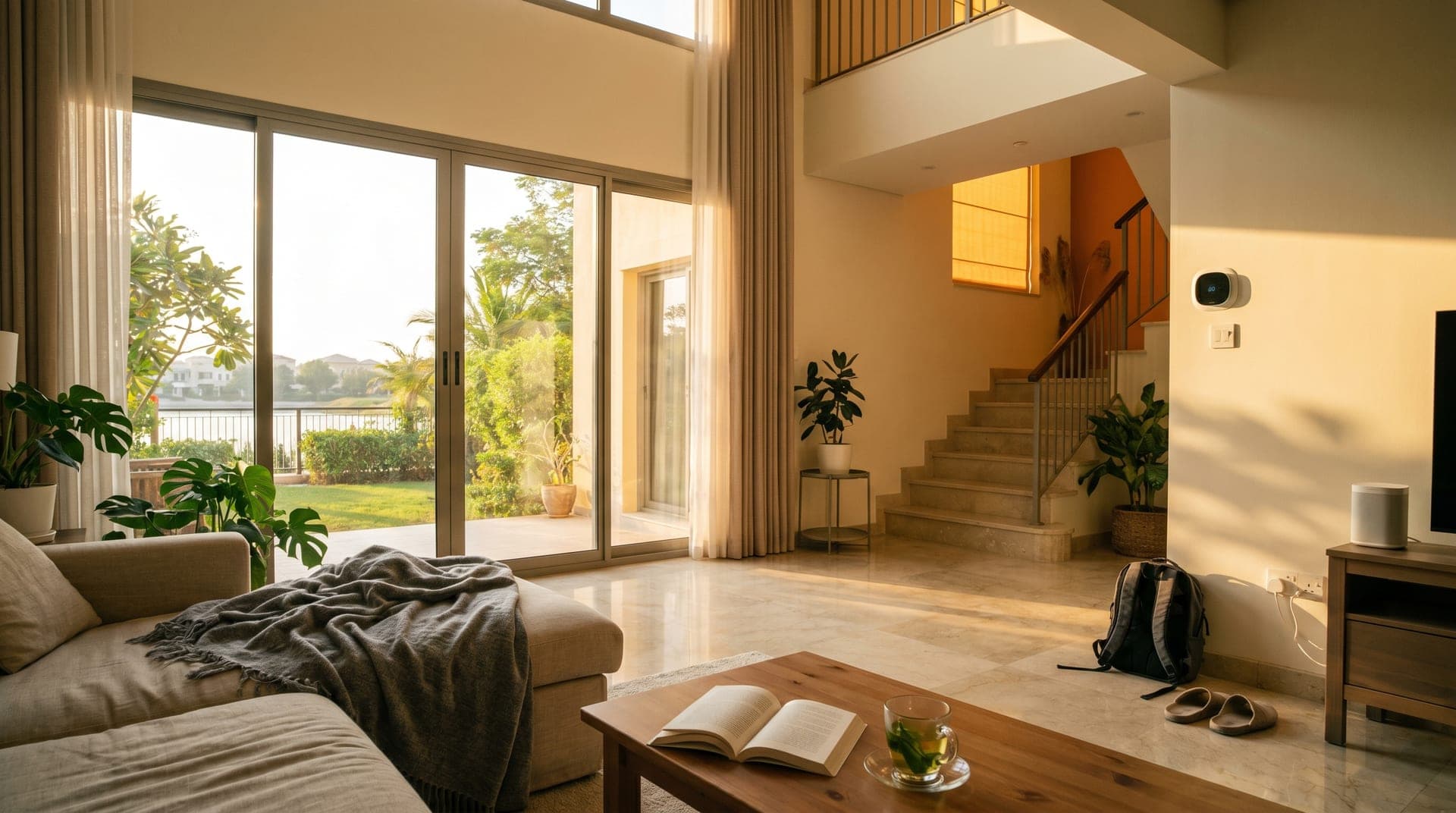
Your thermostat reads 22. The downstairs living room is genuinely 22. The upstairs bedrooms are 28 and nobody can sleep. The AC has been running since noon and the compressor outside hasn't stopped once. The DEWA bill that landed last month was almost double what it was in March, and June hasn't even started.
This is the Springs summer story. We hear it from clients in Springs 1, 4, 7, 12 and everything in between. The villa was built for a different climate logic than what the family wants from it, and on a 41C afternoon that mismatch shows up as a single, very expensive problem: the thermostat is somewhere the family does not live, the rooms they do live in are above it, and heat does what heat does.
The fix is not a new AC system. It is a zone-control layer that sits on top of the AC you already have.
TL;DR: Springs villas run a single-thermostat AC on a two-story layout, which means downstairs is cool, upstairs is hot, and the compressor cycles all afternoon trying to satisfy the wrong room. A smart AC zone-control setup (one controller per indoor unit plus per-room sensors and schedules) costs AED 3,000-6,000 installed, cuts the worst summer DEWA spikes by 20-30 percent, and ends the 4pm arguments about why nobody can sleep upstairs. Renter-friendly, no wiring, takes a day.
The two-story problem, in 60 seconds
Most Springs villas, 2 through 4 bedrooms, are 1,600 to 3,200 square feet across two floors (Property Finder, 2026). The AC is usually a set of split units, one outdoor compressor feeding two or three indoor units, with a single wall thermostat sitting in the downstairs hallway or living room.
Heat rises. In a Dubai summer, heat rises hard. The upstairs gains heat through the roof, the upstairs windows, and any sunlight hitting the upper west or south walls. Downstairs gains heat too, but the cool air the AC produces falls there first and stays there longer. The thermostat sees that air, decides everything is fine at 22, and stops calling for more cooling. Upstairs, where nobody put a sensor, the rooms keep climbing.
For a multi-level home, professional HVAC guidance is direct about this: set the top floor to the temperature you want, and set the bottom floor two degrees higher, because the cooler air from upstairs settles downward on its own (Quality HC, 2024). Most Springs villas do the opposite. The thermostat sits downstairs and is set low, so downstairs gets even colder while upstairs stays warm. The compressor runs longer than it needs to, the family is uncomfortable, and the DEWA bill absorbs both problems at once.
In our experience surveying Springs villas, this is the single most common pattern. Not bad insulation, not an undersized AC, not a broken unit. A control layer that does not match the building.
What zone control changes
A zone-control setup does three things the existing thermostat cannot.
It puts a sensor in every room the family lives in. Bedroom 1, bedroom 2, living room, kitchen. The AC stops chasing the temperature of the hallway and starts chasing the temperature of where the family is. WiFi-connected AC controllers with room sensors save 15 to 30 percent on cooling costs through scheduling, geofencing, and per-room temperature rules (Sensibo, 2026).
It controls each indoor unit independently. Most Springs villas have two or three indoor evaporator units, one downstairs and one or two upstairs. A smart controller goes in front of each one. The downstairs unit can run at 24 in the afternoon while the upstairs unit pre-cools the bedrooms to 22 at 8pm. The compressor still does the work, but the units it feeds now have a brain each.
It runs a schedule that matches the family's day. Pre-cool the upstairs bedrooms from 8pm to 10pm so they are sleepable by bedtime. Hold downstairs at 24 during the day. Let everything drift to 26 after midnight when the family is asleep. Geofence the system to step everything back to 28 when the last person leaves the villa and start the recovery 20 minutes before the first person gets home.
That is the entire fix. The hardware is the same. The control layer is different.
What it costs in a Springs villa
Springs villas come in three common shapes from a smart AC perspective, and the pricing reflects how many indoor units a setup needs to cover.
Two-bedroom (1,600-2,000 sq ft): 2 indoor units, typically one downstairs and one upstairs. Two smart AC controllers (Sensibo Sky or Tado, AED 600-700 each on Noon UAE). Two extra room sensors (AED 150-250 each). One smart hub if the family wants HomeKit or local automations (AED 200-450). Installation, configuration, and family training included. AED 2,500-3,500.
Three-bedroom (2,000-2,500 sq ft): 3 indoor units. Three controllers, three room sensors, one hub. Same install pattern. AED 3,500-5,000.
Four-bedroom (2,500-3,200 sq ft): 3 to 4 indoor units, often with a separate master bedroom unit upstairs. Four controllers, four sensors, one hub, occasionally a second hub for range if the villa is long. AED 4,500-6,500.
For context, smart thermostat devices in Dubai start from AED 380 for basic models up to AED 1,200 for premium options with room sensors (7Mayfair, 2026). We use the AED 600-700 IR controllers in Springs because they work with any existing split AC, do not need an electrician, and a renter can take them when they move.
The DEWA math, with the savings as a side effect
Springs DEWA bills in summer are blunt. A typical 3-bedroom Springs villa, running AC roughly 14 to 18 hours a day from May through September, can run AED 1,500-2,000 a month on hotter days, with cooling alone adding an extra AED 650 or so to the household bill (Casttio, 2026). Larger villas with pool pumps and irrigation routinely push past AED 5,000 a month at peak summer (Casttio, 2026).
The 15-30 percent cooling-cost savings number from Sensibo translates, in the kind of villa we typically work on, to AED 200-450 a month off the summer bill. For an upper-bound villa carrying AED 5,000 monthly, well-implemented zone control plus other smart adjustments can move the bill 20-40 percent without sacrificing comfort (My DEWA Bill, 2026).
We are deliberately not leading with that number. It is real, but it is the second-best reason to install zone control. The first reason is that the bedrooms become sleepable in August. The DEWA savings are what makes the project pay back in one summer instead of three.
What we install in a Springs villa, in the order it pays back
After installing this setup in roughly thirty Springs and Meadows villas, here is the order we recommend, with the why for each step.
Step 1: Controller and sensor on the upstairs master bedroom unit. This is the room that wakes the family up at 2am because it is 27 degrees and the ceiling fan is doing nothing. Pre-cool from 8pm. Hold 22 from 10pm to 6am. Let it drift after. One controller, one sensor, one room. Most families notice the difference the first night.
Step 2: Controller and sensor on the upstairs kids-room unit. Same logic as the master, scheduled around when the kids go to bed and wake up. If two bedrooms share an indoor unit, the sensor goes in whichever bedroom the family cares more about.
Step 3: Controller and sensor on the downstairs living unit. The thermostat that came with the villa stays mounted, but the smart controller takes over the cooling decisions. Set the daytime target to 24, not 22. The downstairs feels the same because that two-degree gap was being created artificially by the original thermostat fighting heat that was not there.
Step 4: Geofencing and schedules. Last person leaves the villa, everything steps back to 28. First person within 20 minutes of arrival, everything starts coming back. This is where the DEWA savings get real. A Springs villa runs AC 18 hours a day in July. If 4 to 6 of those hours are at 28 instead of 22, the compressor does measurably less work.
Step 5: A leak sensor under the master ensuite AC drip tray. Not strictly zone control, but every Springs villa we have worked on has a drip line under the upstairs AC. They fail. When they fail, the ceiling underneath gets wet. Leak sensors are AED 60-80 each. Put one under each upstairs indoor unit and one under the kitchen sink and forget about them until they save a ceiling.
What we tell renters in Springs
A lot of Springs is owner-occupied, but the 2026 rental market in the community is active. Two-bedroom villas in The Springs rent from AED 70,000 to AED 135,000 per year, three-bedroom from AED 90,000 to AED 195,000, and four-bedroom around AED 145,000 (Property Finder, 2026). If you are renting, the entire setup we described above is yours to take. The controllers come off the IR receiver of the AC with two screws. The sensors are battery-powered and stick to the wall with adhesive. The hub plugs into the router and goes in a bag.
What we have found is that the smart AC controllers most renters install in apartments translate directly to Springs villas. The brands, the install method, the app are all the same. The only thing that changes is you are buying three or four controllers instead of one. We have walked clients through this on their existing equipment before they signed a lease, before the keys were in their hand.
If you are mid-lease and the previous tenant left a smart thermostat already mounted on the wall, we usually recommend bypassing it. The hardwired smart thermostats sold for Dubai villas (Ecobee, Nest, the AED 380-1,200 range we mentioned earlier) work fine, but they typically control only one zone and were placed during construction in the hallway, which is exactly the position that created the two-story problem in the first place. The IR-controller-per-unit approach gets around the location of the wall thermostat entirely.
Where this fits in the wider smart home
Springs villas have a few more smart-home opportunities than the equivalent apartment, mostly because of the garden and the front-door access. The order we recommend after zone AC is the same one we recommend for Arabian Ranches and Dubai Hills villas, adjusted for the smaller Springs plot size.
After AC, the next layer is motorized blinds or solar screens on the upstairs west-facing windows (more on which windows matter most). The afternoon sun hitting an upstairs west window adds 4-6 degrees to the room behind it. Cutting that with shading reduces the work the upstairs AC was told to do. The two systems compound.
After that, smart locks and a video doorbell. Springs has its own community gate, but the front door of the villa is still the place packages are stolen from. A retrofit smart lock and a battery-powered doorbell (here's what we install for apartments and the logic transfers cleanly) cost AED 1,000-1,800 together and let the housekeeper, the maintenance team, and family members in without anyone losing a key.
Then lighting. Springs villas typically have 25-40 light points across two floors. A full smart lighting retrofit is AED 6,000-12,000, but most of that bill comes from rooms the family barely uses. Start with the upstairs hallway (auto-on at 10 percent overnight so the kids can find the bathroom without lighting up the whole floor) and the downstairs entrance scene. Add the rest when there is a reason.
What we recommend skipping
A whole-home automation processor like Control4 or Crestron is the wrong starting point for a 3-bedroom Springs villa. We have nothing against those systems and we install them in larger villas where the scope and the budget make sense. In a Springs villa, the cost of the processor itself is the cost of the smart AC setup we walked through above. If the goal is fixing the summer DEWA problem and ending the bedroom-temperature arguments, an open-platform IR-controller setup gets there for a third of the budget and leaves the family in control of what comes next.
We also do not pitch in-ceiling speakers in the living rooms of most Springs villas. The acoustics of a 1,800 sq ft villa living room with a tile floor and high ceilings are not solved by ceiling speakers, and the install cost is significant. A soundbar with a sub does the job for a tenth of the budget. Save the architectural audio conversation for the master bedroom, the cinema room if there is one, or the garden, where it changes the experience enough to be worth the install.
Frequently Asked Questions
Will smart AC controllers work with the original Springs villa split units?
Yes. Smart IR controllers like Sensibo Sky and Tado work with any split AC that has a remote control, regardless of brand or age. They learn the IR codes from your existing remote and replace the remote with an app, schedules, and per-room sensors. The compressor, the indoor unit, and the existing wall thermostat all stay where they are.
How much can a Springs villa save on DEWA in summer with smart AC zone control?
A typical 3-bedroom Springs villa running well-implemented zone control plus reasonable scheduling sees 15-30 percent off the cooling portion of the DEWA bill (Sensibo, 2026). On a summer bill of AED 1,500-2,000, that is AED 200-450 a month, or roughly AED 1,000-2,250 across the May-September window. The full setup pays back in one summer in most villas we have worked on.
Can a renter in Springs install this without the landlord's approval?
Yes. The whole setup is non-permanent. Controllers attach to the front of the AC unit with adhesive or a small bracket, sensors stick to the wall, and the hub plugs into the router. Nothing is wired, drilled, or screwed into structure. When the lease ends, everything comes off in 20 minutes and goes in a bag.
What about hardwired smart thermostats like Ecobee or Nest?
Hardwired smart thermostats work fine in Springs villas and are sold and installed by local resellers across Dubai (Just Thermostat, 2026). The trade-off is that they replace the existing wall thermostat in the same location, which means they inherit the same two-story heat-rise problem the original thermostat had. The IR-controller-per-unit approach lets you put a sensor in every bedroom and the kitchen instead, which is what the building needs.
Does this work if the villa has central or ducted AC instead of splits?
Some larger Springs and Meadows villas have ducted units instead of wall-mounted splits. In those, a hardwired smart thermostat (Ecobee, Nest) replacing the existing wall thermostat is the better starting point, paired with per-room remote sensors. The pricing is similar, the install is more involved, and the savings logic is the same. We survey before recommending which approach fits the villa.
What to do next
If you are in a Springs villa and the upstairs is unsleepable from May to October, the next step is a survey. We come look at the AC layout, count indoor units, check where the existing thermostat is mounted, and check WiFi coverage upstairs. A survey takes 30-45 minutes and is free. The proposal that follows shows every controller, sensor, hub, install cost, and the full price before any work starts.
Get a free survey for your Springs villa and we will tell you exactly what your setup needs. If your problem is solved by AED 2,500 of controllers, we will tell you that. We do not pitch the AED 12,000 setup to a 2-bedroom renter.
Springs was designed as a quiet community 25 years ago. The AC system that came with it was designed for a quieter climate. The control layer is the part that catches up.
Ready to Get Started?
Get a free consultation and we'll recommend what makes sense for your situation.
Get Free Consultation