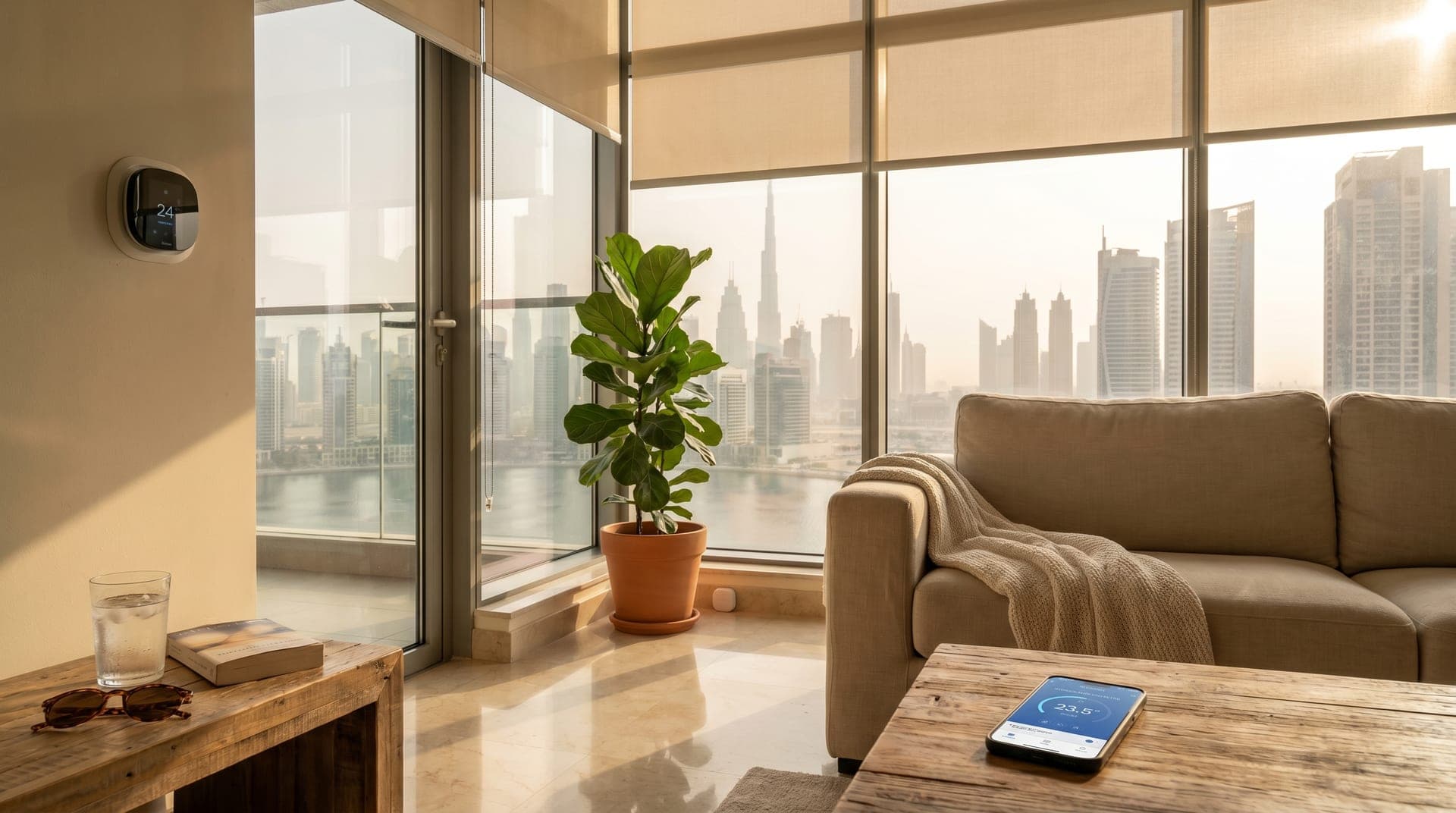
You have maybe two weeks. Sometimes less. The first 40C day in Dubai almost always lands in the last week of April or the first two of May, and the spread between a calm summer and a scrambling one comes down to what you do before it arrives.
TL;DR: The first 40C day usually hits Dubai late April or early May. Spend 5 minutes before it arrives on five things: confirm your smart thermostat setpoint (24C, per DEWA guidance), re-activate your pre-cooling schedule, arm your leak sensors, schedule your blinds for the 2pm sun, and test vacation mode once. Done right, smart thermostats alone can cut cooling costs by up to 20 percent across the summer.
Most Dubai residents wait for the heat to hit before reacting. The AC screams, the DEWA bill doubles, and by the time the thermostat gets reset and the blinds get rescheduled, three or four weeks of higher slab pricing have already locked in. The effort to avoid all that is five minutes, done once in April. What follows is the pre-flight checklist.
Why the Window Is So Short
The UAE's National Centre of Meteorology tracks daily highs closely, and last year April was the hottest on record for the UAE, with averages around 42.6C. May was the hottest May on record too, with peaks above 50C. The direction of travel is not subtle.
In our experience, the apartments that stay comfortable and cheap through June are the ones that were set up in the second half of April. The apartments that blow their DEWA bill are the ones that reacted instead of planned. Once the heat hits, your AC runs 14 to 18 hours a day and every inefficiency gets amplified by that runtime. A badly set thermostat in January costs you rounding errors. In July, the same thermostat costs you hundreds of dirhams a month.
The point of doing this in April is that it costs nothing to run your AC correctly on a 33C day. You're setting the system now so it's already doing the right thing when the 44C day surprises you in two Tuesdays.
The 5-Minute Pre-Flight Check
Five steps, one minute each, in this order.
Step 1: Confirm the Setpoint
Open your smart thermostat app. Look at the target temperature for your main living zone. If it says anything below 24, change it.
DEWA's energy guidance puts 24C as the optimal setpoint for cooling in Dubai. Every degree below that roughly adds 5 to 8 percent to your cooling load. One client in a 2-bed Business Bay apartment had his thermostat at 20C from last summer and had never touched it. Moving it to 24C, with no other changes, cut his DEWA bill by AED 340 in the first month.
If your smart thermostat supports zoning, repeat this for each zone. Bedrooms at 23 overnight if you like it cooler for sleep. Living areas at 24 during the day. Guest rooms that are empty most of the time at 26 or off entirely. The zone-by-zone temperature differences in Dubai apartments are larger than most people realise, and a one-setpoint-fits-all strategy is why your bedroom feels fine while your living room roasts.
Step 2: Re-Activate the Pre-Cooling Schedule
If you followed our AC pre-cooling schedule for Dubai in March, check that it's still active. If you never set one up, now is the 90-second version.
Decide when you're typically home. For a 9-to-6 hybrid worker, that's usually 6:30pm onward on weekdays. Set your AC to drop to 24C at 5:30pm, a full hour before you walk in. That's pre-cooling. You don't blast a warm apartment; you come home to a cool one.
Between the hours when nobody is home, the AC should sit at 26 or 27, not off. A completely-off apartment in a Dubai July becomes a 38C oven by the afternoon, and then your AC spends two hours of high-load compressor time just dragging it back down. That's the single most expensive mistake in Dubai cooling. Smart scheduling fixes it by default. Smart AC zoning with occupancy and time-based scheduling cuts DEWA consumption 18-25% versus traditional thermostats, according to DEWA energy-audit data shared in 2026.
Step 3: Arm the Leak Sensors
This one surprises people. Water leaks spike in May and June in Dubai apartments for three overlapping reasons: AC condensate drains get overwhelmed by the humidity load, water heaters that were dormant all winter come back online under pressure, and the summer water tariff pushes more people to run longer dishwasher and laundry cycles.
If you have water leak sensors (Aqara, Shelly, or similar), open your app and check that each one is online and armed. Test one by placing a damp fingertip on the contacts. You should get a push notification within 10 to 15 seconds. If you don't, replace the battery or re-pair the device.
What we've found is that leak sensors earn their place in the first year alone. One Dubai Marina apartment we surveyed had an AC drain pan overflow that dumped into the ceiling cavity of the unit below over the course of eight hours while the owner was at work. The repair bill was in the tens of thousands. A AED 150 leak sensor would have caught it in 10 seconds.
Step 4: Schedule Your Blinds for 2PM
The sun hits Dubai balconies hardest between 1pm and 4pm in summer. If your apartment has west- or south-facing windows and you don't automate the blinds, your living room absorbs hours of direct heat every day. Even if you leave the AC running, the room hits peak temperature around 3pm because thermal mass delays the heat dump by roughly two hours. We covered the 3PM problem in detail, and the short version is that concrete, marble, and glass absorb heat slowly and release it back into your apartment hours after the sun's peak.
If your blinds are motorised, open the app and set a daily schedule: lower to 70 percent at 1pm, full at 2pm, back open at sunset. That single automation reduces cooling load by 10 to 20 percent in south-facing rooms, depending on the glass. If your blinds aren't motorised, the pre-flight check is lower-tech: go close them manually before you leave for work.
Step 5: Test Vacation Mode Once
Most Dubai residents travel at least twice over the summer, whether for Eid Al Adha, a European escape, or a long weekend to Oman. Before you actually leave, you want to know vacation mode works.
Open your smart home app. Enable vacation mode manually. Check that the following things happen: AC goes to 28C across all zones, any scheduled lighting automations continue (so the apartment looks occupied), leak sensors stay armed, and the water heater either goes to a reduced setpoint or turns off entirely. This is exactly what a good vacation mode does in Dubai and why it saves hundreds of dirhams across a summer of travel.
Turn it off after the test. Now you know it works, so when you leave for real in June you don't have to think about it.
What This Actually Saves
The savings from this setup are not a single line item. They compound.
DEWA's residential tariff is a slab-based system. The first 2,000 kWh cost AED 0.23 per kWh. The next slab is AED 0.28, then 0.32, then 0.38 above 6,000 kWh. A typical Dubai 2-bed apartment in July pushes well into the top slab. Every kWh you cut at the top saves you AED 0.38, not 0.23. Cut 500 kWh from your monthly consumption through better scheduling and setpoints, and you're saving AED 190 a month on electricity alone, before the surcharge and VAT stack on top.
Across a five-month summer, that's over AED 1,000 from a 5-minute setup you did in April. DEWA's own 2026 audit data shows smart thermostats reducing cooling costs by up to 20 percent, and full smart AC zoning pushes that to 18-25 percent. Our own client numbers line up with that range. The smart thermostat savings in Dubai we've published break down real before-and-after DEWA bills from apartments we've worked on.
The cost of the setup is 5 minutes. The cost of not doing the setup is five months of a warm apartment and a hot bill.
If You Don't Have Smart AC Yet
This is the single most common objection we hear in April: "I'd love to do all this, but I don't have a smart thermostat."
The fix is simpler than most people think. A basic smart AC controller that works with your existing split unit starts from AED 3,000 installed, which covers a starter setup including the controller, configuration, and app setup. It takes about half a day. Renters, this works for you too, because smart AC for renters needs no landlord approval and you take the controller with you when you move. No drilling, no rewiring, no permanent modification.
If you want the full pre-summer context on why this month matters specifically, our May DEWA bill preview lays out what's coming if you don't change anything, and the summer DEWA bill survival guide covers the five automations that do the heaviest lifting across a full Dubai summer.
Frequently Asked Questions
When is the first 40C day in Dubai each year?
The first sustained 40C day usually lands between April 20 and May 10 in Dubai. The exact date depends on the year's weather patterns, but NCM data shows the trend has been earlier and hotter year over year. April 2025 was the hottest on record for the UAE. Plan your pre-flight check for the second half of April every year.
What temperature should I set my AC to in a Dubai summer?
DEWA recommends 24C as the optimal setpoint for cooling in Dubai apartments. Each degree below 24 increases your cooling load by roughly 5 to 8 percent. For sleeping, 23C is reasonable. Setting your AC to 20 or 18 overnight can add AED 200-300 per month to your DEWA bill without meaningfully improving comfort.
Does smart AC actually reduce my DEWA bill?
Yes. DEWA's own energy audit data shows smart thermostats reducing cooling costs by up to 20 percent through precision scheduling. Smart AC zoning with occupancy sensors can cut DEWA electricity consumption 18-25 percent compared to a standard thermostat. AC accounts for roughly 70 percent of residential energy use in a Dubai summer, so a 20 percent AC cut is a meaningful whole-bill cut.
Do I need to run this pre-flight check every year?
Yes, at least once a year in mid-April. Apps update, firmware shifts settings back to defaults, family members nudge setpoints over the winter, and batteries in sensors run down. A 5-minute review every April catches all of that before the heat amplifies any mistake.
What if my apartment doesn't have motorized blinds?
The manual version still works. Close your blinds or curtains before you leave for work on any day the forecast is above 35C. You'll lose the automation but keep most of the thermal benefit. Motorised blinds make it easier to do consistently, but consistency is what matters, not the motor.
Your first 40C day is the fire drill that tells you whether you prepared in April or didn't. The apartments that stay comfortable and cheap are the ones that spent 5 minutes now. Tell us about your home and we'll recommend where to start, or if your smart AC is already in place, run this checklist today. The window is closing fast.
Ready to Get Started?
Get a free consultation and we'll recommend what makes sense for your situation.
Get Free Consultation