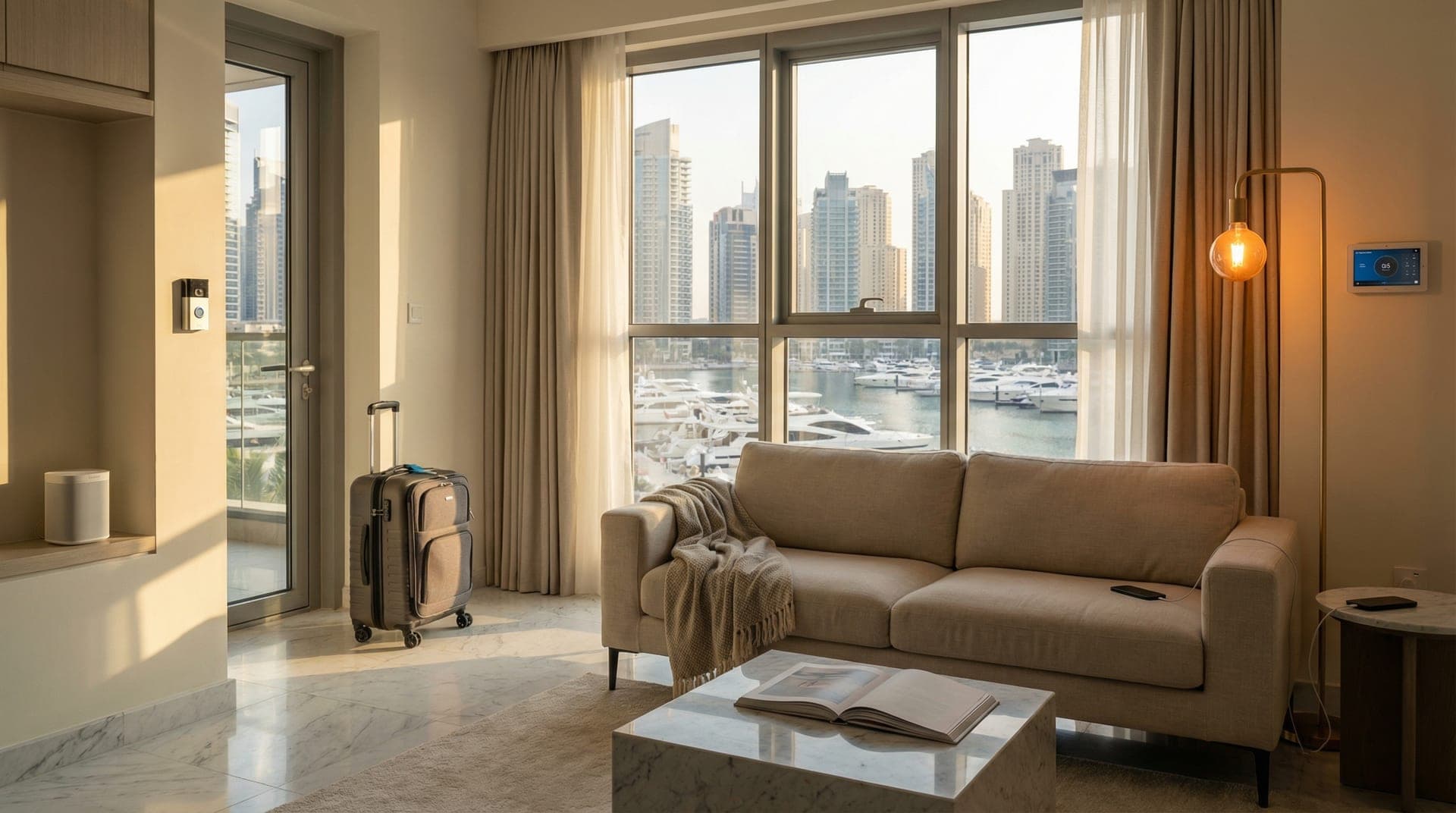
You're at the airport. Your home is still working.
Your bags are packed, your boarding pass is on your phone, and you're heading out for the summer. But your apartment in Dubai Marina or Business Bay doesn't shut down when you leave. If it's set up right, it's doing more for you empty than most apartments do occupied.
A smart home in vacation mode handles the things you'd otherwise worry about from 3,000 miles away: security, energy, water, and the slow damage that happens when nobody's paying attention. For Dubai residents who leave for weeks or months during summer, this is where automation stops being a convenience feature and becomes a property protection system.
TL;DR: A smart home in vacation mode simulates occupancy to deter break-ins, schedules AC to prevent mold and humidity damage, shuts off water heaters to stop wasting AED 25-40 per month, monitors for leaks, and gives you live camera access from anywhere. A full vacation-ready setup for a 2-bedroom apartment runs AED 3,850-5,400 installed.
How Does a Smart Home Protect Your Apartment While You're Away?
A smart home protects an empty apartment through four layers: occupancy simulation, climate management, appliance control, and remote monitoring. Each layer runs automatically once configured, and you control everything from your phone regardless of which country you're in.
The biggest risk to an unoccupied home is looking unoccupied. Homes without a security system are 300% more likely to be targeted by burglars (DeepSentinel, 2025). And in 40% of unlawful entries, the intruder got in through an unlocked door or window (ASU Center for Problem-Oriented Policing, 2024). A smart home addresses both problems without you being there.
Smart locks confirm your doors are secured. Smart cameras send motion alerts to your phone. And smart lighting makes your apartment look lived-in every evening, even when you're sitting on a beach in Greece.
Occupancy Simulation: Making Your Apartment Look Lived-In
Occupancy simulation uses your smart lights, blinds, and speakers to mimic normal daily activity. Lights turn on and off in different rooms at slightly different times each evening. Blinds open in the morning and close at night. A speaker plays ambient sound. From the outside, your apartment looks like someone is home.
This works because burglars look for patterns of vacancy. Accumulated mail, dark windows every night, and total silence are signals. A vacation mode lighting schedule randomizes which rooms light up and when, so there's no predictable pattern to observe over multiple days.
In our experience setting up vacation automations for clients across Downtown Dubai and Palm Jumeirah, the lighting schedule is always the first thing we configure. It takes 15 minutes to set up and runs indefinitely until you turn it off. Most smart lighting systems, including Philips Hue and Lutron, have built-in vacation or away modes that handle the randomization automatically.
What Happens to Your AC When You Leave for Weeks?
Turning your AC completely off for the summer sounds like the obvious move. But in Dubai, where indoor humidity can climb to 70-80% without climate control, a fully shut-off apartment risks mold growth on walls, furniture, and inside AC ducts. Air conditioning accounts for 60-70% of residential electricity in the UAE (SolarisKit, 2024), so running it full-time in an empty apartment is expensive. The answer is somewhere in the middle.
A smart AC controller lets you set a vacation schedule that cycles the AC on for a few hours every day or two, keeping humidity below the mold threshold without running 24/7. Set it to 27-28 degrees for a couple of hours in the afternoon, when Dubai heat peaks. That's enough to circulate air and pull moisture out without burning through your DEWA bill.
When we set up vacation AC schedules for apartments, we typically see the monthly DEWA bill drop to AED 150-250 compared to AED 800-1,200 during occupied summer use. You're spending a fraction of the normal cost while still protecting your property from humidity damage. And because the controller is connected to WiFi, you can adjust the schedule from anywhere if conditions change.
Should You Turn Off Your Water Heater Before Leaving Dubai?
Yes. Your water heater is one of the biggest standby energy wasters in a Dubai apartment, and you don't need hot water in an empty home. Standby appliances can consume up to 5% of total household electricity (MyBayut, 2025). A traditional tank water heater keeps 50-80 liters of water heated around the clock, even when nobody is using it. That costs AED 25-40 per month in pure waste.
A smart switch on your water heater's circuit lets you shut it off remotely and turn it back on the day before you return. The water will be hot within an hour of switching it on, so there's zero comfort sacrifice. You save AED 75-120 across a three-month summer absence. In most Dubai apartments the heater has no plug at all and switches at its own wall switch, which we set out in our guide to putting a water heater on a smart schedule.
Beyond the water heater, a smart home lets you check that every unnecessary appliance is off. Lights you forgot about, a TV on standby, the second AC unit in the guest room. One glance at your phone confirms everything is shut down. When we hand over a completed smart home installation, we always walk clients through the "leaving home" checklist so they know exactly what to power down and what to leave running.
Can You Monitor Your Home From Another Country?
Yes, and this is where the peace of mind factor is strongest. Smart cameras and doorbells give you live video access from anywhere with an internet connection. Motion-triggered alerts send notifications to your phone when something moves in your apartment. You see the delivery driver drop a package, the cleaner arrive on Tuesday, or anything unexpected.
Smart locks let you grant temporary access codes to your cleaner or a friend checking on the apartment. Each code can be set to work only on specific days and times, and you get a notification when it's used. When the cleaner leaves, you can verify the door locked behind them.
Water leak sensors placed under sinks, near the washing machine, and by the water heater send immediate alerts if moisture is detected. Water damage claims are the second most common homeowner insurance claim, and smart leak detection can reduce leak frequency by up to 96% (Travelers Insurance, 2025). A leak that runs undetected in an empty apartment for weeks can cause thousands of dirhams in floor and wall damage.
What Does a Dubai Summer Do to an Empty Apartment?
Dubai summers are harder on empty apartments than occupied ones. Without anyone opening doors, running taps, or circulating air, problems develop slowly and silently.
Humidity is the biggest threat. The UAE's coastal climate pushes humidity to 70-90% in summer months. Without AC cycling periodically, moisture settles on surfaces and creates conditions for mold. We've seen apartments where residents turned everything off for two months and came back to mold patches on bedroom walls and a musty smell in every closet. Running AC for two hours every other day prevents this entirely.
Stagnant air creates odors. Drain traps in sinks and showers dry out, letting sewer gas seep into the apartment. Dust settles on every surface and bonds with humidity. Pests find their way into kitchens with crumbs left behind. A scheduled AC cycle keeps air moving and prevents the worst of the stagnant air problems.
Plumbing sits unused, and seals can dry and crack. A small drip under the kitchen sink that would be caught immediately in an occupied apartment can run for weeks, warping cabinets and damaging flooring. Leak sensors solve this for under AED 200 per sensor.
How Much Does Vacation Mode Cost to Set Up?
For a 2-bedroom apartment, a vacation-ready smart home setup breaks down like this:
Smart AC controllers (2 units) run about AED 1,600 installed. A smart lock with temporary access codes costs AED 800-1,500. Two indoor cameras with cloud storage run AED 600-1,000. Smart plugs for standby appliances cost AED 150-300, and switching the water heater itself is a separate job at its own circuit. Water leak sensors (3 units) add AED 300-600. And if you don't already have smart lighting, a starter set of 6 bulbs costs about AED 400.
Total for a full vacation-ready setup: AED 3,850-5,400. If you already have smart AC and lighting, you're adding cameras, a lock, and sensors for AED 1,850-3,400.
The savings from a single summer of reduced DEWA bills, prevented water damage, and avoided emergency maintenance calls make this a practical investment, not a luxury purchase. Clients who travel frequently tell us the remote monitoring alone is worth the setup cost. Knowing the apartment is secure, the AC is cycling, and nothing is leaking replaces weeks of low-grade worry.
This guide assumes you live here and are leaving for a while. If the apartment is the other way around, empty most of the year and you are the visitor, the priorities change, and we cover that in managing a Dubai apartment from abroad.
The Pre-Departure Checklist
Here's the pre-departure checklist we walk through with every client:
Set your AC to vacation schedule. Two hours every other day at 27-28 degrees keeps humidity in check without running up costs.
Confirm all doors and windows are locked through the smart lock app. Set up temporary access codes for anyone who needs entry while you're gone.
Turn off the water heater at its switch. Set a reminder to turn it back on the day before you return.
Activate your occupancy simulation lighting schedule. Make sure it covers at least two rooms with randomized on-off times between 6pm and 11pm.
Check camera feeds and confirm motion alerts are enabled. Test the notification on your phone before you leave.
Place water leak sensors under every sink, by the washing machine, and near the water heater. Test each one.
Empty the fridge of perishables, take out the trash, and run the garbage disposal. These small steps prevent odor problems in a sealed apartment.
Set your motorized blinds to a daily schedule. Open in the morning for natural light (which also supports the occupancy illusion), close during afternoon heat to protect furniture from sun damage.
Frequently Asked Questions
Can I control my Dubai apartment from another country?
Yes. Every smart home device connects through WiFi to cloud-based apps that work from any internet connection worldwide. You can adjust AC schedules, view camera feeds, lock and unlock doors, and receive alerts from your phone whether you're in London, Mumbai, or Bangkok.
How much electricity does vacation mode use compared to normal?
A vacation AC schedule running two hours every other day uses roughly 80-85% less electricity than occupied summer usage. For a 2-bedroom apartment, expect a monthly DEWA bill of AED 150-250 in vacation mode compared to AED 800-1,200 when living there full-time during summer.
Do I need to leave my WiFi router on while I'm away?
Yes. Your router needs to stay powered on for all smart devices to function and communicate with you remotely. The router itself uses very little electricity, around AED 5-10 per month. Unplug everything else, but leave the router and modem connected.
Will my smart devices work if there's a power outage?
Smart devices come back when power returns, but what each one does depends on its power-on setting, and many smart bulbs return at full brightness unless you change it. Most apartment smart locks run on their own batteries, so a cut does not affect them. A hub cannot send an alert while it has no power itself. Our guide to what your smart home does after a power cut covers the settings worth checking.
Is it safe to give my cleaner a temporary smart lock code?
Yes. Temporary codes can be set to work only during specific hours on specific days. You receive a notification when the code is used, and you can see camera footage of arrivals and departures. The code expires automatically, so there's no risk of it being used later.
Coming back after a long absence? Read what your apartment looks like after three weeks away - and what a smart home does differently.
Planning to leave Dubai for the summer? Get a free consultation and we'll set up your apartment's vacation mode before you go. We'll walk through your specific layout, recommend the right sensors and cameras, and make sure everything runs smoothly while you're away. No cost for the consultation, no obligation.
Ready to Get Started?
Get a free consultation and we'll recommend what makes sense for your situation.
Get Free Consultation