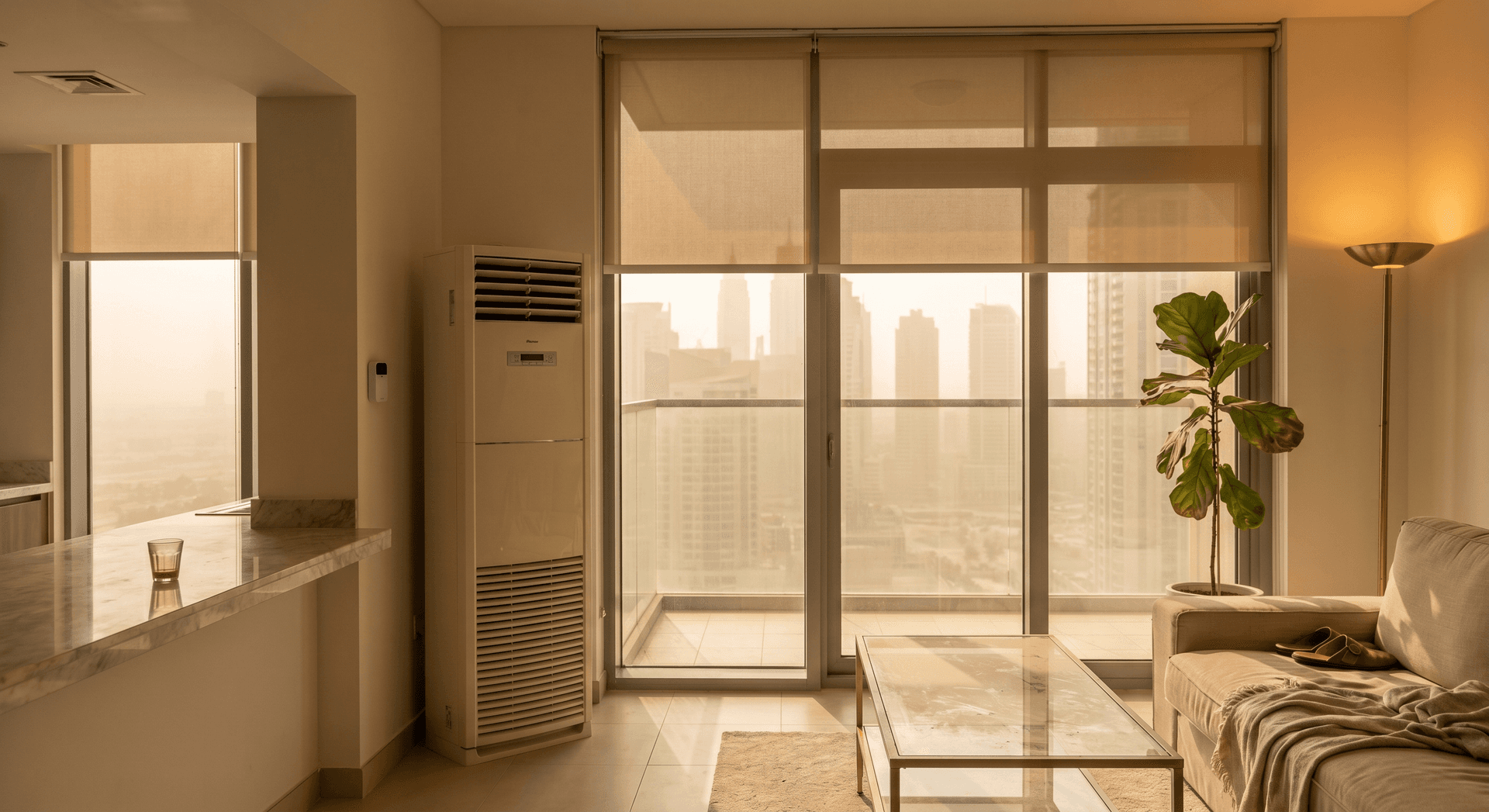
You land at DXB. You've been away three weeks, somewhere with autumn on the way. The Uber pulls up to your building in Business Bay and you're already thinking about your bed.
You open the front door and the heat hits first. Your apartment is 34 degrees and smells like stale AC.
Then you see the DEWA notification on your phone. The apartment ran the AC on the setting you left it on before you rushed out for the airport. For three weeks, it cooled air nobody was breathing.
TL;DR: A Dubai apartment left empty for three summer weeks with a standard AC setup costs AED 600-900 in electricity while nobody is home. Humidity creeps toward 70-75%. Dust settles on every flat surface. A smart home configured for summer absence costs AED 80-120 for the same period, maintains safe humidity levels, and pre-cools to 22 degrees in the 30 minutes before you walk in the door. The difference is AED 500-780 in DEWA charges - and a home that greets you instead of ambushing you.
What a Standard Dubai Apartment Does While You're Gone
Nobody leaves a Dubai apartment in summer with a plan. You pack, you check the passport, you forget to cancel the food delivery subscription, and you turn the AC down to 25 on your way out because leaving it at 21 feels wasteful.
That 25-degree setting runs for 21 days. On a summer schedule where outdoor temperatures hit 42-48 degrees in June, your AC cycles hard to maintain 25 in an empty room. AC accounts for 60-70% of residential electricity in the UAE during summer (DEWA, 2025), and a 2-bedroom apartment cooling an empty space through three weeks of summer heat runs AED 600-900 in electricity.
The worse outcome is the apartment turned off completely.
A sealed Dubai apartment with no climate control in June builds up heat and moisture. HVAC engineers measure this as the latent heat load: the moisture content of the air that the AC normally removes as it cools. Without the AC cycling at all, indoor relative humidity climbs toward 70-75% within days of the apartment being sealed (ASHRAE Standard 55, 2023). Fine dust - the kind that settles from the city air and from sandstorms that move through without warning - layers on every flat surface. The apartment you come back to is not the apartment you left.
What happened is not a mystery. Your home didn't know you were gone. So it kept doing what you told it to do, or it stopped entirely, and the summer moved in.
The Dust Layer Is the Signal
Smart home absence setups reduce dust accumulation for a measurable reason. A 2-bedroom apartment with motorized blinds scheduled to close before the afternoon heat hits the west-facing glass sees significantly less thermal convection inside the room. Less convection means less air movement. Less air movement means less airborne particulate settling on surfaces.
In our experience visiting client apartments for post-absence checks, the pattern is consistent: apartments with scheduled blind positions come back cleaner than apartments left on whatever setting the occupant chose before the trip. Not spotless - the apartment still needs cleaning - but the fine layer that coats counters and shelves in unmanaged apartments is thinner or absent on the flat surfaces that matter most.
This is not a dramatic claim. It is a physics outcome. Dust settles fastest when air is circulating rapidly across surfaces. Controlled blind positions reduce that circulation on the worst-heat-load windows. When you're also running a minimal AC humidity schedule - not cooling the apartment to 22, just cycling to pull moisture - the temperature differential that drives convection stays low.
Over three weeks during a summer Dubai's National Center for Meteorology has rated as potentially the hottest on record, with El Nino now at 98% probability through November (Gulf News, 2026), that difference compounds.
What the DEWA Bill Shows
The June DEWA bill for a 2-bedroom apartment running AC at 25 degrees through a three-week summer absence: AED 600-900. That is the "I'll figure it out when I'm back" departure cost.
A smart home configured for summer absence uses a minimal-humidity schedule instead. The AC runs two hours in the afternoon, maintaining 28-29 degrees. Enough to keep moisture below the 60% relative humidity threshold where mold becomes a risk (ASHRAE Standard 55, 2023), not enough to cool air nobody is breathing.
The water heater is scheduled off. The hot water circuit stops heating water for three weeks. That alone saves AED 25-40 per month.
The DEWA bill for the same apartment, same period, with a smart absence configuration: AED 80-120.
A AED 500-780 difference per three-week trip. What we've found, setting up absence profiles for apartments across Business Bay, Dubai Marina, and Downtown Dubai, is that the savings case closes itself the first time a client comes back and checks the bill against the previous year.
The Pre-Arrival Automation Is the Part People Talk About
Here is the thing that clients mention to their friends.
They're in the Uber from DXB. Thirty minutes out. They open the home app and tap "arriving" - or a location-based automation has already fired when their phone crossed within a certain radius of the building. The AC shifts from 28 to 22. The blinds tilt to let in ambient light without direct sun. The speaker in the kitchen wakes up.
They open the front door and the apartment is 22 degrees and feels like home. Not a storage unit for their furniture.
That automation costs nothing to run. It uses the same infrastructure that managed the AC during the absence. All it adds is a trigger.
One client in Palm Jumeirah described it as "the apartment meeting me at the door." Your phone knows you're 30 minutes out. Your Uber driver knows which building you're headed to. Your home should know you're coming.
What Gets Damaged in a Three-Week Summer Absence
The absence conversation is not only about DEWA bills. Three weeks of elevated humidity in a sealed space without controlled climate management causes real physical changes.
Wooden furniture joints absorb moisture and warp, particularly in dining tables and bed frames with timber slats. AC filters that sat without circulation grow mold inside the unit, which then blows into the room when the AC restarts. Condensation forms behind large appliances in hot kitchens. Soft goods - linen, towels, throw cushions - take on the particular damp smell that takes days of open windows and fresh air to clear.
A smart AC running a minimal humidity-prevention schedule prevents all of this by keeping indoor relative humidity below 60%. It does not cool the apartment to a comfortable living temperature. It cycles just enough air and dehumidification to keep moisture from accumulating.
The Aqara temperature and humidity sensor paired with a smart AC controller automates this precisely: the AC runs when the sensor reads above a humidity threshold, stops when it drops back down, and logs everything so you know exactly what the apartment experienced while you were gone.
Smart Locks and the Cleaner Question
Most people leave Dubai for the summer without thinking carefully about who enters while they're away. The building has a concierge. The cleaner has a key. It feels covered.
A smart lock logs every entry with a timestamp. A video doorbell saves a record of anyone who rang or knocked. A pair of wide-angle indoor cameras covering the main living area costs AED 800-1,200 installed.
The value is record-keeping, not surveillance. For apartments in buildings where the management team has master access, or where a cleaner or handyman needs to enter once while you're away, a home security setup means you know what happened in your apartment with the same certainty you have over your other responsibilities. You review the log when you land. If everything looks right, you delete it and get on with unpacking.
The Setup That Handles It All
For a standard 2-bedroom Dubai apartment, the absence setup that manages cooling, humidity, security, and the pre-arrival automation:
Cooling and humidity: Smart AC controller on each split unit (Sensibo, Tado, or Aqara IR controller): AED 500-900 per unit installed. Configured for a minimal humidity-prevention schedule: 28-29 degrees, two hours per afternoon.
Heat management: Motorized blinds on west-facing windows: AED 1,400-2,400 for battery-powered options that need no wiring and work for renters. Scheduled to close before the afternoon heat peak and open at night.
Security: Video doorbell: AED 600-900 installed. Smart lock with access log: AED 1,200-1,800 installed. Optional wide-angle indoor cameras: AED 400-700 per camera.
Water: Smart switch on the water heater circuit: priced once we have seen the heater's circuit. See our guide to putting a water heater on a smart schedule.
Total for a 2-bedroom: AED 4,100-7,150 installed, depending on which components you choose, plus the heater switch once we have seen it. The second summer is entirely convenience.
Coming back after three weeks is a different problem from coming back twice a year. For owners who are not resident here, managing a Dubai apartment from abroad covers what has to report on itself in between visits.
Frequently Asked Questions
Can I set this up remotely if I'm already abroad?
Yes. Smart AC controllers are configured through an app, and most can be set up remotely if the device is already connected to WiFi. Smart locks and cameras can be monitored from anywhere. If you want a configuration reviewed or changed from abroad, contact us and we can walk through the app settings without an on-site visit.
What if my AC doesn't have a separate remote?
Every split AC unit in UAE apartments uses an infrared remote. Smart AC controllers work with any remote-compatible unit regardless of brand or age. They learn the remote's signals and take over the scheduling from there.
Does the system need constant internet to run schedules?
Schedules on most smart AC controllers run locally, so a brief internet outage will not break the humidity-prevention routine. Remote access requires an active connection, but the core scheduled functions continue even if your router reboots while you're away.
What is the DEWA saving for a typical three-week absence?
Based on client data from Business Bay and Dubai Marina apartments, a smart absence profile reduces the DEWA charge for a 2-bedroom from AED 600-900 to AED 80-120 over three weeks. The exact saving depends on your AC's age, capacity, and the apartment's insulation.
How long does pre-arrival cool-down take?
On a June Dubai day with outdoor temperatures at 42-44 degrees, pre-cooling a 2-bedroom apartment from 28 to 22 degrees takes 35-50 minutes depending on AC capacity and insulation. Starting the sequence 45 minutes before your Uber reaches the building covers it reliably. For everyday commutes rather than multi-week absences, location-based automation using your phone's geofence handles the pre-cool trigger automatically without a manual remote start.
Come back to an apartment that was running while you were gone. Get a free consultation - we'll look at your specific setup and tell you exactly what makes sense, with full pricing before any work starts.
Ready to Get Started?
Get a free consultation and we'll recommend what makes sense for your situation.
Get Free Consultation