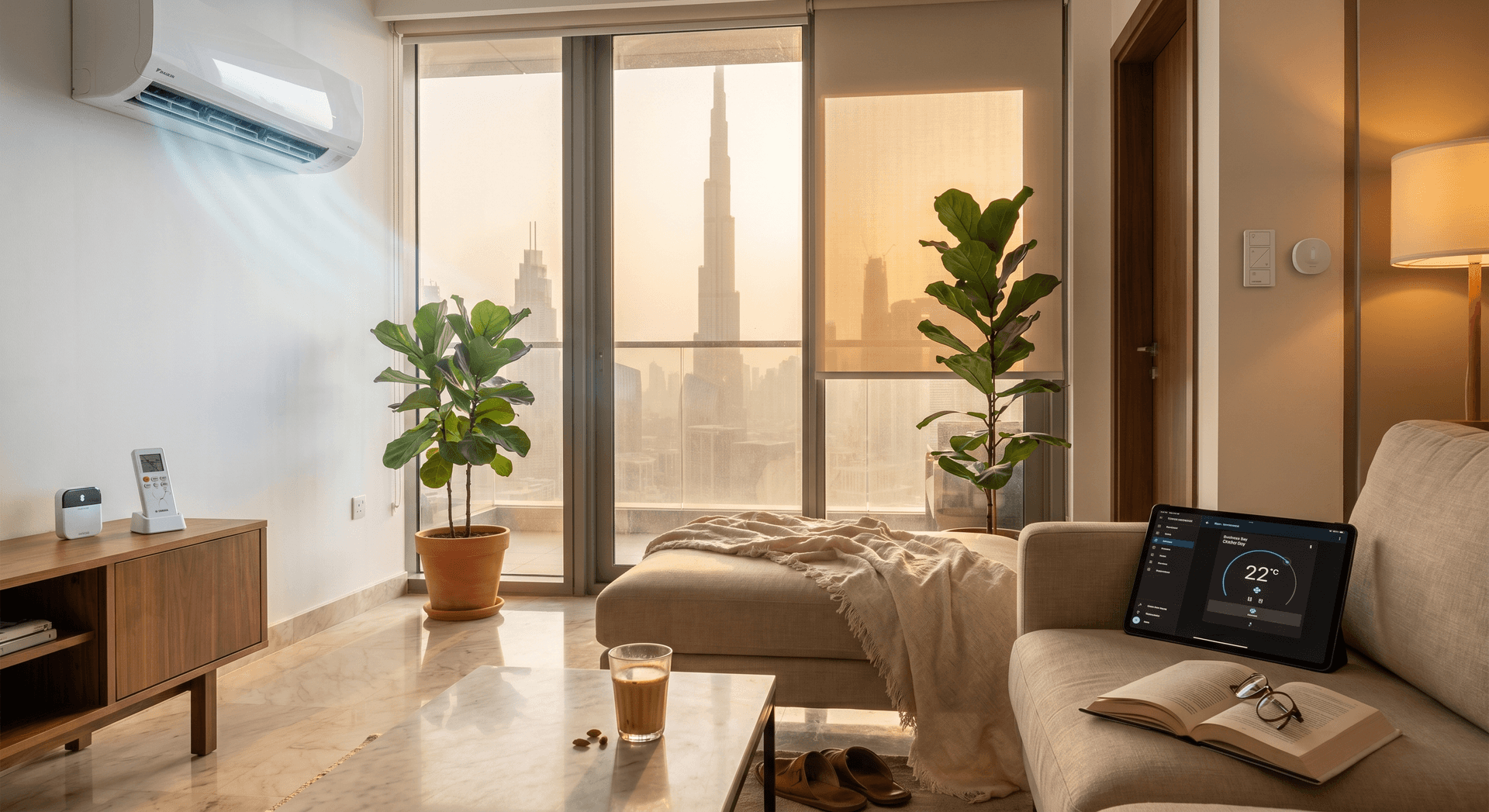
Half a kilometre down the road from Business Bay, DEWA runs the grid that cools your apartment from a building that holds 110,000 smart sensors and produces 1.9 million automated control commands every day (Khaleej Times, 2026). This month, the world's first AI Virtual Engineer comes online to monitor the network and predict failures in real time (Utilities Middle East, 2026). Inside your apartment, the AC remote has a cracked screen and lives somewhere between the sofa cushions.
That gap is what people mean when they search for smart AC control in the UAE. They are looking for the bit between the AI grid and the cracked-screen remote.
TL;DR: Smart AC control in the UAE means three different things depending on which of three cooling systems your home runs: a DEWA-direct split, a district-cooled split, or a central system with a wall thermostat. A WiFi AC controller for a split unit starts from around AED 800 installed and the AED 3,000 starter covers controller plus configuration plus app setup. Sensibo, Aqara P3, and Tado work with any remote-based AC. Honeywell, Ecobee, and Lutron wall thermostats replace existing thermostats in central systems. Open platforms only, never locked-in.
What Smart AC Control Means in a UAE Home
A smart AC control system turns your air conditioning from a remote-only device into something that responds to your schedule, your location, and your phone. Three things change. You stop fighting a cracked-screen remote. You set the AC to pre-cool the apartment before you walk in. And the system runs schedules so the AC is not sitting on 18 degrees in an empty bedroom all day.
The same idea looks different in three UAE homes. A renter in a 1-bedroom Dubai Marina apartment with a Daikin split AC needs a small WiFi controller that learns the existing remote. An owner of a Dubai Hills villa with a central system and a wall thermostat needs a smart thermostat that replaces the thermostat. A district-cooled 2-bedroom in Business Bay needs the renter setup plus a layer that understands the chiller bill is separate from the DEWA bill. The hardware is different. The outcome is the same: cool when you want it, off when you do not, all from your phone.
The Three Cooling Systems Inside UAE Homes
The first decision is not what to buy. It is figuring out which of the three cooling systems your home runs.
A DEWA-direct split AC is the most common setup in older Dubai buildings and most Sharjah and Ajman apartments. You have an indoor unit on the wall, an outdoor compressor on the balcony or roof, and a handheld remote. The compressor pulls electricity straight off your DEWA meter, which is why your DEWA bill in July is usually three to four times your bill in January. If yours jumped and you are not sure what drove it, our guide on why a DEWA bill jumps and how to find the culprit walks through the free checks to run before you buy anything. That gap is widest during Jamrat Al Qayth, the hottest 40 days of the year, when the compressor runs the longest and a smart schedule saves the most.
A district-cooled split looks the same from inside the apartment, but the chilled water comes from a central plant blocks away. Empower runs the largest network in Dubai, holding more than 80 percent of the connected district cooling capacity, serving more than 1,500 buildings across Downtown, Marina, Business Bay, JBR, and 120 other districts (Markets and Markets, 2026). Tabreed operates 76 plants across the UAE with 1.57 million tons of connected cooling capacity (Tabreed, 2025). If you live in a 2010-or-newer Dubai apartment, there is a strong chance one of these companies cools your home and bills you separately from DEWA at AED 0.568 per refrigeration ton hour of consumption plus an annual capacity charge (Utility Bill UAE, 2026).
A central system with a wall thermostat is what most American smart-home content assumes you have. Ducted central air, one thermostat on the wall, and the same thermostat controls the whole house. Some Dubai Hills, Emirates Hills, and Palm villas have this. Most apartments do not.
The 30-second self-check is at the bottom of this post, but the short version is this: if you have a handheld remote and an indoor unit on the wall, you have a split. If you have a thermostat on the wall and no remote, you have central. If both, you have a hybrid and the wall thermostat wins.
Three Control Approaches for Three Systems
The shape of the controller maps to the shape of the AC.
For a split AC with a remote, the answer is a WiFi-to-infrared bridge. Sensibo Sky and Sensibo Air sit near the indoor unit, learn the IR codes from your existing remote, and from then on pretend to be a smart remote you control from your phone. If you want the mechanism behind that, we explain how a smart AC controller actually works, including why the app and the old remote can fall out of sync. Aqara P3 does the same job and adds Zigbee for local control. Tado Smart AC Control V3+ adds room sensors and a tighter geofencing flow. All three plug into a regular AED 5 power outlet, install in fifteen minutes, and leave the AC unit itself untouched. If you move out, you unplug it and take it with you. Pricing starts from around AED 800 for the device, plus configuration if you want it set up properly with schedules and automations.
For a central system with a wall thermostat, the answer is a smart thermostat that physically replaces the existing one. Honeywell Lyric, Ecobee SmartThermostat, and a Lutron Caseta wall keypad paired with their climate gateway all work in UAE villas that have proper 24V thermostat wiring. The thermostat reads room temperature, talks to the compressor through the existing control wire, and turns the whole HVAC system into something you can control from anywhere. Pricing starts from around AED 1,600 for the device plus electrical work.
For a district-cooled split, the renter setup is identical to a DEWA split. The chiller is just the building's source of cold water, not something you control or modify. Your IR controller still talks to your fan coil unit through its existing remote, which still adjusts how much chilled water flows. The thing that changes is the billing math, which we get to below.
For any whole-home setup, the controllers become parts of a larger automation that also runs lights, blinds, and security. Read more about whole-home automation in Dubai if that is the goal.
Why UAE Conditions Change the Math
Three things make the UAE cooling load different from anywhere else, and they all change which smart AC control approach makes sense.
First, the season is six months long. Summer 2026 began on the first of June and runs through September. Dubai is at 39 degrees on the high today and 30 degrees on the low (Khaleej Times NCM, 2026). Thirty degrees as an overnight low is the new wrinkle for 2026: the AC does not get a break at night anymore, which means a 24-hour cooling load that pushes any system without smart scheduling into roughly twice the bill it needs to run.
Second, the air is dusty. The Khaleej Times forecast for today notes blowing dust and sand at 10 to 25 kilometres per hour with gusts to 40. That matters for smart AC control in two ways. Open windows let in dust, so the open-window detection that comes standard on Sensibo, Tado, and Aqara matters for indoor air quality, not only for energy waste. And it pushes the system toward a sealed-envelope model where the AC runs longer at a lower setpoint, which is exactly where scheduling pays off. A sealed apartment also holds its moisture, which is why the fan speed on your remote quietly decides how humid the room feels once August arrives.
Third, district cooling changes the bill. Smart AC controllers claim 15 to 30 percent energy savings (Sensibo, 2026), and those numbers hold on a DEWA-direct split where every saved kilowatt-hour shows up in next month's DEWA bill. They hold differently on a district-cooled apartment, where saving consumption shows up in a separate chiller bill and the annual capacity charge does not move. We have seen Empower bills in Business Bay 2-bedrooms run AED 700 to 1,200 in peak summer months. A smart controller can take 20 percent off the consumption line. The capacity line stays fixed.
The AED 3,000 Starter for a UAE Apartment
The cheapest version of smart AC control is buying a Sensibo Sky from Amazon for AED 600, plugging it in, and setting up the app yourself. That works. We have helped clients who already did that and just needed Home Assistant added on top later.
The Bayora Smart Home Starter is AED 3,000 installed and covers a controller plus configuration plus app setup. The difference between the two is the second hour. Configuration means schedules that match your actual life: pre-cool before you arrive, off-while-away, a sleep schedule that drifts the temperature up at 2am and back down at 5am so the compressor does not cycle hard overnight. App setup means the same control surface across iPhone and iPad and a webhook that fires when DEWA pushes an outage notification. It is the part that turns a controller into a system.
For a 2-bedroom Dubai Marina or Business Bay apartment, the starter covers one main bedroom or one living-room AC. Adding the second AC starts from AED 1,500 per zone. Two-room coverage lands around AED 4,500 installed. Whole-home automation that ties AC to lights and blinds and security runs AED 10,000 to 50,000 depending on scope. That is the entire pricing ladder. If you are timing the spend around the summer sales, we wrote a separate guide to what is worth upgrading during Dubai Summer Surprises and what to skip.
What Bayora Will Tell You Not To Buy
Three categories of smart AC product get a hard no from us for UAE homes.
A Nest or first-generation Ecobee for a split-AC apartment. The product is good. It is the wrong shape. Nest and Ecobee are wall thermostats designed for ducted central air in American homes. Most UAE apartments have split units and no wall thermostat to replace. A friend of ours moved into a Marina 2-bedroom last year, ordered an Ecobee from Amazon, and texted us a photo of it in its box asking where to install it. There was nothing to install it on.
A no-name IR blaster for AED 80 that sells on Amazon UAE with no app you can find in any app store. The hardware is sometimes fine. The cloud disappears in six months. When the manufacturer pulls the app, the device becomes plastic. We see this every few months in client homes from previous installers.
A controller that locks you into one ecosystem at the point of purchase. If the only way to use the device is through one brand's app and there is no Home Assistant or Matter or HomeKit path, the device fights you the day you want to add anything else. Open platforms are a principle, not a feature.
Open Platform vs Locked In
Sensibo and Tado are both cloud-first. The controller in your apartment talks to the company's servers in Europe or Israel, the servers talk to your phone, and the round trip from your finger on the iPhone to the AC turning on takes about 1 to 2 seconds. The companies have been around for a decade. The product works. The risk is that if either company shuts down or changes terms, your device becomes a paperweight.
Home Assistant is the local-first alternative. It runs on a small box in your apartment, talks to your AC controller directly, and continues working when your internet goes down. We install it as the brain layer in most of our Business Bay and Marina apartments for clients who want one dashboard for AC, lights, and blinds. Aqara P3 controllers paired with a Home Assistant box give you the WiFi-to-IR convenience of Sensibo with the local control of a proper smart home brain. Matter compatibility, where it exists, is the new bridge that lets devices from different brands talk to each other without going through a manufacturer's cloud.
The honest answer for most renters: start with Sensibo or Aqara, cloud-first is fine, you are getting comfort and convenience. If you stay in the apartment for three years, add a Home Assistant box. If you own and you are doing a whole-home build, start with Home Assistant on day one.
How Smart AC Control Stacks with DEWA's AI Engineer
When DEWA's AI Virtual Engineer ships this month (Utilities Middle East, 2026), three things become possible at the home end, and they all need a smart AC layer to work.
Your consumption data gets faster. The DEWA Smart App already gives daily consumption history. With the AI layer reading 15 million data units a day across the grid (Utilities Middle East, 2026), residents start to see hourly resolution and the day-by-day waste pattern that a flat monthly bill hides. The data is only useful if you can act on it, and acting on it means a controller that can change setpoints from a phone.
Outage notifications become predictive. Right now DEWA tells you the power is out after it is out. With the AI brain monitoring the network, push notifications can land before a feeder trip happens, and a Home Assistant brain can pre-cool the apartment to 21 degrees in the two hours before the predicted outage so the apartment coasts through the gap on the cold air it already stored.
Your home automation reads grid signals. Open-platform setups like Home Assistant can subscribe to DEWA push events through a webhook, the same way they subscribe to weather alerts today. Your AC then runs a different schedule on a peak-demand day than on a cool morning. None of that works if your AC has nothing in front of it but a cracked-screen remote.
The deeper write-up on the DEWA AI integration for your apartment goes through the three changes in more detail.
A Real Build: Business Bay 2-Bedroom, District-Cooled
A client in a Business Bay 2-bedroom apartment came to us in early May with a problem that has nothing to do with DEWA's AI Virtual Engineer. She had a Daikin split in the living room, a smaller Daikin in the main bedroom, and an Empower chiller bill that kept landing around AED 850 a month in summer. The remotes were both somewhere in the apartment, usually under the cushions. She works in marketing, leaves the apartment at 8am, and comes home around 7pm to find the living room at 31 degrees.
We installed a Sensibo Sky in the living room and an Aqara P3 in the main bedroom. The configuration was the part that mattered: schedules that set both ACs to 26 from 8am to 6:30pm, pre-cool to 22 from 6:30pm to 7pm, drift to 24 at sleep, and a 2-degree drift up at 3am to let the compressors rest. A geofencing rule turns both ACs to 27 if her phone leaves the apartment for more than an hour during work hours. The cost was AED 4,500 installed, both zones, configuration and app setup included. The geofencing piece of that setup - how it works, what radius to set, and how to handle multi-person households - is covered in the location automation guide for Dubai apartments.
Her July Empower bill landed at AED 670, a 21 percent drop on the consumption line. The annual capacity charge did not move. She does not think about the remotes anymore. The apartment is cool when she walks in. The savings on the chiller bill are the side effect. The reason she stopped complaining about the apartment was that the apartment stopped fighting her every evening.
For more on what changes when you stop thinking about the remote, read about Bayora's smart AC service or our Marina and Business Bay apartment work. If you work from home, the specific WFH scheduling problem (study at 22°C, everything else off, pre-cool at 7am) is covered in the WFH summer guide for Dubai apartments.
The 30-Second Self-Check
Stand in your living room and look at the AC.
If there is a unit mounted high on the wall with a vent that blows down, and you control it with a small white handheld remote, you have a split AC. Smart AC control means a WiFi-to-IR controller. Sensibo, Aqara P3, or Tado. From AED 800 for the device, AED 3,000 installed with configuration.
If there is no unit in the room you can see, but there is a vent in the ceiling and a square thermostat on the wall, you have central air. Smart AC control means a smart thermostat that replaces the wall unit. Honeywell, Ecobee, Lutron. From AED 1,600 for the device plus electrical work.
If both, the wall thermostat is doing the real work. Treat it as central.
If you have no idea, look at your bill. A DEWA-only bill means you have a DEWA-direct split or a central system on a single property. A DEWA bill plus a separate chiller bill from Empower, Tabreed, Emaar District Cooling, or Palm District Cooling means you have a district-cooled system. The controller approach is the same. The savings math is different.
Frequently Asked Questions
Will a Sensibo Sky work with my district-cooled apartment in Business Bay?
Yes. A Sensibo Sky sits next to your indoor fan coil unit and learns the IR codes from your existing remote. The chiller water source is upstream of the fan coil unit, so the controller does not know or care whether your cold water comes from your own outdoor compressor or from an Empower plant. Schedules, geofencing, and app control all work identically. The energy savings show up on your Empower consumption line rather than your DEWA bill.
Do I need landlord approval to install a smart AC controller in a rented apartment?
No, for the wireless plug-in controllers. Sensibo, Aqara P3, and Tado plug into a regular power outlet, learn your existing remote, and do not modify any wiring, walls, or AC hardware. When you move out, you unplug them and take them with you. For a wall-mounted smart thermostat in a central HVAC villa, that is a different conversation. The smart thermostat physically replaces an existing thermostat and counts as a modification, so check your tenancy contract or ask the landlord. Most owners are fine with it because it stays with the property.
Can I control multiple ACs in different rooms with one app?
Yes. Each AC needs its own controller, so a 2-bedroom apartment with three ACs needs three controllers, but a single app dashboard shows all three. Sensibo, Aqara, Tado, and Home Assistant all handle multi-zone control natively. You can set the bedroom to a different schedule than the living room, run scenes that adjust all three at once for night mode, and see each zone's current temperature on one screen.
Does smart AC control work without WiFi?
The initial setup needs WiFi, and remote control from your phone needs WiFi. But once schedules and automations are configured, most controllers continue running locally even if the internet drops. Sensibo schedules keep running on the device. Aqara paired with a Home Assistant box runs entirely locally and does not need internet at all for day-to-day control. The cloud-first products lose remote control and voice control when the internet drops, but the AC keeps running on its last schedule.
How long does professional installation take?
A single-zone setup with configuration takes us about 90 minutes in a Dubai apartment. The controller mounts or plugs in, we pair it with your network, learn your AC remote, set up schedules, configure geofencing for everyone in the household, install the iOS or Android app on each phone, and walk you through the dashboard. Two zones is closer to 2.5 hours. A whole-home automation build with Home Assistant on top runs 1 to 3 days, but the AC layer is always the first thing we configure.
Using DEWA's Summer Data to Tune Your Smart AC
If you already have a smart controller installed, DEWA's 2026 summer campaign gives you hourly consumption data that makes tuning much easier. The app shows you which hours your AC drew the most power. Your smart controller lets you act on that by tightening schedules or adjusting setpoints for those windows. We wrote a separate guide on how the two layers work together: DEWA's App Is Watching Your AC. Your Home Isn't.
If you are newer to smart home and want the full layer-by-layer picture beyond AC control, The Honest Starter Guide for Dubai Apartments covers the progression from AC to lighting to security and explains what to do in what order.
Ready to Get the Remote Out of Your Life?
The grid running your AC is about to have an AI. Your apartment can either stay on a cracked-screen remote, or it can meet the grid halfway. The AED 3,000 starter is the smallest useful version of meeting it halfway.
Tell us about your apartment and we will recommend the controller setup that fits your AC, your building, and how you use the place. Free consultation, no obligation, complete pricing in the proposal.
Ready to Get Started?
Get a free consultation and we'll recommend what makes sense for your situation.
Get Free Consultation