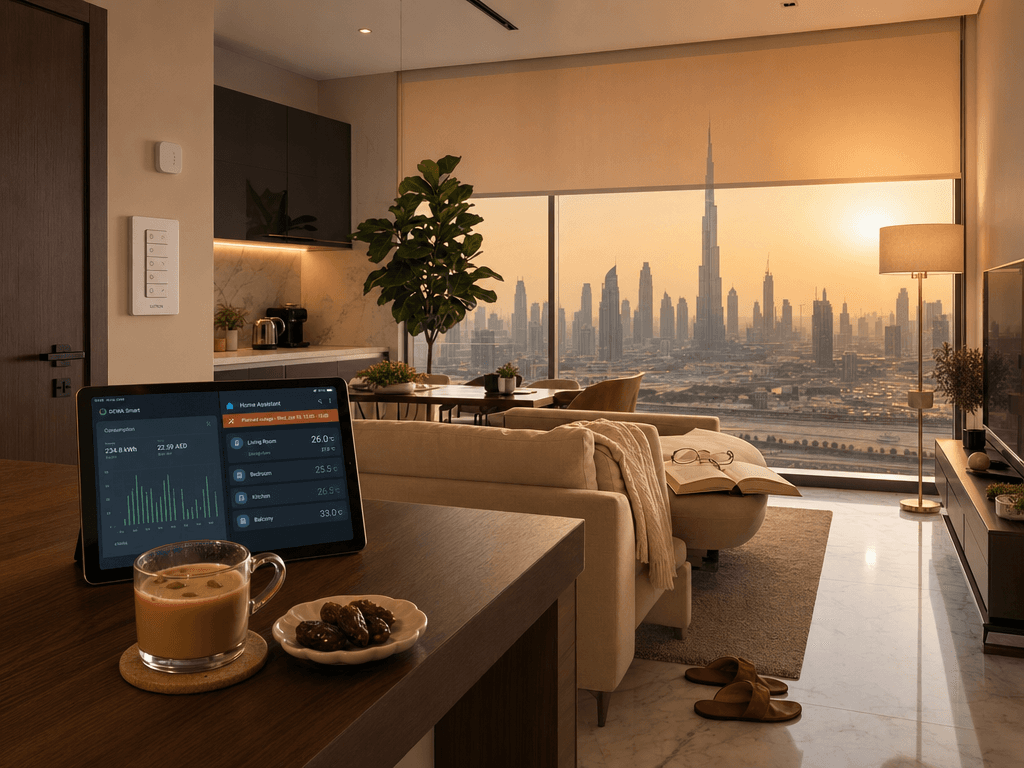
DEWA runs the grid from a building in Al Jaddaf, half a kilometre down the road from Business Bay, that holds 110,000 smart sensors and produces 1.9 million automated control commands every day (Khaleej Times, 2026). This month, the world's first AI Virtual Engineer comes online to monitor the network, predict failures, and run grid scenarios in real time (Utilities Middle East, 2026). A couple of substations and a handful of feeders separate that tower from your apartment.
Inside your apartment, the most automated thing is the kettle, and only because you remembered to fill it.
TL;DR: When DEWA's AI Virtual Engineer ships this June, three things change for residents. Your consumption data gets faster and richer inside the DEWA Smart app. Outage and maintenance prediction starts to push to your phone before the building feels it. And your own smart-home brain can read those grid signals and act on them. Most of what the grid AI does for you, a Dubai apartment can already do today from AED 3,000 installed. The grid AI is the headline. Your home AI is the build that meets it.
What Launches This Month
The June launch is not a customer-facing product. It is an internal engineering tool that DEWA's network operators use to monitor the grid faster than a human team can, predict where failures will occur, and run scenario simulations across substations and feeders before a problem becomes an outage (Utilities Middle East, 2026). DEWA's chief executive Saeed Mohammed Al Tayer describes it as the first step toward becoming the world's first fully AI-driven utility service provider.
That sounds far from your living room. It is not. The grid that runs the AC in your apartment is the same grid this AI now monitors. The 2.2 million smart meters across Dubai already feed Al Sheraa's Distribution Network Smart Centre, which analyses 15 million data units a day and lifts grid efficiency by about 20 percent (Utilities Middle East, 2026). The forecast on solar output now stretches 72 hours ahead. The infrastructure for a thinking grid is already in place. The Virtual Engineer is the new brain on top.
The change shows up for residents in three places, and only one of them touches your bill.
Change 1: Your Bill and Consumption Data Get Faster
DEWA's customer-facing layer is already three apps deep. The DEWA Smart App handles billing, payment, consumption history, and outage reporting (DEWA Smart App, 2026). The Smart Living service inside it gives you daily, monthly, and annual consumption reports, a high-water-usage alert that flags leaks after the meter, and customisable goals. DubaiNow, Dubai's government super-app, brings DEWA bill payment alongside RTA, residency, and 280 other services from 44 entities into a single app (Khaleej Times, 2026). Rammas, DEWA's customer chatbot, has answered 12.7 million inquiries since 2017 without a human touching it (WAM, 2025).
What the AI layer adds, in our experience tracking the rollout for clients, is depth and tempo. Bill anomalies that today take you a billing cycle to notice will surface as a push notification in days. Consumption breakdowns that today read like a monthly summary will start to read like a behaviour pattern. The AI is not setting your thermostat. It is reading your house at higher resolution and surfacing the right number to you faster.
That faster signal only saves money if there is a hand at the other end of it. A push notification that says "your kWh is 18 percent above your June average" does nothing on its own. Someone in the household has to walk to the thermostat, raise the setpoint two degrees, and remember to leave it there. Most households read the notification, feel mildly bad, and carry on. This is the gap a smart-home brain closes. An AC controller takes the same signal and shifts the schedule automatically. The DEWA AI tells you. The home AI does something about it.
Change 2: Outages Get Predicted Before They Reach You
DEWA already sends planned-outage notifications through the Smart App for scheduled maintenance in your building or feeder area. The Virtual Engineer changes what is possible on the unplanned side. The grid AI looks at sensor data, weather forecasts, and load patterns and flags components likely to fail before they do (Utilities Middle East, 2026). Operators can then schedule pre-emptive maintenance during a window that is convenient instead of waiting for the substation to trip on a 47C July afternoon.
For residents, this shows up as fewer surprise outages, and earlier notice on the ones that do happen. The 45-minute summer outage that catches the family halfway through dinner becomes a 24-hour heads-up on the app. The fix becomes scheduled. The disruption stays small.
What a smart home does with that earlier notice is the part most apartments still miss. A 24-hour outage alert is useful if the home reacts. In the Business Bay installs we have done over the past 18 months, the DEWA push notification feeds into Home Assistant via a webhook, and a routine fires that pre-cools every room to 21C in the two hours before the outage window, drops standby loads, switches the fridge to its cold-hold mode, and confirms the front door is locked. The family comes home to a cool apartment even though the AC was off for 45 minutes during the outage. The grid AI provided the warning. The home AI made it useful.
You do not need a webhook to get most of the benefit. A push notification that you read and act on manually is 60 percent of the value. The webhook is the last 40 percent. Both are easier than people think.
Change 3: Your Automations Get Smarter Inputs
The third change is the one we are most excited about, and the one most homeowners have not yet noticed. As DEWA exposes more grid telemetry to residents, your own smart-home automations get better inputs to work with.
Today, most home automations are blind. The schedule on your smart AC controller fires at 5:30pm because someone typed 5:30pm into the app eight months ago. The schedule does not know whether the grid is under stress, whether your solar generation dropped that afternoon, whether the outdoor temperature is two degrees higher than the forecast said, or whether the neighbourhood is running at peak load. It just fires.
A thinking home reads context and acts on it. Today's context is mostly inside the home: temperature, humidity, presence, time, calendar. As DEWA's data surfaces become richer, the context starts to include the grid. The smart-meter signal, available every 15 minutes (Utilities Middle East, 2026), can feed your automations directly. Your AC schedule no longer fires at a clock time. It fires when consumption crosses a threshold or when the next billing slab is one bad day away. The blinds close when the AI forecast says the next three hours will be 2C hotter than predicted. The water heater shifts its cycle to the off-peak hours that the grid prefers, even when the resident tariff has not yet been time-of-use priced.
This is what open platforms buy you. Home Assistant, Matter, KNX, and the bigger systems like Control4 all expose webhook and API surfaces that can ingest a DEWA signal. The closed brand apps cannot. We have written before about why we picked Home Assistant as the default brain for our apartment-scale installs. The DEWA AI rollout is the clearest commercial case for it. A home stuck on a 2018 closed hub will not read DEWA's new signals in 2027. A home running on Home Assistant will.
The Honest Caveat: One of These Saves Money
Of the three changes, only the first one touches your bill directly. Better consumption visibility plus a household that acts on the notifications drops a typical summer DEWA bill by AED 200 to AED 500 a month in the apartments we have measured. The second change saves discomfort, not money. The third change positions your home to save money later, when the tariff structure inevitably moves toward time-of-use pricing (likely in the next five years, in our reading of where DEWA is going).
We say this because the AI Virtual Engineer is being marketed in the kind of language that sounds like personal savings, and it is not, at least not yet. It is a utility-side efficiency play. Dubai's grid runs better. Your bill runs slightly better only if you read your push notifications and act on them. The real resident upside is in years two, three, and five, when the platforms that talk to DEWA start to compound.
The good news is the upgrade you do today to be ready costs almost the same as the upgrade you would do anyway. A smart AC controller from AED 3,000 installed is the same hardware whether DEWA's AI exists or not. The only question is whether you bought it on a platform that can read tomorrow's signals.
What AED 3,000 Buys You Today
Most of the DEWA-AI benefit you can capture today, before the Virtual Engineer formally launches, with a single device on an open platform. The Smart Home Starter at AED 3,000 includes a Sensibo Air or Aqara TRV-equivalent AC controller, configuration, and a one-hour walk-through with the household. From day one it does the following.
It schedules the AC around your actual day, not a default profile. It pre-cools before you arrive so the room is at 22C the minute you walk in, instead of 28C and slowly dropping. It cuts AC runtime by 15 to 30 percent compared to a manual remote (Sensibo, 2024), which translates to AED 200 to AED 500 a month in summer on a typical 2BR. It exposes a webhook so when DEWA push notifications eventually plug into it, the schedule adjusts automatically.
That is one device, one app, one bill reduction, and one webhook ready for whatever DEWA exposes next. The cost is AED 3,000 installed. The setup is one survey visit and one install day. No landlord approval needed in any apartment we have surveyed in Marina, Business Bay, JBR, or Downtown.
The next rung up, around AED 10,000 to AED 18,000 installed, adds a proper brain box. This is where Home Assistant or a Matter coordinator lives. The brain reads the AC, reads the smart-meter feed (today via the DEWA app, tomorrow via API), reads the weather, and writes back to lights, blinds, and locks. This is the rung where a DEWA outage push starts to trigger automations automatically. We do not recommend this rung to renters in a year-one tenancy because the value sits in the integration layer, and the integration layer takes a few months of household use to tune.
The AED 25,000+ range is the proper whole-home build, with full climate integration, multi-room audio, security, and the automations dialled in across every room. This is where DEWA's grid signals become invisible to the household because the home is acting on them in the background. The brain works while the family lives.
How DEWA's New App Layer Connects to Your Home
For the next 6 to 12 months, the easiest way to get DEWA's smart signals into your apartment is the manual chain. The DEWA Smart App sends a push notification (planned outage, consumption alert, usage anomaly). You read it on your phone. You open your smart-home app (Sensibo, Aqara, or Home Assistant) and adjust a schedule, or run a pre-cool scene, or change the AC setpoint. It takes 30 seconds. It catches 70 percent of the value.
The next layer is iOS Shortcuts or Android Tasker. When DEWA sends a specific push, your phone automatically triggers a Home Assistant scene. This catches 90 percent of the value with no DEWA API required. Setup is one evening per resident, or 90 minutes if Bayora sets it up during the install.
The third layer, which is where we expect the most movement in the next 18 months, is a direct API from DEWA to a household automation. DEWA has not yet published a public API for resident-side automations, but the smart meters are already there, the smart-app push is already there, and the AI Virtual Engineer needs a data surface. Our reading, from talking to the platform team at one DEWA event this spring, is that a structured push to third-party home brains is coming, on the order of 12 to 24 months out. Bayora installs today will read those signals when they arrive. Closed-system installs will not.
What Bayora Will Talk You Out Of
We will, as we always do, walk you away from four things at the first survey.
The wall-mounted touchscreen for AED 12,000 to AED 18,000 that does the same job a tablet on a magnetic mount does for AED 800. The DEWA app already runs on your phone. You do not need a hallway panel.
The voice-assistant-in-every-room kit at AED 6,000 plus. One HomePod or Echo in the kitchen and one in the living room is plenty. Voice gets less use in practice than households expect, and the DEWA chatbot does not need a smart speaker to talk to you.
The closed-brand smart panel from the vendor who tells you their app is "the only one you need." Five years from now their app is the only one that does not read DEWA's signals, and you cannot swap it out without re-wiring. Open platforms only.
The AED 4,500 smart-fridge with a DEWA-bill widget built into it. Appliances should be reliable for ten years. The right place for a DEWA widget is your phone, not the door of a fridge that depreciates the day you take delivery.
In our experience installing across the city, the four lines above account for the most overspending we see clients do before they meet us. None of them improves the home's ability to read DEWA's signals. All of them add cost without adding capability.
A Business Bay Two-Bedroom That Got DEWA-Ready
A couple in a 110sqm two-bedroom in Business Bay we worked with last winter wanted three things. Lower DEWA bill. Easier weekday mornings. A home that would still work when DEWA's AI rollout went live. They had read about the Al Sheraa inauguration in Khaleej Times and asked the obvious question. What can we do now so we are not behind in two years?
The build came in at AED 14,200 installed across two visits. The first visit added Sensibo Air controllers on both AC units, a Home Assistant Green box on a kitchen shelf, a Lutron Caseta dimmer and a Pico keypad by the door, and an Aqara door sensor on the entry. The second visit, three weeks later, added a motorized roller blind on the west-facing living room window, the DEWA Smart App webhook chain via iOS Shortcuts, and the four scenes the family runs daily. The brain was wired to read the household calendar, the local weather feed, the DEWA app push, and the room sensors.
The first DEWA bill after the install came in at AED 612 versus AED 894 the month before, on similar weather. A 32 percent drop. The second was AED 597 versus an expected AED 940 for early summer. The household reads the DEWA Smart App push notifications and the home AI acts on the consumption alerts automatically. When DEWA pushed a planned-outage alert for the building in April, the apartment pre-cooled to 21C an hour before, and the husband, who works from home, did not notice the 30-minute outage. The wife came home at 7pm to a 22C apartment, an open book on the sofa, and a husband who had been productive all day.
The build was not at the upper end of what is possible. It was the middle. The brain reads three external signals today (calendar, weather, DEWA app) and is ready to read more when DEWA exposes them. The AC controller is a Sensibo on an open API. The blind is on Bluetooth and Zigbee. The lighting is on Lutron Clear Connect. The locks are still mechanical. The cost is AED 14,200, including the brain box, all the sensors, and two install visits.
This is the build that meets the grid AI halfway, on a renter timeline, in a Dubai two-bedroom, at a sensible budget. Nothing about it is exotic.
Where to Start If You Are Renting
We have written before that the renter starter is the most important entry point in Dubai because two-thirds of the apartments we walk into are tenant-occupied. None of the DEWA-AI rollout changes that calculation. The same three layers apply.
The AC layer first, because the AC is 60 to 70 percent of your summer bill (DEWA tariff, 2026). A smart AC controller is a 30-minute install with no landlord approval, reversible at move-out. It captures the bulk of the DEWA-AI-readiness benefit on its own. If you have not picked a controller yet, the smart AC control guide for UAE covers the three cooling systems and which controller fits which one.
The lighting layer second, because the household notices lighting first and it sets the daily rhythm. Lutron Caseta dimmers and Pico keypads behind your existing switches retrofit cleanly and come off in 20 minutes.
The blinds layer third, because the sun in Dubai is the heat. Battery-powered motorized blinds clip onto the inside of existing brackets. The most important window is the west-facing one in the room you use after work.
The brain comes last, after the family has lived with the first three layers for a few months and knows what they want it to do. The brain is where the DEWA signals get processed once DEWA exposes them, but the family-facing benefit is biggest at the AC layer first.
The full renter-friendly starter kit lands at AED 4,000 to AED 8,000 in our experience. It moves with you to the next apartment. The hardware is unaffected by the landlord changing.
How the AI Engineer Reshapes the Decision
The honest summary is that DEWA's AI Virtual Engineer ships this month and most Dubai residents will not notice. The grid will be slightly more reliable. The DEWA Smart App will get smarter notifications. The unplanned-outage rate will drop a notch. None of that requires you to do anything.
What does require a decision is whether your home is ready to read the grid signals that come next. The three changes above all assume a home that can act on better data. The bill notification only works if something at home adjusts. The outage warning only matters if the cooling schedule shifts. The grid signal only feeds your scenes if the brain can read it.
The decision, in our reading, is not "do I buy smart home now or wait for DEWA to launch their API." It is "do I want my next eight years of Dubai-apartment automation built on an open platform that will read DEWA's signals when they come, or on a closed brand app that will not." The cost is identical. The capability over five years is not.
DEWA's AI shows up this month. The grid is becoming a thinking grid. The bill is becoming a thinking bill. The window of choice for your apartment is now.
Frequently Asked Questions
Does the DEWA AI Virtual Engineer connect directly to my smart home?
Not yet. The AI Virtual Engineer launches this month as an internal grid-operations tool (Utilities Middle East, 2026). The resident-facing surfaces today are the DEWA Smart App, Smart Living service, DubaiNow, and Rammas chatbot. The most reliable way to bridge today is iOS Shortcuts or Tasker, listening for DEWA app push notifications and triggering Home Assistant scenes. A direct API from DEWA to third-party home brains is not yet published, but the architecture is in place.
Will DEWA introduce time-of-use pricing for residential customers?
DEWA has not announced a residential time-of-use tariff. The current slab tariff is volume-based, not time-based (DEWA tariff, 2026). Our reading is that time-of-use pricing follows the AI Virtual Engineer rollout naturally over the next three to five years, because the smart meters and grid telemetry already support it. Building today on an open platform is the cheapest way to be ready when it arrives.
Do I need to wait for DEWA's AI to launch before installing a smart home?
No. About 70 percent of the resident-side DEWA-AI benefit is captured by a smart AC controller and a habit of reading DEWA Smart App notifications, both of which are available today. The remaining 30 percent comes from a smart-home brain that can read external signals, which is also available today. Waiting for DEWA's launch does not change the install path.
Which smart-home platforms will work with DEWA's AI?
Open platforms with webhook and API surfaces are the safe bets. Home Assistant, Matter coordinators, KNX bridges, and the higher-tier systems like Control4 and Crestron can all ingest external signals. Closed brand apps that only talk to their own devices cannot. The Bayora install pattern defaults to Home Assistant on the brain, with brand-agnostic devices underneath, exactly because the upgrade path stays open as DEWA exposes more.
How much does the DEWA-AI-ready setup cost?
The entry point is AED 3,000 installed for a single smart AC controller on an open platform. The mid-tier with a brain, a motorized blind, lighting control, and the DEWA app webhook chain lands at AED 12,000 to AED 18,000 installed for a two-bedroom apartment. The whole-home build for a 4-5BR villa starts at AED 25,000 and goes up to AED 100,000 depending on scope. The price is the same whether you optimise for DEWA-AI readiness or not. The difference is platform choice.
What to Do Next
The two-minute version of this post: pick a smart-home brain that can read external signals, and start with the AC. Most clients we see overthink the brain and underthink the AC. The AC carries the bulk of your bill and the most of the DEWA-AI-readiness benefit.
If you are renting, the AED 3,000 starter on an open platform gets you 70 percent of the way there with one install visit. If you are buying or own, the AED 12,000 to AED 18,000 mid-tier with the brain is the smart pre-AI position, because it positions you to read whatever DEWA exposes next without changing platforms.
Tell us about your apartment and we will tell you exactly which two devices to start with for the home you live in. The free survey takes 90 minutes. The decisions take a day. The DEWA AI ships this month.
Ready to Get Started?
Get a free consultation and we'll recommend what makes sense for your situation.
Get Free Consultation