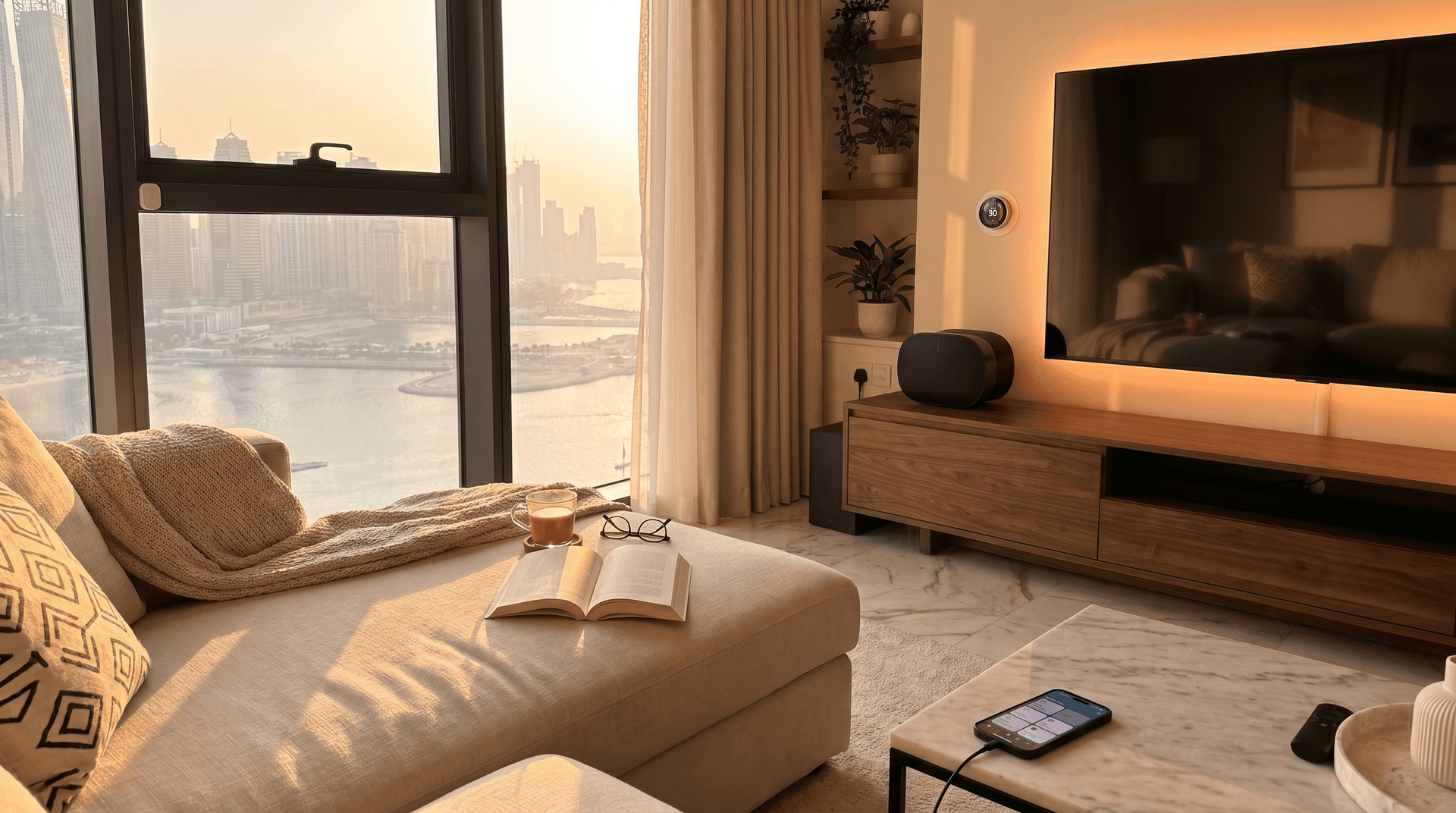
You bought a smart bulb from one brand, a plug from another, and a door sensor from a third. Now you have three apps on your phone, three logins, and none of them talk to each other. Your bulb can turn on by itself. Your sensor can see the door open. But the sensor cannot tell the bulb anything, because they were never built to speak the same language.
Matter is the fix for that. It is a smart home standard that lets devices from different brands work together and answer to one app, instead of trapping each one in its own.
TL;DR: Matter is a smart home standard backed by Apple, Google, Amazon, and Samsung that lets devices from different brands work together in one app. If your device has the Matter logo, you can add it to Apple Home, Google Home, or Alexa without being locked to one brand. It does not replace your existing gear, and it does not do the installation for you.
Below is what Matter actually does, how to tell if your devices support it, and what it changes for a home in Dubai.
What Matter Is in Plain English
Matter is a connectivity standard for smart home devices, developed by the Connectivity Standards Alliance and backed by Apple, Google, Amazon, Samsung, and more than 500 other companies (Connectivity Standards Alliance, 2022). It launched in late 2022.
The idea is simple. Before Matter, a smart lock built for one platform often would not work with another. You picked an ecosystem, then you were stuck buying only what that ecosystem supported. Matter sets one common language so a device that carries the Matter logo works with any major platform that supports Matter, including Apple Home, Google Home, Amazon Alexa, and Samsung SmartThings.
Think of it like USB-C. Before, every device had its own charger. Now one cable works across most of them. Matter is trying to be the USB-C of the smart home.
Why Matter Exists
For years, the smart home was a walled-garden problem. You would walk into a store, fall for a nice smart bulb, get it home, and find out it only worked with the one app it shipped with. Add a lock from a different brand and now you are juggling two apps that ignore each other.
That fragmentation was the single biggest reason people gave up on smart homes. A survey-backed pattern the whole industry kept hitting was that buyers wanted things to "just work together," and they mostly did not (Connectivity Standards Alliance, 2022). Apple, Google, and Amazon are usually competitors. The fact that they sat at the same table to build Matter tells you how real the problem was.
In our experience setting up homes across Dubai, the "too many apps" complaint comes up more than price does. People are not scared of the cost. They are tired of the mess.
Wi-Fi vs Thread: The Part Everyone Gets Wrong
Matter is not a single radio. This trips up almost every first-time buyer. Matter devices reach your network two ways: over Wi-Fi (and Ethernet) for always-powered devices like plugs and TVs, and over Thread for low-power battery devices like sensors and locks (Connectivity Standards Alliance, 2024).
Thread is a low-power mesh network. It is great for battery life, but it needs a Thread Border Router on your network to work. The good news is you may already own one. Thread border routers are built into devices like the Apple HomePod and Apple TV 4K (Apple, 2024), the Google Nest Hub second generation (Google, 2024), and recent Amazon Echo speakers (Amazon, 2024).
So when someone asks "is my AC Matter," the honest answer is usually about how it connects, not just whether it has a logo. A Matter-over-Wi-Fi device needs Wi-Fi and a controller. A Matter-over-Thread device also needs that border router.
How to Tell If a Device Supports Matter
Look for the Matter logo on the box or the device itself, plus an 11-digit setup code or a QR code you scan during setup (Connectivity Standards Alliance, 2022). If it has the logo, it can join any platform that supports Matter.
One thing clients always ask is whether "works with Alexa" on the box is the same as Matter. They are different things. A device can work with Alexa through Alexa's own integration and still not be a Matter device. The Matter logo is the thing to look for if you want true cross-platform freedom.
When we survey an apartment, this is one of the first things we check. We sort what is Matter-native, what is Matter through a bridge, and what is locked to its own app, because that map decides how clean the final setup feels.
What Devices Work With Matter
Matter started with the basics and has grown with each release. The supported categories now cover lights, plugs, switches, locks, thermostats, blinds and shades, fans, and a wide range of sensors for contact, motion, temperature, and occupancy (Connectivity Standards Alliance, 2024).
More recent updates added bigger categories: robot vacuums, major appliances like fridges and washers, air purifiers and air-quality sensors, energy devices and EV chargers, and most recently cameras (Connectivity Standards Alliance, 2024). The list keeps expanding, which is the point of a living standard.
For a typical Dubai apartment, the categories that matter most day to day are lighting, plugs, sensors, locks, and blinds. Those are mature in Matter and easy to mix across brands.
You Do Not Have to Replace Your Zigbee Devices
The reassuring part: Matter does not kill Zigbee or Z-Wave, and it does not mean your current gear is junk. Existing Zigbee devices, like many Aqara sensors or IKEA bulbs, keep talking Zigbee to their hub. That hub then bridges them into Matter, so they show up alongside your Matter-native devices (Aqara, 2024).
So you do not rip out a working system to "get Matter." You add a hub that speaks both, and your old devices come along for the ride. We have done exactly this in homes where a client already owned a drawer full of Zigbee sensors and did not want to start over.
This is also why a platform like Home Assistant pairs so well with Matter. It can sit in the middle, speak to Zigbee, Wi-Fi, and Matter devices at once, and give you one place to run everything.
What Matter Does Not Fix
Matter is honest about its job, and so are we. It standardizes the common functions of a device reliably. Advanced or brand-specific features can still need the maker's own app. A robot vacuum might appear in Apple Home for start and stop, but its room-by-room mapping may live only in its own app. Matter exposes the shared basics first.
It also does not solve installation. Matter is about devices understanding each other. It does nothing about mounting a camera, motorizing a blind, or fitting a smart switch into a UAE back box. Those are still physical jobs, and they are where most of the real planning happens.
And Matter is a feature, not a reason to start a project. If your home already runs well, adding Matter for its own sake changes very little. We treat it as a way to keep your options open, not as a sales hook.
What Matter Means for a Dubai Home
For Dubai specifically, two things stand out. First, Thread takes battery sensors off your Wi-Fi, which helps in dense towers in Dubai Marina or Business Bay where the 2.4GHz band is crowded and devices keep dropping. If your sensors keep falling off Wi-Fi, Thread is part of the answer.
Second, AC. Climate control here usually runs through IR or fan-coil controllers like Sensibo or Tado, and most of those are not Matter-native yet. That is fine. A controller bridges your AC into the system, the same way a hub bridges Zigbee. So smart AC control still works beautifully, just through a bridge rather than a Matter logo.
Third, the wider context here matters. Dubai's grid itself is being rebuilt around AI (DEWA is launching the world's first AI Virtual Engineer this month, and Al Sheraa runs on 110,000 sensors making 1.9 million decisions a day), and the same shift is now happening across the federation: Abu Dhabi is committing to a fully AI-native government by 2027, Sharjah just signed off on its own AI Assistant Programme, and the federal Cabinet has put half of UAE government services on AI agents inside two years (three emirates inside an eight-week window). Homes that speak Matter slot into that future cleanly. Closed platforms get stuck.
For renters, Matter-over-Thread sensors, plugs, and bulbs need no wiring and travel with you when you move. That fits the way most people live in Dubai, where the apartment is rented and the smart home should not be.
How Bayora Approaches Matter
We build on open platforms, and we never lock anyone in. Matter is the literal version of that principle, written into a standard instead of a promise. Your phone, your laptop, and your watch all talk to each other. Your light switch and your door lock should not pretend the other does not exist.
When we plan a whole-home setup, we lean toward Matter and Thread where they are mature, bridge what is not, and tell you plainly when a device is better left on its own app. We recommend what fits your home, not what carries the most expensive logo. If you are deciding between Apple Home, Google Home, and Alexa, Matter means that choice is far less permanent than it used to be.
Curious whether your current devices already support Matter, or what it would take to bring them under one app? Tell us about your home and we will give you an honest read, no obligation, no surprises.
Frequently Asked Questions
Is Matter free or do I have to pay for it?
Matter itself costs nothing extra to you. It is a standard built into devices that support it, not a subscription or a separate product. You pay for the devices and any hub or border router you need, but there is no Matter fee. If a device has the Matter logo, the capability is already included.
Do I need a hub for Matter to work?
It depends on the device. Matter-over-Wi-Fi devices need a Matter controller on your network, like a HomePod, Echo, or Nest Hub. Matter-over-Thread devices also need a Thread border router, which is built into many of those same speakers and hubs. Many homes already own one without realizing it. We go through what a hub does and what stops working without one separately.
Will Matter replace my Zigbee or Z-Wave devices?
No. Matter does not replace Zigbee or Z-Wave at the radio level. Your existing Zigbee devices keep working through their hub, and that hub bridges them into Matter so they appear alongside newer devices. You do not need to throw out a working system to start using Matter.
Can one Matter device work with both Apple Home and Google Home?
Yes. Matter supports multi-admin, which means a single device can be added to more than one platform at the same time. You could control the same light from both Apple Home and Google Home. Setup can be slightly fiddly and depends on each platform being up to date, but the standard allows it.
Is my air conditioner a Matter device?
Usually not yet, and that is fine. In Dubai, AC is normally controlled through IR or fan-coil controllers like Sensibo or Tado, most of which are not Matter-native. A controller bridges your AC into the system, so smart AC scheduling and remote control still work without the AC itself being a Matter device.
Ready to Get Started?
Get a free consultation and we'll recommend what makes sense for your situation.
Get Free Consultation