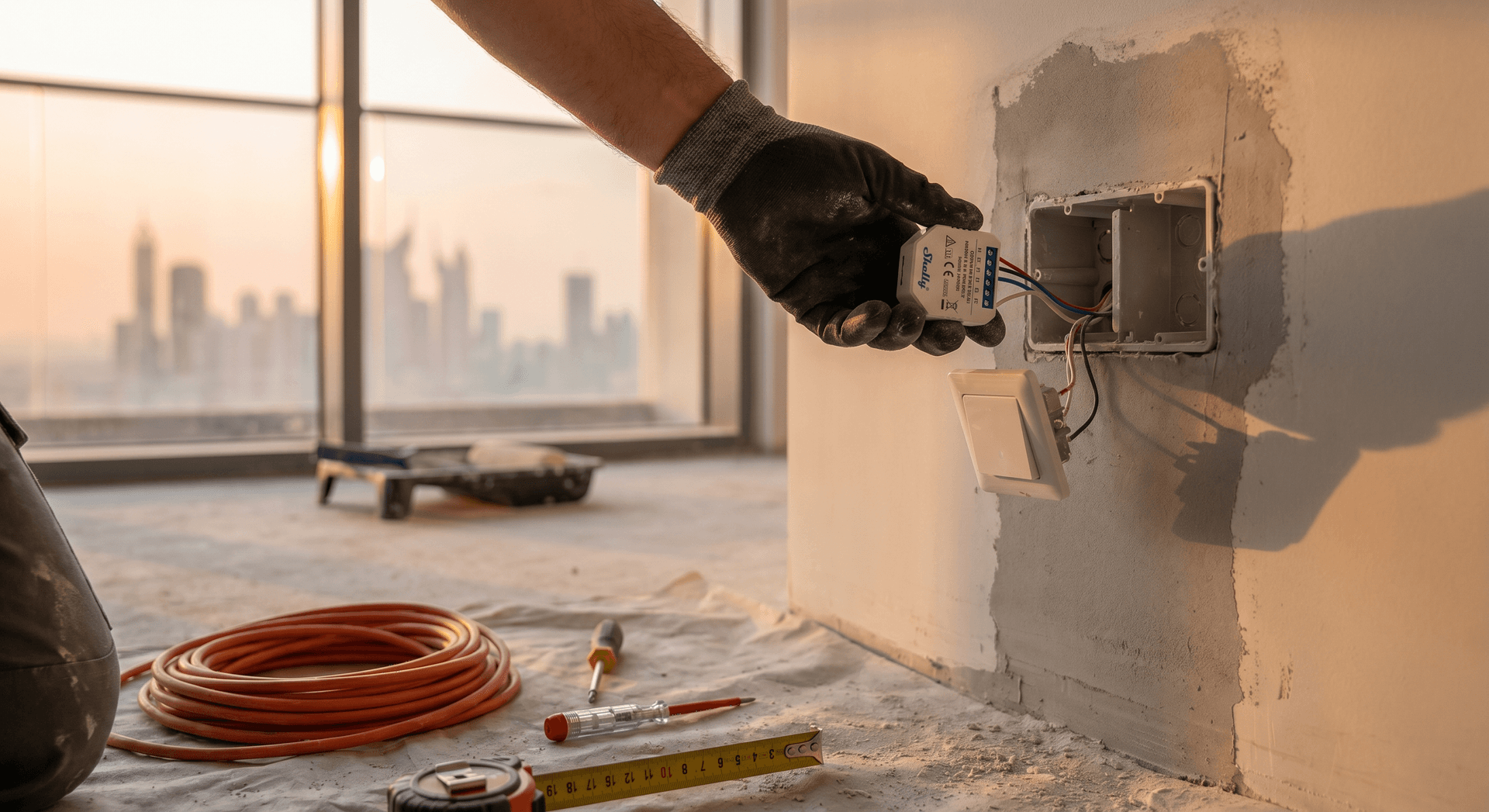
You measured the room. You picked the brand. You bought a box of smart switches online, the ones with the good reviews. Now the electrician has the wall open mid-renovation, holds one up to the back box, and tells you it does not fit.
TL;DR: Most imported smart light switches are 30-50mm deep, but a Dubai light-switch back box is often only 16-25mm deep. The fix is usually a small relay module like a Shelly (16mm deep) tucked behind your existing switch, not a replacement switch. Two things decide whether it works: the depth of your back box and whether you have a neutral wire at the switch. Sort both before the electrician closes the wall, because reopening it costs more than the switch.
This is the single most common renovation mistake we see in Dubai smart home projects. It is also the easiest one to avoid, if you know the two measurements that matter before the plaster goes back on. Here is what fits, what does not, and the conversation to have with your electrician this week.
The Real Reason Imported Smart Switches Fail in Dubai
The problem is depth, not brand. Most US and European smart switches are built for 47-50mm back boxes, the deeper boxes common in drywall construction. A Dubai light-switch box is often a 16mm or 25mm box chased into solid concrete or block (BS 4662 standard depths are 16mm, 25mm, 35mm, and 47mm, 2025).
The UAE runs on British wiring standards. Sockets are Type G (BS 1363) at 230V, and wall boxes follow BS 4662, the same family used across the UK and the Gulf (GoSwitchgear UAE socket guide, 2025). In our experience surveying apartments and villas across Business Bay and the Marina, the light-switch boxes are usually the shallowest type on the wall, the 16mm "plaster depth" box that exists only to hold a thin switch flush (flameport metal back boxes, 2025).
So you take a switch designed to sit in 47mm of space and try to fold its wiring into 16mm. The faceplate will not seat. The screws will not bite. The wall will not close.
The Two Measurements That Decide Everything
Before anyone buys a single device, two numbers settle the whole question. Get them and the rest is easy.
The first is back-box depth. Have your electrician measure the depth of the metal box behind one light switch and one socket. A light-switch box at 16-25mm is normal in Dubai. A socket box is often 25-35mm. Anything 35mm or deeper gives you room for almost any module (acaselectrical depth guide, 2025).
The second is the neutral wire. Pull the switch off the wall and look. If you see only one or two live wires and no neutral (usually a blue conductor), you have switch-loop wiring, where power runs to the ceiling fixture first and only a live drops to the switch (switch-loop wiring explained, 2024). This is common in older Dubai buildings. It does not block a smart switch, but it changes which one you can use.
Write both numbers down for every room you plan to automate. That single sheet of paper is what stops the mid-renovation surprise.
Which Modules Fit a Dubai Back Box
The thing that fits a shallow Dubai box is rarely a replacement switch. It is a small relay module that sits behind the switch you already have.
A Shelly 1 Mini Gen3 is 29 x 35 x 16mm and handles up to 8A at 240V (Shelly knowledge base, 2025). At 16mm deep, it fits even the shallowest plaster-depth light-switch box, tucked in behind your existing toggle. Shelly modules are widely available here, from around AED 45 to AED 99 depending on the model, on Amazon.ae, Noon, and Whizz (Noon UAE, 2026).
The advantage of the behind-the-switch approach is that nothing on the wall changes. Your existing switch plates, your existing décor, all of it stays (the smart retrofit approach, 2026). The physical switch keeps working as a manual override, so if the WiFi drops you walk over and flip it like you always have. You get app control, schedules, and voice from Alexa, Google, or HomeKit without anyone seeing a single new gadget.
What usually does not fit a shallow Dubai box: most US Decora-style smart switches, several wall-plate-mounted dimmers built for deep drywall boxes, and a number of bulky KNX modules. We get into the brand-by-brand trade-offs in our Aqara vs Shelly vs Philips Hue comparison.
The No-Neutral Problem in Older Buildings
A smart switch is a small computer. It needs a constant trickle of power for its radio and processor, which means it needs a neutral wire as a return path (why smart switches need a neutral, 2024). In a switch-loop apartment with no neutral at the switch, a standard smart module will not run.
There are two clean ways around it. The first is a no-neutral module. The Shelly 1L Gen3 is built for exactly this, running without a neutral wire by drawing a tiny current through the load, with a small bypass added for low-wattage LED fixtures (Shelly no-neutral guide, 2025). The second is to stay at the bulb instead of the switch: smart bulbs and a wireless wall button skip the switch wiring entirely, which we cover in our smart bulbs vs smart switches piece.
One thing clients always ask is whether they can just connect the smart device to the ground wire instead. The answer is never. Using ground as a neutral removes a critical safety mechanism and is dangerous, and we set out exactly what DEWA's regulations say about it, and what goes wrong, in why the earth wire is not a substitute for a neutral. If you have no neutral and want a behind-switch module, use a no-neutral model, or have a neutral pulled while the wall is already open.
Who Is Allowed to Touch the Wiring in Dubai
This is where the renovation timeline matters most. In Dubai, only a DEWA-approved licensed contractor can legally modify fixed wiring, and anything touching the distribution board needs DEWA approval (DEWA-approved electrician requirements, 2025). Work done by an unapproved contractor is illegal and the fine lands on the property owner, not just the contractor (DEWA electrical renovation approval, 2025).
Swapping a relay module behind an existing switch on a circuit that is already there is light-touch work. Chasing a box deeper into the wall, pulling a new neutral down to a switch, or anything at the DB is licensed-contractor territory, and it has to happen while the wall is open. That is the whole reason the pre-renovation check is worth doing. A neutral pulled during the renovation costs a fraction of a neutral pulled after the wall is painted.
UAE wiring follows BS 7671 with local amendments (wiring regulations basis, 2025). The practical takeaway for a renovating homeowner: decide the smart layer before the electrical first-fix, not after.
The Pre-Renovation Checklist
If you are renovating right now, or about to, run this before the electrician closes any wall. It takes one site visit.
- Measure the back-box depth at one light switch and one socket per room. Note anything under 25mm as "shallow, module only."
- Check for a neutral wire at each switch you want to automate. No neutral means a no-neutral module or a bulb-based setup.
- List the rooms and circuits you actually want smart. Not every switch needs it, and deciding now avoids paying to chase boxes you will never use.
- Pick the module that fits the shallow boxes (a Shelly-style 16mm relay is the safe default) rather than a deep replacement switch.
- If a circuit needs a neutral or a deeper box, get that done during first-fix, while the wall is open and the licensed contractor is already on site.
The order matters. Every one of these is cheap before the plaster goes back on and expensive after.
What Bayora Will Tell You Not To Buy
The honest version of this conversation saves people money, so here is what we routinely advise against on a renovation.
- A box of imported US smart switches bought before the depth check. This is the most common wasted spend we see. People buy a 12-pack from a US site, then half will not fit a Dubai light-switch box. Measure first, buy second.
- Chasing every box in the home deeper. You do not need smart control on the storeroom light or the second bathroom. Chasing boxes you will never automate is labour and re-plaster cost for nothing. Pick the rooms that matter.
- A full rewire to add neutrals everywhere. If most of your switches have a neutral and only a couple of switch-loop circuits do not, a no-neutral module on those few is far cheaper than rewiring the apartment.
- A wall-mounted touchscreen panel for a single room. A AED 1,200-1,800 touchscreen to control one room's lights gets touched twice. A wireless wall button or a Lutron Pico keypad does the same job for a fraction of the cost.
A Real Renovation: Behind-the-Switch in Dubai Marina
A renter in Dubai Marina came to us after buying a set of US smart switches online for a light refresh, none of which fit the building's shallow switch boxes. Rather than send anything back to the wall, we kept every existing switch plate and fitted Shelly relay modules behind them. Where a switch had no neutral, we used the no-neutral model.
The result the tenant noticed was that the apartment looked exactly the same. Same plates, same finish, nothing bolted on. But the living room and bedroom lights now ran on schedules and from a phone, and the wall switches still worked for any guest who reached for them. The whole job ran on modules at AED 45 to AED 99 each, plus the install, and it moves with the tenant when they leave because nothing is built into the wall in a permanent way.
This is the pattern we reach for first in Dubai apartments. It respects the open-platform principle too, because Shelly Gen3 modules speak Matter, HomeKit, Home Assistant, Alexa, and Google, with local control and no cloud lock-in (Shelly Matter support, 2025).
Frequently Asked Questions
How deep is a standard back box in a Dubai apartment?
Light-switch boxes in Dubai are often 16mm or 25mm deep, the shallowest British-standard sizes. Socket boxes are usually 25mm to 35mm. Anything under 25mm is too shallow for most replacement smart switches, which is why a slim relay module behind the existing switch is the usual fix.
Do I need a neutral wire for a smart switch in Dubai?
Most smart switches need a neutral wire for standby power. Many older Dubai buildings use switch-loop wiring with no neutral at the switch. If you have no neutral, use a no-neutral module like the Shelly 1L Gen3, or use smart bulbs with a wireless wall button instead.
Can I install smart switches myself in a Dubai apartment?
You can fit a plug-in or bulb-based setup yourself. Anything involving fixed wiring, a new neutral, or the distribution board must legally be done by a DEWA-approved contractor in Dubai. Doing it otherwise is illegal and the fine falls on the property owner.
Will a Shelly fit behind my existing light switch?
Usually yes. A Shelly 1 Mini Gen3 is 16mm deep and fits even the shallow plaster-depth boxes common in Dubai. It sits behind your existing switch, so the switch plate and the manual switch keep working while you add app, schedule, and voice control.
What should I tell my electrician before a renovation?
Tell them which rooms you want to make smart, and ask them to confirm two things at each of those switches before closing the wall: the back-box depth and whether a neutral wire is present. If a circuit needs a neutral or a deeper box, that work has to happen during the first-fix.
Plan It Before the Wall Closes
The smart layer is the cheapest part of a renovation to get right and the most expensive to retrofit later. A behind-the-switch module that costs AED 45 today can cost a re-plaster and a repaint if you wait until the wall is shut.
Measure the depth. Check the neutral. Pick the module that fits. Do the wiring while the wall is open.
If you are renovating an apartment or villa in Dubai and want the smart layer planned around your actual walls, get a free consultation. We will survey the boxes, check the neutrals, and tell you exactly what fits before anyone closes a wall.
Ready to Get Started?
Get a free consultation and we'll recommend what makes sense for your situation.
Get Free Consultation