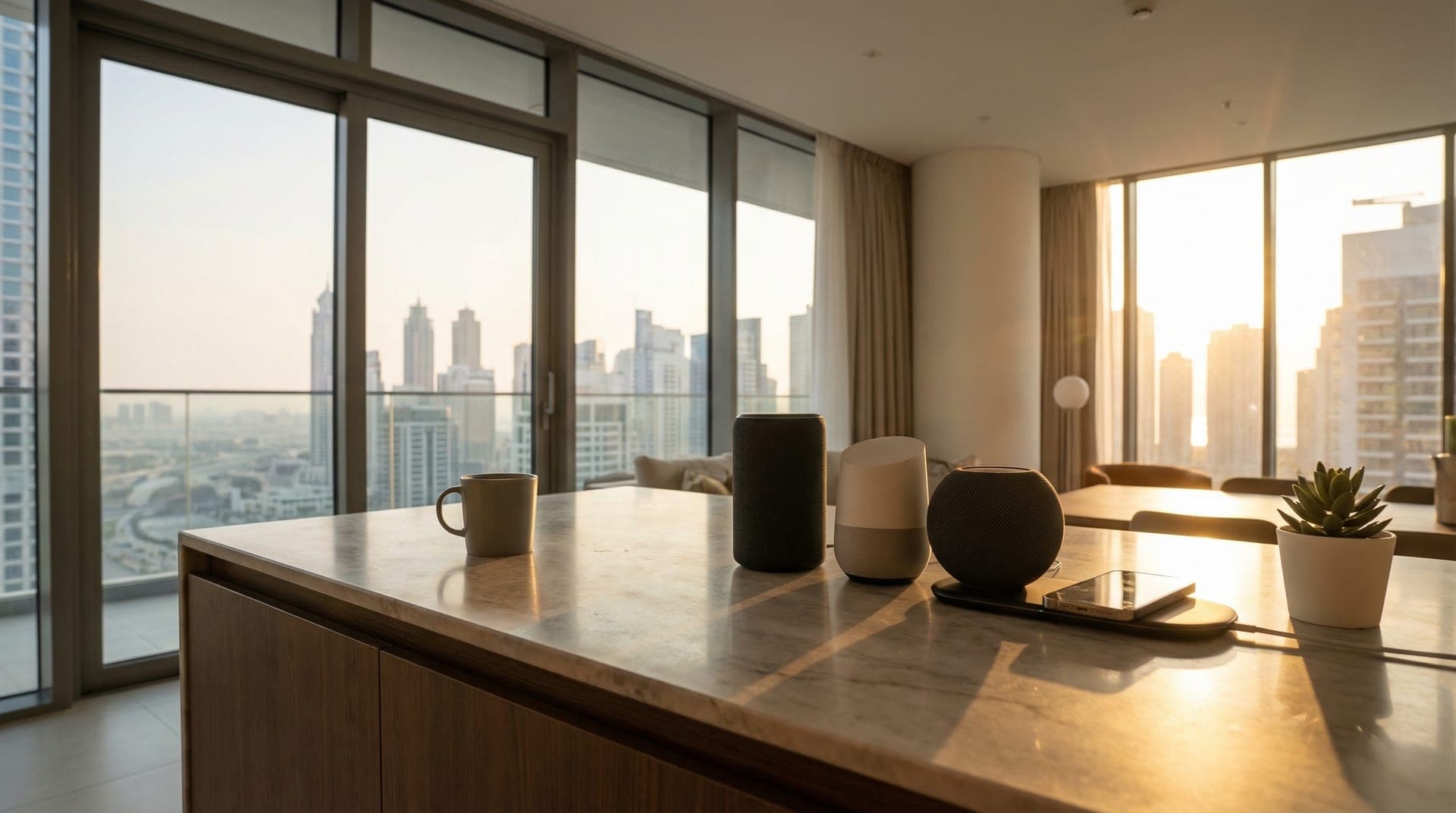
Every Comparison You've Read Was Written for Americans
Search "Alexa vs Google Home vs Apple HomeKit" and you'll get dozens of articles comparing features, device counts, and voice assistant quality. They're detailed, thorough, and almost entirely irrelevant if you live in the UAE.
Why? Because platform availability here is different. The devices you can actually buy, the languages they speak, and the services they connect to all change when you're in Dubai instead of Dallas. So here's the comparison nobody else is writing - the one that accounts for where you actually live.
The UAE Availability Problem
Before we compare features, let's start with what you can actually buy in Dubai without importing or paying a markup.
Amazon Echo (Alexa) - Officially available. Amazon sells Echo devices directly on amazon.ae, with prices starting around AED 99 for an Echo Pop. Full UAE support, local warranty, Arabic language built in.
Google Nest (Google Home) - Not officially sold in the UAE. Google rebranded its Home speakers to Nest, and they've never launched the hardware lineup here. You can find them through third-party sellers, but there's no local warranty or official support.
Apple HomePod (HomeKit) - Also not officially sold through Apple's UAE retail channels. You can find units on Noon and other e-retailers, but expect to pay a AED 300-400 premium over US pricing. No local Apple warranty on the speaker itself.
This alone narrows the conversation for most people. If you want a smart speaker you can buy locally with full support, Alexa is the only option that doesn't require workarounds.
But Here's What Most People Get Wrong
The speaker is not the platform. You don't need a HomePod to use HomeKit, and you don't need a Nest speaker to use Google Home.
HomeKit runs on any iPhone, iPad, or Mac. If you own Apple devices (and in Dubai, a lot of people do), you already have HomeKit built into your phone. An Apple TV or HomePod acts as a home hub for remote access, but the app itself works without one.
Google Home runs on any Android phone or iPhone through the Google Home app. You don't need a Nest speaker to control your devices - your phone does the job.
Alexa works through the Alexa app on any phone, plus the full range of Echo speakers and displays available locally.
So the real question is less about which speaker to buy and more about which ecosystem to build around. Let's compare them on what actually matters in a Dubai home.
Voice Assistant Quality
Alexa handles routines and smart home commands well. Her strength is the sheer number of "skills" (third-party integrations) and the depth of smart home device support. For home control specifically, Alexa is hard to beat.
Google Assistant is the strongest conversational assistant. It handles follow-up questions naturally, understands context better, and gives more useful answers to general questions. If you want your assistant to be genuinely helpful beyond turning lights on and off, Google leads here.
Siri has improved but still lags behind for smart home use. It handles basic commands fine ("turn off the living room lights") but struggles with complex routines and multi-step automations. Where Siri wins is deep integration with your iPhone - if you're already in the Apple world, asking Siri to control your home feels natural.
Arabic Language Support
This matters in the UAE. Many households are bilingual or primarily Arabic-speaking.
Alexa speaks Gulf Arabic (Khaleeji dialect) - Amazon spent two years teaching it local phrases, cultural references, and casual Arabic. It understands prayer time queries, local news, and everyday conversation in the dialect most UAE residents actually use. This is Alexa's strongest regional advantage.
Google Assistant supports Egyptian and Saudi Arabic dialects. You can set it up as bilingual (English and Arabic), which works well for mixed-language households. The Arabic understanding is decent, though not as locally tuned as Alexa's Gulf dialect support.
Siri supports Modern Standard Arabic (Fusha), which is the formal version used in news and official documents. It works, but it's not how most people actually talk at home. If you switch between English and Arabic mid-sentence (as many Dubai residents do), Siri handles it less gracefully than the other two.
Device Compatibility
This used to be the deciding factor. Each platform had its own list of supported devices, and choosing wrong meant your new smart lock or light wouldn't work.
Matter changed that. Matter is a universal smart home standard backed by Apple, Google, Amazon, and Samsung. A Matter-compatible device works across all three platforms simultaneously, without bridges or workarounds. As of 2026, most new smart bulbs, plugs, locks, and thermostats ship with Matter support built in.
What this means for you: the device compatibility gap between platforms has narrowed dramatically. A set of Philips Hue bulbs or an Aqara sensor works with Alexa, Google Home, and HomeKit equally well.
Where differences still exist:
- Alexa supports the most devices overall (100,000+ products), including many older pre-Matter devices
- HomeKit has the strictest certification requirements, which means fewer compatible devices but more consistent quality
- Google Home falls somewhere in between, with strong Matter support and a growing device library
For most Dubai apartments, this is a non-issue. The popular brands we install - Aqara, Shelly, Philips Hue, Sonos, Lutron - all work with every platform.
Privacy and Security
HomeKit is the clear winner here. Apple requires every HomeKit device to pass security certification. All communication is encrypted end-to-end, and Siri processes many requests locally on your device rather than sending them to the cloud. If privacy is your top concern, HomeKit sets the standard.
Google Home collects more data than Apple but has improved its privacy controls. You can review and delete voice recordings, and Google has added more local processing. That said, Google's business model is built on data, and that's worth knowing.
Alexa has faced the most scrutiny around privacy. Amazon stores voice recordings by default (you can change this), and Echo devices have been at the center of several privacy discussions globally. Amazon has added opt-out controls, but you need to actively configure them.
For most Dubai residents, this comes down to personal comfort. If you're already using Gmail and Google Maps, the data Google collects from your smart home is a drop in the ocean. If you care about keeping your home data locked down, HomeKit is the move.
Which One for Renters?
If you're renting in Dubai Marina, JBR, Downtown, or Business Bay, your smart home needs to be portable and wireless. All three platforms work fine for renters, but some practical differences matter.
Alexa is the easiest to set up with renter-friendly devices. Pick up an Echo from Amazon.ae, plug in a few smart AC controllers, and you're running in an afternoon. The local availability makes replacement and expansion simple.
HomeKit works beautifully if you already have an iPhone and Apple TV. You can control everything from your phone and Apple Watch without buying additional hardware. Battery-powered sensors from Aqara pair directly with HomeKit through your iPhone.
Google Home works well through the app on any phone, but the lack of official Nest hardware in the UAE means you're relying entirely on your phone or tablet for voice control at home.
For most renters, the question is: do you want a dedicated smart speaker in your apartment, or are you happy controlling everything from your phone? If you want a speaker, Alexa is the practical choice. If phone control is enough, any platform works.
Which One for Villa Owners?
If you own a villa in Arabian Ranches, Dubai Hills, or Palm Jumeirah, you're likely looking at a more comprehensive setup - whole-home automation with lighting, climate control, security, motorized blinds, and multi-room audio.
At this scale, the voice assistant becomes one interface among many. The platform underneath matters more than the voice on top.
This is where Home Assistant comes in. Home Assistant is an open-source hub that connects to all three ecosystems simultaneously. You can have Alexa in the kitchen, HomeKit on your iPhone, and Google in the study - all controlling the same devices through one unified system.
For villa-scale projects, we recommend building on Home Assistant as the foundation and letting each household member use their preferred voice assistant. You get the flexibility of an open platform without being locked into any single ecosystem. And if you switch from iPhone to Android (or the other way around) next year, your smart home keeps working.
The Bottom Line
For a Dubai apartment, the honest answer is: pick the ecosystem you already use.
- iPhone household? HomeKit. You already have the hub in your pocket.
- Big on voice commands and want Arabic? Alexa. Best local availability and Gulf Arabic support.
- Android household that wants a strong assistant? Google Home. Best conversational AI, works well through the app.
- Building a villa-scale system? All of the above, unified through Home Assistant.
The good news is that Matter has made this decision much less permanent than it used to be. Your devices will work across platforms, so if you start with Alexa and switch to HomeKit next year, your smart lights and sensors come with you.
The choice that matters more than which assistant you pick is whether your system is built on an open platform. That's what keeps you flexible as these ecosystems evolve.
Curious which setup makes sense for your home? Get a free consultation and we'll recommend the right combination for your space, your devices, and how you actually live.
Ready to Get Started?
Get a free consultation and we'll recommend what makes sense for your situation.
Get Free Consultation