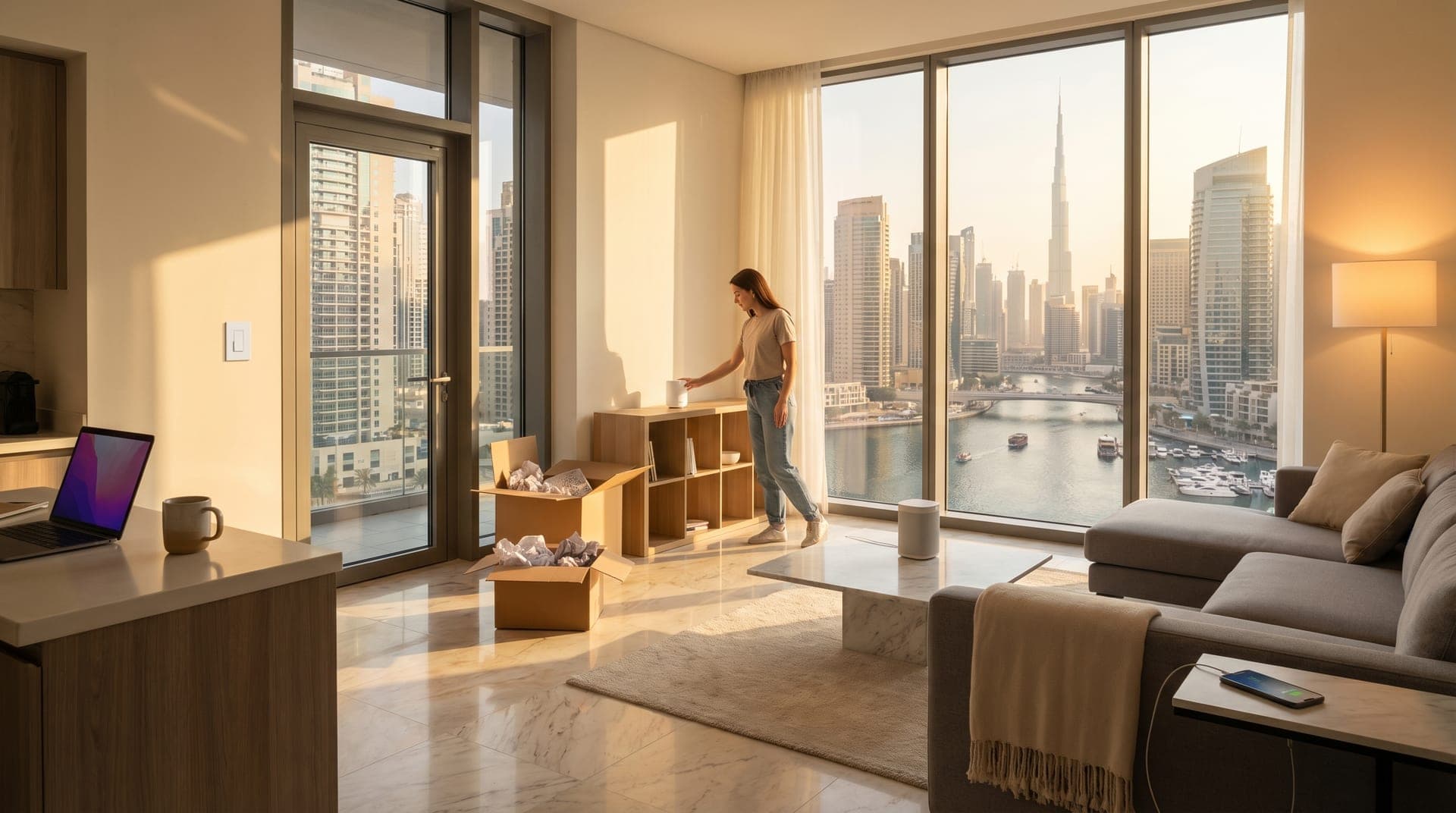
Dubai recorded 60,303 real estate transactions in Q1 2026 alone - a 6% increase over last year (Dubai Media Office, 2026). DEWA added 56,897 new customer accounts in 2025 (DEWA, 2026). Thousands of people are moving into new apartments across the city right now. And most of them will spend the first week fighting with AC remotes, hunting for light switches in the dark, and wondering why the WiFi doesn't reach the bedroom.
TL;DR: Start with WiFi (mesh network, separate 2.4 GHz band for smart devices), then add smart AC control, followed by lighting and security. A basic smart setup for a Dubai apartment starts from AED 3,000 installed. Get the network right first - every other smart device depends on it.
There's a better way. If you're moving into a new place, the first 48 hours are the perfect window to set up smart home tech. The walls are empty, the furniture is still being arranged, and you haven't yet developed the habit of walking across the apartment to flip that one switch by the kitchen.
This guide is the full room-by-room install order. If you just want the tight first-week triage - the three things to set up before the boxes are unpacked and what to leave for later - start with your first week in a new Dubai apartment.
This is the setup order we recommend after working on apartments across Dubai Marina, Business Bay, Downtown, and JBR.
Step 1: Fix Your WiFi Before Anything Else
Every smart device in your apartment talks through WiFi. A flaky network means lights that don't respond, AC schedules that skip, and a security camera that goes offline at 2 AM. In our experience, about half of the "broken smart device" complaints we hear trace back to a weak or overloaded WiFi network.
Dubai apartments create specific WiFi challenges. Concrete walls between rooms block signal. The router your ISP provides usually sits by the front door - the worst possible location for whole-apartment coverage. And if you're in a dense tower in Dubai Marina or Downtown, you're competing with hundreds of neighboring networks for bandwidth.
What to do: replace your ISP router with a mesh WiFi system. Brands like TP-Link Deco, eero, or ASUS ZenWiFi place multiple access points around your apartment so every room gets strong signal. Set up a separate 2.4 GHz network specifically for smart devices - most IoT devices only work on 2.4 GHz, and keeping them on their own network prevents them from slowing down your main connection for streaming and video calls.
This is the boring step. It's also the one that prevents every frustrating problem that follows.
Step 2: Smart AC Control - The Biggest Win in Dubai
Air conditioning accounts for 60-70% of residential electricity consumption in Dubai (DEWA, 2026). In summer, a two-bedroom apartment can run AED 600-800 per month on DEWA - and most of that cost comes from cooling empty rooms or forgetting to adjust the temperature before leaving for work.
A smart AC controller is the single most impactful device you can install. It connects to your existing split unit via infrared (the same way your remote works), then lets you control temperature from your phone, set schedules, and trigger automations. When we installed smart AC controllers in a Business Bay apartment last month, the resident's first DEWA bill dropped 23% compared to the same unit's previous tenant.
The setup takes about 15 minutes per unit. No wiring, no landlord approval needed if you're renting. The controller sits on a shelf or mounts on the wall with adhesive, and it pairs with your WiFi in under five minutes. Start with your living room and bedroom - those two rooms account for most of your cooling costs.
For a deeper look at what smart AC can do for your bill, read our guide to smart AC scheduling and DEWA savings.
Step 3: Lighting That Responds to Your Day
Lighting is where a new apartment starts feeling like your home rather than a blank space. Smart lighting lets you create scenes - warm and dim for evening, bright and focused for working from home, a soft hallway glow for 3 AM trips to the kitchen. Once you set these up, they run on schedules or activate with a single tap.
You have two options. Smart bulbs (like Philips Hue) screw into your existing fixtures and work immediately. Smart switches (like Lutron Caseta or Shelly) replace the wall switch itself, which means any bulb you put in the fixture becomes smart. For a rental apartment, smart bulbs make more sense because you can take them when you leave. For an owned apartment, smart switches are the cleaner long-term solution. We break down the tradeoffs in our smart bulbs vs smart switches comparison.
Start with two or three rooms. Living room, bedroom, and the hallway connecting them. Set up a "Good Night" scene that dims everything to warm amber and an "I'm Home" scene that turns on the lights you actually use when you walk in. Those two scenes alone change how your apartment feels every single day.
Step 4: Security and Access Control
A Yale or similar smart lock lets you ditch the physical key entirely. You unlock with a PIN, your phone, or a fingerprint depending on the model. When guests come over, you send them a temporary code. When the cleaner arrives on Tuesday, their code works only during the time window you've set. No more hiding keys under doormats or coordinating handoffs with building security.
54% of renters now expect smart locks, thermostats, and security cameras as standard features in a modern apartment (Rently, 2025). For Dubai apartments, a smart video doorbell adds another layer. You see who's at the door from your phone, talk to delivery drivers without getting up, and keep a record of who visited while you were out. Learn more about your options on our home security page.
The smart lock installs in about 20 minutes on most standard Dubai apartment doors. No drilling into the frame if you pick a model designed for renters. Keep the original hardware in a drawer - it goes back when you move out.
Step 5: Connect Everything to One System
Once you have AC, lighting, and a lock, you need a way to make them work together instead of running three separate apps. A smart home hub - whether it's an Apple HomePod, Amazon Echo, or a dedicated controller like Home Assistant - ties everything into a single interface.
With a hub in place, you can build automations that chain devices together. "Good Morning" turns on the kitchen lights, sets the AC to 23, and unlocks the front door. "Leaving Home" turns off all lights, lowers the AC to economy mode, and locks the door. One tap or one voice command instead of walking around the apartment doing each thing manually.
After setting up around 200 of these systems, what we've found is that most people use three to five automations daily and rarely touch the individual device apps again. The hub becomes the single control point for your entire apartment. For a full walkthrough of platform options, see our home automation guide.
What a Basic Smart Setup Costs in a Dubai Apartment
A practical smart home setup for a one-bedroom apartment starts from AED 3,000 installed - that covers smart AC control for one or two units, a few smart bulbs, and basic automation (Bayora, 2026). A two-bedroom with lighting scenes, AC control, and a smart lock typically runs AED 5,000-8,000 depending on how many devices you want in each room.
Smart home technology adds 3-5% to property valuations on average, with an ROI around 30% (SmartRent, 2025). For landlords in Dubai's booming market - where Q1 2026 saw AED 252 billion in transactions (Dubai Media Office, 2026) - smart home features help listings stand out and justify higher rents.
The investment pays for itself through DEWA savings and convenience. But the bigger return is harder to measure: you stop thinking about your home's systems entirely. They run themselves.
The Order Matters More Than the Budget
The mistake most people make is buying a stack of smart devices on Amazon and trying to set everything up at once. They end up with three apps, two ecosystems that don't talk to each other, and a smart plug that's been "connecting..." for four hours because the WiFi doesn't reach the spare bedroom.
When we set up apartments for clients, we follow the exact order in this guide. Network first, then climate control, then lighting, then security, then connect everything. Each layer builds on the one before it. Skip a step - especially WiFi - and everything after it becomes unreliable.
If you're moving in this month and the budget is tight, start with just WiFi and smart AC. Those two things solve the biggest daily frustrations in a Dubai apartment: the bedroom that's still hot when you get home from work, and the bill that spikes because nobody remembered to turn the AC off.
Frequently Asked Questions
Can I install smart home devices if I'm renting in Dubai?
Yes. Smart AC controllers, smart bulbs, smart speakers, and most smart locks install without any wiring changes or landlord approval. Everything connects via WiFi and mounts with adhesive or screws into existing fixtures. Keep the original hardware and reinstall it when your lease ends. Read our full renter's guide for details.
How long does a full smart home setup take in a new apartment?
A basic setup covering AC, lighting, and a smart lock takes about half a day for a one-bedroom apartment. A two-bedroom with full scenes and automations takes a full day. We handle configuration, testing, and walk everyone in the household through how to use the system before we leave.
Do I need to upgrade my internet plan for smart home devices?
Most etisalat and du home packages provide enough bandwidth for smart devices. Smart home gadgets use very little data individually - a smart AC controller uses about 50 MB per month. The bigger factor is WiFi coverage, not speed. A mesh network ensures signal reaches every room, which matters more than raw download speed for smart device reliability.
What happens to my smart home setup if I change apartments?
Wireless smart home devices come with you. Smart bulbs unscrew, AC controllers unplug, and smart locks swap back to the original hardware in minutes. Your automations and scenes are saved in the app or hub, so you reconfigure the new apartment much faster the second time around.
Should I wait for my apartment to be fully furnished before adding smart home tech?
No - the move-in window is the best time. You're already reorganizing, placing furniture, and setting up utilities. Adding smart devices during this phase means you position WiFi access points optimally, route any cables you need behind furniture, and start living with automation from day one instead of retrofitting later.
Moving into a new apartment in Dubai? Get a free consultation and we'll tell you exactly what makes sense for your layout, your budget, and how you use your space. No obligation, no surprises - just an honest recommendation for where to start.
Ready to Get Started?
Get a free consultation and we'll recommend what makes sense for your situation.
Get Free Consultation