In April 2022, a company called Insteon switched off its cloud servers without telling anyone. Tens of thousands of homes around the world woke up to find every smart switch, every plug, every motion sensor, every routine they had built over a decade had stopped working overnight. The hardware was still on the wall. The lights still turned on if you flipped the switch by hand. But the smart part of the home was gone, because the company that owned the app had gone with it (The Register, 2022).
Two years before that, Wink put its users behind a monthly subscription with a week's notice. Pay up or lose the home you had built (How-To Geek, 2024). In 2024, Google killed cloud connectivity for the Nest Secure devices people had installed in their homes (How-To Geek, 2024). In 2025, Neato robot vacuums became dumb robot vacuums when the parent company shut the servers off, leaving only the physical button on the device (How-To Geek, 2024).
This is the part of the smart home conversation that rarely survives a Dubai sales pitch. The standard offer in this market is a unified app, though a handful of local integrators now build on open platforms too, and that is a good thing for buyers. We picked Home Assistant. What we do differently is who we will build it for: we publish an entry price of AED 3,000, we work with renters, and we do apartments, not only villas.
TL;DR: Bayora builds every whole-home system on Home Assistant, the open-source platform that runs locally on a small server in your home rather than on a company's cloud. Open platform means three things in practice: your home keeps working if the company you bought devices from goes out of business, you are never locked into one brand of switch or sensor, and you can change providers without throwing the system out. The trade-off is one less unified-app marketing pitch. Small single-product jobs, a Hue sync kit or a gate relay, stay in the manufacturer's own app, because a hub behind a two-hour visit would be billing you for our convenience. For a whole home, the math comes out heavily in your favour.
What Open Platform Really Means
The phrase "open platform" gets used loosely in this industry, so worth being precise. Three things have to be true.
First, the brain of the system runs on hardware in your home, not on a server in a data centre. When your internet drops at 3pm because Etisalat is doing maintenance, your lights still respond, your AC schedule still fires, your motion sensors still trigger. The home is local-first.
Second, the platform supports devices from many manufacturers, not one. You are not locked into a single brand of switch, sensor, lock or thermostat. If a better motion sensor comes out next year, you swap it in. If your Aqara hub fails, you can replace it with a cheaper alternative without rewriting the system.
Third, the platform itself is not owned by a company that can disappear. Home Assistant is a project of the Open Home Foundation, a non-profit set up in 2024 to guarantee the platform stays open and locally-controlled regardless of what happens to any one vendor (Open Home Foundation, 2024). The code is open source. If every commercial backer walked away tomorrow, your home would keep working and the community would keep building.
A unified app from one company can do the first thing if it is well-built. It cannot do the second or third by definition. The unified app is the lock-in.
Why We Picked Home Assistant Specifically
There are a handful of platforms that meet the open-platform definition. Home Assistant is the one with the scale to be safe in 2026.
In May 2025, Home Assistant crossed 2 million active installations worldwide (Home Assistant, 2025). The platform has integrations with over 3,000 different brands of devices and services (Home Assistant, 2026). It runs in 600,000+ homes that share their analytics openly, which means the actual installed base is several multiples of that (Home Assistant Analytics, 2026).
That scale matters because it means three practical things for a Dubai client.
It means the integrations you depend on get maintained. When Aqara releases a new sensor next month, the Home Assistant integration is usually live within days, written by the community. When Sonos changes its API, someone fixes it before most users notice.
It means you can hire a different installer in five years if you want to. The community of professional Home Assistant builders is large enough now that you are not stranded with one provider. Bayora itself runs on the principle that any client should be able to walk away with their system intact and find someone else to maintain it. That is a feature, not a bug.
It means the platform is not going to disappear. A commercial smart home company can be acquired, restructured, or shut down by a parent company looking for a quick exit. The Open Home Foundation is structurally protected against that. Even Nabu Casa, the commercial company behind Home Assistant, is owned by the foundation (Nabu Casa, 2026). The company cannot sell out the project.
What You Give Up
Honest section. There are real things you lose when you pick open platform over a tightly controlled unified-app system. Worth saying them out loud. The gentler version of the same risk, a company that stays in business and changes its mind, is covered in what happens when the app updates overnight.
The polish of the app is rougher than a single-vendor system. When one company controls the hardware and the software end-to-end, they can make every interaction feel premium in a way that a community-built platform usually cannot. Home Assistant has caught up enormously over the last three years and the dashboards we ship to clients now are clean and readable. But if you put a Home Assistant dashboard next to the polished marketing demo from a luxury vendor, the marketing demo will look prettier in the screenshot.
The setup is more complex on day one. A unified-app system from one vendor is "plug in this hub and download our app." Home Assistant requires someone to design the system, configure the integrations, write the automations, build the dashboards, and train the household. That is what we do. It is also why DIY Home Assistant has a reputation for being hard. It is hard if you do it yourself. It should not be your problem.
You sometimes have to make a deliberate choice. With a unified system, every device in the catalogue works the same way because the vendor designed it that way. With Home Assistant, you compare two motion sensors and pick the one with better local response time over the one with the prettier app. We make those calls for clients during the design phase so the client never sees the menu of options, only the recommendation.
These are real tradeoffs. We accept them because the alternative is a home that depends on a company staying alive, profitable, and committed to the product line you bought into.
The Dubai Context
Three things make the open-platform argument sharper in Dubai than it would be in London or Singapore.
The villa and apartment turnover rate is high. The average expat length of stay in the UAE has been measured at 4.4 years, well above the global average of 3.2 (Mike Coady, 2024), and even with longer-term residency rising under the Golden Visa, families still move apartments at least once or twice across that span. A smart home built on a closed platform with a long-term subscription is a long-term commitment from someone whose housing situation is shorter-term by design. Open platform means the dashboard, the automations, the family routines all move with you. Everything is exported and re-imported on the new server in a few hours.
The grey-import market for smart home devices in the UAE is real. Most clients we work with end up with at least some hardware imported from Amazon US or directly from manufacturers in Asia, because the local distributor either does not carry the model or marks it up too aggressively. A closed-platform vendor refuses to integrate hardware they did not sell you. Home Assistant treats every Zigbee, Matter, WiFi or Z-Wave device the same way. The grey-import Aqara FP2 you brought back from Hong Kong gets configured the same week as the Sonos system the previous owner left behind.
The professional-services market for smart homes in Dubai is still small enough that vendor lock-in is a real risk. If you commit to a closed platform with three certified dealers in the country and one of them stops responding to your messages, your options narrow fast. Open platform means we can hand off your install to any other Home Assistant builder in the city, internationally, or to your own technical relative who wants to learn. The lock-in is gone.
What This Looks Like in a Real Dubai Install
What does this look like in practice in a 2-bedroom Marina apartment or a 4-bedroom villa in Dubai Hills?
A small piece of hardware lives in your service cupboard or on a shelf. Usually a Home Assistant Green or a Home Assistant Yellow, both purpose-built devices made by Nabu Casa. The Green is USD 199 from the official store in 2026, around AED 730, and the Yellow runs between AED 900 and 1,500 depending on storage configuration (Nabu Casa, 2026). It is the size of a paperback book. It draws less power than your WiFi router. It is the brain of the home.
Connected to that brain is a Zigbee mesh of Aqara sensors and switches, a Lutron lighting controller if the project is large enough to justify it, Shelly relay modules at certain light fixtures, Ecobee thermostats on the central AC, Sonos for audio, the Hikvision cameras the developer installed, motorized shades from whichever vendor the previous owner picked, and a HomePod Mini or two for voice commands. Full details on the platform itself live on our Home Assistant Dubai brand page.
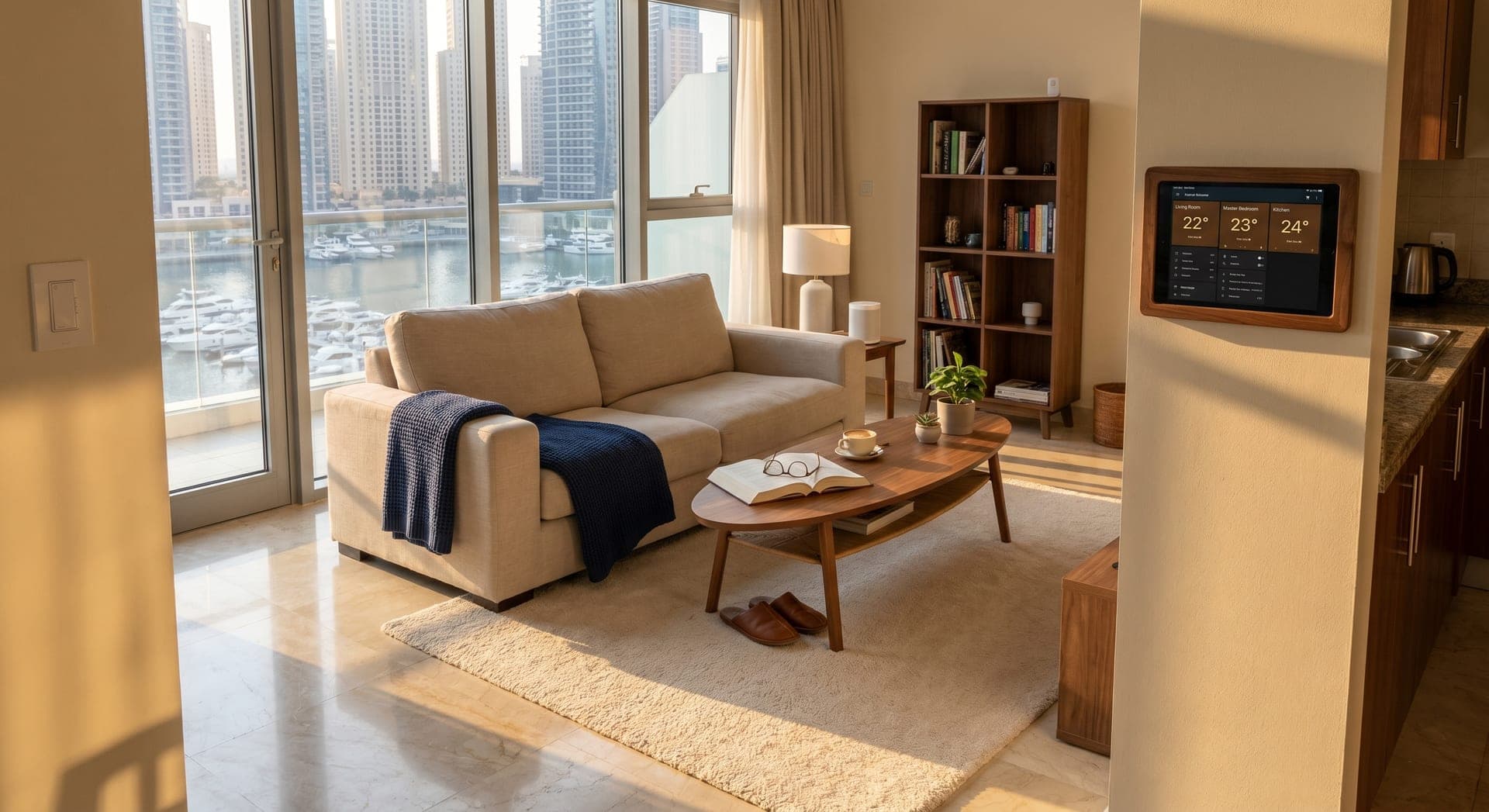
None of these devices needed to come from the same brand. None of them depend on a cloud service to function. None of them requires a separate app on the family's phone. The whole system is one dashboard on an iPad mini mounted by the kitchen.
If Aqara goes out of business in 2030, the Home Assistant integration keeps working as long as the Zigbee chip in the sensor keeps transmitting, which is most of the foreseeable life of the device. If Sonos pivots to a hostile subscription model, you can swap out the speakers for any other AirPlay-compatible alternative without changing the rest of the system. If we go out of business, you can hand the install to any Home Assistant builder anywhere in the world.
That is what no-lock-in looks like in practice.
How This Compares to a Unified-App System
Worth being concrete about what you are getting and giving up. Side-by-side.
| Dimension | Unified-app system (single vendor) | Home Assistant (open platform) |
|---|---|---|
| Where the brain lives | Vendor's cloud | Local hardware in your home |
| Works without internet | Sometimes | Always |
| Brand lock-in | High (vendor's catalogue only) | None (any brand, any protocol) |
| What happens if vendor exits | System degrades or stops | System keeps running |
| Switching providers | Rip and replace | Hand over the credentials |
| Day-one setup polish | Higher | Equivalent after Bayora's design phase |
| Long-term flexibility | Limited to vendor roadmap | Limited only by what hardware exists |
| Subscription needed | Often (AED 50-300/month) | None required |
| Total 5-year cost | Higher (subscriptions + lock-in upgrade pressure) | Lower (one-time hardware + occasional updates) |
In our experience building our whole-home systems this way, the unified-app advantage that gets pitched in marketing collapses the moment you ask "what happens in year four?"
The Honest Recommendation
This is not a religious argument. There are clients we have advised to go with Crestron instead, because the project is large enough, the budget is set, and the household manager is the right kind of person to work with a single dealer relationship. There are clients in serviced apartments where a fully open-platform install does not make sense and a small Aqara setup with their own app is fine.
But for the Bayora-typical project, a 1-3 bedroom apartment in Marina, JBR, Downtown or Business Bay, or a 3-5 bedroom villa in Dubai Hills, Arabian Ranches, the Springs or the Meadows, open platform on Home Assistant is the recommendation we have given every single client since the company started.
It is the recommendation we would give a friend asking for advice. It is the recommendation we follow in our own homes. It is the principle Bayora was built on, not a technology choice we made later.
The thing that sits behind all of this is a simple question. Who owns your home, you or the company that sold you an app? If the answer is the second one, you do not have a smart home. You have a long-term lease on someone else's product roadmap.
It is also the single question most comparison guides skip when they tell you how to choose a smart home company in the first place. Ask it before you ask anything about price.
Frequently Asked Questions
Is Home Assistant only for technical people?
No. The reputation comes from the DIY community that built the platform, but a professionally installed Home Assistant system looks and behaves like any other smart home from the family's point of view. They tap a button, the lights change. They speak to a HomePod, the AC adjusts. The technical complexity is on the installer's side, not the household's.
What happens if the small Home Assistant hardware in my home breaks?
You buy a new one for around AED 730 to 1,500, restore the configuration backup that runs nightly to your cloud storage of choice, and the system is back up in about 30 minutes. The hardware is commodity and replaceable. The configuration is portable. We set up the backup as standard during install.
Can I take Home Assistant with me when I move apartment?
Yes, this is one of its core strengths. The brain unplugs from your service cupboard and goes in a box with the rest of your belongings. The portable devices (smart plugs, sensors, voice assistants) come too. We help reinstall it in the new apartment as part of our service for previous clients.
Does Home Assistant work with Alexa, Google Home, and Apple HomeKit?
Yes, all three. Home Assistant exposes the entire system to whichever voice assistants the household already uses. Most Bayora clients run HomeKit because the household already has iPhones, but Alexa and Google Home both work without compromise. See our guide to Alexa vs Google Home vs HomeKit in the UAE.
What does a Bayora install built on Home Assistant cost?
A typical 2-bedroom apartment install, including the Home Assistant hardware, design, configuration, automations, and family training, runs AED 8,000 to 15,000 depending on scope. A 3-4 bedroom villa runs AED 15,000 to 35,000. There is no monthly subscription. The cost is one-time hardware and our professional services. We give complete pricing in the proposal before any work starts.
Curious whether open platform is the right call for your home? Get a free consultation and we will walk you through what your specific apartment or villa would look like on Home Assistant, what it would cost, and where you would feel the difference.
Ready to Get Started?
Get a free consultation and we'll recommend what makes sense for your situation.
Get Free Consultation