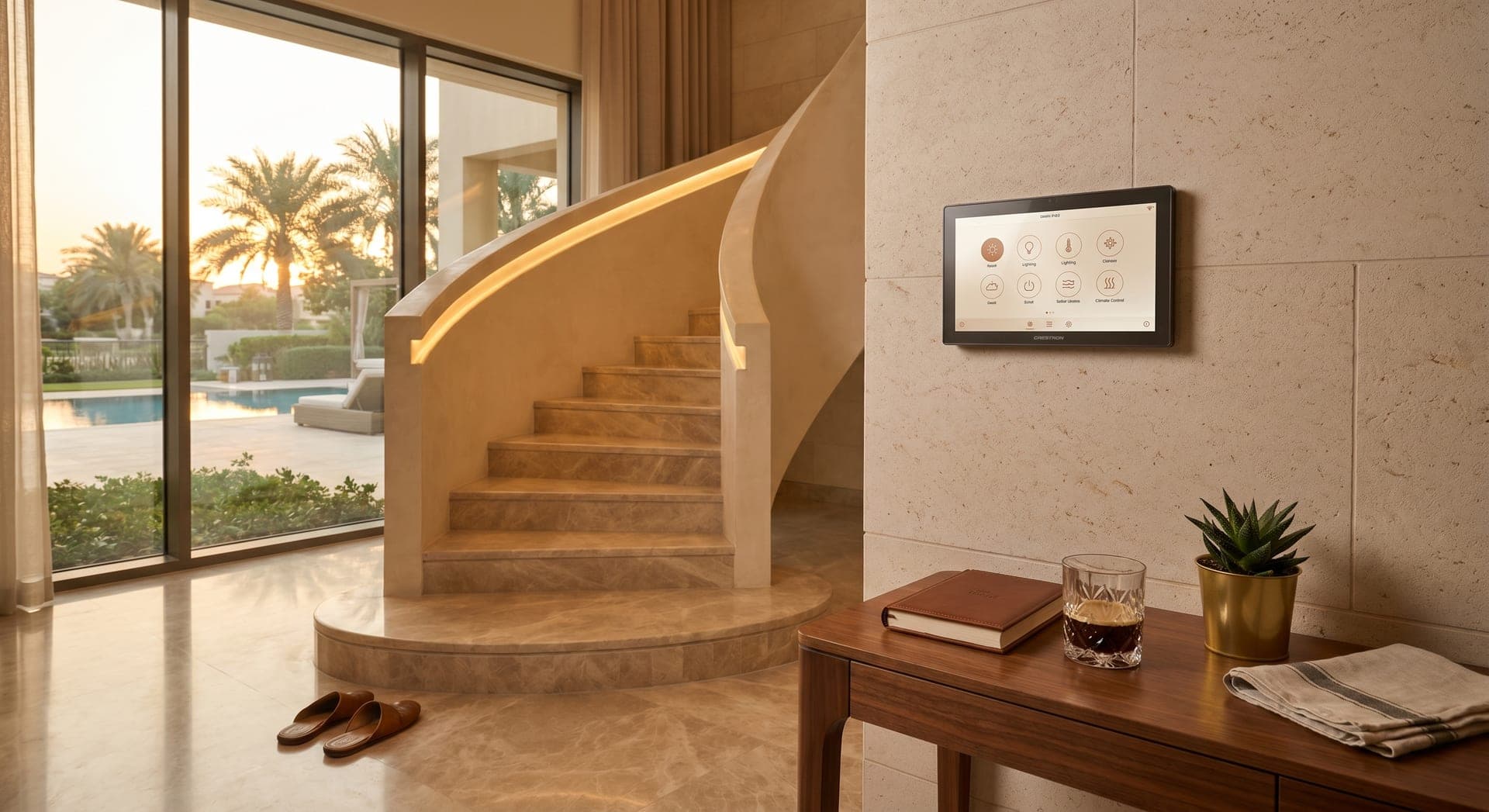
The office your company moved into last year has a Crestron panel by the main meeting room door. One touch and the blinds drop, the projector wakes up, the lights step to 40 percent, and the conference call is already dialled in. You have used that panel a hundred times without thinking about it. You probably do not know the brand name.
That same brand, with the same logic, sits on the wall of every grade-A office tower in Business Bay and DIFC, every five-star hotel from the Atlantis to the Bvlgari, and a small number of Dubai villas where someone decided their home should work the way their office does. It is called Crestron, and the question of whether it belongs in a villa instead of an office is the conversation we have with one specific kind of client every few weeks.
This is what that conversation looks like, with the numbers, the tradeoffs, and the alternatives that get recommended more often than people expect.
TL;DR: Crestron is the smart-home platform behind most Dubai office towers, hotels, and a small number of villas in Emirates Hills, Palm Jumeirah, and Tilal Al Ghaf. Pricing starts around AED 150,000 for a 3-bedroom villa and climbs past AED 500,000 for large mansions (Ziotech, 2026). It earns the price tag if the villa has 8+ rooms, custom AV integration, and a household manager. For most other Dubai homes, Control4 or an open-platform Home Assistant build delivers 80 percent of the experience for 20 to 40 percent of the cost.
What Crestron Is, in Plain Terms
Crestron is a commercial-grade control and AV platform that started in industrial and broadcast settings and migrated into corporate, hospitality, and the top end of residential. It does not sell direct. You cannot buy Crestron on Amazon. Every install in Dubai goes through Avientek as the regional distributor and then through one of a handful of certified dealers (Crestron UAE, 2026).
The system runs on dedicated controllers (small black boxes mounted in a rack somewhere out of sight), a private Crestron network, and custom programming written for each villa by a certified Crestron programmer. The on-screen interface is custom from the icon up. The fonts, the colours, the room names, the page layout, the gesture behaviour, the way a scene transitions, all of it gets specified by the dealer and the client.
That is the part most people do not understand about Crestron until they have lived with one. It is not a product you buy. It is a system that gets designed for your specific villa and then programmed. The hardware is half the project. The other half is what gets typed into the programming software over four to eight weeks before the install team mounts a single panel.
What It Looks Like in a Real Dubai Villa
We finished a Crestron rebuild on a 16,000 sq ft Emirates Hills mansion in January. The owner had inherited three legacy installer systems from the previous tenant: an obsolete lighting control from 2014, a separate audio matrix, and a third-party gate and security setup that did not speak to either of them. He wanted one platform.
The Crestron build replaced all three. 240 individual lighting circuits on Lutron Homeworks (the Crestron sister-platform for commercial-grade lighting), 36 motorized drapes, the audio system on Sonos, a 14-zone climate control, the gate and CCTV, and staff access for the housekeeping team and the chef. One platform, one rack room, custom touch panels in every key space, and a phone app for the family. The system also exposes a Home Assistant bridge so the owner can write his own scenes without booking a dealer visit (Residential Tech Today, 2025). The basement cinema room in that same house runs on a Trinnov processor tied into the same Crestron rack, and we have written up what that room actually needed and cost separately, since a cinema build is its own decision inside a whole-home scope like this one.
That villa is the high end of what Crestron is for. 8 bedrooms, dedicated cinema, gym, staff quarters, three separate AV zones, a long-running custom programming relationship between the dealer and the owner. The system earns the bill.
For a 3-bedroom apartment in Marina, it would have been the wrong recommendation by a wide margin.
What It Costs in Dubai in 2026
Pricing depends almost entirely on scope, but the bands are stable enough to plan around.
Apartments (2-4 bedrooms): Crestron is rarely the right call here, but when it does happen, projects start around AED 80,000 to 100,000 for the basic stack (one controller, app control, lighting and AC integration on existing wiring, one or two touch panels). Add a home cinema and audio matrix and the number climbs past AED 150,000 (7Mayfair, 2026).
Standard villas (3-5 bedrooms in Arabian Ranches, Dubai Hills, Tilal Al Ghaf): AED 150,000 to 300,000 for a full integration. Custom programming and touch panels are most of the cost. The hardware is meaningful but the programming and integration work runs 40-60 percent of the bill.
Large villas and mansions (6+ bedrooms in Emirates Hills, Palm Jumeirah, Al Barari): AED 300,000 to 500,000+. At this scale the system is usually paired with Lutron Homeworks lighting, an AV distribution matrix, a dedicated cinema, and substantial programming complexity. Premium villa smart home systems in Dubai with AI climate, full-coverage security, solar integration, and wellness features range from AED 60,000 to 150,000 for mid-tier brands (HRE Development, 2026), but Crestron at this villa scale sits well above that band.
Ongoing costs: Crestron projects come with a dealer relationship. Adding a new automation, reconfiguring a scene, or troubleshooting after a firmware update is a service call. Most dealers in Dubai bundle a year of programming support into the project price; after that, expect AED 400 to 800 per dealer visit, or an annual maintenance retainer in the AED 6,000 to 18,000 range depending on system complexity.
This is the part of the conversation that surprises clients more than the install number. The build is one cost. The relationship after the build is another, and it never goes away.
Who Crestron Fits
After working on Crestron projects in Dubai for clients ranging from a 4-bedroom Tilal Al Ghaf villa to the Emirates Hills mansion, the pattern of who it fits is clear.
You have 6+ rooms and a household team. The villa is large enough that one app on one phone cannot reasonably control everything from one place. Touch panels in key zones (kitchen, master bedroom, family room, cinema, garden) make the system usable for everyone, not only the technically inclined member of the household. The housekeeper, the chef, the kids, the parents, the guests can all interact with the same control without anyone teaching anyone how to use an app.
You want custom AV. Multiple cinema rooms, a music studio, an outdoor entertainment zone, a private gym with synced screens and audio. Crestron's commercial AV heritage is the strongest part of the platform. The DM AV distribution system can route any source to any display in the villa with no perceptible delay. For families that entertain at the scale Dubai's top-end villas were designed for, this is the only platform that ships this kind of capability as a single coherent product.
You will hand off the design to a professional. Crestron is at its best when the dealer programs every detail to match how the family lives day to day. That requires the owner to be patient with a 4 to 8 week programming process before the system feels right, and willing to call the dealer back when something needs to change. People who want to write their own scenes at midnight on a Tuesday tend to find Crestron frustrating.
You are building or renovating. Crestron really shines when the structured wiring goes in before the walls close. Retrofitting Crestron into a finished villa is possible but expensive, and a lot of the elegance of the integration comes from being able to put the rack room, the cable runs, and the panel locations exactly where they should be.
If three of these four are true, Crestron is the right conversation to have. If only one is true, the math almost always favours something simpler.
Who Crestron Is Not For
Most Dubai apartments, even high-end ones. Renters. Anyone who wants to make changes themselves. Anyone whose budget for the smart home is under AED 100,000. Anyone who values flexibility over polish. Anyone who lives alone or as a couple and does not need a system that scales to a household team.
This is the conversation we have most often, and it is the one we recommend skipping more than running. Crestron is not a bad system in any of these scenarios. It is the wrong tool. The same way a 6,000 sq ft villa is not a bad home for a single professional in Business Bay, it is just a different problem.
Crestron vs Control4: The Honest Comparison
Control4 is the platform Crestron loses to most often in Dubai, and the comparison is not subtle. For the full seven-question decision framework, see our Crestron vs Control4 decision walkthrough.
| Dimension | Crestron Home OS 4 | Control4 OS 3 |
|---|---|---|
| Starting price (3BR villa) | AED 150,000 | AED 60,000 |
| Programming model | Fully custom UI per villa | Standardized templates |
| Install timeline | 4-8 weeks programming + install | 2-4 weeks |
| Third-party device support | Growing, smaller catalog | Mature, larger catalog (Definitive Electronics, 2025) |
| Touch panel customization | Down to fonts, icons, colours | Templated with branding options |
| Best fit | 6+ room villas, custom AV, full household | 2-5 bedroom homes, standard automation |
| Dealer network in Dubai | ~5 certified dealers | ~10 certified dealers |
The flattest way to describe the difference: Crestron is the platform you specify and program; Control4 is the platform you configure. Both are dealer-installed. Both lock you into a dealer relationship. Both deliver a polished experience. The price gap between them is mostly the cost of full customization vs. configuration of a strong template.
For most Dubai villas that we are asked to scope between these two, Control4 is the right answer. The reasons people pick Crestron over Control4 are usually one of three: the office their company runs on Crestron and they want continuity; the architect or interior designer is specifying it; or the AV scope is large enough that Crestron's commercial heritage matters. None of those reasons are wrong. They are just specific.
Crestron vs Open Platforms: The Other Honest Comparison
The other comparison Crestron loses to more often than its dealers would like is Home Assistant, the open-source platform that has matured fast over the last three years and is now genuinely capable in villa-scale projects.
Home Assistant on a small local server, paired with Lutron Caseta or Shelly for switches, Sonos for audio, Aqara for sensors, and any video doorbell or camera the family prefers, delivers a smart-home experience that does 80 percent of what a Crestron system does for AED 15,000 to 40,000 in a 3-bedroom villa. The 20 percent it does not do is the polished custom interface and the single-vendor support relationship.
What we have found is that the right answer is sometimes both. The Emirates Hills mansion we worked on runs Crestron on the front end and Home Assistant on the back end. Crestron handles the touch panels, the AV distribution, the staff access. Home Assistant handles the long-tail integrations that the owner wants to write himself, exposed back to Crestron through a documented bridge (Residential Tech Today, 2025). This is how a meaningful number of Crestron projects globally are now being built, and it is the model we recommend for clients who have the scale to justify Crestron but want the freedom of an open platform underneath.
For a 3-bedroom Dubai villa where the goal is climate, lighting, blinds, audio, and basic security, an open-platform build is almost always the better recommendation. It works the same way. It costs a fraction. It does not require a dealer relationship. If you ever want to upgrade to Crestron later, the wiring and most of the devices carry forward.
What Goes Wrong With Crestron in Dubai
After surveying enough Crestron installs in Dubai over the last two years, the recurring issues are not the platform's fault. They come from how the system gets specified and installed.
The wrong dealer. Crestron certification is a real bar, but it does not guarantee the dealer is good at residential design. Many UAE Crestron dealers came up through commercial AV and approach a villa the way they would approach a hotel ballroom. The result is technically correct and emotionally cold. The villa works but does not feel like a home. Ask any dealer for a current client whose villa is similar to yours and ask to see it in person. The dealers who do good residential work are happy to do this.
Over-spec. It is easy to spend AED 400,000 on Crestron in a villa that needed AED 200,000. Touch panels in every room, when the family only uses two. Premium AV distribution to bedrooms that watch one show a month. Custom programming for scenes nobody runs. The temptation to maximize the system is real and the dealer commission scales with it. Insist on a phased proposal that shows what you need first, with optional add-ons priced separately.
Dealer lock-in. This is the longest-tail issue. Most Crestron villas in Dubai cannot be reconfigured by anyone except the original programmer. If you fall out with your dealer, switching is expensive and slow. We recommend asking up front whether the dealer will document the system and provide the source code on handover. Many will not, and that is a yellow flag. Crestron is supposed to be the platform, not the dealer.
WiFi and network design. Crestron runs on a private network that has to be properly designed. We have walked into Crestron villas where the consumer router was overloaded, the access points were in the wrong rooms, and the touch panels lagged for a full second after every press. None of that is Crestron's fault. All of it is fixable. Insist on a separate network for the smart home (Crestron, Lutron, Sonos, cameras), with enterprise-grade access points placed where the panels are.
How We Approach Crestron Projects
A Crestron survey is not a Bayora-built revenue product. We do not pretend it is. If a client asks us to scope a Crestron build, here is how we run it.
We start with a 90-minute survey at the villa. We walk every room, we talk to the family about how they live in the home day to day (who cooks, who watches sports, who travels, who hosts), and we look at the existing electrical and AV. Then we put together a phased proposal that shows three options: a Crestron build, a Control4 build, and a Home Assistant build, all delivering the same outcomes. The pricing for each is complete with everything itemized.
We do not get a commission from Crestron, Control4, or Home Assistant. We are open-platform people by default, but we have the certifications and dealer relationships to install any of the three. The recommendation in the proposal is honest. We have talked clients out of Crestron more often than into it.
If Crestron is the right answer for the villa, we project-manage the dealer relationship so the family is not negotiating Crestron change orders themselves. If a simpler platform is the right answer, we build it. Either way, the goal is the system that makes the home feel right, not the system that maximizes the project size.
Frequently Asked Questions
Is Crestron still the gold standard for luxury villas in Dubai in 2026?
Crestron is still the most-specified platform in Dubai's top-end residential, particularly in Emirates Hills, Palm Jumeirah, Tilal Al Ghaf, and DAMAC Hills 2 (HRE Development, 2026). But in 2026 the gap has narrowed. Control4 and properly built Home Assistant systems now cover the majority of what residential clients use Crestron for in real life, at a fraction of the cost.
How long does a Crestron install take in a Dubai villa?
4 to 12 weeks for most villa projects in Dubai, depending on scope. The hardware install itself is usually 1-2 weeks. The programming and commissioning is 4-8 weeks for a typical villa. Larger mansions with custom AV distribution and 6+ rooms can run 12 weeks or more.
Can I install Crestron in a Dubai apartment?
Yes, and it happens occasionally in high-end Downtown and Marina apartments. But the math rarely works out. A Crestron apartment install starts around AED 80,000 to 150,000 (Ziotech, 2026), versus a Home Assistant or Lutron Caseta build delivering 80 percent of the same experience for AED 8,000 to 25,000. For an apartment, we recommend Crestron only when the owner specifically wants it for continuity with their workplace AV.
Can Crestron and Home Assistant work together?
Yes. Crestron exposes a public driver for Home Assistant integration that lets the two platforms share device state and scenes (GitHub, 2025). The hybrid model (Crestron for the front end and AV, Home Assistant for the long-tail integrations and owner-written scenes) is increasingly common in Dubai villas at the AED 200,000+ scale.
Who are the Crestron dealers in Dubai?
Avientek is the official Crestron distributor for UAE and the wider Middle East (Avientek, 2026), and they supply a handful of certified residential dealers including Bayora, GS-IT, and several boutique integrators serving specific developer relationships. The Crestron Experience Centre in Dubai is open by appointment.
What to Do Next
If the question on your mind is whether your villa is a Crestron villa, the next step is a survey. We walk the property, talk through how the family lives, and put together a proposal that compares Crestron against the two honest alternatives at the same scope. Most villas we survey are not Crestron villas. The ones that are, we are happy to build properly.
Book a free villa survey and we will come look. If your problem is solved by an open-platform build at one fifth the cost, we will tell you that. If the villa really does need Crestron, we will scope it, project-manage the dealer relationship, and hand you a system that feels like the office your company built, but quieter, warmer, and at home.
The office you work in already runs on Crestron. The question is whether your home should too. For most Dubai villas, the answer is something simpler. For a small number, it is exactly this.
Ready to Get Started?
Get a free consultation and we'll recommend what makes sense for your situation.
Get Free Consultation