On Monday last week the Crown Prince of Sharjah told the Sharjah Digital Department to accelerate the integration of AI assistants into government work and launch the Sharjah AI Assistant Programme (Gulf News, 2026). It is the third emirate this season to make AI a default operating layer for how a government talks to its residents. Abu Dhabi committed to becoming the world's first fully AI-native government by 2027 with an AED 13 billion budget (Department of Government Enablement, 2026). Dubai is launching the world's first AI Virtual Engineer to run its electricity grid this month (Utilities Middle East, 2026). The federal Cabinet has committed half of UAE government services to AI agents inside two years (The National, 2026).
Three emirates plus the federal layer. Eight weeks. One direction.
Your apartment in Business Bay is running on a thermostat from 2008 and a wall switch installed by an electrician who is now retired.
TL;DR: In the last eight weeks Dubai, Abu Dhabi, and Sharjah have each committed publicly to AI-driven government, alongside the federal UAE Government 4.0 directive that puts half of all federal services on AI agents inside two years. The institutional baseline for what "intelligent" means in the UAE is moving fast. A Dubai apartment that responds to your schedule, pre-cools before you arrive, and closes the blinds when the dust picks up starts from AED 3,000 installed and grows from there. The institutions are becoming thinking institutions. The home is the only surface in your day that has not.
What Three Emirates Have Now Said in Eight Weeks
The Sharjah directive landed on June 2 (Gulf Today, 2026). Sheikh Sultan bin Mohammed bin Sultan Al Qasimi, the Crown Prince and Chairman of the Sharjah Executive Council, ordered the acceleration of AI assistants across government operations. The Sharjah Digital Department is leading the build. The scope is not a single pilot inside one ministry. It is government-wide, in coordination with the private sector, academic institutions, and community members.
Abu Dhabi went earlier and went harder. In April the emirate set out a strategy to become the world's first fully AI-native government by 2027, with more than 200 AI-driven solutions in deployment, 100% adoption of sovereign cloud computing for government operations, and AED 13 billion in funding through 2027 (CIO, 2026). Agentic AI is already routing ambulances in real time, pulling patient records, hospital capacity, specialist availability, and theatre slots into a single routing decision (Khaleej Times, 2026).
Dubai is launching the AI Virtual Engineer this month inside DEWA. It is the world's first (Khaleej Times, 2026). It sits in a new headquarters called Al Sheraa, where 110,000 sensors run more than 1.9 million automated commands a day (Gulf News, 2026). Saeed Mohammed Al Tayer, DEWA's chief executive, has called it the first step toward DEWA becoming the world's first fully AI-driven utility service provider.
Above all three sits the federal directive. In April the UAE Cabinet approved a programme called UAE Government 4.0 that commits half of all federal government services to AI agents inside two years (The National, 2026). Four AI agents are already in production across tax, procurement, customer service, and technical support. Sheikh Mohammed bin Rashid framed the standard plainly. "Performance across government," he said, "will be measured by speed of adoption, quality of implementation and mastery of AI in redesigning government work."
That is the institutional picture. Now look at the room you are reading this in.
Your Home Is the Last Manual Surface in Your Day
Walk through a Mon morning in Business Bay. You wake up. Your iPhone alarm fades in over fifteen minutes because Apple thought about the sleep cycle. Your bank app opens with Face ID before you have set the phone down. Your Careem book the moment you tap Standard, and the driver is two minutes away because the routing engine on Sheikh Zayed Road already knew. Deliveroo takes your karak order at 7:42 and confirms an 18-minute window because the kitchen and the rider and the traffic light at Al Khail Road are all in the same model now. Your DEWA bill arrives inside WhatsApp through Rammas, the bot that has now answered 12.7 million inquiries since 2017 without a human reading a single one (WAM, 2025). Your laundry is picked up by an app, your cleaner books through an app, your office building's parking gate reads your plate before you have slowed down.
Then you walk back into your apartment at 6pm.
The AC is 28C because you switched it off in the morning and the western wall has been collecting sunlight since 11am. The blinds are wide open because nobody told them about the 4pm dust. The lights are off because nobody flipped a switch. The kettle is the only smart thing in the kitchen and only because you remembered to fill it.
In our experience surveying Dubai apartments, the average two-bedroom in Marina, JBR, Business Bay, or Downtown still runs on hardware that has not been touched since handover. A 2008 thermostat. A wall plate from the original electrician. A remote with a cracked screen. The home is the one place where the convenience economy did not reach, because the home is the one place nobody else operates for you.
When every emirate in the federation is being rebuilt around AI, the apartment becomes the laggard relative to the city it sits in.
What "Thinking Home" Means at Apartment Scale
The phrase "AI smart home" gets overloaded. Most of what makes a Dubai home feel intelligent is not generative AI making decisions from scratch. It is automation that has been carefully scoped: schedules that know your week, sensors that respond to a state change, scenes that bundle five actions into one tap. Those building blocks have been around for a decade. The reason most apartments do not have them is not the tech. It is that the original developer fit-out treats the home as a sealed unit, and most owners never go back inside it.
A thinking home in Dubai usually means three layers stacked on top of each other.
The first layer is awareness. Temperature sensors in three rooms, occupancy sensors at the front door, a humidity reading in the kitchen, a dust signal from the balcony. None of these are decisions. They are inputs.
The second layer is response. The AC scales back when nobody is home, the blinds close when the west-facing windows hit 41C, the hallway nightlight comes on when the toddler's bedroom door opens at 3am, the front-door lock arms the cameras when everyone has left. The decisions are simple if-then rules. There is no AI involved at this layer, only logic.
The third layer is anticipation. This is where the language gets interesting. A platform like Home Assistant or Apple HomeKit can learn your weekday rhythm, calculate that a Sun work-from-home day looks different from a Mon in-office day, hold the AC at 23C for the home-office hours and let the bedrooms run warmer, and shift the wake-up scene by twenty minutes if the calendar shows an early call. This is closer to what people mean by "AI smart home." It is still not a chatbot. It is pattern matching against your week.
The federal AI strategy operates on a similar logic. AI agents are not replacing decisions humans need to make. They are removing the friction from decisions humans should not have to make twice. A Dubai resident should not have to repeat their Emirates ID number, choose between leaving the AC on at 22C or off, or walk to the wall to flip the foyer light at 6:45pm. Those are friction points that institutions have already removed everywhere else.
How Far Behind a Standard Dubai Apartment Is
If you measure your apartment against the city outside it, the gap is not small. The Al Sheraa building runs 1.9 million automated commands a day across 110,000 sensors. The Abu Dhabi government is committed to digitising and automating 100% of its processes. Sharjah's new programme will give residents AI assistants for any government service they touch. Half of all UAE federal services will be on AI agents inside 24 months.
Your apartment runs zero automated commands a day, has zero sensors past the smoke detector, has not had a single process digitised since 2008, and operates entirely on manual input.
In a Mira Oasis villa we walked through in May, the owner had set up Apple Pay, Salik, RTA Smart Drive, Emirates Skywards, ENBD mobile, the DEWA Smart App, the Du Live app, Talabat, Careem, Deliveroo, the Sharaf DG account, and a Google Calendar that synced his wife's school-run shifts. Every appointment in his life ran through an app. His AC ran through a remote.
That is the gap. The institutions caught up with the convenience economy. The home did not.
What It Costs to Catch Up
A Dubai apartment does not need to become an Al Sheraa. The goal is not a 110,000-sensor building. The goal is a home that responds to the eight or ten moments in a day where the gap between "smart life" and "manual home" shows up: arriving home in the heat, going to sleep, the toddler waking at 3am, the western glare at 4pm, the dust storm, the Mon-Fri schedule shift, the iftar hosting evening, the Eid travel week.
The price ladder for that level of intelligence is shorter than most people assume.
Smart Home Starter (from AED 3,000 installed). A single smart AC controller plus schedule, geofencing, and a phone-based scene system. This solves the largest source of manual labour in a Dubai apartment (the AC, the climate control) and the largest source of waste on a DEWA bill (Sensibo, 2025). One product, one install day, one app to learn. Most renters start here.
Layered apartment (AED 10,000-25,000). Smart AC plus smart lighting plus motorized blinds on the west-facing windows plus a smart lock at the front door. Scenes for arrive-home, sleep, wake-up, host. A Home Assistant or HomeKit hub coordinating everything. This is the level where "thinking home" becomes a daily experience instead of a single feature.
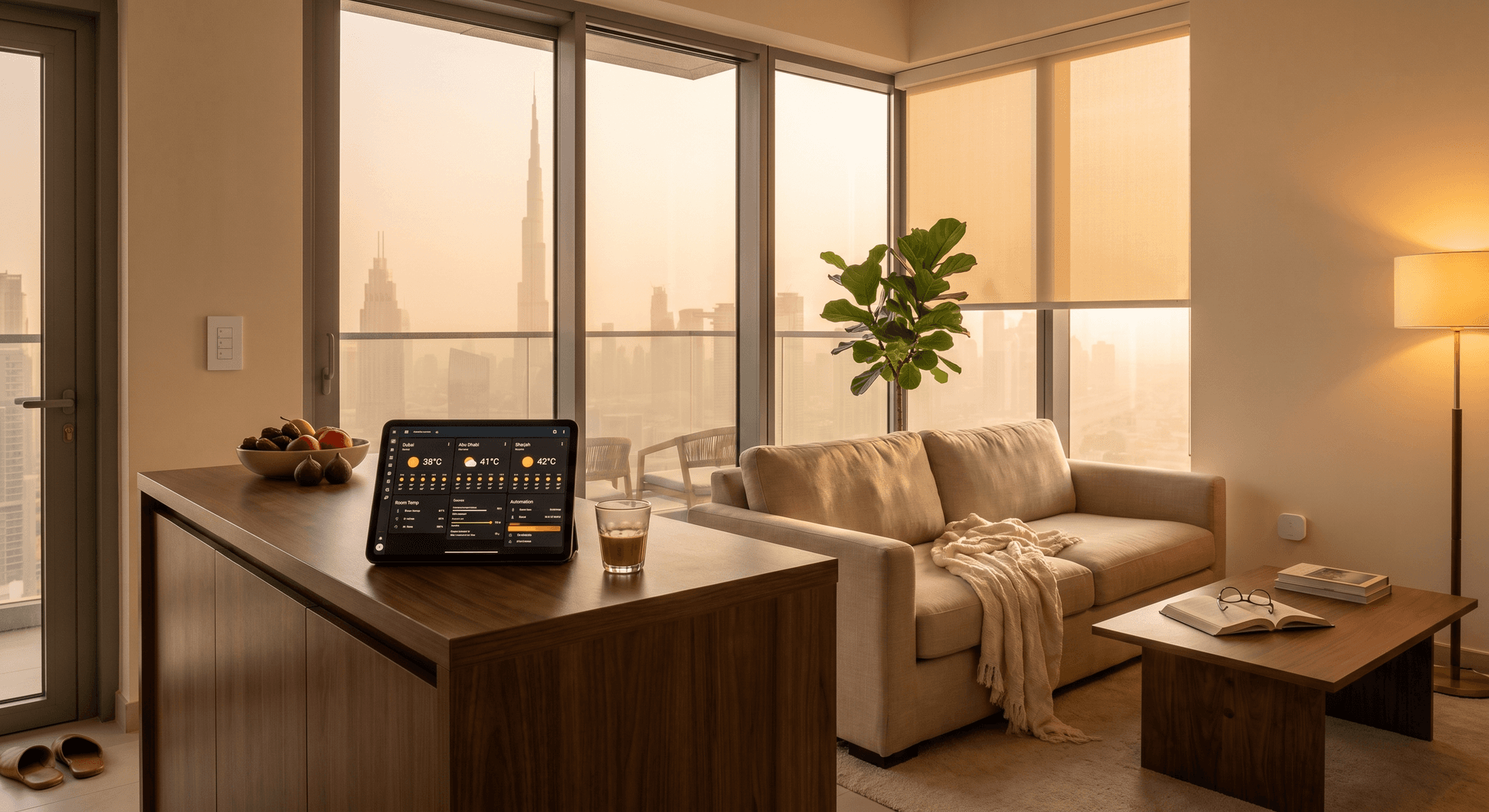
Whole-home (AED 25,000-50,000+). Every room, every device, integrated through an open platform with future-proofing for Matter, the Home Assistant brain, redundant Z-Wave and Zigbee meshes, security cameras, smart locks, multi-room audio, and a tablet on the kitchen wall that shows the state of the home at a glance. This is the territory of villas and larger apartments where the install team is on-site for a week.
The reason the starter price is AED 3,000 and not AED 30,000 is that the convenience economy figured out the right product mix three years ago. The hardware is available locally. The install takes a day. The platforms are open. What is rare is someone who will design the schedule for your week, set up the scenes for your hosting, calibrate the AC for your office hours, and come back two weeks later to tune it. That is the part that disappears when residents try to do this themselves from Amazon.
What Bayora Will Talk You Out Of
We have been on enough surveys this year to know what gets oversold to people who hear "AI smart home" and assume they need a full institutional build.
Skip the AED 18,000 wall touchscreen for a 2BR apartment. Your phone is already there. A small AED 350 Lutron Caseta Pico keypad by the door does the same job for the scenes you use every day, with a tactile button in the dark.
Skip the all-room RGB lighting. Most clients use warm white for 90% of the year. We have never seen anyone use the full RGB rainbow past the first month. A single Hue Bridge with white-ambience bulbs and one or two accent strips in the living room gets you 95% of the experience at 30% of the cost.
Skip the closed-platform brand-of-the-year subscription. Anything that locks you to one app for life is a bet against the next eight years of Matter, Home Assistant, and federal AI standards. The institutions are going open. So should your home. We always build on open so you can switch providers in 2031 without ripping wires.
Skip the rush to install everything in week one. A thinking home in Dubai gets built in two stages. AC and front-door layer first, lighting and blinds three weeks later when you have lived with stage one. The wrong product picked on day one is harder to undo than no product at all.
A Business Bay Two-Bedroom, Built in Two Stages
In April we worked with a tenant in a 2BR in Business Bay who had renewed her lease for another year. She had been in the apartment since 2022. Her DEWA bill in summer 2025 averaged AED 1,420 a month from May to September. She left her AC on at 23C during the workday because she did not trust her body to walk into a 32C apartment at 6:30pm.
Stage one was a single Sensibo Sky on the living-room AC plus a smart lock on the front door. AED 2,360 installed. We set up four scenes: Morning, Work-Away, Arrive-Home (geofenced to 800m), and Sleep. The Work-Away scene runs the AC at 27C with fan-auto, the Arrive-Home scene drops it to 23C the moment her Careem crosses the Marasi Drive bridge, and the Sleep scene shifts the bedroom AC to 25C overnight. Her May 2026 DEWA bill came in at AED 1,090, down AED 330 on a comparable month a year earlier.
Stage two went in mid-May. Two motorized blinds on the west-facing living-room windows, a Lutron Caseta dimmer on the dining pendant, a Hue starter kit in the bedroom, and a Home Assistant Green hub on the network shelf. AED 4,940 installed. The west-facing blinds now close automatically at 2:30pm so the room never absorbs the worst of the afternoon sun, and the lighting layer ramps from cool white at sunrise to warm amber after sunset. Her bill in May 2026 with the blind layer added was AED 1,050.
Total spend across both stages: AED 7,300. Total monthly saving on the bill: AED 370-450. The bill effect was a side story. What changed was that her apartment now does what her phone does. It anticipates her. It does not wait for her.
She does not use the word AI to describe it. She says, "the apartment knows what I am doing." That is the only definition of a thinking home that matters.
How the Cross-Emirate Picture Should Shape Your Choices
If you are buying or specifying smart home in Dubai right now, the cross-emirate AI rollout changes one thing about how you should approach the build: open platforms have gone from a preference to a structural requirement.
Two years ago a Dubai apartment built on a single closed brand was a viable choice. The risk of being locked in was abstract. Today, with three emirates publicly committed to AI government, the federal directive pushing Matter and open standards, and the Matter protocol now embedded in iOS, Android, Samsung, Apple, Google, and Amazon devices, anything that does not speak open standards is a bet you cannot easily unwind. The home you specify in 2026 will need to talk to a federal AI agent for service requests by 2028. You want the option open.
The second thing the cross-emirate rollout changes is timing. The institutional shift is happening on a two-year window. Your home has the same window to catch up cheaply. Smart home hardware is at the bottom of its cost curve. Install talent is available locally. The next two years are the right window to layer in the basic intelligence before institutional standards demand it.
The third thing it changes is expectation. A Dubai resident who deals with a Sharjah AI assistant in 2027 and an Abu Dhabi AI-routed service in 2027 will not return home to a wall switch and feel neutral about it. The contrast will get sharper every quarter. The resident-side mechanics of what shifts the day DEWA's AI Virtual Engineer ships in Dubai specifically are laid out in what DEWA's AI actually does for your apartment.
Where to Start If You Are New to This
If the room you are reading this in still runs on manual everything, start with the climate layer. That is the largest source of friction and the largest source of cost in a Dubai apartment. A smart AC controller from AED 1,500 plus a one-day install gets you 80% of the convenience win on day one. We can come and look at the apartment, give you a fixed-price quote for the climate layer and the door layer, and stay out of your way on everything else until you have lived with it for three weeks.
The rest of the build can wait. The institutional shift is structural and it is not slowing down. Your home should catch up on your terms, in your time, in your apartment, with no lock-in.
The grid got smart. The government got smart. The third emirate joined last week. The next move is the one inside your front door.
Frequently Asked Questions
What is the cheapest entry point for an AI smart home in Dubai?
A single smart AC controller from AED 1,500 plus install from AED 1,500 is the most useful first product in a Dubai apartment. It solves the largest source of manual labour and the largest source of waste on a DEWA bill in one step. Most renters start with this and add lighting or blinds in stage two, three weeks later.
Do I need a wired install or can I do this in a rental apartment?
You do not need any wiring for the starter layer. Smart AC controllers, smart bulbs, battery-powered motorized blinds, and smart locks all install in a few hours with zero modification to the apartment. Everything is portable when you move. This makes the AED 3,000 starter realistic for tenants on a one-year lease.
How does the federal UAE Government 4.0 directive affect smart home choices?
The federal directive commits half of UAE government services to AI agents within two years. That standard pushes the regional smart home market toward open protocols like Matter and away from closed brand silos. For homeowners, the practical effect is that any platform you choose today should speak open standards, so that in 2028 your home can integrate with federal AI services for things like utility scheduling, building management, and security.
Is this the same kind of AI that ChatGPT uses?
No. Most home automation runs on rule-based logic and pattern matching, not generative AI. The schedules learn your week, the sensors trigger scenes, the platform coordinates devices. The federal and emirate-level AI rollouts are different in scale and scope but use a similar combination of agentic decision-making and machine learning. The home is on the same trajectory at a smaller scale.
How long does a Dubai apartment install take?
A stage-one install (AC controller plus smart lock) takes one day. A layered apartment build with lighting, blinds, scenes, and a hub takes two to three days, usually split across a week so you can sleep in the apartment between visits. A whole-home install in a 4BR villa runs one to three weeks depending on scope. We never leave until everything works and the household is trained.
Curious what a thinking home would look like for your apartment? Tell us about your place and we will come look. No cost, no obligation, and an honest recommendation on where to start.
Ready to Get Started?
Get a free consultation and we'll recommend what makes sense for your situation.
Get Free Consultation