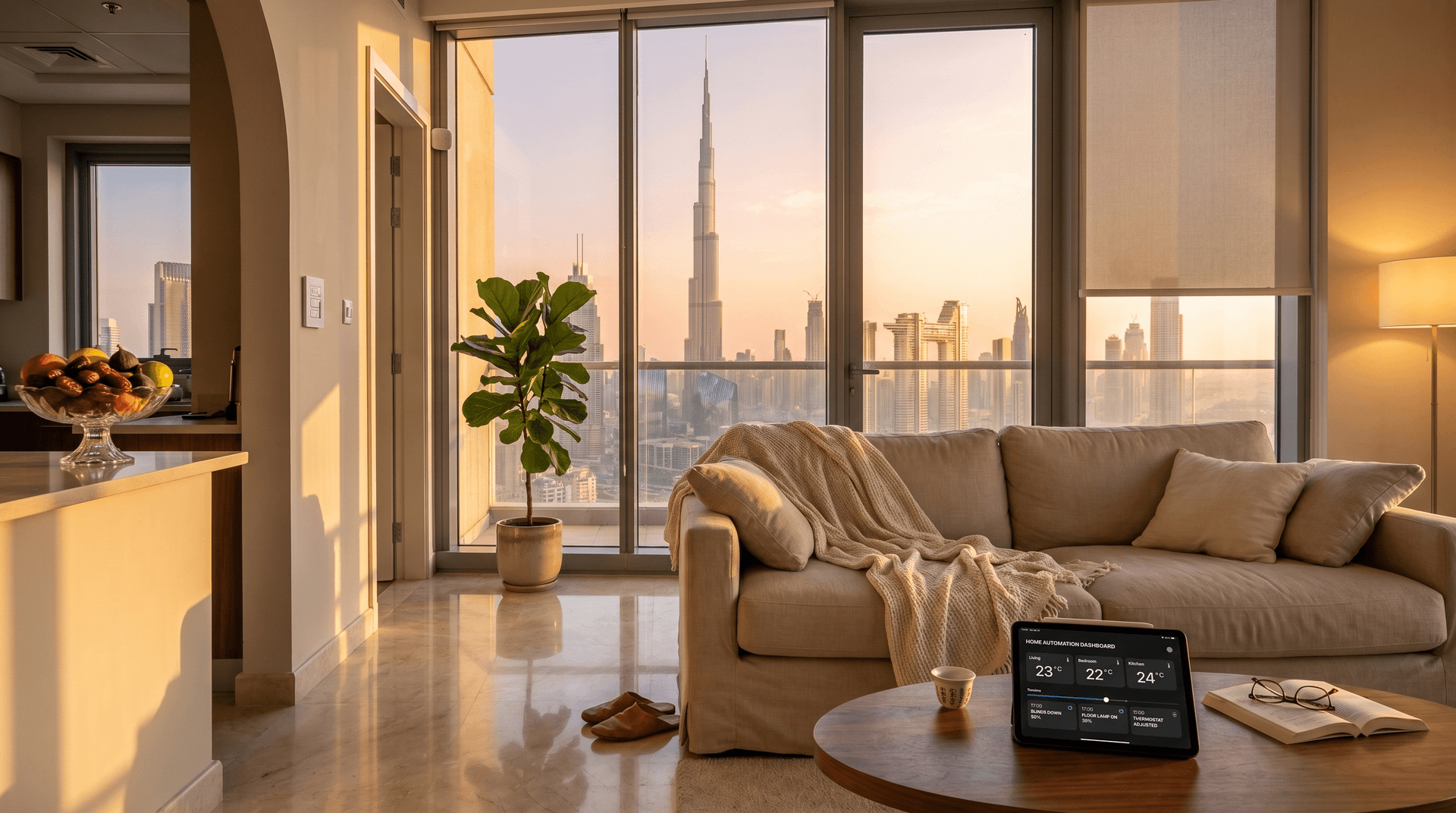
Dubai is the only city we know of where the airport remembers your face, the bus stop tells you when to leave, the bank lives inside WhatsApp, and the new tower running the electricity grid makes 1.9 million automated decisions every day before you have finished your morning coffee. This month, the Dubai Electricity and Water Authority is adding an AI Virtual Engineer to monitor the power network in real time (Khaleej Times, 2026). It is the world's first.
You walk back into your apartment after work. Your AC has not heard from you since this morning. Your blinds let the 4pm sun cook the living room until midnight. Your lights are on a switch that was installed in 2008 by an electrician who is now retired. The most automated thing in your home is the kettle, and only because you remembered to fill it.
TL;DR: DEWA's new headquarters runs on 110,000 sensors that produce more than 1.9 million automated control commands a day, and the utility itself is launching an AI Virtual Engineer this month to manage Dubai's electricity grid (Khaleej Times, 2026). Meanwhile most Dubai apartments still run on manual switches and a thermostat from 2008. A thinking home, the kind that pre-cools before you arrive, dims the lights at sunset, and closes the blinds when the dust picks up, starts from AED 3,000 installed and grows from there. The institutional intelligence is here. The next step is your front door.
Dubai's Grid Already Got Smart. Your Home Did Not.
Half a kilometre down the road from Business Bay, in Al Jaddaf, sits a building that opened in May. Its name is Al Sheraa, Arabic for "the sail." It is the world's tallest, largest, and smartest net-positive government building, and it is the new headquarters of DEWA (Gulf News, 2026). Inside that tower there are 110,000 smart sensors, more than 1,500 wireless access points, and 3,200 network devices, all of which produce more than 1.9 million automated control commands every single day (Khaleej Times, 2026). The system reads environmental data, operational data, energy demand, occupancy, and weather in real time. It runs the building.
That same utility runs your DEWA bill. In June it is adding an AI Virtual Engineer that monitors the power network, predicts failures before they happen, calculates efficiency autonomously, and runs real-time scenario simulations on the grid (Utilities Middle East, 2026). DEWA's chief executive, Saeed Mohammed Al Tayer, calls it the first step toward DEWA becoming the world's first fully AI-driven utility service provider.
There is a layer above that one. The UAE Cabinet approved a programme last month called UAE Government 4.0, which trains 80,000 federal employees in Agentic AI and commits to running half of UAE government services on AI agents within two years (The National, 2026). Four AI agents are already live across tax, procurement, customer service, and technical support. The directive is now spreading across the emirates: Abu Dhabi is spending AED 13 billion to become the world's first fully AI-native government by 2027, and Sharjah's Crown Prince signed off on a Sharjah AI Assistant Programme last week, putting three emirates inside an eight-week window of AI rollouts.
So the grid is becoming a thinking grid. The government is becoming a thinking government. The bus stop already thinks. DEWA's customer service chatbot, Rammas, has answered 12.7 million inquiries since 2017 without a human touching it (WAM, 2025).
Your home is the last thing in your life that does not think yet.
What "Thinking" Means at Home
Forget the science fiction version. A thinking home is not a robot in the kitchen and it is not a hologram of a butler. In our experience installing smart homes across Dubai, what clients call "thinking" is much simpler. It means the home runs on context instead of buttons. It knows what time it is, who is at home, what the weather is doing outside, and what the household routine looks like. Then it acts.
Concretely, this is what that looks like in a Business Bay two-bedroom we set up earlier this year. At 4:50am the bedroom AC drops two degrees so the room is cool by alarm time. At 5:30am the blinds open in stages, slowly. At 7:15am the front door knows the wife has left for work, so it locks itself. At noon the living room blinds close because the west sun has reached the floor. At 2pm a dust alert from the weather feed triggers all windows to verify they are closed and the air purifier to step up. At 6:40pm the lights warm to 2700K because the sun has set and the family is home. At 11pm the bedroom AC steps back to night mode, the kitchen lights go to dim navigation, and the front door confirms it is locked.
None of that requires an app. None of it requires the homeowner to remember anything. The home knows the family's rhythm and runs to it. When the family changes, the home adjusts.
That is the thinking part. The intelligence is in the schedule plus the sensors plus the conditions. The hardware is mostly off-the-shelf. The brain that ties it all together is a piece of software running on a small box on a shelf.
Why Your Apartment Cannot Do Any of This Today
The apartments we walk into in Marina, Business Bay, JBR, and Downtown are typically a decade old or close to it. The wiring is fine. The AC works. The kitchen is fine. The problem is that everything in the home is on its own island. The AC has a remote with a cracked screen. The lights have a switch on the wall. The blinds have a cord. The TV has its own remote. The water heater is on a timer in a cupboard nobody opens. The home has no idea any of these systems exist.
In a thinking home, those islands are connected by one quiet brain that reads from all of them and writes to all of them. The AC tells the brain the room is 26C. The brain knows it is 4pm and the family will be home at 6:30. The brain tells the AC to cool to 22 by 6:25, then it tells the living-room blinds to close because the west sun is still hitting the windows. Two simple decisions, made automatically, save the family ninety minutes of feeling hot in the evening and lower the cooling load by about a third.
That brain costs less than people think. The hardware to run a small thinking home, the box, the controllers, the sensors, the bridge, starts from AED 3,000 for the entry tier and goes up depending on how many systems you connect. The setup process takes a day for an apartment and one to three weeks for a villa, depending on how many rooms and how many systems are involved.
The Three Layers a Thinking Home Needs
When we plan a smart-home install in Dubai, what we sketch out is always the same three layers, in this order.
The first layer is the sensing layer. Sensors for temperature, motion, door state, leak, and ambient light. A weather feed from outside. A calendar. A presence signal from the family's phones or a geofence. This is the home's nervous system. Without it the home is blind.
The second layer is the control layer. The switches that operate the AC, the lighting, the blinds, the locks, the audio, and any appliances on smart plugs. This is the home's hands. The control layer is usually retrofit, meaning it sits behind your existing switches or inside the box on the wall. It is rarely visible.
The third layer is the brain. This is the part most homeowners get wrong, because they buy individual brand apps instead of a brain. The Sonos app controls the speakers. The Aqara app controls the sensors. The Sensibo app controls the AC. The Lutron app controls the lights. Five apps is not a smart home. Five apps is a home with five remotes that happen to be digital.
A brain is a single piece of software that reads from every device and writes to every device, regardless of brand. In our experience the right brain for the kind of Dubai home Nadia lives in is Home Assistant, which is open-source, runs on a small box on a shelf, and never locks you in to one vendor. We have also installed Control4, KNX, and Crestron for villa projects, depending on budget and architecture, and they all do the same job at different price points.
What an AED 3,000 Starter Buys You
Bayora's Smart Home Starter from AED 3,000 installed is the entry rung. The price has not changed in 18 months and it includes the controller, configuration, app setup, and a one-hour walk-through with the household (Bayora services, 2026). What you get at this level is a single thinking system, usually smart AC control, that runs on its own brain in the cloud and connects to your phone.
That single system on its own already changes the home meaningfully. Pre-cooling before arrival shifts the cooling load away from the peak DEWA tariff window. Scheduled overnight setbacks save 15 to 30 percent on AC runtime (Sensibo, 2024). The room is cool when you walk in instead of after 45 minutes. The compressor outside stops cycling 200 times an hour because the schedule is doing the work instead of the manual setpoint.
The next rung up, around AED 6,000 to 10,000 installed, adds lighting control and motorized blinds on one or two priority windows. This is where the home starts to feel like it knows what time it is. Lights warm at sunset. Blinds close before the 4pm heat. The Goodnight routine runs at 11pm with one tap or one voice command.
The AED 10,000 to 25,000 range adds the brain proper, multiple rooms of AC, a door lock, a video doorbell, and the first proper scenes. This is the level where the home starts running on context. The "Welcome Home" scene drops the AC, opens the blinds, turns on the lights, and unlocks the door at the right minute. The "Goodbye" scene confirms windows are closed, sets the AC to away mode, locks the door, and arms the cameras. Nadia stops thinking about her home and starts living in it.
Above AED 25,000, the install becomes whole-home and starts to include audio, full security, integrated climate across every room, and any custom automations the family wants. Some clients spend AED 50,000 on apartments. Most villas land between AED 25,000 and AED 100,000 depending on scope and the brand stack they pick.
What This Costs to Run, and What It Saves
Operating a thinking home in Dubai costs almost nothing once it is installed. The hardware draws a few watts. The brain box draws less than a phone charger. The cloud services are mostly free or under AED 50 a month, depending on the platform.
What the home saves shows up in three places, and we are honest with clients that the savings are a side effect, not the headline. The AC schedule cuts cooling runtime by 15 to 30 percent. The lighting layer drops about 20 to 40 percent of standby and overlit hours. The blind layer cuts about 4 to 5 degrees of solar gain on the west side in summer. None of those are 50 percent savings. Together they typically drop a Dubai summer DEWA bill by AED 300 to AED 800 a month for a two-bedroom apartment, and by AED 800 to AED 2,500 a month for a 4-5BR villa, based on the bills we have seen in our Meadows, Springs, and Business Bay projects (DEWA, 2026).
The real return is in the time. A family with a thinking home does not spend mental energy on the home. The home is not a project anymore.
How DEWA's AI Engineer Changes Things for You
Here is the part most homeowners do not realise yet. As DEWA's grid gets smarter, the value of having a smart home grows with it. The Distribution Network Smart Centre at DEWA already analyses 15 million data units a day and the AI grid management system improves efficiency by about 20 percent (Utilities Middle East, 2026). The grid can predict solar output 72 hours ahead. It can balance load down to fifteen-minute intervals because every home in Dubai has a smart meter.
A home that talks to the grid, even indirectly, can shift its heavy loads, its AC, its water heater, its washing machine, to the off-peak hours that DEWA prices lower. A home that does not talk to the grid runs the AC compressor flat out from 1pm to 9pm and pays peak rates the entire time. As the grid gets more responsive, the gap between thinking homes and dumb homes will keep widening in cost terms, not closing. Today the savings are modest. In three years they will be material. In five years the gap will be the difference between a normal bill and a high one. We have written separately about what actually changes for your apartment when DEWA's AI Engineer ships, and which two of the three resident-side changes you can capture today on an AED 3,000 starter.
This is also why the open-platform principle matters. The platforms that talk to other platforms, Matter, Home Assistant, KNX with bridges, will plug into whatever DEWA or RTA or DLD ship next. The platforms that lock you in will not. We pick open every time, not because we are ideological about it, but because we have seen too many clients stuck on a 2018 hub that the manufacturer stopped supporting in 2022.
Where to Start If You Are Renting
Most of the people who read this post are renters, and the good news is none of this requires landlord approval. Smart AC controllers like Sensibo and Aqara are plug-in or wall-mount with adhesive, both reversible. Smart blinds with battery motors clip onto the inside of existing brackets without drilling. Smart switches that go behind an existing wall switch are reversible in 20 minutes. Smart locks like the Aqara U200 retrofit onto your existing door cylinder without changing the lock. A complete renter starter setup that delivers most of the "thinking home" feeling lands at AED 4,000 to AED 8,000 and moves with you to your next apartment.
The order we recommend, in our experience setting these up across Marina, Business Bay, JBR, and Downtown, is always the same. AC first, because that is 60 to 70 percent of the cooling problem. Lighting second, because that is the layer the household notices first. Blinds third, because in Dubai the sun is the heat. Locks and security fourth, because the perimeter matters less than people think until they travel.
The whole-home brain comes last, after the family has lived with the first few layers and knows what they want it to do.
What Bayora Will Talk You Out Of
We will tell you, before you spend anything, the five things we walk most clients away from at the first survey.
The wall-mounted touchscreen for AED 12,000 to AED 18,000 that does the same job a tablet on a magnetic mount does for AED 800. Apartments do not need a butler-style control panel in the hallway.
The AED 6,000 voice-assistant speaker in every room. One HomePod or Echo per major room is plenty. Most clients use voice less than they think they will.
The full RGB lighting kit for every bulb in every room. Most rooms benefit from one warm dimmable scene. The kids' room is the only place colour earns its keep.
The custom-built app on a custom server. Anything we build on a closed system today is locked-in in five years. Open platforms only.
The smart fridge, the smart oven, the smart washing machine. Appliances should be reliable. They should not require an app to start.
These five "no" items often add up to AED 30,000 to AED 80,000 of fluff on a quotation, and they make almost no difference to the daily feel of the home. We would rather sell you the AED 12,000 installation that runs perfectly than the AED 60,000 installation that has three things you never use.
Frequently Asked Questions
Do I need fast internet for an AI smart home?
No. The brain runs locally on a small box on a shelf in your apartment, and most automations work even when your internet drops. The internet matters only for voice assistants, remote control from outside the home, and cloud-based services. Routine scheduling, sensor responses, scenes, and security all run locally on most platforms we install (Home Assistant Community, 2026).
Is the DEWA AI Virtual Engineer something I sign up for?
No. The AI Virtual Engineer is a DEWA-side system that manages the electricity grid, predicts failures, and optimises supply. You do not sign up for it. What it changes for you, indirectly, is that the grid will be more responsive to demand shifts, which makes a thinking home that schedules loads off-peak more valuable over time.
Can I keep my Alexa or Google Home if I install an open-platform brain?
Yes. Open platforms like Home Assistant integrate with Alexa, Google Home, and Apple HomeKit. You keep your voice assistant of choice and add the brain underneath. Most of our clients keep at least one voice assistant for natural-language commands and use the home's scenes for the routines that run automatically (Apple Support, 2026).
What happens to all this hardware in five years?
Open-platform hardware ages well. Closed-platform hardware ages badly. The brain we install today will run software updates for the next decade. The sensors and switches use the Matter standard or Zigbee, both of which are designed to outlive any single manufacturer. The blind motors and AC controllers are the only items that typically need replacing on a 5 to 8 year cycle, the same as a coffee machine or a TV.
Is this overkill for a one-bedroom apartment?
No. The AED 3,000 starter is built specifically for small apartments. A one-bedroom with smart AC control, smart lighting on the main room, and a smart lock already feels meaningfully different to live in. The full thinking-home setup is a ladder. Most clients climb it over two or three years, not all at once.
What to Do This Week
DEWA's grid is becoming smarter every quarter. The new AI Virtual Engineer launches this month. The institutional infrastructure of Dubai, from the grid to the bus stops to the airport, is being rebuilt around context-aware AI. Your home is the last manual layer in your daily life. It does not have to stay that way.
The starting move is small. Book a free consultation, walk through your apartment with us for 30 minutes, and we will tell you what one or two systems will give you the biggest "this finally works" moment for your routine and your budget. We do not charge for the survey. We do not pitch the AED 50,000 setup to a one-bedroom renter. If your problem is solved by an AED 4,000 install, that is what we will quote.
The bus stop already knows when to call you a taxi. The grid is about to know when to ship more power. Your house should at least know when you are coming home.
Book a free consultation. We will tell you, honestly, what would change.
Ready to Get Started?
Get a free consultation and we'll recommend what makes sense for your situation.
Get Free Consultation