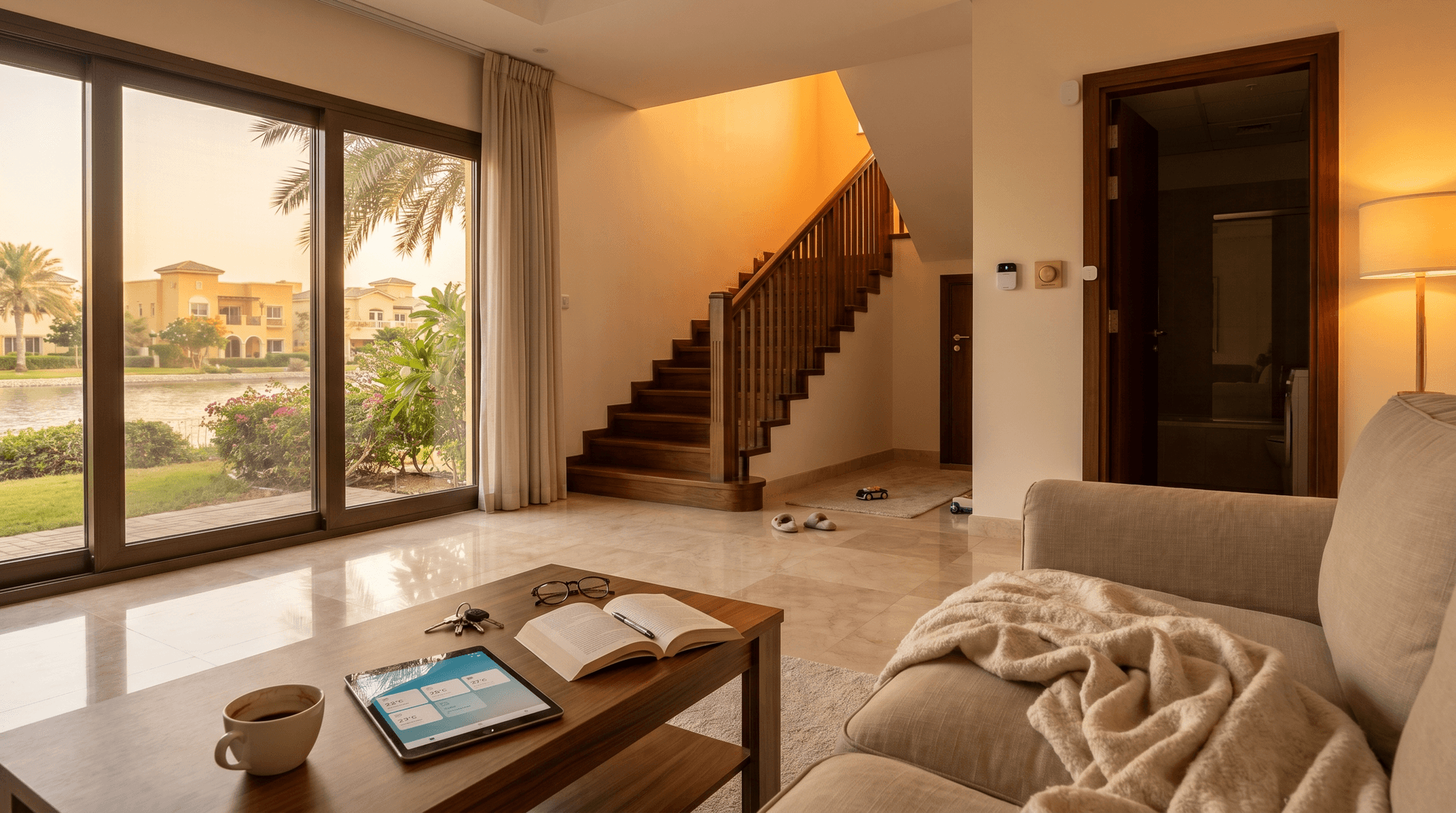
The Meadows summer story is the same one we hear in Springs and Arabian Ranches, but the villa is bigger and the math gets harder. Downstairs reads 22 on the thermostat. The upstairs master is 27. The kids' rooms on the east side of the house are 25. The downstairs living room with the floor-to-ceiling windows facing the community lake is 26 by 4pm because the sun has been hitting that glass since 2. One thermostat is trying to satisfy four different rooms at four different temperatures, and the compressor outside has not stopped since noon.
This is what happens when a villa built in 2004 for a different climate logic gets asked to do the work of three. The Springs fix is two zones. The Arabian Ranches 1 fix is two zones. The Meadows fix is almost always three.
TL;DR: A 4-5BR Meadows villa has at least three distinct temperature regions: the upstairs master (usually the hottest, west-facing), the upstairs kids' or guest rooms (cooler, east-facing), and the downstairs living areas (high glass load, late afternoon heat). A single wall thermostat cannot manage all three. A 3-zone smart AC setup with one controller per indoor unit and a sensor in each room costs AED 4,500-8,500 installed, cuts peak summer DEWA spikes by 15-30 percent, and ends the upstairs-versus-downstairs argument by midnight. Renter-friendly, no wiring, one day.
What's Different About a Meadows Villa
The Meadows is nine sub-communities, 1,800 villas, all completed between 2003 and 2007 by Emaar (Bayut, 2026). The villas come in 3 to 6 bedrooms across roughly twenty architectural styles, and the four-bedroom and five-bedroom types are where this post lives. A 4BR Meadows villa runs 3,500 to 4,700 square feet across two floors. A 5BR is closer to 4,900 (Emirates.Estate, 2026). Standard layout puts a living and dining room downstairs, an American-style kitchen with a bar opening into the dining area, a maid's room and guest room downstairs, and three to five bedrooms upstairs (Espace, 2026).
The cooling architecture is the same as Springs: chiller-free split AC. One DEWA bill, no separate cooling charges. Most Meadows villas have two or three outdoor compressors feeding four to six indoor units, with one wall thermostat sitting in the downstairs hallway near the entrance (Property Finder, 2026). That thermostat is from 2005. It does what the family asks it to do, which is hold the hallway at 22. It cannot do anything else.
In our experience surveying Meadows villas across Meadows 1, 4, 6, and 8, the cooling problem is almost never the AC itself. The compressor is fine. The indoor units are fine. The control layer is what was built for a smaller, simpler home that does not exist any more.
The Three-Zone Heat Problem
Heat rises. Sun moves. Glass loads up. None of that is news. What is news is how those three forces line up in a Meadows 4BR by 3pm in June.
Zone one is the upstairs master. It is almost always the hottest room in the house. In most Type 6 and Type 12 layouts, the master sits at the back of the villa with windows facing the rear garden, which is often west or south. That glass takes a 1,000-watt heat hit per two square meters during the 4-to-6pm peak (Stråla, 2024). Even with the door closed and the AC running, the master is trying to cool a room that is being heated as fast as it is being cooled.
Zone two is the upstairs kids' or guest rooms. They sit on the opposite side of the villa, usually east-facing. They got their sun load in the morning. By the time the family gets home from school at 3pm, the kids' rooms are 24 or 25 because the walls finished radiating around lunchtime. They do not need aggressive cooling. They need a gentle hold and a pre-bedtime dip.
Zone three is the downstairs. The living room has floor-to-ceiling sliding glass onto a small garden, often facing west across the community lake. That glass takes the same heat hit as the upstairs master, only later in the day. Downstairs is fine in the morning, fine at lunch, and then steadily climbs from 2pm until 8pm when the family is using the room hardest.
Three rooms. Three different heat profiles. Three different cooling needs. One thermostat in the downstairs hallway that does not know any of them exist.
For multi-level homes, the professional HVAC guidance is direct: set the top floor to the temperature you want, and let the cooler air settle downward (Quality HC, 2024). Most Meadows villas do the opposite. The thermostat is downstairs, the family sets it low, downstairs gets very cold, the compressor cycles all afternoon, and the rooms upstairs stay where they were. The DEWA bill absorbs both problems at once and lands at AED 3,000 to 5,000 for a 4BR in July (UtilityBillUAE, 2025).
What a Three-Zone Setup Does
A 3-zone smart AC layer does four things the single thermostat cannot.
It puts a sensor in every room the family cares about. Master bedroom, two or three kids' rooms, living room, and usually a sensor in the dining area. The AC stops chasing the temperature of the hallway and starts chasing the temperature of where the family is.
It controls each indoor unit independently. A typical 4BR Meadows install has four indoor evaporator units: one in the master, one or two upstairs for the kids' rooms, and one downstairs for the living and dining. A smart controller goes in front of each one. WiFi-connected AC controllers with room sensors save 15 to 30 percent on cooling costs through scheduling, geofencing, and per-room temperature rules (Sensibo, 2026).
It groups them into three zones that match the building, not the floor plan. Zone one (upstairs master) gets a 4pm pre-cool to 22 so the room is sleepable by bedtime. Zone two (kids' rooms) gets a gentle hold at 24 in the afternoon and a dip to 22 from 8pm to 6am. Zone three (downstairs) gets a 24 hold from noon to 6pm, a step down to 23 when the family is home from work, and a drift to 26 after midnight.
It runs a schedule that matches the family's day, not the building's hot afternoon. Everything pulls back to 27 when the last person leaves the villa. Everything starts recovering 20 minutes before the first person comes back. The compressor outside still does the work. The four indoor units it feeds now have a brain each.
What It Costs in a Meadows Villa
We price these in three tiers based on the number of indoor units a setup needs to cover. Hardware is mostly Sensibo or Aqara depending on whether the client wants a clean app experience (Sensibo) or full integration with the rest of a smart home build (Aqara plus a hub). Both work, both honor the open platform principle, and both come back out cleanly if the family ever moves.
3-bedroom Meadows villa (smaller stock, 3 indoor units typical): AED 3,500-5,500 installed. Three Sensibo Sky controllers, three room sensors (the controllers themselves sense the room they live in, so this often only adds one or two extra sensors for rooms the controller cannot see), schedule build, geofence setup, and one Saturday morning of configuration. The master gets its own controller. The kids' room gets its own controller. Downstairs gets its own controller. This is the simplest tier and the most common renter setup.
4-bedroom Meadows villa (Type 6, Type 12, the common 3,500-4,700 sqft footprint): AED 4,500-7,000 installed. Four controllers, four to six room sensors covering the master, two kids' rooms, living, dining, and sometimes a downstairs guest. A Zigbee hub if we are integrating with lighting or blinds later. Per-zone schedules, geofence, voice control through whatever the family already uses (Alexa, Google, or HomeKit). This is the heart of the Meadows install pattern.
5-bedroom Meadows villa (largest stock, 4,900+ sqft, 5-6 indoor units): AED 6,000-8,500 installed. Five or six controllers, six to eight room sensors. The downstairs guest room gets its own zone because guests visit, the maid's room gets a separate schedule because it is almost always under-cooled in the original install, and the upstairs picks up a third zone if the kids' wing splits east and south. This is the full Meadows treatment.
All three tiers include configuration, training for the family and the housekeeper, and twelve months of support. None of them require an electrician. The DEWA bill goes down somewhere between 15 and 30 percent in peak summer, depending on how aggressive the family wants the schedule to be. The argument about who gets to sleep first stops happening.
The Install Order We Use
A Meadows 3-zone setup takes one day. The order we follow on every install:
- Upstairs master first. It is the worst room. The family feels the change before lunch.
- Kids' rooms next, paired into zone two. The schedule is gentler than the master.
- Downstairs living and dining as zone three. This is the most complex zone because it has the highest glass load and the longest occupancy window in the evening.
- Geofencing last. We set this up to be conservative, with a 27-degree pullback when everyone leaves rather than 30. Tone-sensitive periods or families that prefer not to broadcast their absence can skip this step, and the schedule alone will do most of the work.
- Leak sensors under the kitchen sink, the master ensuite, and the upstairs guest bath. Meadows villas have had washing machine and dishwasher leaks more often than we would like, and a AED 50 sensor catches the problem at 9am instead of 9pm.
The whole sequence is one Saturday. The family is in and out of the house during install, the kids do not notice anything, and by Sunday morning the villa is running on schedules nobody had to think about.
A Real Meadows Project
A four-bedroom Type 6 in Meadows 4. Family of four, two kids under ten, both parents working from offices in Tecom and JLT. They moved in three years ago. The villa is original-spec from 2005 with four indoor units, one outdoor compressor, and a wall thermostat in the downstairs hallway.
Their July 2024 DEWA bill was AED 3,820. Their August 2024 was AED 4,140. The complaint that brought them to us was not the bill. It was that the kids' rooms were 26 at 9pm and they could not get the eight-year-old to sleep without the door open and a portable fan on the floor.
We installed four Sensibo Air controllers (one per indoor unit), six Aqara temperature and humidity sensors (master, two kids' rooms, living, dining, downstairs guest), and a Zigbee hub for future expansion. AED 5,420 all-in including configuration and family training. We talked the wife out of a wall-mounted touchscreen in the kitchen (the iPad they already had on the counter does the same job) and out of a fifth controller for the maid's room (we added it to the existing controller's schedule instead).
The first July after the install (July 2025) the DEWA bill was AED 3,180. August was AED 3,290. That is AED 1,490 saved across two months, on a setup that paid for itself before the end of the second summer. More importantly, the kids' rooms were 22 by 8:45pm every night because the schedule pre-cooled them while the family was at dinner. The eight-year-old slept through the night for the first time in a year.
The May 2026 bill that landed last week was AED 2,640. The June bill, with the heat ratchet that started this week (NCM forecasts 30°C overnight today and 40°C tomorrow (Khaleej Times, 2026)), will likely come in around AED 2,950 to 3,100. Slightly higher than May, but still meaningfully below where the villa would have run on the original control layer.
What Bayora Will Talk You Out Of
Honest recommendations matter more than total bill, and there is a small list of things Meadows owners often think they need and almost never do.
You do not need a new AC. The original split units in Meadows villas are sturdy. We have walked into homes with 2004 compressors that still hold a 6°C delta on a 41°C afternoon, which is what they are rated for. The problem is never the hardware. It is the control layer.
You do not need to upgrade to ducted central. Some Meadows villas already have ducted central from previous renovations, and they work fine. If you have splits, splits are the better choice for a 3-zone setup because each unit is already physically isolated.
You do not need a wall-mounted touchscreen for AED 12,000 to 18,000. We have installed dozens of these and they get used for the first month. After that, the iPad in the kitchen and a phone do the same job better. The Lutron Pico keypad we install in the master is the only physical control surface that has not gotten retired in any client home.
You do not need to motorize every blind in the villa for phase one. The west-facing master windows and the downstairs living room windows are the two that matter most for heat. Everything else can wait for phase two. Pair the AC zone control with motorized blinds on those two windows first (motorized blinds for Dubai living rooms). Together they shift the cooling load by 3 to 5°C at peak, which is a much bigger lever than the AC alone.
You do not need a smart home brain on day one. We install Aqara, Sensibo, or Tado depending on what the family wants. All three are open platforms. None of them lock you in. If you want to add Home Assistant or full integration with lighting and blinds later, the AC zone control still works the same way the day you decide.
Pair With Motorized Blinds on the West Windows
The single biggest accelerant for a Meadows zone-control setup is motorized blackout blinds on the west-facing windows that share the master and the downstairs living. West glazing drives 20 to 40 percent of the total cooling load in a 2-story villa (Optimal Windows, 2024). A blind scheduled to close at 2pm, before the sun has cooked the wall behind it, cuts the radiant heat into the master by 60 to 70 percent. The AC controller then has half the work to do, which is what turns a 15 percent saving into a 30 percent saving.
The same blind opens at 6am on a schedule so the bedroom wakes up with the sunrise, then closes mid-morning before the room heats. The handshake is automatic. The AC and the blinds talk through the hub. No app-tapping required.
We typically add three motorized blinds to a Meadows phase two: master, master ensuite skylight if there is one, and the downstairs living room. AED 4,500 to 8,000 depending on window count and motor choice (battery for renters, hardwired for owners).
Frequently Asked Questions
Does this work in my Meadows villa if I'm renting?
Yes. Every controller and sensor in this setup is plug-in or stick-on. Nothing requires landlord approval. When you move, the controllers come off the wall in five minutes and the sensors peel off. The AC unit, the thermostat, and the wiring are exactly as you found them. The schedule and the configuration travel with you on the app.
Will it void my AC warranty?
No. The controllers sit in front of the indoor unit using infrared, the same signal your remote uses. There is no electrical modification to the AC itself. Manufacturer warranties remain intact. We have run this setup on AC units from 2003 in Meadows 1 without issue.
What happens if the WiFi drops?
The schedule keeps running. Modern AC controllers store their schedule locally on the device, so a Du or Etisalat outage does not stop the 4pm pre-cool from running. You lose the ability to control the AC remotely from outside the house until WiFi comes back, but the family does not notice anything inside.
Can I use Alexa, Google, or HomeKit with this?
All three. Sensibo, Tado, and Aqara controllers all integrate with the three major voice platforms. We set up whichever the family already uses. If the family does not use any of them, we configure the controllers to work entirely through their own apps and schedule themselves.
How long does the install take?
One Saturday. We arrive at 9am, survey the house and confirm the placement of each controller and sensor, install the four to six controllers (one per indoor unit, mounted within infrared range), place the sensors, build the schedules and zones, train every member of the household including the housekeeper, and leave by 5pm. The family is using the new system that evening.
What This Costs to Get Started
A 3BR Meadows villa: AED 3,500-5,500 installed, one day.
A 4BR Meadows villa (the common case): AED 4,500-7,000 installed, one day.
A 5BR Meadows villa: AED 6,000-8,500 installed, one day.
Add motorized blackout blinds on the master and downstairs living windows: AED 4,500-8,000 phase two.
We do a free on-site survey. The proposal has the controller count, the sensor placement, the schedule design, the pricing, and the line item for every part. Nothing changes mid-install without a written update first.
Where to Start
Your villa is twenty-one. The summer is forty. The thermostat does not have to be 2005.
Get a free survey and we will walk you through your villa room by room, point at where the heat is winning, and put a one-day plan in front of you. No obligation, no surprises, and an honest recommendation about which zones to build first.
If you want to read the prior posts in this series, here is the Springs zone-control guide, the Arabian Ranches 1 guide, and the Victory Heights guide. For the larger Emirates Living stock with lake-facing glass on the ground floor, the same three-zone shape applies with one structural twist: the lakefront double-load on the living room makes the downstairs its own zone instead of a margin around the upstairs. We walk through that variant in the Lakes villa zone-control guide. For Nakheel's Jumeirah Park stock, the wide sliding garden doors that the family rarely closes add a door-sensor layer to the same three-zone pattern, covered in the Jumeirah Park villa zone-control guide. The pattern is consistent across the older-villa stock. The villa size and orientation change the number of zones, but the fix is the same shape.
If you want to understand whether your villa needs a smart AC controller, a smart thermostat, or both, the controller vs thermostat guide we published earlier this week walks through how to tell.
Ready to Get Started?
Get a free consultation and we'll recommend what makes sense for your situation.
Get Free Consultation