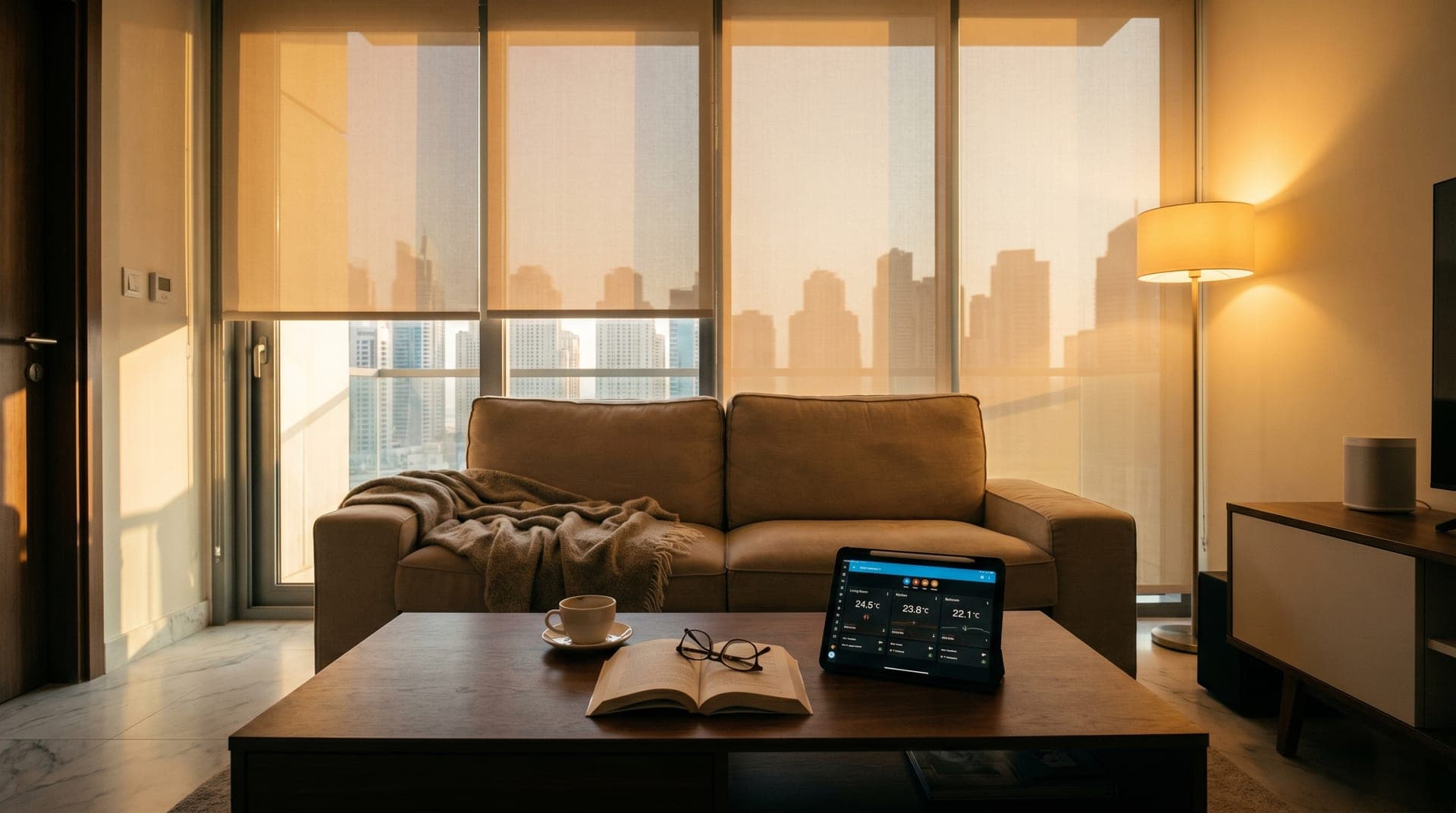
By 4pm, your living room is the hottest room in your apartment. By 7pm, it is where everyone is sitting.
The west-facing wall took six hours of direct sun, the glass radiated heat into the room all afternoon, and now you have eight people coming over for dinner. You shut the blinds by hand, the AC has been fighting a losing battle since lunch, and someone always squints because the glare is hitting the TV at exactly the wrong angle. This is the living room problem in Dubai, and it is the room most people fix last.
TL;DR: Living rooms drive 70-80% of an apartment's afternoon heat gain in Dubai because they hold the largest west or south-facing windows. Motorized blinds on a 3pm scheduled close drop the room 4-5 degrees by sunset and cut afternoon AC load by up to 30%. Per-window pricing runs AED 800-2,000 installed for standard motorized roller blinds, and a typical Dubai living room needs two or three of them, not eight. The hosting upgrade is incidental. The heat fix is the reason.
Most blinds posts focus on the bedroom or the renter retrofit. This one is for the room you live in. Here is why the living room is the worst offender in a Dubai apartment, what the right setup looks like, and what it costs to make hosting feel different once you fix it.
Why the Living Room Takes the Worst of Dubai's Afternoon Sun
The living room in a Dubai apartment is built around glass. Floor-to-ceiling windows in Dubai Marina, Business Bay, Downtown, and JBR towers are the marketing photograph and the architectural identity. They are also, by 3pm in May, the single largest source of heat in your home.
West-facing windows in a Dubai apartment contribute 120-160 BTU/hr per square foot of afternoon solar heat gain (US Department of Energy, 2025). A standard living room in a 2-bedroom Marina apartment holds 80-120 sq ft of west-facing glass, which works out to as much as 19,200 BTU/hr pouring through the wall between 2pm and 6pm. That is a small space heater running at full power, on the inside of your home, every afternoon from May to September.
Peak residential cooling load in the UAE consistently lands between 4pm and 6pm (IEEE, 2019). Your AC is already working hardest at the exact moment your living room is taking the hardest hit. In our experience surveying apartments across Marina, Business Bay, and Downtown, west-facing living rooms run 4-6 degrees warmer than the rest of the apartment for at least four hours every summer afternoon. The thermostat sits in a hallway showing 24°C while the sofa is closer to 29°C, and the AC has no idea anything is wrong.
What a Schedule-Closed Blind Does to a Dubai Living Room at 3pm
A motorized roller blind set to close at 3pm changes the room before you ever feel the difference. The fabric stops light and heat at the glass rather than letting them in to be cooled later. Once the heat is in the room, your AC has to remove it through compressor cycles that cost real money. Once it is blocked outside, it never becomes your problem.
Automated shading paired with smart AC scheduling can cut afternoon cooling load by up to 30% during peak summer hours (Sensibo, 2024). For a west-facing Dubai living room that means a room temperature drop of 4-5 degrees by sunset and an AC compressor that cycles short and shallow instead of long and deep. We measured one Business Bay 2-bedroom this April with paired room sensors. Living room at 3pm pre-install: 28.9°C. Same time, same outdoor temperature, with the west-facing blind closed: 24.7°C. The thermostat never changed.
The bill effect is the side story. DEWA's 2026 residential slab tariff plus the AED 0.065 per kWh fuel surcharge (DEWA, 2026) makes that 30% reduction land at AED 150-300 per month in the living room's share of your summer bill. You bought the blinds for the room temperature. The DEWA bill shrinking is the bonus you mention to your father the first time he visits.
The Glare Problem on the TV and the Sofa
Solar heat is the financial story. Glare is the daily one. A Dubai living room with afternoon sun does three things that no curtain you pull by hand can fix on a schedule.
First, the TV. Reflective glass on most modern televisions turns the screen into a mirror for the sun between 4pm and 6pm. You can buy a matte anti-glare screen or you can block the source. Blocking the source is cheaper. Second, the sofa. Direct sun on a fabric sofa for six hours a day fades the upholstery faster than a Dubai summer should be allowed to and warms the cushions to the point where you can feel it through your clothes when you sit down at dinner time. Third, the floor. Marble floors absorb solar radiation and release it back as room heat through the evening, which is why your living room still feels warm at 10pm even after the AC has been running since you got home.
Smart blinds set to close at 3pm and reopen at 8pm fix all three at once. The TV is usable in the afternoon. The sofa stays the colour you bought it in. The floor never stores the heat in the first place. One caveat on the 3pm default: west-facing walls in Dubai receive direct sun at different clock times in July versus September - the gap is up to 90 minutes by the end of summer. Sun-position automation tracks the actual solar azimuth and self-corrects each day so the blind closes at the right moment through the whole season. We covered the broader window-priority logic in which windows in your Dubai apartment need motorized blinds first, and the underlying case in why motorized blinds are the most underrated smart home upgrade in Dubai. Living room is where the case lands hardest.
The Hosting Setup: One Tap, Three Blinds, Six Lights
The reason living-room blinds get fixed last is the reason they get noticed first. Hosting in Dubai means people arrive between 7pm and 8pm and stay until midnight. The room you spent six months decorating is the room your guests evaluate by lamp, not by daylight. Motorized blinds let you set a scene that takes the room from afternoon-functional to evening-presentable without anyone watching you reach for a curtain.
The scene we set up most often for clients is called "guests at seven." A single voice command or one tap on a phone closes the west-facing blinds, dims the overhead lights to 40%, brings on three lamp sources at 60%, sets the AC to 22°C, and queues the Sonos playlist on a low volume. The whole thing takes the room from "still warm from the afternoon" to "people will think you hired someone" in under thirty seconds. Hosting tonight. One tap: lights warm, music on, AC to 22. Guests think you hired someone.
The technical part is unglamorous. A blind, an AC controller, smart bulbs in three lamps, and a hub that runs the automation. We use Lutron for lighting in higher-spec apartments and Aqara for renters because the bulbs come back with you when you move. The blinds talk to the same hub, the Home Assistant routine ties them together, and the AC is on a Sensibo or Tado controller. None of this is exotic. It is just decided once and never touched again.
What Motorized Living Room Blinds Cost in a Dubai Apartment
Living room blinds in Dubai fall into three rough tiers depending on whether you are retrofitting an existing curtain, buying off-the-shelf motorized rollers, or going custom for a villa or owner-occupied apartment.
Battery-powered retrofit kits like the SwitchBot Curtain 3 or the Aqara E1 Curtain Driver clip onto an existing curtain track and motorize what is already there. Cost lands at AED 500-900 per window all-in, including the device and a hub if you do not already have one. The Aqara E1 lasts up to 12 months on a single charge (Aqara, 2024). This is the right answer for renters in JBR or Business Bay who want the schedule without the wiring conversation.
Standard motorized roller blinds with solar-blocking fabric run AED 800-2,000 per window installed (Hayat Interiors, 2026). Installation adds AED 200-800 depending on window size and access. For a typical 2-bedroom Marina or Downtown apartment with two large west-facing living room windows, expect a total of AED 2,000-4,500 for the pair installed and configured. This is the right tier for most owner-occupied apartments and high-end rentals.
High-end systems on Lutron Sivoia or hardwired motors run AED 3,000-7,000 per window. These belong in villa living rooms in Arabian Ranches, Dubai Hills, or Palm Jumeirah, or in apartment living rooms where the fabric, acoustics, and silence at close matter as much as the heat blocking. The motors are inaudible, the fabric is custom, and the installation is permanent. For renters and most apartment owners, this tier is overkill.
Which Living Room Windows to Automate First
Most Dubai living rooms have between two and four windows on the same wall. You do not need a blind on every one of them. The rule we use after dozens of apartment surveys is the two-window rule. Find the two windows that take the most direct afternoon sun, automate those, and leave the rest alone.
For most west-facing Marina, JBR, and Business Bay apartments, the answer is the two outermost windows on the west wall. Those windows get the lowest-angle sun in the late afternoon and contribute the most heat at peak load. South-facing windows in Downtown apartments matter less in summer than west-facing ones because the sun is high overhead and the heat is more spread out across the day. North-facing windows almost never need automation. East-facing windows matter in bedrooms, which we covered in smart bedroom blinds in Dubai, but rarely in living rooms.
Start with two windows. You will spend AED 1,600-4,000 on the pair installed, you will feel the room change within the first hot afternoon, and you can add a third later if the hosting setup wants symmetry. We have walked clients out of five-blind orders into two-blind orders more often than the other way around. The two windows that matter do 80% of the work.
How Motorized Blinds Talk to Your AC
A blind on its own is half a fix. A blind talking to your AC is the actual upgrade. When the living-room blind closes at 3pm, the AC can stop fighting the sun and shift to a lighter workload. When the blind opens at 8pm for the view of the marina, the AC pre-cools the room so it is ready for guests.
The integration runs through a single hub. Both the blind and the AC controller report into Home Assistant, Aqara, or Apple HomeKit. A simple automation reads "if living-room blind closes, hold living room at 24°C and reduce compressor demand" and "if living-room blind opens, drop to 22°C twenty minutes before guests typically arrive." This is the system pattern we describe in Dubai apartment temperature differences and zone control.
What we have seen across 2026 install jobs is that the living room blind plus AC pairing is the second-highest-impact two-device combination in a Dubai apartment, behind only the bedroom blind plus AC pairing. The reason is simple. The living room takes more solar gain than any other room, and it is also the room you spend the most hours in. The combination compounds.
What to Skip in a Dubai Living Room
The honest list of what we will talk you out of buying for your living room is shorter than the list of what we recommend, and it is more useful.
Skip motorized blinds on north-facing windows. They will run a schedule, but the schedule is not earning its keep. Skip the high-end Lutron tier in an apartment unless you can hear the standard motor and it bothers you, which is rare. Skip smart bulbs in every fixture. Three lamps on smart bulbs and the overhead on a smart switch covers every scene you would ever use. Skip the wall-mounted touch panel for AED 12,000. A phone does the same job and a voice command does it faster.
What we will recommend that nobody mentions on the first sales call is a single solar-blocking roller blind on the largest west-facing window in the living room, paired with one Aqara TRV-style smart controller on the AC, and three smart bulbs in floor and table lamps. Total cost: AED 2,800-4,500. Total scenes: morning open, afternoon close, guests at seven, late-night low. That setup will do more for the room than five blinds and a panel ever will. This is the same start-small logic we use in our smart home guide for Dubai renters.
What This Looks Like in a Real Business Bay 2BR
A client in Business Bay with a west-facing 2-bedroom on the 28th floor came to us in April with two questions. Why is the living room always warmer than the bedroom and why does hosting feel like a sprint. Her DEWA bills had hit AED 1,180 for March, and she was hosting weekly Friday dinners through Ramadan.
We installed two motorized solar-blocking roller blinds on the west-facing living room windows for AED 3,400 installed, added an Aqara hub and three smart bulbs in her existing floor lamps for AED 1,100, and paired the system with a Sensibo Sky on her living room AC for AED 850. Total: AED 5,350. Two scenes. One automation. Four-minute install time on the Sensibo, two days on the blinds, and a 45-minute walkthrough at the end.
Her May 2026 DEWA bill landed at AED 1,290 against an unmitigated forecast of AED 1,520 based on the prior summer's curve. She told us the living room is 3-4 degrees cooler at 6pm, the TV is watchable in the afternoon, and the hosting tap is the thing her friends keep asking about. We have done this pairing in eleven Dubai apartments since January. The numbers are consistent within a range. The living-room hosting feeling is the part that compounds into referrals. For apartments that host across multiple visits in one day, the same heat-and-glare logic extends into a three-visit blinds sequence for hosting that runs morning coffee, afternoon majlis, and evening dinner from a single schedule.
Frequently Asked Questions
Do motorized blinds work without WiFi in Dubai?
Battery-powered motorized blinds run locally on Bluetooth or Zigbee and operate on a stored schedule even if your WiFi drops. You lose remote control from your phone outside the apartment until WiFi returns, but the schedule keeps closing the blinds at 3pm regardless. Hardwired Lutron and other professional systems also run locally with a hub and do not depend on internet connectivity for daily operation.
How long do motorized blind motors last in Dubai conditions?
Most quality motorized blind motors are rated for 10,000-20,000 cycles and last 8-12 years in residential Dubai conditions. Heat and humidity in apartments are managed by your AC, so the motor itself rarely sees the outdoor extremes. Battery-powered retrofit kits like the Aqara E1 and SwitchBot Curtain hold up well for 5-7 years before the battery shows degradation, and the battery can be replaced when it does.
Can I install motorized blinds in a rental apartment?
Yes. Battery-powered retrofit kits from SwitchBot, Aqara, and Soma clip onto existing curtain tracks or roller blinds without drilling, wiring, or landlord approval. They install in 10-20 minutes per window. When your lease ends, you unclip the devices and take them with you. We cover the broader portable kit in the smart home guide for Dubai renters.
How loud are motorized blinds when they close?
Standard motorized roller blinds run at 35-45 decibels at close range, roughly the volume of a quiet refrigerator. High-end Lutron motors run at 25-35 decibels and are nearly inaudible across a room. For most living rooms the standard motor is fine. If your bedroom is adjacent to the living room and the close schedule overlaps with sleep, consider the quieter tier or stagger the schedule by 20 minutes.
Will motorized blinds increase my apartment's resale or rental value?
Motorized blinds installed in living rooms add measurable appeal to apartment listings in Dubai's mid-to-upper market. They are visible at viewing, they signal a thoughtful upgrade, and they are increasingly expected in newer towers. The direct return on investment varies, but our installer experience is that apartments with motorized living-room blinds and smart AC consistently rent or sell faster than equivalent units without them in Marina, Business Bay, and Downtown.
What This Costs to Find Out
The honest version of this conversation is shorter than this blog post. Walk into your living room at 4pm tomorrow and stand at the window. If the room is hotter than the rest of the apartment by more than 2 degrees, your living room has the same problem as every Dubai apartment in summer.
We do free surveys for apartment owners and renters across Dubai. We will walk the room, tell you which two windows are doing the damage, give you an honest range, and tell you what to skip. If the right answer for your apartment is two blinds and a hub for AED 4,000, we will not pitch you AED 18,000. Get a free consultation and we will start with the room that is costing you the most.
The living room is twenty-six degrees at four in the afternoon. The blinds do not have to be manual.
Ready to Get Started?
Get a free consultation and we'll recommend what makes sense for your situation.
Get Free Consultation