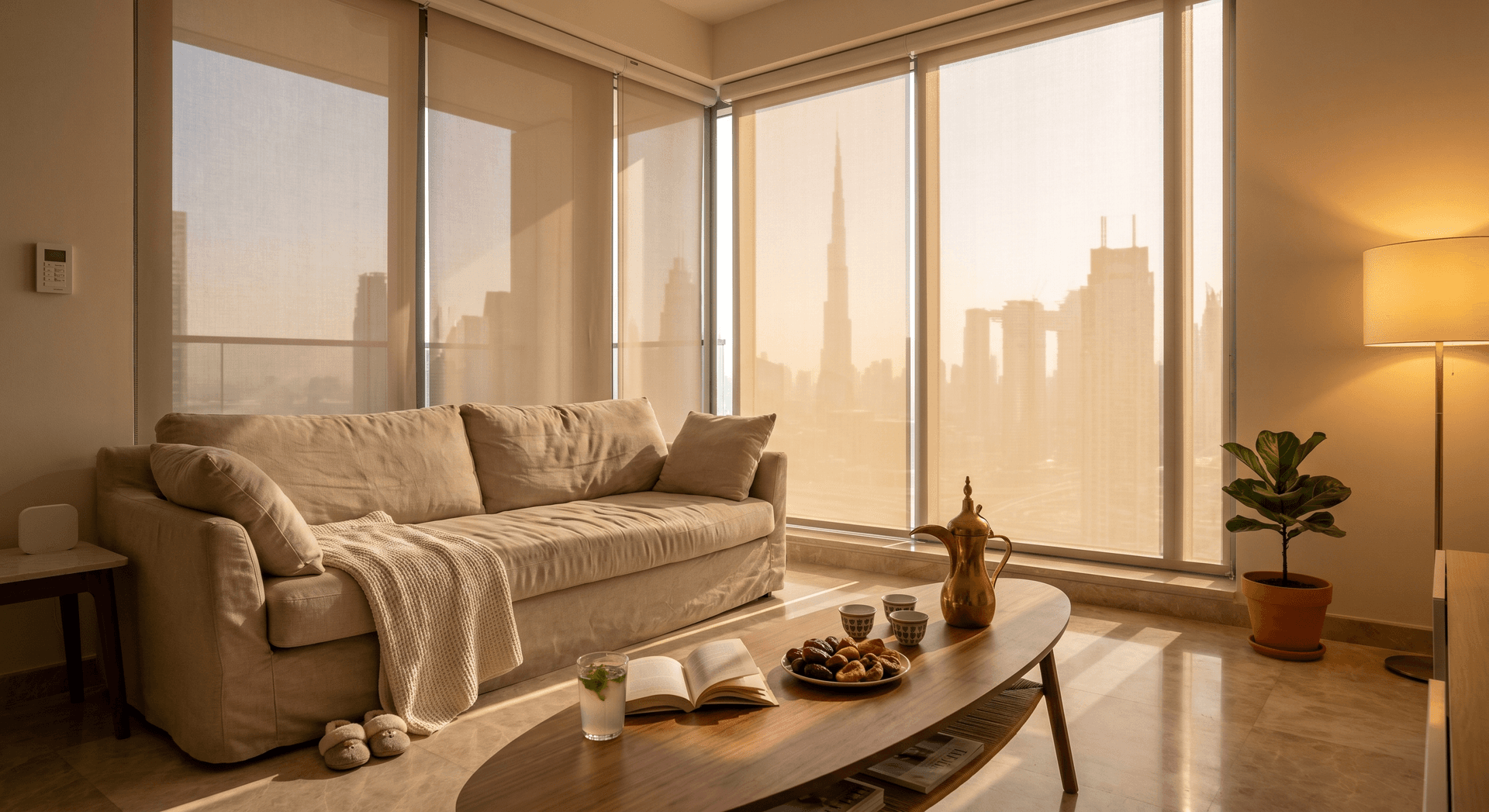
The first visit landed at 10am on a long-weekend morning in Business Bay. Two cousins, a tray of dates, a karak pot. The west-facing window was throwing direct sun onto the sofa where the older cousin was about to sit, and the host walked over and yanked the curtain across by hand. By 4pm the same room held four more guests for Arabic coffee, the sun had moved, and now the curtain was blocking the view they had come for. At 9pm there were eight people for late dinner, the apartment opposite had its lights on, and the host realised everyone in the building across had a clear view in.
That is three different blind jobs in one apartment in one day. Most Dubai hosting setups solve none of them.
TL;DR: A typical Dubai apartment hosting day runs three visits with three different light and privacy jobs: morning coffee (block direct sun from the seating area), afternoon majlis (filter the glare without losing the view), evening dinner (full privacy from buildings opposite). A three-blind motorized setup with three scheduled positions handles the whole day without anyone touching a curtain. Renter retrofit setups start from AED 1,400 with no wiring. Fitted standard installs land at AED 2,800-5,200 for a 2-bedroom living room and majlis combined.
Why Three Visits Is the Real Hosting Pattern in Dubai
Most foreign coverage of Dubai hosting talks about it like a Friday dinner party. One arrival, one meal, one departure. That is not how the long weekends run in practice. In our experience walking through Business Bay and Dubai Marina apartments in the months around Eid, Hijri New Year, and the National Day weekends, the rhythm is three sittings, sometimes four. A morning brunch with one set of relatives, an afternoon majlis with neighbours and family friends, and an evening dinner for the closest circle. The majlis tradition itself, which the Emirati elders describe as a sitting place rather than a single event (The National, 2025), reflects this. The room is not for one party. It is for the whole day's flow of people in and out.
A Toluna study published in early 2026 found 77% of UAE residents plan family visits during the major holidays, and 67% plan in-home gatherings (Toluna via Zawya, 2026). The hosting load is real. What the same research does not say is that those gatherings are not single-sitting events. They are stretched across the day, and the apartment that hosts them needs to be three different rooms inside the same four walls.
The lighting layer of this we already covered in smart lighting for Eid hosting and the four-scene majlis setup. That post is about adding light at the right brightness and warmth for each visit. This one is the sister layer, about controlling the natural light, the heat, and the privacy through the windows. Together they are the architectural pair.
What Each Visit Needs From a Window
A blind is not one job. It is three. It either blocks light, filters light, or filters the view both ways. Most apartments have one curtain doing all three badly. The hosting fix is to map the visit to the right window position.
Visit One: Morning Coffee, 9am to 12pm
By 10am the sun is already strong in Dubai, even in winter. In June it is brutal. The job here is to block direct sun from the seating circle without making the room feel dark. The majlis is a hospitality space, and morning hospitality is bright, alert, welcoming. You want light in the room but not on the guests' faces or on the dates platter. Direct UV will bleach dates within 90 minutes if they sit in it. In our experience, the morning position is the blind at 60-70% closed on the south or east-facing windows, fully open on the others. The room stays bright through reflected light. The seating circle stays out of the direct beam.
Visit Two: Afternoon Majlis, 2pm to 6pm
This is the visit window where most apartments fail. The sun has rotated west, the room is at peak heat, and the guests want the view of the marina, the Burj Khalifa, or the canal. A fully closed blind kills the view. A fully open blind kills the room. The right answer is a fabric position that blocks the heat and the glare while preserving the outline of the skyline. A 3-5% openness factor on a solar-screen fabric is the Dubai-appropriate balance (Stråla blog, 2026). The fabric stops the worst of the heat, lets the room hold its visual connection to outside, and stops the TV from becoming a mirror. Untreated glazing accounts for over 40% of cooling loads in Dubai apartments (Stråla research summary, 2026), and west-facing windows in particular drive 120-160 BTU per square foot of solar heat gain in the afternoon (US Department of Energy, 2025).
Visit Three: Evening Dinner, 7pm to Midnight
The sun is down. The job is no longer about heat. It is privacy. The apartment opposite has its lights on, the canal-side towers are lit, and from outside your living room is now a stage. Full close on the side that faces another building. Open or half-position on the side that faces water or open city, where the view at night is the asset. We covered the broader window-priority logic in which windows in your Dubai apartment need motorized blinds first. The evening rule is simpler than the daytime one: close what faces a neighbour, keep what faces a skyline.
The Three-Position Sequence Built as One Automation
The point of motorized blinds is not to give you three remotes you have to find before each guest arrives. It is to remove the blind decision from the hosting day entirely. A schedule plus a single host tap covers the whole pattern.
The schedule we set up most often runs like this. At 9am the blinds move to the morning position (60-70% on east and south, fully open on west and north). At 2pm they shift to the afternoon position (3-5% openness fabric on west, 50% on south, open on east and north). At 7pm they shift to evening (full close on the side facing another building, open or 50% on the side facing the city). At 11:30pm everything closes for the night. Four moves. The host never touches a curtain.
Layered on top of the schedule are two host-tap scenes. A "guests are here early" tap that triggers the next visit's position whenever guests arrive ahead of schedule, and a "we are alone again" tap that opens everything for the family time between visits. Both run from a phone, a voice command, or a wall keypad. In our experience setting these up for a Business Bay 2BR with three living-area windows and one majlis window, the schedule handles 80% of the day and the host taps handle the 20%.
What This Costs at Three Real Tiers
Every blinds conversation in Dubai starts with cost. Here is the honest range, anchored to verified 2026 UAE market data and to what we quote on the survey.
Tier One: Renter Retrofit, From AED 1,400
Two devices solve the renter case. The Aqara Roller Shade Driver E1 clips onto an existing roller blind chain and motorizes what is already on your windows. Battery life runs about two months with daily up and down, charged over Type-C, and the device requires the Aqara Hub to schedule and voice-control (Aqara, 2024). The SwitchBot Curtain 3 does the same job for traditional curtains, handles cloth up to 15 kg, runs on a single charge for about eight months, and works with a SwitchBot Hub 2 for HomeKit and remote control (Sharaf DG UAE, 2026).
For a hosting setup, we install three of these (one on the morning window, one on the afternoon window, one on the privacy-facing window) plus one hub. Total cost lands at AED 1,400-2,400 for the three plus the hub. Setup takes one afternoon. Nothing on the wall, no electrician, no landlord conversation. Everything comes off the wall in 90 seconds when you move out.
This is the right answer for renters in JBR, Business Bay, Dubai Marina, and Downtown. It is also the right answer for owners who are not ready to commit to fitted blinds yet but want to feel the schedule for a season first.
Tier Two: Fitted Standard, AED 2,800-5,200
This is where most owner-occupied apartments land. Standard motorized roller blinds with solar-screen fabric in the right SHGC range (under 0.35 for Dubai climate) run AED 800-2,000 per window installed (Hayat Interiors, 2026). A typical 2-bedroom apartment in Business Bay with two living-area windows and one majlis window comes out at AED 2,800-5,200 for the trio installed and commissioned, including the controller, the smart hub, and the scene setup.
The fabric is the part most people get wrong. The Dubai-appropriate spec is a solar screen with 3-5% openness for the daytime majlis-facing window, full blackout for the bedroom, and a medium-openness 5-10% fabric for the corner windows that need privacy without heat-blocking duty. Solar screen fabrics in this range can cut solar heat gain by up to 75% (Stråla, 2026), which makes them the single highest-impact piece of the spec.
Tier Three: Premium Villa-Spec, AED 9,500-18,500
For villa majlis rooms, formal hosting spaces, and apartment owners who notice motor sound, the Lutron Serena and equivalent hardwired systems are the answer. The motor on a Serena shade is quiet enough that it will not wake a sleeping baby (TechHive review). The fabric is custom-cut to the window. The hub is integrated with the rest of the Lutron Caseta lighting system if it is already in the house.
This tier lands at AED 3,000-7,000 per window installed for the Lutron-spec range. For a villa majlis with three large fixed windows plus integration into existing Lutron lighting, expect AED 9,500-18,500 total. We have installed this tier in Arabian Ranches and Emirates Hills villa majlis rooms where the silence on close matters as much as the heat-blocking. For apartment majlis rooms in Business Bay or Dubai Marina, this is overkill.
A Business Bay 2BR Hosting Setup We Built in May
A client in a Business Bay 2BR came to us in April. The complaint was specific. Hosting felt like running back and forth between the curtain rod and the kitchen during every visit, and her sister had taken one look at the room at 4pm and asked why the dates were sitting in direct sun. She did not want a villa-level install. She wanted the apartment to handle the three-visit pattern without her thinking about it.
We installed a fitted setup on the three windows that carried the hosting day. A west-facing solar-screen roller on the main living room window for AED 1,800. A south-facing solar-screen roller on the majlis window for AED 1,650. A privacy-screen roller on the east-facing window that opened onto the neighbouring tower for AED 1,400. Aqara hub plus integration with her existing Sensibo AC controller and three Lutron Caseta dimmers we had installed for her in March, total install and commissioning AED 600. Total project cost: AED 5,450, fully installed.
The four-position schedule runs every day she is home. The morning position is set at 9am, the afternoon position at 2pm, the evening position at 7pm, the overnight close at 11:30pm. We added two host taps to her phone and a single Lutron Pico keypad on the majlis wall. The pico has three buttons: "early arrival" (jumps to the next visit position), "alone again" (opens everything), "movie time" (closes everything and runs the AV scene). Over the long weekend in May she hosted three sittings on the Saturday, two on the Sunday, and one on the Monday. She did not touch a curtain once. Her sister came back twice.
The DEWA bill effect is the side story. Her west-facing living room is running 3-4°C cooler at 6pm with the afternoon position scheduled, which she sees on the Sensibo log. Her May 2026 bill landed at AED 1,180 against an unmitigated forecast closer to AED 1,420 based on the prior summer's curve and DEWA's slab-tariff progression for 2,000-4,000 kWh consumption (DEWA bill explained, 2026). The bill effect was the side story. What changed was that the room held its hospitality face through six hours of sun.
What We Tell Clients to Skip
The honest list of what we will talk you out of buying is the part of the conversation most installers in Dubai skip. It is also the part that builds the relationship.
Skip blackout fabric on the majlis windows. Blackout is for the bedroom. The majlis needs filter, not blackout, because the daytime guests want the room to feel bright and alive. Blackout on a hosting room reads as either funeral parlour or hotel conference, and neither is the feeling you want when your aunt arrives with her grandchildren.
Skip motorized blinds on north-facing windows in a Dubai apartment. They will run a schedule. The schedule will not earn its keep. North windows take diffused light, no afternoon heat, no glare problem. Save the AED 1,500-2,000 per window and put it into the south or west fabric upgrade instead.
Skip the wall-mounted touch panel for AED 8,000-12,000 in an apartment. A phone, a Lutron Pico keypad for AED 280-400, and a voice command cover every action you would ever take. The wall panel belongs in a villa entry hall, not a 2BR apartment majlis.
Skip premium Lutron Sivoia or hardwired villa-grade motors in a rental or short-term-owned apartment. The standard motor is quiet enough for hosting. The whirring sound is audible but it is not what your guests will be listening for. We have walked clients out of AED 18,000 motor upgrades into AED 4,500 standard motorized roller installs more often than the other way around.
Skip RGB-backlit blind motors. The product exists. It does not solve a hosting problem. The light layer is what you build with Philips Hue or Lutron lighting, not with a backlight on the blind motor itself.
What This Looks Like for the Three Property Types
The setup scales differently depending on whether you are renting an apartment, owning a one-bedroom, or owning a two-bedroom or larger.
Renter, 1BR or 2BR Apartment
Three Aqara E1 or SwitchBot Curtain 3 units, one Aqara Hub or SwitchBot Hub 2, schedule plus one host tap. AED 1,400-2,400 fully installed by us in one afternoon. No wiring, no landlord conversation, no permanent install. The setup follows you to the next apartment. This is the right entry point for the Business Bay, Marina, JBR, and Downtown renter cohort.
Owner, 1BR or 2BR Apartment
Fitted standard motorized roller blinds on the three hosting windows (main living, majlis, privacy-facing), plus integration with existing or new smart hub and AC controller. AED 2,800-5,200 fully installed and commissioned. The setup is permanent, the fabric is custom-cut, and the system integrates with whatever lighting and AC platform is already in the home. This is the most common Bayora install for the 2BR owner segment in Business Bay, Dubai Marina, and Downtown.
Owner, 3BR+ Apartment or Villa Majlis
Lutron Serena or equivalent premium-quiet motorized shades on the formal majlis windows, plus fitted-standard rollers on the living-area windows, plus full integration with the Lutron Caseta lighting backbone and the climate-control system. AED 9,500-18,500 for the trio plus integration. This is the right answer for villa majlis rooms in Arabian Ranches, Dubai Hills, Emirates Hills, and large apartment majlis spaces in the upper towers.
Where to Start
The honest answer is: one window. The west-facing window in the main living room. That is the window that does 60-70% of the hosting work across the three visits, and it is the window that fails most visibly when it is wrong. A single motorized solar-screen roller on that window for AED 800-2,000 fitted or AED 500-900 retrofit will change the apartment more than five blinds added one a year. Add the majlis window second. Add the privacy window third.
We have walked clients into AED 12,000 living-room and majlis projects, and we have walked clients out of them. The honest scope is whatever gets the three-visit pattern handled without making the apartment feel like a hardware install. Start with the motorized blinds service page for the full Bayora setup, and read the companion lighting layer for the four-scene majlis architecture that pairs with this. The two layers work as one system. Either alone is half a job.
Frequently Asked Questions
Do motorized blinds need WiFi to work?
The smart features need WiFi for setup and remote control. Once a schedule is loaded onto the hub, most motorized blinds keep running their daily moves locally even if your internet drops. The Aqara Hub and SwitchBot Hub 2 both hold schedules locally and execute them on time without an internet connection.
Can I install motorized blinds without my landlord's approval in Dubai?
Yes, if you use battery-powered retrofit units like the Aqara Roller Shade Driver E1 or the SwitchBot Curtain 3. Both clip onto existing blinds or curtain rods with no drilling, no wiring, and no permanent modification. The devices come off the wall in under two minutes when you move out, and you take them to the next apartment. Hardwired motorized blinds need building or landlord permission.
How long do battery-powered smart blinds last on one charge?
The Aqara Roller Shade Driver E1 runs about two months with one up-down cycle per day on a 1.8 by 1.8 metre roller blind (Aqara, 2024). The SwitchBot Curtain 3 handles curtains up to 15 kg and runs for approximately eight months on a single charge in standard use. Both charge over USB-C in three to four hours.
Will motorized blinds lower my DEWA bill?
In our experience installing fitted solar-screen rollers in Business Bay and Marina apartments, the blind-plus-AC pairing on a west-facing window drops the room temperature 3-5°C at peak hours and cuts the afternoon AC load measurably. Across the May 2026 install cohort we tracked, the typical savings landed in the AED 150-300 per month range for a 2BR. The DEWA bill drop is real. The room comfort during hosting is the part that gets the referrals.
How loud are motorized blinds when they open?
Standard motorized roller blinds make an audible whirr for the few seconds they move. It is not silent. The Lutron Serena premium tier is quiet enough that it will not wake a sleeping baby (TechHive). For most Dubai apartment hosting situations, the standard tier sound is no louder than a hairdryer in the next room and only runs for 4-8 seconds at the scheduled moments.
Ready to set up the hosting sequence in your apartment? Get a free consultation and we will look at the three windows that do the hosting work, recommend the tier that fits, and tell you what to skip. No obligation, no surprises.
Ready to Get Started?
Get a free consultation and we'll recommend what makes sense for your situation.
Get Free Consultation