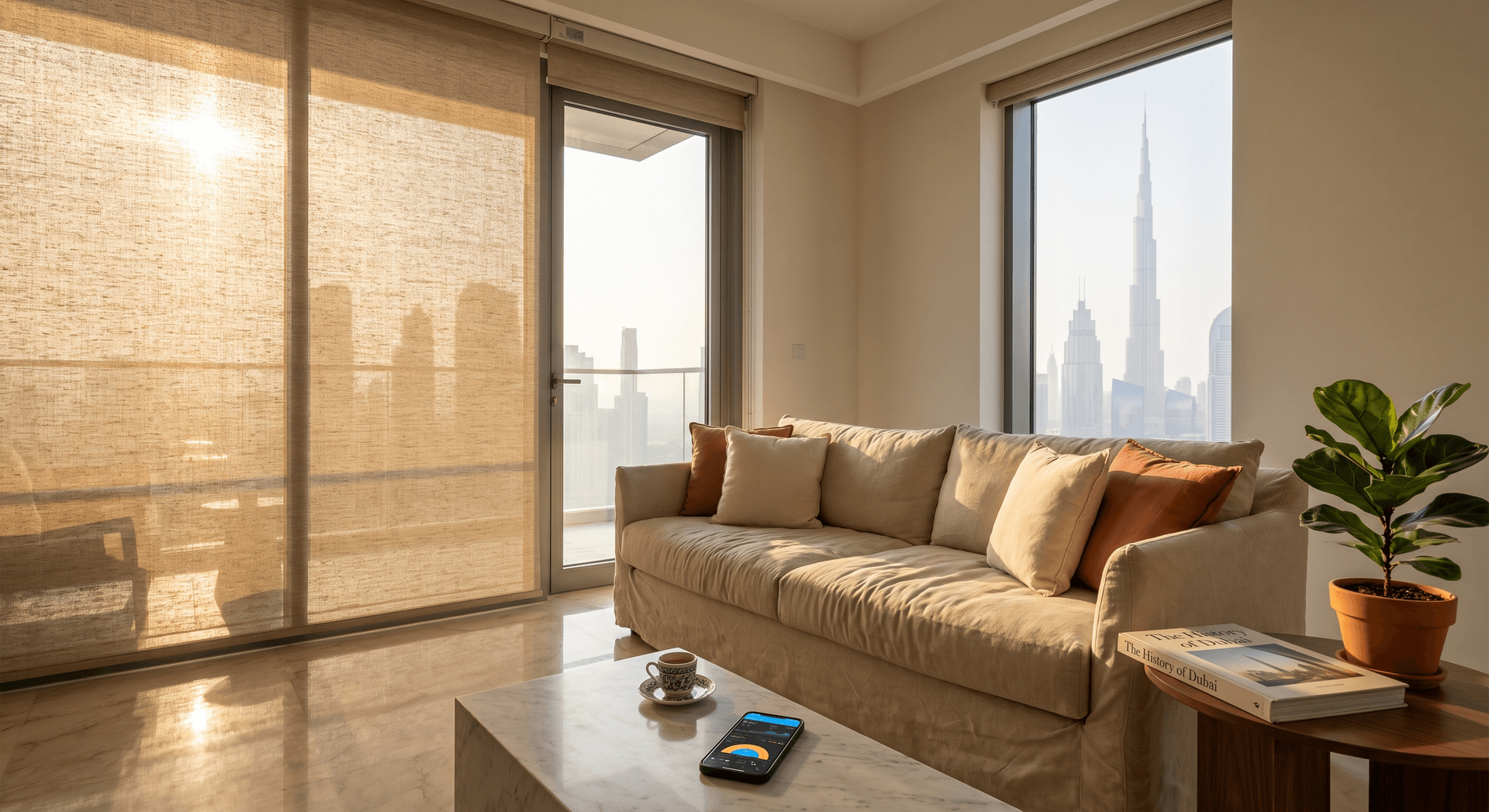
Your timer says close at 3pm. The sun is already through your window by 1:30pm. In September it will not arrive until nearly 4pm.
The same timer. Different results every month. That is the core problem with timer-based blind automation in Dubai, and it is why west-facing apartments with smart blinds on a fixed schedule still run warm in July and waste a fully-closed afternoon in September.
TL;DR: Timer blinds use a fixed clock time that drifts from the actual solar position across the summer by up to 90 minutes. Sun-position automation reads your specific window's solar azimuth exposure in real time and closes the blind exactly when direct light crosses the glass. For west-facing Dubai apartments this recovers 60-90 minutes of unblocked afternoon sun exposure that timers miss, costs nothing extra if you already have Home Assistant or an Aqara hub, and self-adjusts from now through September without you touching anything.
The question of whether motorized blinds are worth it is settled elsewhere - see why motorized blinds are the most underrated smart home upgrade in Dubai. This post is about the logic inside the automation, and why the most common setup people use gets it wrong by a meaningful margin.
The Solar Drift Problem No One Mentions
Dubai sits at roughly 25.2 degrees north latitude. The sun rises northeast in June and sets northwest. By September it rises more due east and sets due west. That shift changes when direct sunlight crosses a west-facing wall by a significant margin over the summer.
On July 1, a west-facing wall in Dubai starts receiving direct midday solar exposure around 2pm. By September 21, that same wall does not catch direct light until closer to 3:30pm - sometimes later depending on the building orientation and surrounding towers.
A blind on a fixed 3pm schedule is 60 minutes early in July, closing against heat gain that has not arrived yet. In September the same blind closes 30 minutes before the sun even hits the glass, then the sun crosses the wall while the blind is open, and the automation does nothing useful for nearly an hour.
The gap sounds small until you feel it in the room. A west-facing Dubai living room gains 120-160 BTU per hour per square foot of glass under direct sun (US Department of Energy, 2025). A 90-minute window of uncovered exposure at 45C outdoor temperatures is several hours of AC compressor work your system now has to do to pull the heat back out of the room.
Timer blinds are not wrong. They are a proxy for the sun, and proxies drift.
What Sun-Position Automation Actually Does
Sun-position automation replaces the clock with astronomy.
Your home automation platform - Home Assistant is the most common, and what Bayora builds on - knows your GPS coordinates. It tracks the sun's azimuth (compass direction) and elevation (height above horizon) in real time using the built-in sun.sun entity (Home Assistant Community, 2024). The automation closes your blind when the solar azimuth reaches the angle that corresponds to your specific window orientation, not when the clock hits a number.
For a window facing due west (270 degrees), the automation fires when sun.sun reports azimuth 270 - or whatever your specific wall angle is after accounting for the building's rotation relative to true north. The blind closes at exactly that moment on July 1. It closes at a different clock time on September 1. Same automation, same logic, self-correcting.
The practical result is that the blind is closed for roughly the same number of hours of actual sun exposure each day, regardless of where you are in the summer. The timer version gives you too much coverage in July (the sun has not arrived yet) and too little in September (the sun is past the wall before the timer fires).
Why This Matters More in Dubai Than in Most Places
In moderate climates, the drift between a timer and actual solar position costs you half a degree of room temperature on a bad day. In Dubai it costs you significantly more.
Outdoor temperatures between 2pm and 5pm in July and August regularly reach 41-45C. At those temperatures, the rate of heat gain through an uncovered west-facing glass wall is near its peak. The additional load from 60-90 minutes of uncovered exposure can raise a Dubai living room 3-5 degrees above where a properly-timed closure would leave it, which in turn means your AC runs deeper cycles to catch up (Sensibo, 2024).
The compressor cycles do not feel like failure - the room eventually cools down. What you measure is the DEWA bill, which reflects the extra kWh pulled to remove heat that a better-timed blind could have blocked at the source. In our experience installing smart blinds in Dubai Marina, Business Bay, and Downtown Dubai apartments, west-facing floors with sun-position automation consistently run 3-4 degrees cooler at 6pm than identical floors using the same hardware on a timer schedule.
How to Set It Up
There are three levels of implementation depending on what platform you already have.
Level 1: App-Based Astro Scheduling (No Hub Required)
Every major battery-powered motor brand - Aqara, SwitchBot, Zemismart - includes sunrise/sunset scheduling in their companion app. You set a trigger tied to "X minutes before/after sunset" rather than a fixed time. The app calculates the actual sunset time for your GPS location and adjusts the schedule automatically.
This is better than a fixed timer. The blind tracks seasonal sunset movement and self-corrects. The limitation is that sunset-based scheduling uses sunset as the proxy rather than the actual azimuth crossing your wall. West-facing walls catch direct light for 2-3 hours before sunset, so "close 2 hours before sunset" is a workable approximation.
For most renters with a single west-facing window and a battery motor, this level is enough. It costs nothing extra if you already have the motor and app.
Level 2: Hub-Based Automation with Astro Triggers
Aqara's M2 or M3 hub, or any Zigbee hub with astronomical trigger support, lets you fire an automation at a defined offset from solar noon or sunset. The logic is: "when the sun azimuth crosses 240 degrees, close the west-facing blind by 80%."
This requires knowing your window's azimuth (a compass reading on the window from inside, or from the building plans if you have them) and calibrating the trigger angle. For a window truly facing west at 270 degrees, the automation fires 2-3 hours before sunset at peak summer and 2.5-3.5 hours before sunset by September, automatically.
Cost overhead: if you have an Aqara hub already (AED 150-250 for the M2), this is zero added cost. If you are buying a hub for this alone, it is worth doing at the same time as the motor install, not after.
Level 3: Home Assistant with the sun.sun Entity
This is the full implementation. Home Assistant's built-in sun integration calculates azimuth and elevation for your precise GPS coordinates every minute. An automation using a template trigger fires when state_attr('sun.sun', 'azimuth') > 240 (or whatever angle you have calibrated for your window).
The advantage over Level 2 is precision and flexibility. You can set separate azimuth triggers for east-facing bedroom blinds (opens when sun clears the east), south-facing living room blinds (partial close from 11am to 2pm), and west-facing windows (close at azimuth cross). All from one platform, all self-correcting daily.
The Home Assistant sun.sun entity requires a running Home Assistant instance and the motor's Zigbee or Z-Wave integration. For apartments already running Home Assistant for AC, lighting, and security automation, the blind trigger is one additional automation, not a new system.
Battery Motors in Dubai Summer: What to Expect
Battery-powered motors are the default for rented apartments because they need no hardwiring and no landlord permission. In Dubai summers they run into a practical challenge that does not apply in cooler climates.
The Aqara Roller Shade Driver E1 is rated for 2 months of battery life at one open/close cycle per day at standard conditions (Aqara, 2024). The operating temperature ceiling is 55C. In a west-facing Dubai apartment at 2pm in August, the glass surface and the space directly behind it can reach well above ambient outdoor temperature. The motor body sitting on the roller track, exposed to that heat for 4-6 hours a day, draws battery faster than the rated estimate.
In our experience with apartments in JBR and Dubai Marina that have fully-exposed west-facing facades, battery motors on heavily-used west-facing windows may need charging every 5-6 weeks rather than every 2 months during peak summer. This is manageable but worth planning for. Options:
First, a solar charging panel attachment (available for Zemismart motors and some Aqara configurations) converts window-adjacent sun exposure into a net positive, using the heat source to recharge the motor that blocks it. This is the most practical solution for a window where USB-C access is inconvenient. Second, a hardwired motor. If you are renovating or the window is in a permanent setup, a hardwired motor removes the battery question entirely. Third, accepting the recharge cycle as a trade-off for the renter-friendly, no-drilling install.
We typically recommend hardwired motors for west-facing living room windows in owned apartments where the installation will outlast a lease cycle, and battery motors for rentals where portability matters more than the charging frequency.
The Azimuth Calibration Step
The most common setup mistake with sun-position automation is using the cardinal direction (west = 270) and finding the automation fires too early because your "west-facing" window is south-southwest, or too late because the building is rotated slightly east of true north.
Calibrating correctly takes one afternoon. Stand at the window around 2pm on a clear day and watch when the direct sun first strikes the glass - not the wall across the room, but the glass itself. Note the time. Run the same observation at 3pm and 4pm to see when it peaks and when it stops. Cross-reference those times against what sun.sun reports for azimuth at that hour in the Home Assistant developer tools.
The result is your window's actual solar incidence angle, not the assumed cardinal direction. For most Dubai apartments we have surveyed, actual west-facing windows are between 255 and 285 degrees after accounting for building rotation. That 30-degree spread translates to about 45 minutes of timing difference if you use 270 as the default.
One calibration, then the automation runs correctly for every day through September without adjustment.
What This Costs to Add to an Existing Motor Install
If you have motorized blinds already and they are running on a timer:
- App-based astro trigger: AED 0. Open the app, switch from fixed time to sunset offset.
- Aqara hub upgrade (if not already on one): AED 150-250 for an M2. One-time.
- Home Assistant setup (if not already running): The hardware is a Raspberry Pi 4 or an Orange Pi (AED 200-350) plus a Zigbee coordinator (AED 80-120). Setup time is an afternoon the first time. Long-term cost is near zero.
If you are buying motors for the first time, the cost of the motor itself is the same whether you use a timer or sun-position trigger. The trigger logic is software. Buying hardware that supports astro scheduling now costs nothing extra over hardware that only supports fixed timers - both Aqara and Zemismart motors support both modes.
What to Skip
A few common upsells around smart blinds automation that do not add meaningfully to the sun-position case:
Light sensor add-ons: External lux meters that trigger blinds when light exceeds a threshold sound logical but in practice they close the blind on bright overcast days and open it during a cloudy afternoon. The sun's position is a more reliable signal than ambient brightness in Dubai, where cloud cover is uncommon enough that the exception logic adds complexity without improving the primary outcome.
Full tilt-angle control: Motorized blinds that adjust tilt angle (slats rather than solid rollers) in response to sun elevation can theoretically optimize the angle throughout the day. In a Dubai apartment context, solid roller blinds with a closed-or-open model are simpler, more reliable, and serve 95% of the benefit. Tilt-angle optimization is a villa-scale or commercial-glazing solution.
Multi-zone controllers that only work within their own app: If your motor requires a proprietary hub and has no open-platform support, you lose the ability to tie the blind to your AC schedule, your motion sensors, or your arrival automation. An Aqara motor that talks to Home Assistant is worth more than a cheaper alternative that only talks to its own app.
For motorized blinds service in Dubai, our standard recommendation is Aqara motors with Home Assistant integration for apartments that already have any smart home setup, and standalone app-based astro scheduling for single-window installs where a hub would not be used for anything else.
Frequently Asked Questions
Do I need Home Assistant for sun-position automation to work?
No. App-based sunset scheduling in the Aqara or SwitchBot app is a built-in feature and works without any hub. It adjusts automatically each day based on your GPS location. Home Assistant gives you more precision (actual azimuth trigger vs sunset offset) but the app-based version is a meaningful improvement over a fixed timer with no added cost or setup.
How much earlier does the sun hit a west-facing window in July vs September?
In Dubai, direct sun crosses a west-facing wall approximately 90 minutes earlier in early July than in late September. A fixed 3pm timer that works reasonably well in late summer will be 60-90 minutes early in peak summer, closing the blind before the sun arrives. Sun-position automation adjusts for this automatically.
Will the battery drain faster because the motor is running more cycles?
Not meaningfully. Sun-position automation fires the same number of open and close cycles as a timer - once or twice per day. The battery impact of the cycles themselves is minimal. The heat-related drain we described above is a constant whether you use a timer or sun tracking; it is ambient temperature, not cycle count.
Can I set up sun-position automation without knowing my exact GPS coordinates?
Yes. Both the Aqara app and Home Assistant use your phone's GPS to set your location. You confirm the location on setup and the system handles the astronomy from there. You do not need to calculate anything manually.
Does sun-position automation work for east-facing windows too?
Yes, and it is often more useful there. East-facing bedrooms in Dubai get direct morning sun from around 6am - earlier in summer than in autumn. A sunrise-offset or east-azimuth trigger opens the bedroom blind after you are likely to be awake and closes it before the morning heat builds, without you adjusting a timer twice a year.
Ready to move your blinds from timer to sun-position? Get a free consultation and we will look at your apartment layout, measure the actual window orientations, and design the automation logic before any hardware is ordered.
Ready to Get Started?
Get a free consultation and we'll recommend what makes sense for your situation.
Get Free Consultation