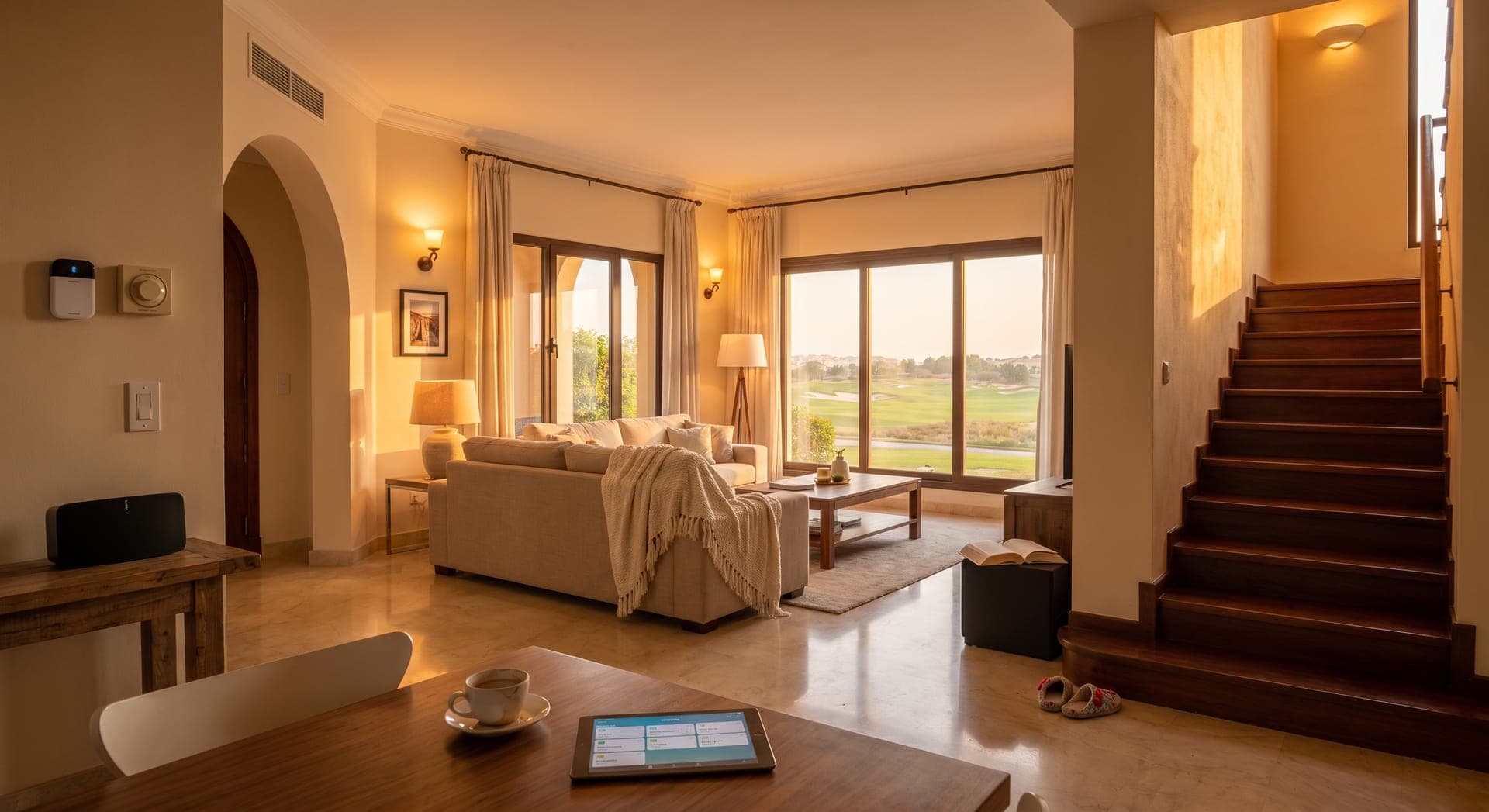
The villa is 14 years old. You bought it for the view of the Ernie Els course, and on a winter morning that view is the best thing about the property. On a 41C afternoon in May it is a different story. The same west-facing glass that frames the seventeenth green is letting in about a kilowatt of heat per square metre, and by 4pm the living room is 28 even with the AC running flat out. The bedrooms upstairs are worse. The thermostat sits somewhere none of you actually live, and your May DEWA bill landed at AED 3,400.
This is the Victory Heights summer story. Whether you are in Calida, Carmen, Estella, Esmeralda, Morella, Novelia, Oliva, Sevilla, or Mirabella, the cooling math is roughly the same. The villas are big. The orientation toward the golf course is a feature you paid for. The original AC system was sized in 2007 for a thermostat strategy that nobody has used since the original owners moved in. And heat, in Dubai, does what heat does.
The fix is not a new AC system. Victory Heights villas almost never need a chiller upgrade or a duct replacement. They need a control layer that sits on top of the AC already on the wall, and a control layer that takes the west-facing rooms seriously instead of treating them like the rest of the house.
TL;DR: Victory Heights villas were built 2007-2010 with single-thermostat split AC systems on two-story Spanish, Mediterranean, and European Classical floorplans, most with golf-course-facing rear gardens that point west or southwest. The combination produces a predictable summer problem: downstairs at 22, west-facing master at 28, AC compressor running 14 hours a day, summer DEWA bill 60-100 percent above winter. A smart AC zone-control setup (one controller per indoor unit plus per-room sensors and west-facing schedules) costs AED 4,000-8,000 installed, cuts the worst summer DEWA spikes by 20-30 percent, and ends the 9pm argument about why the master bedroom is hotter than the kitchen.
Why Victory Heights Has a Specific AC Problem
Victory Heights was developed by Dubai Sports City through its subsidiary Victory Heights Real Estate Development, with handovers running from 2007 through May 2010 (The National, 2010). That puts the original housing stock at 16-19 years old in 2026. The community wraps around the Ernie Els-designed championship course on the western side of Dubai Sports City, which means the most desirable villas are the ones whose rear elevations face the course. In practical terms, those rear elevations point west or southwest.
The villas were built in three architectural styles: Spanish Andalusian, Mediterranean, and European Classical (Luxhabitat, 2025). All three styles share the same Dubai-villa convention of large rear-elevation windows and floor-to-ceiling doors that open onto the garden. The same windows that frame the view are the windows the afternoon sun comes through.
That period of villa construction used chiller-free split AC systems, meaning each villa runs its own outdoor compressor (or two) feeding indoor evaporator units in different rooms. There is no district cooling and no shared chiller plant. The full cooling cost shows up on your DEWA bill (RELO Dubai, 2026). On a Victory Heights villa with three or four indoor units, that cooling cost is concentrated almost entirely in May through September.
The thermostat is a single 24V dial, usually in the downstairs hallway or near the staircase. The indoor units upstairs were sized for what the original 2010 owners thought was a reasonable bedroom temperature. The villas were not designed around the idea that the master, the kids' rooms, and a downstairs majlis would each want a different temperature at a different time.
Heat rises. In a 43C Victory Heights afternoon, heat rises hard. The upper floor gains heat through the roof, through the upstairs windows, and through whichever walls hold the afternoon sun. The downstairs gains heat too, but the cool air the AC produces falls there first and stays there longer. The thermostat sees that downstairs air, decides everything is fine at 22, and stops calling for more cooling. Upstairs, the rooms keep climbing past 26 and toward 28 by sundown.
Professional HVAC guidance for multi-story homes is direct about this pattern: set the top floor to the temperature you want, and set the bottom floor two degrees higher, because cooler air from upstairs settles downward on its own (Quality HC, 2024). Most Victory Heights villas do the opposite, because the thermostat sits downstairs and the family sets it low to feel comfortable in the living room. The result is a system that overruns the ground floor and underruns the rooms anyone sleeps in.
The West-Facing Window Problem
Victory Heights has a problem that Springs and Arabian Ranches 1 do not have in the same intensity. The rear-elevation orientation toward the golf course means the largest run of glass in the villa points at the worst afternoon sun.
The numbers are sharp. A two-square-metre west-facing window with a Solar Heat Gain Coefficient of 0.7, in Dubai peak afternoon conditions, admits over 1,000 watts of heat into the room. That is the equivalent of running ten 100-watt incandescent bulbs continuously, just from the window (Stråla, 2025). Most Victory Heights villas have considerably more than two square metres of west-facing glass. A typical living-and-dining run with floor-to-ceiling doors onto the garden is closer to 12-16 square metres of glass. Scale the math and you are looking at 6,000-8,000 watts of heat coming in from the west in the last three hours before sunset, every single day from late April through early October.
Windows account for 20-40 percent of total residential cooling load in this climate (Stråla, 2025). For a Victory Heights villa with a deep west elevation, the upper end of that range is closer to the truth. The downstairs AC is fighting a single-room heat source that is loading up the room faster than the unit can cool it. The compressor responds the only way it knows: by running longer and pulling more electricity.
In our experience surveying Victory Heights villas, the west-facing rooms are usually 3-5 degrees warmer than the matching east-facing rooms in the same villa at 5pm. Same thermostat, same AC system, same setpoint. Different room temperatures. The thermostat does not see this because it sits in the wrong room.
What a Victory Heights Summer DEWA Bill Looks Like
A 4-bedroom Victory Heights villa with a typical resident family usually runs AED 2,000-3,500 per month on DEWA across summer, with the cooling load doing 60-70 percent of the work. A 5-6 bedroom villa commonly runs AED 3,500-5,500 across the peak July-August window (My DEWA Bill, 2026).
The 2026 DEWA residential slab structure makes the upper end of those bills more punishing than it looks. The first 2,000 kWh of consumption is charged at 23 fils per kWh, but anything between 4,001 and 6,000 kWh sits at 32 fils, and anything above 6,000 kWh sits at 38 fils. A summer Victory Heights villa easily crosses 4,500-7,000 kWh in a peak month (DEWA Bill Calculator, 2026). That means the marginal kWh on a July bill costs 65 percent more than the marginal kWh on a March bill, before fuel surcharge and VAT.
Winter bills for the same villas often sit at AED 1,200-1,800. The summer delta is AED 1,200-2,500 per month, almost entirely AC. Over the four hottest months (June through September) that is AED 4,800-10,000 of cooling cost concentrated into a third of the year.
A zone-control retrofit does not eliminate that. It does not turn Victory Heights into a chilled-water building or change the physics of a 43C afternoon. What it does is cut 15-30 percent off the worst months by stopping the AC from running rooms nobody is in, by running rooms it needs to cool slightly less hard, and by pre-cooling at off-peak times instead of catching up at peak ones (Sensibo, 2026). On a peak AED 3,000 July bill, that is AED 450-900 per month. Over the four hot months, AED 1,800-3,600 of savings on a setup that costs AED 4,000-8,000. The math closes inside the first summer.
What Zone Control Changes
A zone-control setup does three things the original Victory Heights thermostat cannot.
It puts a sensor in every room the family lives in. Master bedroom, kids' rooms, living room, kitchen, and the west-facing rooms specifically. The AC stops chasing the temperature of the downstairs hallway and starts chasing the temperature of where the family lives. WiFi-connected AC controllers with room sensors save 15-30 percent on cooling costs through scheduling, geofencing, and per-room temperature rules (Sensibo, 2026).
It controls each indoor unit independently. Most Victory Heights villas have three to five indoor evaporator units: one downstairs in the living and dining area, one in the upstairs hallway feeding the bedrooms, one or two in the larger master suites, and sometimes another for the maid's room or majlis. A smart IR controller goes in front of each one. The downstairs living unit can run at 24 in the afternoon while the upstairs unit pre-cools the master to 22 starting at 8pm. The compressor still does the work, but the units it feeds each have a brain.
It runs a schedule that matches the family's day and the sun's day. The afternoon schedule in a Victory Heights villa needs to treat west-facing rooms differently. Start the west living-room unit harder at 3pm, before the sun hits the deep windows. Hold the east-facing breakfast room at 25 because nobody is in it. Pre-cool the upstairs master from 8pm to 10pm so the room is sleepable by bedtime. Let everything drift to 26-27 after midnight when the family is asleep.
That is the entire fix. The hardware stays the same. The control layer is different.
What It Costs in a Victory Heights Villa
Victory Heights villas come in three common shapes from a smart AC perspective, and the pricing depends on how many indoor units the setup has to cover.
A 3-bedroom Victory Heights townhouse or smaller villa (around 2,500-3,000 sq ft, mostly in Calida and parts of Morella) usually has three indoor units. The zone-control setup is three smart AC controllers (Sensibo Sky or Tado at AED 600-900 each on Noon.com UAE), four to five room sensors (AED 80-150 each), and a small WiFi hub if the existing network is weak. Total: AED 3,500-5,500 installed.
A 4-bedroom Victory Heights villa (the most common configuration in Estella, Carmen, Esmeralda, Novelia, and Oliva, around 3,500-4,800 sq ft) usually has four indoor units. Four controllers, five to six sensors, hub, and a slightly more involved configuration day to handle the west-facing schedule. Total: AED 4,500-7,000 installed.
A 5-6 bedroom Victory Heights villa (the larger Estella and Carmen layouts, plus Sevilla and Mirabella, 5,000-6,600 sq ft) usually has four to five indoor units, sometimes six if the maid's room and outdoor majlis are separate. Five controllers, seven sensors, hub, and a more involved configuration. Total: AED 6,000-8,500 installed.
These numbers assume the existing split AC units are functional and the IR remotes still work. For a 4-6 bedroom villa, broader smart home automation packages run AED 15,000-45,000 (European Technical, 2026), but zone control alone is the entry point that pays back fastest because it targets the single largest line item on the bill.
What If the AC Is Older Than 2010
A handful of Victory Heights villas still have their original 2007-2010 AC systems, never replaced, just serviced. Two questions matter for smart retrofit on those units.
Does the indoor unit have a working IR remote? If yes, a Sensibo Sky, Tado, or Cielo Breez IR controller will work. They learn the remote's commands and replay them. The brand of the AC (Daikin, Carrier, LG, O General, York) does not matter as long as the remote is alive. We have set this up on AC units from 2008 in Carmen without issue.
Is the compressor cycling normally? If the outdoor unit is short-cycling (turning on and off every two to three minutes), tripping the breaker on hot days, or making loud bearing sounds, no smart controller will fix it. The AC needs a service or replacement first. A zone-control setup on a failing compressor will just route the failure into smarter scheduling.
The 2007-2010 split AC systems still in many Victory Heights villas have another quirk: the indoor units run on 220V mains with no C-wire, which means a wired smart thermostat is a non-starter without an electrician. IR controllers sidestep that completely. They mount near the indoor unit, plug into a regular socket, and never touch the AC's wiring.
The Five-Step Install Order
The fastest way to feel the difference is to install in the order the family experiences the heat, not the order the rooms appear in the floorplan.
Step 1: The master bedroom. This is the room with the worst summer complaint and the highest payoff on a smart controller. One IR unit in front of the master split, one sensor on the wall opposite the bed, and a pre-cool schedule from 8pm. Most families report a sleepable master within a week.
Step 2: The kids' rooms. Same setup. The kids' rooms in Victory Heights are usually on the east side of the upper floor, which means they heat up earlier in the morning and cool down faster at night. Schedule the unit to start at 7pm so the rooms are comfortable for the bedtime routine.
Step 3: The west-facing living and dining run. This is the deep-glass elevation. Controller goes in front of the downstairs unit. Schedule starts at 2:30pm to get ahead of the 4pm peak. Set the room to 24 instead of 22, because a 24-degree room with even temperatures across the day feels better than a 22-degree room with hot patches near the window.
Step 4: The geofence. Once the schedules are running, layer in a geofence rule that steps everything back to 28 when the last person leaves the villa and starts the recovery 20 minutes before the first person gets home. This is the single biggest savings lever for families where both parents work outside the home or the kids are at school. For tone-sensitive periods or families that prefer not to broadcast their absence, the schedule alone will do most of the work.
Step 5: Leak sensors. Not AC, but unavoidable. Victory Heights villas have laundry rooms, kitchens, and master ensuites that go unmonitored for weeks. A small water-leak sensor on the floor next to the washing machine and under each sink runs AED 50-100 per unit and ties into the same hub. We add this on every install because the cost of a single villa leak event in Dubai dwarfs the cost of the sensor by a thousand to one.
Pair It With Motorized Blinds for the West Elevation
Smart AC is one half of the west-facing fix. The other half is what shades the glass before the AC has to deal with the heat.
Motorized roller blinds on the deep west elevation, closed automatically at 2:30pm during summer, can cut the radiant heat load on that room by 60-70 percent. The room behind the blinds runs 4-5 degrees cooler at 6pm than the same room with bare glass. We have written about this in detail in our living-room glare and blinds setup.
A typical Victory Heights west-elevation blind run is two or three large rolls. Retrofit options (battery-powered, no wiring) run AED 1,500-3,000 per blind installed. Hardwired premium options run higher. Most clients add the blinds after they see the first summer of zone-control AC, because the savings from the AC pay for the blinds the following year.
The blinds and the AC talk to each other. When the sun-side blinds close, the AC schedule eases up on the west-facing room because the load just dropped. When the family opens the blinds in the morning for the view, the AC pre-cools harder before sunset. The two systems together do what neither one does alone.
A Real Victory Heights Install (4BR Estella)
A family in Estella came to us in May 2025 with the standard complaint. Master upstairs at 28 by 9pm. Living room comfortable at 23 during the day but the dining area near the west doors hit 27 every afternoon. May DEWA bill landed at AED 2,940. Compressor running, the husband told us, "more than the dishwasher."
We installed four Sensibo Sky controllers (one per indoor unit), six room sensors, and a small Aqara hub for the leak detection. Total install AED 5,420 (controllers AED 2,800, sensors AED 720, hub AED 350, install + config AED 1,550). Took one day onsite, plus two days of remote configuration tuning afterward.
The schedule we ran:
- Living-and-dining unit at 24 from 7am-10am, 25 from 10am-2pm, 23 from 2pm-7pm to handle the west sun, 24 from 7pm-10pm, 26 overnight.
- Master upstairs unit at 26 during the day, 22 from 8pm-10pm pre-cool, 23 from 10pm-1am, 24 overnight.
- Kids' rooms upstairs at 27 during the day, 23 from 6:30pm-9pm pre-bedtime, 24 overnight.
- Geofence: everything to 28 when the family is out for more than 90 minutes. Recovery 20 minutes before the first arrival.
July 2025 DEWA bill: AED 2,210. August 2025: AED 2,380. Compared to the previous July (AED 2,830) and August (AED 3,010), that is a saving of AED 1,250 over those two months alone. Compressor runtime dropped from 14 hours a day to about 10. The master bedroom now sits at 22 at bedtime regardless of what the downstairs is doing.
We added motorized roller blinds on the dining-room west elevation in October 2025 (three rolls, AED 5,800). May 2026 DEWA so far is tracking AED 1,840, which is below the previous May despite a hotter forecast. The setup is paid back inside its first full summer.
What Bayora Will Talk You Out Of
If you ask us for the full menu on a Victory Heights villa, we will tell you what to skip first.
You almost certainly do not need a new AC system. The original Daikin and Carrier units in Victory Heights villas are oversized for the rooms they serve, which is why they cycle so often instead of running steady. A smart controller in front of an oversized AC is a better outcome than a new AC sized for the actual room. Save the AED 30,000-60,000.
You do not need a chiller upgrade or central VRF retrofit. Victory Heights was not built around district cooling, and converting it to one now is engineering for the wrong problem. The split AC architecture, with smart control on top, is the right system for the right villa.
You do not need a wall-mounted AED 12,000 touchscreen in the entryway. The app on the phone and a small Lutron Pico-style remote near the front door handle the same use case for a fraction of the cost. Touchscreens are 2015 thinking. We will not specify one unless you specifically want one for aesthetic reasons.
You do not need lighting and audio installed in the same project. Zone-control AC, motorized blinds on the west elevation, and the geofence are the three highest-impact moves in a Victory Heights villa. Lighting and audio are great projects, but they earn their place in a phase-two conversation, not the first install.
Frequently Asked Questions
Does this work for renters in Victory Heights?
Yes. The IR controllers, sensors, and hub are all wireless and renter-friendly. Nothing touches the AC's wiring, nothing requires landlord approval, and the whole setup comes off the walls in 30 minutes when you move out. Most of the families we have set up in Victory Heights rentals take the system with them to the next villa. Renter-friendly setups in Arabian Ranches and Dubai Hills follow the same playbook.
Will smart AC void my AC warranty if the units are still under one?
No. IR controllers communicate with the AC the same way the original remote does. The AC sees them as a remote. No wiring is modified, no firmware is altered, no service plan is voided. We have done this on Daikin, Carrier, LG, and O General units in Victory Heights without a single warranty issue.
What happens if the internet drops?
The schedule keeps running locally. The controllers cache the last schedule and continue to operate the AC against the room sensors even with no internet. You lose remote app access until WiFi comes back, but the household climate keeps running as normal. This is one of the reasons we specify hardware that operates locally instead of cloud-only.
How long does the full install take?
For a 4-bedroom Victory Heights villa, one day onsite for the hardware install plus two to three days of remote configuration tuning. We sit with the schedule for a week after handover and adjust based on actual room behaviour. The family does not lift a finger after the install day.
Does this work with my existing Alexa or Google Home?
Yes. Sensibo, Tado, Cielo, and Aqara controllers all integrate with Alexa, Google Home, and Apple HomeKit. Voice control is optional. Most Victory Heights clients run the system from the phone app and the geofence, and rarely use voice once the schedules are dialled in.
What Changes After the Install
The most common piece of feedback we get from Victory Heights families a month after install is not about the bill. It is that the master bedroom is finally sleepable at bedtime. The kids stop kicking off their duvets at 11pm. The dining room near the west doors is comfortable when guests come over at 7pm. The villa, which was always beautiful, now also matches the way the family lives in it.
The savings show up two bills later, quietly, in the difference between this year's July and last year's. The family stops thinking about the AC. The thermostat goes back to being a thing in the hallway that nobody mentions.
That is the whole point. The villa is fourteen. The view is the same. Summer is forty-three. The thermostat does not have to be 2010.
Ready to fix the upstairs heat trap before the June peak? Book a free survey and we will measure your actual room temperatures, map the west-facing rooms, and quote the exact zone-control setup for your villa. No obligation. We will also tell you what not to install.
Ready to Get Started?
Get a free consultation and we'll recommend what makes sense for your situation.
Get Free Consultation