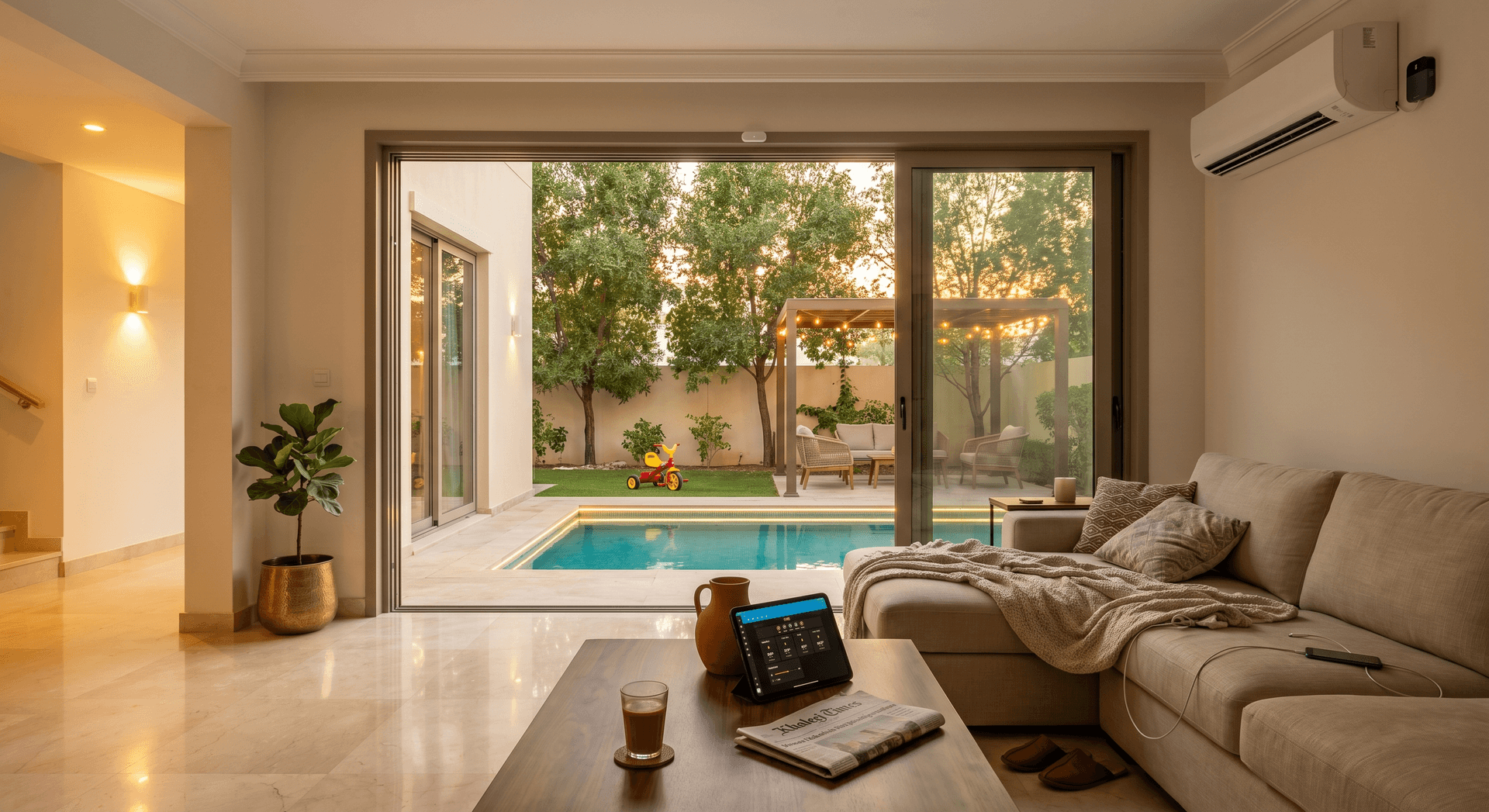
The Jumeirah Park summer story has a different shape than the rest of the older-villa stock in Dubai. The villa is twelve years old. The garden was the reason you signed the lease or bought the place. The downstairs family room opens onto that garden through a sliding glass door wider than most apartment living rooms, and on a Saturday afternoon in June that door is open. Not closed with the AC on. Open, with the AC on. The kids are running between the pool and the kitchen. The dog is following the kids. The gardener is finishing the south side of the lawn. And the Sensibo on the wall, if there was one, would tell you the family room has been at 27 for four hours while the compressor has been running at full output the entire time and never reached setpoint.
This is the Jumeirah Park summer story. The garden glass that sold the villa is the same surface the family does not close, because the whole point of a Jumeirah Park villa is that the garden and the inside live as one room.
The fix is not closing the door. The fix is the AC understanding that the door is open and not trying to cool the garden.
TL;DR: Jumeirah Park villas were built by Nakheel and completed in 2013, with wide sliding garden doors as the signature downstairs design feature and a single wall thermostat trying to manage three to five split-AC units across two floors. A smart AC layer that combines per-unit IR controllers, a door sensor on the garden door that pauses the downstairs AC when the door is open longer than two minutes, and a 3-zone schedule for the master, kids' rooms, and the downstairs family room costs AED 4,500-9,500 installed. It cuts peak summer DEWA spikes by 15-30 percent, ends the 4pm setpoint war when the kids leave the door open, and works on the existing AC. Renter-friendly, no wiring, one day install.
What Makes a Jumeirah Park Villa Different
Jumeirah Park was launched by Nakheel in 2006 and the bulk of the community handed over in 2013, with more than 3,000 villas spread across nine districts and roughly 380 hectares of low-rise residential (Bayut area guide, 2024). The villas come in three to five bedrooms across four architectural styles, Heritage, Regional, Legacy, and the newer Legacy Nova (Emirates.Estate Legacy Nova, 2025). A 3BR Regional villa runs roughly 3,500 to 4,000 square feet built-up. A 4BR is closer to 4,800 to 5,000. A 5BR concentrated in Districts 1 and 2 lands in the 5,400 to 5,500 range (Bayut area guide, 2024).
The headline architectural feature is the garden door. Bayut's area guide puts it directly: "Large doors create a seamless transition between the outside and indoor living area, ensuring that children can enjoy the garden while adults move freely inside and out" (Bayut area guide, 2024). That sentence is the whole brief on what a Jumeirah Park villa is for. The downstairs family room and the garden are one room with a sliding wall of glass between them. On a weekend with the family at home, that wall stays open.
The cooling architecture is standard DEWA-grid split AC, not district cooling. Jumeirah Park is on the regular DEWA tariff, with no separate Empower or Emicool charge for cooling (ExpatWoman community thread on Jumeirah Park district cooling, 2026). That matters here. Every minute the AC runs against an open door shows up on the homeowner's electricity bill directly, because there is no district-cooling abstraction to soften the math. The DEWA bill is the bill.
A typical 4BR Jumeirah Park villa has three to five outdoor compressors feeding four to six split indoor units, with one wall thermostat sitting in the downstairs hallway and the rest of the system run from individual remotes (Homesphere Group DEWA estimator, 2025). That thermostat is from 2013. It does what the family asks it to do, which is read 22 in an empty hallway. It does not know the garden door is open.
In our experience surveying Jumeirah Park villas across Districts 1, 4, and 7, the cooling problem is almost never the AC itself. The compressor is fine. The indoor units are fine. The control layer was built for a house that the family never closes the way it was designed to be closed.
The Open-Door Problem the AC Cannot See
There is a peer-reviewed building-services paper that puts numbers on this. Researchers measured air infiltration into a room running an air conditioner with the door closed and then with the door open. The infiltration rate at the open-door state was 21.3 times the closed-door rate, and at a 24 degree setpoint the room temperature with the door open stabilised about 5 degrees above setpoint while the AC ran continuously and never reached its target (IOP Conference Series, Materials Science and Engineering 609 032069, 2019). That is the entire mechanism in two sentences. The compressor stays at full output. The room stays five degrees warm. The energy goes outside.
That study was a lab. A Jumeirah Park villa on a 41 degree Saturday in June is the field version of the same experiment. The door is not cracked. It is wide open, often for two to four hours at a stretch on a weekend afternoon, while the family rotates between the pool, the kitchen, and the garden. The AC behind the family room is running at full compressor draw the entire time. It is not gentle background cooling. It is the loudest, hottest, hardest-working AC mode there is, and it is delivering nothing the family can feel because the cooled air is leaving the room as fast as the AC can produce it.
The waste shows up on the bill in two ways. The first is the obvious one. The AC runs at maximum output for four hours instead of cycling. The second is more subtle. Because the room never reaches setpoint, the AC never stops, so the compressor cycle that would normally let the system rest in the afternoon never happens. The unit runs through dinner, through bedtime, and into the small hours of the morning because it has been trying to catch up since lunch.
Air conditioning accounts for 60 to 70 percent of total electricity use in a Dubai villa during summer, and a four-bedroom Jumeirah Park villa running cooling near continuously from May through September typically lands at AED 3,000 to AED 5,000 a month for the worst peaks (Solid Cars Dubai utilities 2025, 2025). Larger villas with a pool can push past AED 6,000. The open-door overhead does not show up as a separate line. It shows up as a compressor that ran 18 hours a day instead of 14.
What a Door Sensor Plus a Smart AC Controller Does
A smart AC controller in front of the family-room indoor unit, paired with a contact sensor on the inside of the sliding garden door, changes one thing the existing system cannot do. It sees the door state.
When the sensor reports the door has been open for longer than two minutes, the controller pauses the AC. Not "raises the setpoint by four degrees." Pauses. The compressor stops trying to cool the garden. The fan stops circulating cool air out the door. The unit goes idle. When the sensor reports the door has been closed for longer than thirty seconds, the controller resumes the original schedule and starts the recovery cycle.
The pause-and-resume logic exists already, in two different product shapes, and the Jumeirah Park install we recommend uses whichever one fits the family's wider smart-home plan.
The first shape is Sensibo. A Sensibo Sky controller goes in front of the family-room indoor unit, and a Sensibo door and window sensor goes on the inside of the sliding door frame (Sensibo door and window sensor energy savings, 2025). The Sensibo app handles the pause logic natively, the door sensor talks to the controller over Bluetooth without a separate hub, and the Sensibo Air PRO with its bundled door sensor is available on Amazon UAE for installment plans around AED 750 (Amazon.ae Sensibo Air PRO listing, 2025). The same controllers go on the master and kids' rooms upstairs, on a different schedule, and the whole system runs from one app.
The second shape is Aqara. The Aqara P3 Air Conditioning Companion is a controller plus Zigbee hub plus IR blaster in one unit, and it has the native "opening the window turns off the air conditioning" automation built in when paired with an Aqara P2 door and window sensor (HomeKit News Aqara P3 review, 2020). The P2 sensor is AED 170 from Modo Store in the UAE and runs on Thread plus Bluetooth Low Energy 5.0 (Modo Store Aqara P2 listing, 2025), which means it works inside Apple Home, Google Home, Alexa, and SmartThings through any Thread border router. The Aqara stack costs a little less per unit than Sensibo, and it scales better if the rest of the house is going to add more Zigbee sensors over time.
What we have found in Jumeirah Park installs is that the choice between Sensibo and Aqara matters less than getting the door sensor in. The pause-when-open logic is the part that pays back. Either brand delivers it. We pick whichever one the family is already using or already considering, and we install the same brand across the master, the kids' wing, and the family room so the schedule lives in one app.
Why the Upstairs Still Needs Its Own Zones
The door-sensor fix solves the downstairs garden-door problem. It does not solve the upstairs problem.
Most Jumeirah Park villas have the same upstairs heat geometry as Springs, Meadows, and Arabian Ranches 1: a master bedroom on one side of the floor, two or three smaller bedrooms on the other, and a single thermostat downstairs that cannot read either. The master typically picks up either morning sun or afternoon sun depending on which way the villa faces. The kids' rooms pick up the opposite half of the day. By 9pm in June, with the AC running all afternoon, the master can be three to five degrees warmer than the downstairs hallway thermostat reads.
For multi-level homes with significant solar load, professional HVAC guidance is direct: set the top floor to the temperature you want, and let the cooler air settle downward (Quality HC, 2024). Most Jumeirah Park villas do the opposite. The thermostat is downstairs, the family sets it low, downstairs gets cold, the compressor keeps cycling on the upstairs units to chase the master, and the kids' rooms quietly drift cooler than the kids want.
That is why a Jumeirah Park install adds three zones to the door-sensor fix, not one. Modern WiFi AC controllers with room sensors are documented at 15 to 30 percent cooling savings through scheduling, geofencing, and per-room rules (Sensibo smart AC product page, 2026). The 15 to 30 percent is the upstairs and the kids' wing finally running on their own schedules, while the downstairs runs on its open-door-aware schedule.
A three-zone Jumeirah Park setup puts a controller and a sensor on the upstairs master indoor unit, a controller and a sensor on the kids' wing or guest-suite unit, and a controller on the downstairs family-room unit with the door sensor paired to it. The hallway thermostat stays mounted but stops being the brain of the system.
What This Costs in a Jumeirah Park Villa
Jumeirah Park villas come in three common shapes from a smart AC perspective: the 3BR Regional, the 4BR Legacy or Heritage, and the 4-5BR Legacy Nova or larger 5BR.
3BR Regional (3,500-4,000 sqft built-up): 3 indoor units typically, one downstairs serving the family room and one upstairs serving each bedroom wing. Three smart AC controllers (Sensibo Sky at AED 600-700 each, or Aqara P3 at AED 500-600 each). One door and window sensor on the sliding garden door (Sensibo bundled sensor or Aqara P2 at AED 170). Two extra room sensors for the upstairs zones (AED 150-250 each). One smart hub for HomeKit if needed (AED 200-450). Installation, configuration, scene programming, family training. AED 4,500-6,500 installed.
4BR Legacy or Heritage (4,800-5,100 sqft built-up): 4 indoor units typically, one downstairs family room, one downstairs guest or maid's room, and two upstairs covering master plus kids' wing. Four controllers, one door sensor on the garden door (optionally a second on the dining-room sliding door if the family entertains heavily), three to four extra room sensors, one hub. AED 6,000-8,000 installed.
4-5BR Legacy Nova or large 5BR (5,400-5,500+ sqft): 5 indoor units typically across both floors, often with a separate family-room and living-room unit downstairs and three to four upstairs. Five controllers, one or two door sensors, four to five room sensors, one hub, occasionally a second hub for range across the larger floor plate. AED 8,000-9,500 installed.
For context, smart thermostat devices in Dubai start from AED 380 for basic models up to AED 1,200 for premium units with built-in room sensors (7Mayfair, 2026). We use the AED 500-700 IR controllers in Jumeirah Park villas because they work with any existing split AC, install in a minute by scanning a QR code (Sensibo Sky product page, 2026), do not need an electrician, and a renter can pack them and take them when they move.
The DEWA Math, With Comfort as the Headline
Summer DEWA bills in Jumeirah Park villas are blunt. A typical 4BR running AC roughly 16 to 18 hours a day from May through September lands at AED 3,000 to AED 4,500 a month, with cooling alone accounting for 60 to 70 percent of total electricity in those months (Solid Cars, 2025). Larger Legacy Nova villas with a private pool routinely push past AED 5,500 a month at peak summer, with the pool pump and outdoor lighting adding AED 300 to AED 800 on their own (Solid Cars, 2025).
The 15 to 30 percent cooling-savings figure from the per-unit controller-and-sensor literature translates, in the kind of villa we work on, to AED 450 to AED 750 a month off the summer bill. On the upper-bound Legacy Nova carrying AED 5,500 monthly, well-implemented zone control plus the open-door pause logic can shave AED 800 to AED 1,500 off the worst months. The open-door pause specifically claws back the four to six hours of full-compressor waste that the standard install has no answer to.
We are deliberately not leading with that number. It is real, but it is the second-best reason. The first reason is that the family room becomes usable in August without a constant 4pm argument about whether the door is open or closed. The DEWA savings are what makes the project pay back in one summer instead of three.
How We Install This, in the Order It Pays Back
After installing this setup in Jumeirah Park villas across Districts 1, 4, and 7, here is the order we recommend and the why for each step.
Step 1: Controller and door sensor on the downstairs family-room unit. This is the room with the wide sliding garden door and the four-hour-a-weekend open-state problem. Pair the door sensor to the controller with a two-minute open-state delay before pause, so the AC does not flicker off every time a child walks through. Pair a thirty-second closed-state delay before resume, so closing the door briefly to grab something from the kitchen does not restart the compressor unnecessarily. Most families notice the difference on the first weekend.
Step 2: Controller and sensor on the upstairs master bedroom unit. This is the room that wakes the family up at 2am because it is 27 degrees and the ceiling fan is doing nothing. Pre-cool from 8pm. Hold 22 from 10pm to 6am. Let it drift after. One controller, one sensor, one room.
Step 3: Controller and sensor on the kids' wing unit. Same logic as the master, scheduled around bedtime and morning routines. If two kids' rooms share an indoor unit, the sensor goes in whichever room the family cares about more, usually the younger child or the lighter sleeper.
Step 4: Geofencing and family schedules. Last person out of the villa, everything steps back to 28. First person inside 20 minutes of arrival, the recovery starts. Pre-cooling the master from 8pm even when nobody is home upstairs yet. Holding the family room at 24 when the family is in the garden in the evening so that walking back inside is comfortable. This is where the DEWA savings get real.
Step 5: Leak sensors under the upstairs AC drip trays and the kitchen sink. Not zone control, but every Jumeirah Park villa we have surveyed has a drip line under the upstairs AC. They fail. When they fail, the ceiling underneath gets wet. Leak sensors are AED 60 to AED 80 each, take three minutes to place, and quietly save a ceiling once or twice in the life of the home.
Cross-Breeze in the Shoulder Months
The garden door problem is a summer problem. From November through March, the same door is the answer instead of the problem.
Dubai monthly mean temperatures from authoritative climate data are 26 degrees in November, 22 degrees in December, and 30 degrees daytime in March with overnight lows around 20 (Climates to Travel Dubai climate page, 2025). December evenings drop into the low teens. November and March mornings sit under 25 degrees for four to six hours before the day warms. Those are the windows when the outdoor air is free cooling, and a Jumeirah Park villa with the garden door open and a ceiling fan moving the air does not need the AC on at all.
A smart-home stack handles the shoulder-month logic the same way it handles the summer garden-door logic, with the door sensor and the outdoor temperature reading as inputs. When the outdoor temperature drops below 24 degrees and the indoor temperature is above 25, the system suggests opening the garden door and runs the ceiling fan. When the outdoor temperature climbs back above 26, the suggestion reverses. The family does not have to think about when the climate has shifted. The home tells them. For that to work, the ceiling fan has to be part of the system rather than a pull-chain nobody reaches, which is its own small project we cover in our guide to smart ceiling fans in Dubai.
We do not bill this as a separate project. It is the same hardware doing different work in a different season, and the value of it shows up on the DEWA bill from November through March without anyone needing to remember to open the door.
What We Tell Renters in Jumeirah Park
The Jumeirah Park rental market in 2026 is active across all the village districts, with 3BR Regional villas renting in the AED 180,000 to AED 230,000 range and 4BR Legacy villas pushing AED 280,000 to AED 380,000 depending on district, plot, and finish (Bayut area guide, 2024). If you are renting, the entire setup we described above is yours to take. The controllers attach to the front of the AC unit with adhesive or a small bracket, the door sensors stick to the inside of the door frame with adhesive, the room sensors are battery-powered and stick to the wall, and the hub plugs into the router. Nothing is wired, drilled, or screwed into the structure of the villa.
What we have found is that the smart AC controllers most renters install in apartments translate directly to Jumeirah Park villas. The brands, the install method, the app are all the same. You are buying three or four controllers instead of one. The door sensor on the garden door is the only piece that is different from the apartment setup, and it is the cheapest piece of the install. We have walked clients through this on their existing equipment before they signed a lease, so they could verify WiFi coverage upstairs and Bluetooth range across the floor plate before they committed to the rent.
If you are mid-lease and the previous tenant left a hardwired smart thermostat already mounted in the hallway, we usually recommend bypassing it. The hardwired smart thermostats sold for Dubai villas (Ecobee, Nest, the AED 380 to AED 1,200 range mentioned above) work fine, but they replace the existing wall thermostat in the same downstairs hallway, which is exactly the position that cannot see the garden door. The IR-controller-per-unit approach puts a sensor in the master, in the kids' wing, and in the family room next to the garden door instead, which is what the building needs.
Where This Fits in a Wider Smart Home
Jumeirah Park villas have more smart-home headroom than the apartment stock most of our clients come from, mostly because of the garden, the larger window areas, and the family-room-to-outside flow. The order we recommend after zone AC and door sensors is the same one we recommend for Arabian Ranches and Lakes villas, adjusted for the Jumeirah Park layout.
After AC, the next layer is motorized blinds or solar screens on the upstairs west-facing or south-facing bedroom windows. Cutting the upstairs solar load with shading reduces the work the bedroom AC units are being asked to do, especially through the morning master heat peak. A blackout-and-day-screen setup on the master (details on which windows matter most) runs AED 2,500 to AED 4,500 per window for a hardwired install or AED 1,000 to AED 1,800 per window for a battery-powered renter-friendly setup. The two systems compound. The AC has less to fight, the comfort is more consistent, and the DEWA bill responds.
After that, smart locks and a video doorbell. Jumeirah Park has community gates and security, but the front door of the villa is still where packages arrive and where the housekeeper, gardener, and pool maintenance team need access. A retrofit smart lock and a battery-powered doorbell cost AED 1,000 to AED 1,800 together and let the family grant time-limited access without anyone losing a key.
Then lighting. A Jumeirah Park 4BR villa typically has 30 to 45 light points across two floors and a garden. A full smart lighting retrofit is AED 7,000 to AED 14,000, but most of that bill comes from rooms the family barely uses. Start with the upstairs hallway (auto-on at 10 percent overnight so the kids can find the bathroom without lighting up the whole floor), the staircase, and the downstairs entrance scene. Add the rest when there is a reason.
We have written about how all of this ties together in the wider context of where DEWA is going. Dubai's grid is being run by an AI that makes 1.9 million automated decisions a day (Khaleej Times, 2026), and DEWA's AI Virtual Engineer is rolling out this month. The story we tell clients is the same: when the grid is thinking and the apartment is on a remote with a cracked screen, the gap closes one home at a time. The villa version of that story is the same shape with bigger numbers, and you can read the whole-home thinking-home walkthrough here.
What We Recommend Skipping
A whole-home automation processor like Control4 or Crestron is the wrong starting point for most Jumeirah Park 3BR and 4BR villas. We have nothing against those systems and we install them in the larger Legacy Nova villas and in Emirates Hills mansions where the scope and the budget make sense. In a 4BR Jumeirah Park villa, the cost of the processor itself plus the licensing plus the rack room is the cost of the zone-control plus the door sensors plus motorized blinds plus smart locks combined. If the goal is fixing the open-door garden problem and ending the 4pm setpoint war, an open-platform IR-controller setup gets there for half the budget and leaves the family in control of what comes next. We have written separately about when Control4 is the right call and when it is overkill.
We also do not pitch a full architectural audio system in the family room. The acoustics of a 4BR Jumeirah Park family room with marble floors, a glass garden wall, and a double-height ceiling are not solved by ceiling speakers, and the install cost is significant. A soundbar with a sub does the job for a tenth of the budget. Save the architectural audio conversation for the master bedroom, the dedicated media room if there is one, or the garden where outdoor speakers genuinely change the experience.
A full garden-lighting overhaul is the most common request we politely walk people back from in Jumeirah Park, where the garden was the reason the family bought or rented in the first place. A handful of warm LED uplights on the existing fixtures, on a sunset schedule, does ninety percent of what a full bespoke install does and costs a tenth as much. The remaining ten percent is real, but it is the kind of project that should sit in year two of a smart-home build-out, not year one.
Frequently Asked Questions
Will smart AC controllers work with the original Jumeirah Park villa split units?
Yes. Smart IR controllers like Sensibo Sky and the Aqara P3 work with any split AC that has a remote control, regardless of brand or age. They learn the IR codes from your existing remote and replace the remote with an app, schedules, per-room sensors, and door-sensor pause logic. The compressor, the indoor evaporator unit, and the existing wall thermostat all stay where they are. Most Jumeirah Park villas have AC units from the 2013 build that work fine mechanically and respond to scheduling without any hardware change.
How much can a Jumeirah Park villa save on DEWA in summer with this setup?
A typical 4BR running zone control plus open-door pause sees 15 to 30 percent off the cooling portion of the DEWA bill (Sensibo, 2026). On a summer bill of AED 3,000 to AED 4,500, that is AED 450 to AED 750 a month, or roughly AED 2,500 to AED 4,000 across the May-September window. A 5BR Legacy Nova with a pool can see twice that figure in absolute terms. The full setup pays back in one summer in most villas we work on, mostly because the open-door pause logic claws back a layer of waste the standard install has no answer to.
Will the door sensor pause the AC every time the kids run through?
No. The pause logic has a two-minute open-state delay, so the door has to be genuinely left open before the AC stops. A child walking through, a dog walking through, the gardener bringing tools in, the housekeeper carrying a tray out, none of those trigger a pause. Only a door that has been left open for the family to live across triggers it. The resume delay is set shorter, around thirty seconds of closed state, so closing the door for a minute to grab something from the kitchen does not restart the compressor unnecessarily.
Can a renter in Jumeirah Park install this without the landlord's approval?
Yes. The whole setup is non-permanent. Controllers attach to the front of the AC unit with adhesive or a small bracket, door sensors stick to the inside of the door frame with adhesive, room sensors stick to the wall, and the hub plugs into the router. Nothing is wired, drilled, or screwed into the structure of the villa. When the lease ends, everything comes off in 20 minutes and goes in a bag. We have done this for renters in Districts 4 and 7 inside their first month of moving in.
What about open windows in November or December for cross-breeze?
The same door sensor handles it. In the shoulder months the system uses the outdoor temperature as a second input and runs the opposite logic from summer. When the outside is cooler than the inside and the door has been opened, the AC stays off and the ceiling fan turns on. When the outside warms back up, the suggestion reverses and the home prompts the family to close the door. This is the same hardware doing different work, not a separate project.
What to Do Next
If you are in a Jumeirah Park villa and the family room is unusable on a Saturday afternoon because the garden door is open and the AC cannot keep up, or the upstairs master is unsleepable from May through October, the next step is a survey. We come look at the AC layout, count indoor units, check where the existing thermostat is mounted, check WiFi and Bluetooth coverage across the floor plate, and look at the sliding-door track and frame to figure out where the contact sensor lands. A survey takes 45 to 60 minutes and is free.
Get a free survey for your Jumeirah Park villa and we will tell you exactly what your setup needs. If your problem is solved by AED 4,500 of controllers and one door sensor, we will tell you that. We do not pitch the AED 9,500 setup to a 3BR villa that needs three zones and one sensor, not five and three.
Jumeirah Park was designed so that the garden and the living room would be one room. The AC system that came with the villas was built for a house that nobody lives in that way. The garden door stays open. The control layer is the part that catches up.
Ready to Get Started?
Get a free consultation and we'll recommend what makes sense for your situation.
Get Free Consultation