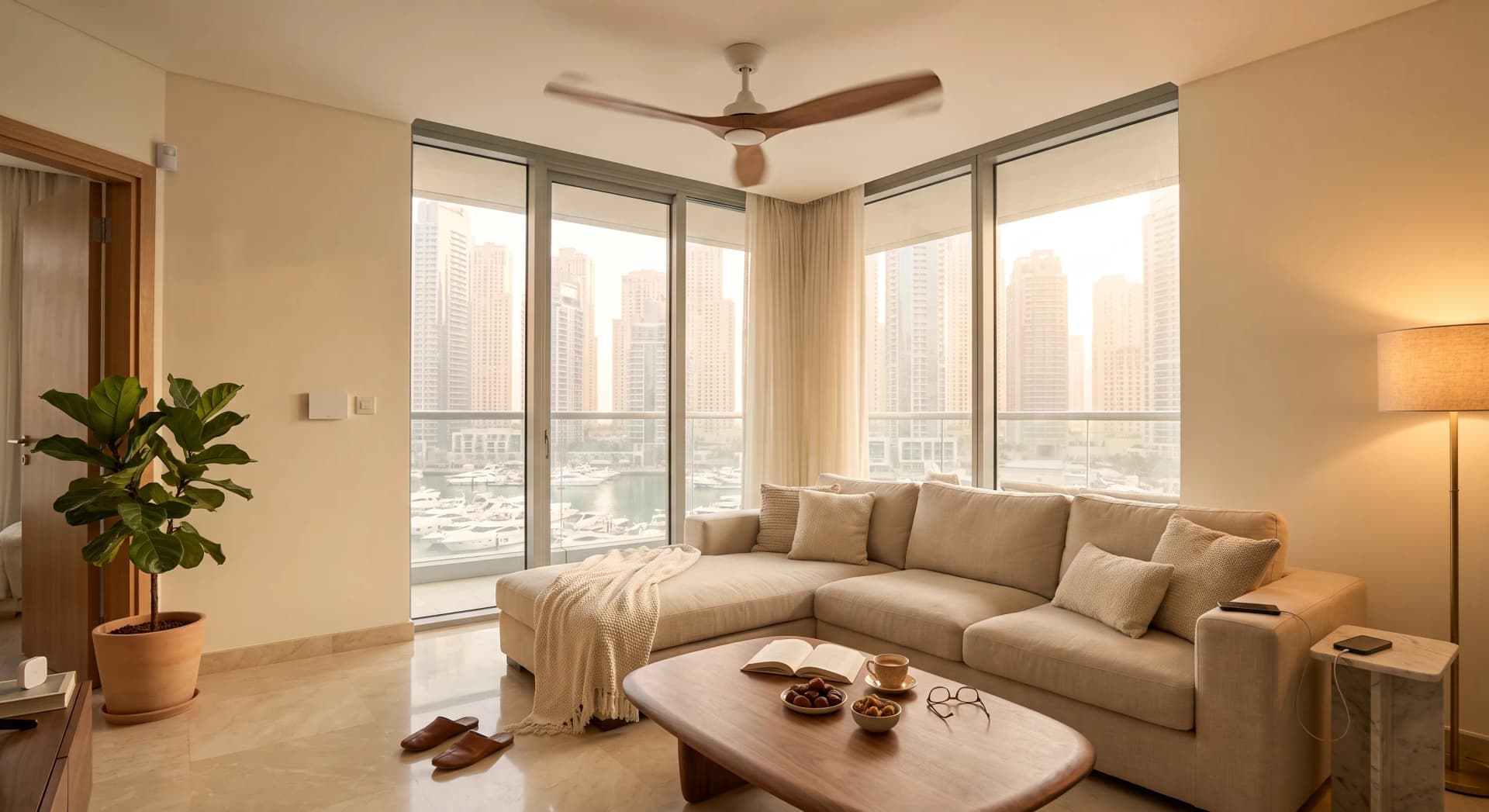
There is a ceiling fan in a lot of Dubai bedrooms and older living rooms, and almost nobody uses it. It has a pull-chain you cannot reach from the bed, or a remote that lives in a drawer, or three speeds you set once in 2019 and never touched again. So the AC does all the work, gets cranked to 20, and the room is either a fridge or an oven with nothing in between.
That fan is the most underused comfort device in the apartment. Not because a fan is powerful, but because of what it lets the AC stop doing. A ceiling fan does not cool a room. It cools you. And once you feel that difference, you can hold the AC two degrees higher and not notice, which in a Dubai summer is the whole game.
TL;DR: A ceiling fan cools people, not rooms, by moving air across your skin. That lets you raise the AC setpoint about 2 degrees with no loss of comfort. Making a fan smart is the part that gets it used: a plug-in hub learns your existing fan's remote with zero wiring, a wired module makes it smart for less, or a new DC-motor smart fan replaces it from around AED 335. The honest limit: in Dubai's 40-plus heat and high humidity, a fan is a supplement to the AC, never a replacement.
What a Ceiling Fan Actually Does (and Does Not Do)
A ceiling fan does not lower the temperature of a room. If you leave one running in an empty bedroom and come back an hour later, the air is exactly as warm as when you left. What a fan does is move air across skin, and moving air pulls heat off your body faster than still air does. The US Department of Energy puts it plainly: "ceiling fans cool people, not rooms, by producing a wind-chill effect" (US Department of Energy, 2025).
That one fact changes how you use it. A fan is worth running when you are in the room and worth switching off the second you leave, because it is cooling a person who is no longer there. Which is exactly the kind of small, constant decision people never remember to make manually, and exactly what a smart home is for. A ceiling fan is also a different thing from the fan-coil unit in a district-cooled apartment, which is part of your AC, not a separate appliance. If you are not sure which you have, our guide on smart AC controllers versus smart thermostats sorts it out.
Why This Matters More in Dubai Than Almost Anywhere
The reason a fan is worth the trouble here is the AC bill behind it. Air conditioning is roughly 60 to 70 percent of a Dubai home's electricity use, and a two-bedroom commonly runs AED 600 to AED 1,000 a month across the hot season (Real Estate Club Dubai, 2026). The fan does not attack that bill directly. It changes the setpoint you can live with, and the setpoint is where the money and the comfort both sit.
The Department of Energy's guidance is that a ceiling fan lets you "raise the thermostat setting about 4 degrees Fahrenheit with no reduction in comfort" (US Department of Energy, 2025), which is a little over 2 degrees Celsius. A simulation for hot, humid Florida found that raising the cooling setpoint 2 degrees Celsius while running ceiling fans saved about 15 percent of cooling energy at the same comfort level (Hoyt, Arens and Zhang, Building and Environment, 2015). We cite the humid-climate study on purpose, because the dry-desert numbers you see online overstate what a fan does in a coastal Dubai summer. The savings are real. They are a side effect. The point is that the room feels right at 24, which is the temperature DEWA itself asks Dubai homes to aim for (DEWA, 2026), instead of demanding 20.
The Honest Limit: Humidity and 45 Degrees
Here is the part most fan guides skip, and the part that matters most in Dubai. A fan cools you by helping sweat evaporate. In dry heat that works beautifully. In Dubai's coastal summer, when relative humidity commonly sits in the 65 to 85 percent range and climbs higher on a July night (Gulf News, 2026), the air is already close to saturated, evaporation slows down, and the fan feels less effective than the same fan would in Arizona. Humidity is its own comfort problem in a Dubai apartment, and the AC does most of the drying, which our guide to managing Dubai summer humidity at home covers on its own.
It still helps. Moving air breaks up the warm, humid layer that sits against your skin, and that alone is worth having. But a fan is not going to make a 45-degree July afternoon comfortable on its own. Anyone who tells you a ceiling fan replaces your AC in a Dubai summer has never spent August here. The fan is a supplement. It lets you run the AC at 24 or 25 instead of 20 or 21, and hold it there. That is the honest job, and it is a good one.
Making the Fan Smart Is the Part That Gets It Used
A fan you have to reach for is a fan you forget. The whole reason to make it smart is that the fan then joins the room instead of waiting for you. When your evening scene runs, the fan comes on with the lights and the AC. When the room empties, an occupancy sensor turns it off so it is not cooling nobody. When you say good night, it drops to a low speed or stops. You stop thinking about the fan, which is the only way a fan ever gets used.
Berkeley's building-comfort researchers describe fans tied directly to room occupancy, "preventing unnecessary operation, energy use, and maintenance," and running the fan first to hold comfort before the AC even starts to work harder (Center for the Built Environment, UC Berkeley, 2024). In our experience that is the difference that makes people keep the fan on. Not a new remote. A fan that behaves like part of the home. That trigger-on-occupancy logic is exactly what makes a fan worth automating in a room that heats up fast when someone is actually working in it, like the spare-room home gym setup we cover separately.
There are three ways to get there, and which one fits depends on whether you own the place and whether your fan already has a remote.
The Retrofit Path: Make Your Existing Fan Smart (Renter-Friendly)
If you already have a ceiling fan with a remote, you probably do not need a new fan at all. A small plug-in hub called a Bond Bridge learns the exact radio or infrared signal your fan's remote sends, then re-sends it on command from an app, a schedule, or a scene. You plug it in, point your existing remote at it once, and the fan is smart. No wiring, no electrician, no landlord conversation, and it comes off the shelf and into your suitcase when you move. One Bond controls up to 30 fans, so a bedroom fan and a living-room fan run from the same hub, and it works with Alexa and Google out of the box (Bond Home, 2026).
One honest catch for Dubai: Bond is not on the local shelves yet, so today it is an import, around AED 365 before shipping and duty. That is the trade-off for the only truly zero-wiring, renter-friendly path. It is the same logic as putting a battery switch on the wall instead of rewiring: you make what is already there smarter, and you take it with you. If your fan has a remote today, this is where to start. Full detail on the renter approach to wall controls is in our guide to smart light switches for Dubai renters.
The Wired Path: A Smart Fan Switch (For Owners)
If you own the apartment, or you are already opening the wall for a renovation, a controller wired into the fan itself is the tidier long-term answer. A Sonoff iFan04 module sits inside the fan canopy, adds Wi-Fi and app control to the fan and its light, and works with Alexa and Google, for around AED 60 to 130 plus an electrician's time. It keeps the wall switch and remote working for guests and the housekeeper, and nothing sits on a shelf.
Two cautions here. First, this touches the wiring, so it is an owner or fit-out move, not a rental one, and many Dubai walls are solid masonry with no neutral wire at the switch, which decides what fits. Second, skip the popular US wall switches for this: a Lutron Caseta fan control and its American cousins are built for 120-volt pull-chain AC-motor fans, need a neutral, and do not work with a DC-motor or remote-controlled fan on UAE power. If you are weighing wired against wireless in general, our guide on wired versus wireless smart home in Dubai covers the trade-off in full.
The New-Fan Path: Buy a DC-Motor Smart Fan
If there is no fan yet, or the one you have is a wobbling, humming builder-grade unit, buy a new smart fan and get two upgrades in one. Look for a DC-motor fan (sometimes labelled BLDC) with built-in Wi-Fi and a remote. A whole DC-motor ceiling fan draws around 35 watts at full speed and far less on the medium settings most people run, against the 75 watts or so of an old AC-motor fan (Atomberg, 2026). It also runs far quieter and comes with app control, schedules, and voice built in. Either way a ceiling fan draws a small fraction of what your AC compressor pulls, so running the fan to hold a higher AC setpoint is a genuinely efficient trade.
The brand a Dubai buyer will find in stock and cheap is Atomberg, whose DC smart fans with Alexa and app control sell on Amazon.ae and Noon for around AED 335 to 480. Aeratron sells quiet DC fans locally at the pricier end, and reiga makes design-forward Wi-Fi fans with an integrated light. Pick the fan for the room size, not for the biggest span you can buy. A giant high-airflow fan in a normal apartment bedroom is loud, oversized, and moves more air than a person wants sitting under it.
What It Costs in a Dubai Apartment
None of these is an expensive project, which is the nice thing about fans. A wired Sonoff module to make an existing fan smart runs around AED 60 to 130 plus the electrician. A plug-in Bond hub to do it with no wiring is around AED 365 imported, and it then controls every fan in the apartment, so the second and third fans are free. A brand-new DC-motor smart fan lands around AED 335 to 480 for an Atomberg, before fitting. Whichever route, this is a couple of hundred dirhams to a few hundred, not a few thousand.
Set against the AC it takes pressure off, the fan is one of the cheapest comfort upgrades in the home. When we fold a fan into a wider smart AC and climate setup during a survey, it is rarely the line anyone questions. The AED 3,000 smart home starter is built around AC control first, and a smart fan is a small, high-value addition to it rather than a project of its own.
A Business Bay Two-Bedroom, In Practice
A couple in a two-bedroom in Business Bay had a ceiling fan in the master they never touched, because the remote had gone missing and the pull-chain was awkward over the bed. The AC held the room at 20 all night and the electricity showed it. We added a plug-in hub that learned a replacement remote's signal, then built it into their existing good-night and wake scenes, and put a small occupancy sensor in the living room so the fan there switched off when the room emptied.
The change was not dramatic to look at. The fan just started getting used. They moved the master AC to 24 overnight with the fan on low, slept the same or better, and the room stopped swinging between freezing and stuffy. The July bill came in lower than the year before, but the reason they mention it to friends is the sleep, not the number. That is usually how it goes. The fan is a comfort story with a savings footnote, not the other way around.
What Bayora Will Talk You Out Of
Not everything with a fan in it is worth buying, and a few of these come up on almost every survey.
Skip the fan with the colour-changing LED light built into the hub. It is a gimmick that dates fast and adds nothing to how the fan works. Skip the oversized industrial fan for a standard apartment room; you want air movement you can sit under comfortably, not a wind tunnel. Skip replacing a fan that works fine just to get an app, when a plug-in hub can make the existing one smart for less. And skip making a fan smart in a room nobody sits in. A fan cools people, so a smart fan in an empty formal dining room you use twice a year is automating a thing that should mostly stay off.
The one thing we will never sell you is a fan as a replacement for your AC. In a Dubai summer that is not honest. The fan earns its place by letting the AC work less, not by letting it work never.
Frequently Asked Questions
Can I make my existing ceiling fan smart without replacing it?
Yes. If it has a remote, a plug-in hub like a Bond Bridge learns the signal and re-sends it from an app or voice, with no wiring, so it suits renters and comes with you when you move (though in Dubai it is currently an import). If you own the place, a wired Sonoff module inside the fan does the same job for less, fitted by an electrician.
Does a ceiling fan actually lower my DEWA bill in Dubai?
Indirectly. The fan does not cool the room, so it saves nothing on its own. What it does is let you raise the AC setpoint about 2 degrees at the same comfort, and a humid-climate study found that saves around 15 percent of cooling energy. The saving comes from the AC working less, not from the fan.
Can a ceiling fan replace air conditioning in a Dubai summer?
No. At 40-plus degrees with high humidity, a fan cannot make a room comfortable on its own, because the humid air slows the evaporation that cools you. A fan is a supplement. It lets you run the AC at 24 or 25 instead of 20, which is a real gain, but it does not let you turn the AC off.
Which way should a ceiling fan turn in summer?
It should blow air down, which most fans do on their standard setting (blades turning counter-clockwise when you look up at them). The downward breeze is what you feel. The reverse, updraft direction is a winter setting, so in Dubai you leave the fan on its summer direction almost year-round.
Do smart ceiling fans need WiFi to work?
The smart features (app control, schedules, scenes, voice) use your home WiFi or a hub. The fan itself still runs on its own remote or wall switch if the internet drops, so you are never stuck without a fan. Setup and remote control need the network; basic on-off does not.
The Fan Was Always There
The fan on your bedroom ceiling has been quietly waiting to be useful. It does not need to be powerful. It needs to come on when you are in the room, turn off when you leave, and let the AC settle at a temperature that does not cost a fortune or freeze you out. That is a small change, and it is the kind a home should make on its own.
If you want to know whether the fan you already have can be made smart, or what a comfortable, efficient climate setup looks like for your apartment, tell us about your home and we will give you an honest recommendation. No obligation, and no pushing you toward a fan you do not need.
Ready to Get Started?
Get a free consultation and we'll recommend what makes sense for your situation.
Get Free Consultation