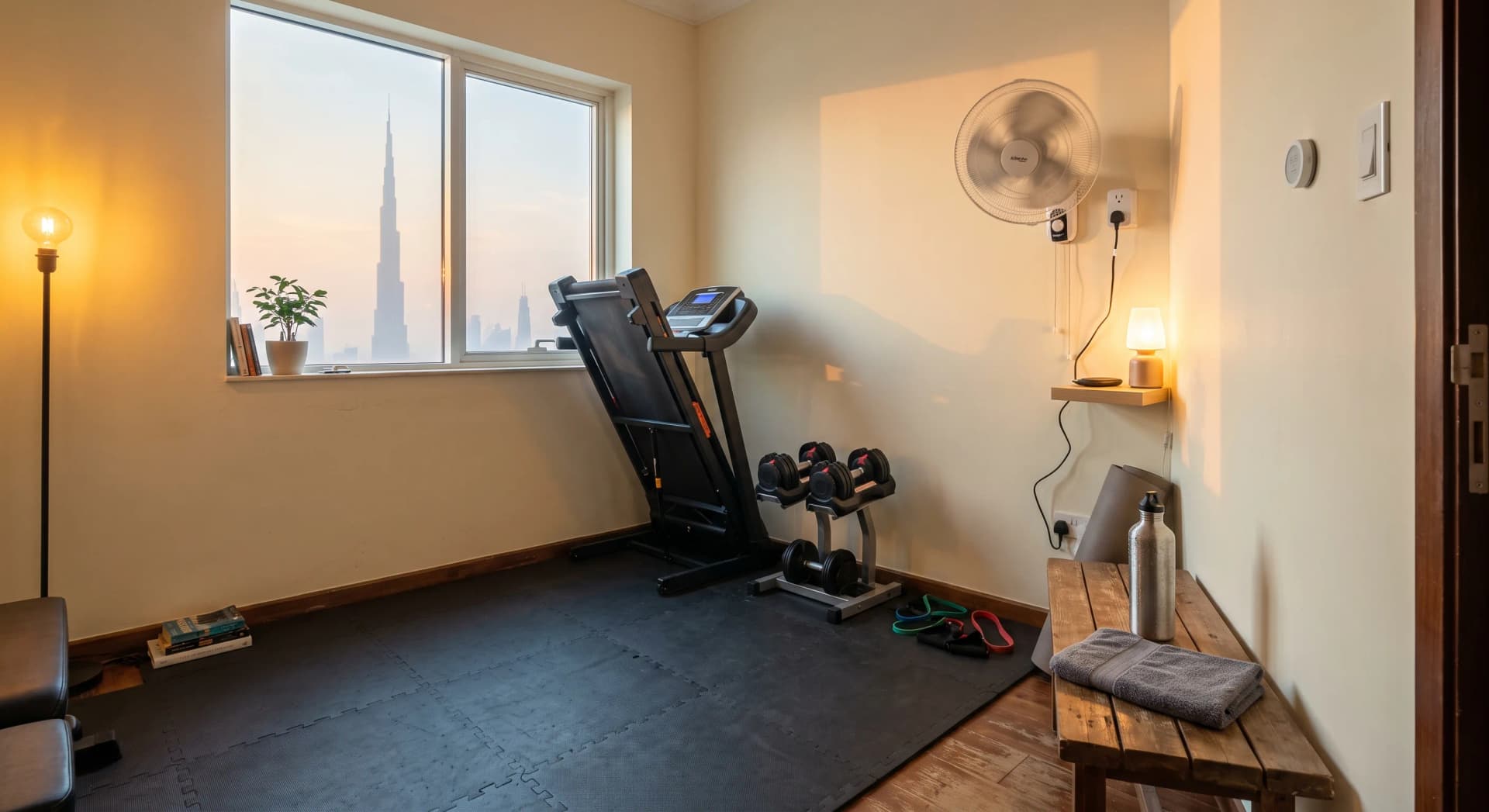
Picture the spare bedroom a lot of Dubai apartments already have. A folded treadmill against the wall, a rack of adjustable dumbbells, a yoga mat rolled in the corner, maybe a smart mirror mounted where the wardrobe used to be. The gym membership gets cancelled, AED 300 to 700 a month depending on the club, and the difference goes into the room.
Two months later the app is open again, looking for a slot at the old gym.
This is the pattern we see most often when a client asks us to look at a spare-room gym that stopped getting used: the equipment was fine, the room was the problem. No air vent from the AC reaches that corner of the apartment, so by evening the room sits at 29 or 30 degrees with the door shut, the same heat load a west-facing bedroom carries in peak summer. The overhead light is a single cool-white panel that makes a 6am stretch feel like a hospital corridor and a 9pm cooldown feel exactly the same way.
TL;DR: A spare-room home gym in a Dubai apartment usually fails on the room, not the equipment: no dedicated airflow, a single lighting mode for every time of day, and a door that traps heat and stale air. The fix is a wall or ceiling fan on a schedule, a temperature and humidity sensor that triggers ventilation before the room feels stuffy, and lighting that shifts from bright cool-white for a 6am session to warm and dim for evening stretching. A renter setup runs AED 800-1,600. A fitted version with a wired exhaust fan and dedicated switches lands AED 2,200-3,200.
Why the spare-room gym usually fails first
Three details predict how long a converted spare-room gym in Dubai lasts: whether the AC vent reaches that room, whether the light has more than one setting, and whether the door gets shut during a workout.
Spare bedrooms in a typical 2BR or 3BR layout are often the smallest room and the last one on the AC duct run, so airflow is already weaker before anyone starts sweating in it. Add a closed door for privacy or to keep the noise contained, and the room heats up the way any small sealed space does when a body inside it is working. Fixing that has nothing to do with which treadmill you bought.
This is not a knock on the equipment guides already out there covering treadmills and adjustable dumbbells for small Dubai apartments. Buy good gear. This post is about the fifteen minutes before and during the workout that the gear cannot fix on its own: the temperature, the air, and the light.
The room gets hotter than you think, fast
A closed spare room with a body moving inside it behaves differently from a bedroom at rest. Exercise raises your own heat output well above resting levels, and in a small room with the door shut, that heat has nowhere to go. Combine that with a room already sitting at the tail end of a Dubai apartment's AC duct run, and a 24-degree room at the start of a workout can read closer to 28 or 29 within twenty minutes.
The honest fix here is not a bigger AC unit for one room. It is a dedicated wall or ceiling fan, the same device we covered in our smart ceiling fan guide, set to run automatically the moment the room is in use. Moving air makes a room feel several degrees cooler than the thermostat reads, which matters far more in a gym than in a bedroom, because you are already generating heat the AC has to fight.
In our experience installing this in Business Bay and Al Barsha apartments, the fan on a schedule or a door-sensor trigger does more for comfort in a 3-square-metre gym room than a second AC vent would, and it costs a fraction of the price.
The air gets stale before you notice
Outdoor air runs around 400 to 420 parts per million of CO2. A small closed room with someone breathing harder than usual can climb to 1,500 to 3,000 parts per million within a heavy session, especially in rooms under about 30 square metres with the door shut (Atmotube, 2026). Above roughly 1,000 parts per million, studies have measured real drops in focus, decision-making, and reaction time, not just a vague feeling of stuffiness (Atmotube, 2026).
An air purifier will not solve this on its own. Purifiers filter particles and some odors, but none of them remove CO2 in any meaningful amount (Peak Primal Wellness, 2026). If the room feels thick with the door shut, the answer is moving air out, not filtering the air that is already there.
The honest gap: no off-the-shelf CO2 sensor
Here is where we will save you some money rather than sell you a gadget. Neither Aqara nor Shelly, the two open-platform brands we install most, makes a dedicated CO2 sensor. What Aqara does make is a TVOC air-quality monitor that also tracks temperature and humidity (Aqara, 2026), and a rising TVOC or humidity reading is a close enough proxy for "this room needs air" that we use it the same way a bathroom exhaust-fan automation does. Pair it with a smart plug or relay on the exhaust or wall fan, and the room clears itself on a threshold instead of waiting for you to notice you feel sluggish twelve minutes in.
One light setting cannot do two jobs
A 6am session and a 9pm stretch are asking the room to do opposite things, and most spare-room gyms light both the same way.
Cooler light in the 4,600 to 6,500 Kelvin range mimics daylight and supports alertness, which is what a morning cardio or strength session wants (Philips Hue, 2026). Warmer light in the 2,700 to 3,500 Kelvin range does the opposite job for an evening cooldown or a wind-down yoga block, avoiding the kind of bright, blue-leaning light that works against the body's evening signal to slow down. A single cool-white ceiling panel, the default fixture in nearly every Dubai spare bedroom, gets the morning session right and gets the evening session wrong every single time.
This is the same layered-lighting logic we walked through for Dubai living rooms: one scene for energy, one scene for wind-down, both living on the same fixture through a smart bulb or a dimmer switch rather than two separate light installations. A Morning scene at full brightness and daylight white. An Evening scene at 30 percent and warm. Same bulb, two jobs, one tap or one automatic trigger from the door sensor.
What Bayora will tell you to skip
Not every gadget marketed for a home gym earns its place in a spare room. A few we will actively talk clients out of:
- A full smart-mirror system before the room itself works. A AED 1,800 to AED 6,000 interactive mirror is a genuinely useful piece of equipment, but it will not fix a hot, stuffy room, and clients who buy the mirror first often end up avoiding the room anyway.
- A dedicated mini-split AC for one small room. The math rarely works for a 3-to-4-square-metre space. A fan plus a scheduled AC vent adjustment gets you most of the comfort gain at a fraction of the cost.
- A CO2-specific smart sensor marketed as a home-fitness product. As covered above, this is not a clean off-the-shelf category on the open platforms we install. A temperature and humidity sensor doing the same job costs less and is easier to source.
- RGB accent lighting as the primary light source. Fun for a photo, useless for reading your own effort at 6am or unwinding at 9pm. Keep RGB as an accent, not the only light in the room.
Pricing: two honest tiers
Renter setup, no wiring, AED 800 to 1,600. A battery or plug-in wall/ceiling fan on a Zigbee or WiFi relay, an Aqara temperature and humidity sensor, two or three smart bulbs on a dimmer app or hub, and a smart plug controlling the fan or a small dehumidifier. Everything unscrews and moves with you.
Fitted setup, AED 2,200 to 3,200. A wired exhaust fan tied to the bathroom-style ventilation logic, a Lutron Caseta dimmer switch replacing the single wall switch, the same temperature and humidity sensor, and two lighting zones (overhead plus one accent) on separate circuits. This is the version we build for owners doing a fuller apartment fit-out at the same time.
Either tier sits inside the AED 3,000 Smart Home Starter range we quote for a single-room project, and both plug into a wider whole-home automation build if the gym room is one of several rooms getting attention at once.
What this looks like in a real Business Bay layout
Take a typical Business Bay 2BR where the second bedroom, doing double duty as the gym, sits at the end of the corridor with the weakest AC vent in the apartment, used for a 6am session before work and a short stretch most evenings.
The build for that layout: a ceiling fan on a relay triggered by a door sensor, a temperature and humidity sensor on the wall, and two smart bulbs split into a Morning scene (full brightness, daylight white) and an Evening scene (dimmed, warm), both switched from a wall-mounted remote by the door. That combination, fan plus sensor plus two lighting scenes, is the fitted-tier build described above, and it is what we would walk a client through room by room during a survey rather than sell as a fixed package.
The point of a build like this is not a cooler thermometer reading. It is that the door gets opened at 6am and 9pm without a second thought about what the room will feel like on the other side.
Frequently Asked Questions
Do I need a dedicated AC vent for a home gym room?
Not necessarily. A wall or ceiling fan set to run automatically when the room is in use solves most of the heat problem for far less than adding or rerouting AC ductwork. Moving air makes the room feel several degrees cooler even without changing the thermostat.
Can I really not buy a CO2 sensor for a home gym?
Not from Aqara or Shelly, the two open-platform brands we install most in Dubai. A temperature and humidity sensor is the practical substitute. Rising humidity and heat in a small closed room correlate closely enough with stale air to trigger the same ventilation response.
What color light is best for an evening workout?
Warmer light in the 2,700 to 3,500 Kelvin range works better for evening sessions and cooldowns than the cool white most spare rooms default to. Save the brighter, cooler light in the 5,000 Kelvin-plus range for morning sessions.
Will an air purifier fix a stuffy home gym?
No. Purifiers remove particles and some odors but do not meaningfully reduce carbon dioxide. If a room feels thick after a session, you need moving air, not filtered air.
How much does a basic smart home gym setup cost in Dubai?
A renter-friendly setup with a plug-in fan, a temperature and humidity sensor, and smart bulbs runs AED 800 to 1,600 with zero wiring. A fitted version with a wired exhaust fan and dedicated switches runs AED 2,200 to 3,200.
Curious what this would look like in your spare room? Get a free consultation and we will tell you exactly what fits before you spend another dirham on equipment.
Ready to Get Started?
Get a free consultation and we'll recommend what makes sense for your situation.
Get Free Consultation