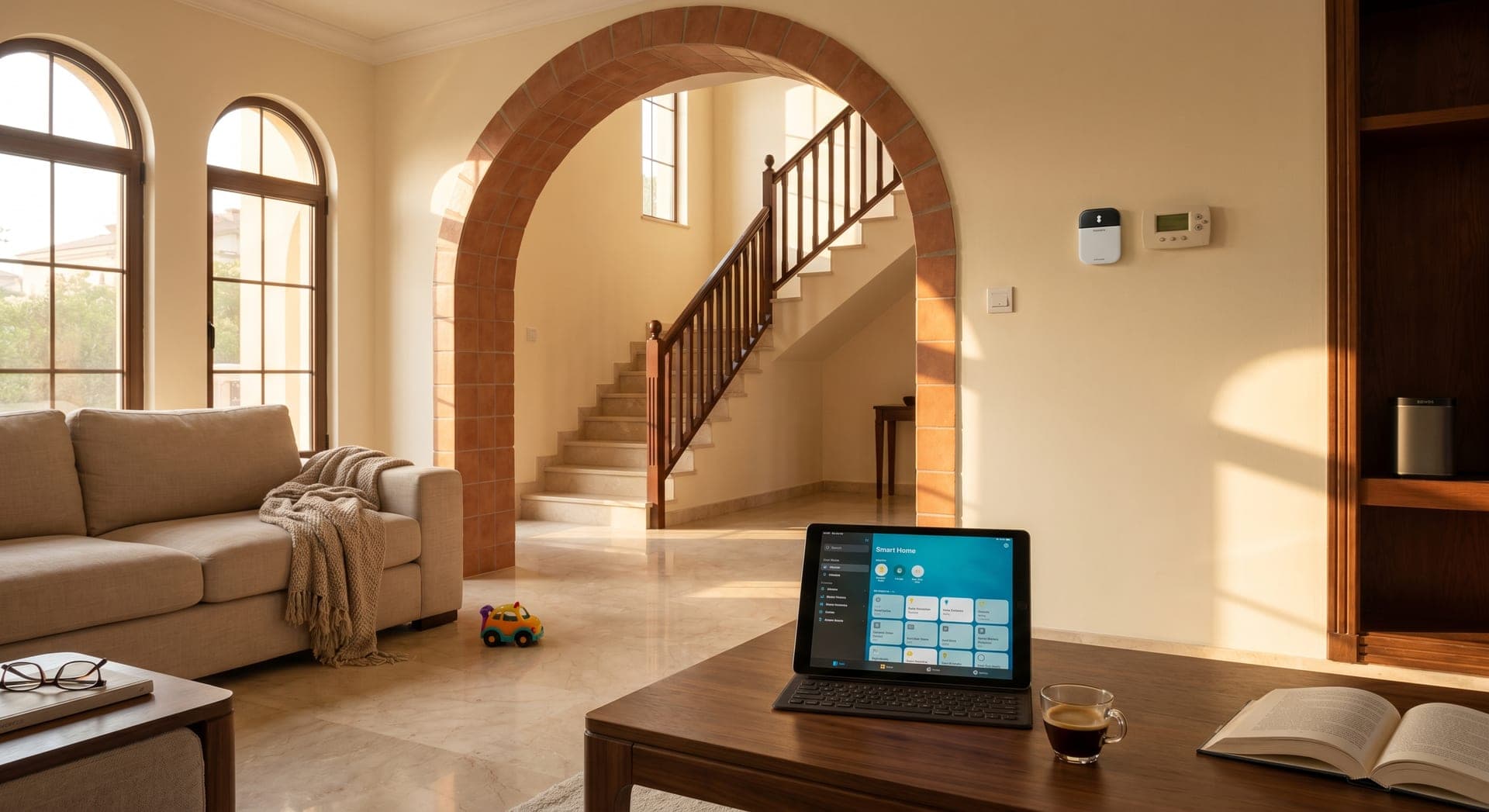
The villa is 22 years old. The original AC system was specified in 2003 for a Dubai that ran 38C summers, not 43C ones. There is one thermostat, it sits in the downstairs hallway, and it reads 22. Upstairs, where the master and the kids' rooms are, the actual temperature at 9pm is 28. The compressor outside has been running since 11am and the May DEWA bill that landed last week is AED 2,100. June is not here yet.
This is the Arabian Ranches 1 summer story. Same as Springs, Meadows, Lakes, every two-story villa from the early Emaar era. The architecture is Spanish, the tiles are terracotta, the staircase is a beautiful sweep. None of those choices were made with a thermostat strategy in mind.
The fix is not a new AC system. AR1 villas do not need a chiller upgrade or a duct replacement. They need a control layer that sits on top of the AC already on the wall.
TL;DR: Arabian Ranches 1 villas were built in 2004-2008 with single-thermostat split AC systems on two-story Spanish-style floorplans. Twenty-plus years later, the layout creates a predictable summer problem: downstairs cool, upstairs hot, compressor cycling all afternoon, DEWA bill 50-100 percent above winter. A smart AC zone-control setup (one controller per indoor unit plus per-room sensors and schedules) costs AED 3,500-7,000 installed, cuts the worst summer DEWA spikes by 20-30 percent, and ends the 9pm arguments about why nobody can sleep upstairs. Renter-friendly, no wiring, one day install.
Why Arabian Ranches 1 Has a Specific AC Problem
Arabian Ranches 1 was launched in December 2004 by Emaar, with the first villas handed over the following year (Wikipedia, 2024). That makes the original housing stock 20-22 years old as of 2026. The villas are Spanish, Portuguese, and Arabic in influence (Strada UAE, 2025), with the original sub-communities (Mirador, Aseel, Saheel, Alma, Hattan, Al Reem) almost all running two-story floorplans.
That period of Emaar construction used chiller-free split AC systems, meaning each villa runs its own outdoor compressor (or two) feeding indoor evaporator units in different rooms. There is no district cooling, no monthly cooling fee, no shared chiller plant. The whole cooling cost shows up on your DEWA bill (RELO Dubai, 2026). This is mostly a good thing. It means your bill reflects your actual usage and you can change your bill by changing how the AC runs. In a district-cooling building you would be paying a fixed fee no matter what you did.
But the AC system was specified twenty years ago. The thermostat is a single 24V dial on the downstairs wall. The indoor units upstairs were sized for what the family in 2005 would set the bedrooms to overnight. The villas were not designed around the idea that anyone would want different temperatures in different rooms at different times.
Heat rises. In a Dubai summer, heat rises hard. The upper floor of an AR1 villa gains heat through the roof, through the upstairs windows, and through the Spanish-style west and south walls that hold afternoon sun. The downstairs gains heat too, but the cool air the AC produces falls there first and stays there longer. The thermostat sees that downstairs air, decides everything is fine at 22, and stops calling for more cooling. Upstairs, where nobody put a sensor, the rooms keep climbing past 26 and toward 28 by sundown.
Professional HVAC guidance for multi-story homes is direct about this pattern: set the top floor to the temperature you want, and set the bottom floor two degrees higher, because cooler air from upstairs settles downward on its own (Quality HC, 2024). Most AR1 villas do the opposite, because the thermostat sits downstairs and the family sets it low to feel comfortable in the living room. The result is a system that overruns the ground floor and underruns the bedrooms.
In our experience surveying AR1 villas, this is the single most common reason families call about high DEWA bills. The AC is fine. The compressor is fine. The control layer was specified for a different problem.
What an AR1 Summer DEWA Bill Looks Like
A 3-bedroom Arabian Ranches villa with a single resident family typically runs AED 1,500-2,200 per month during summer, with the cooling load doing most of the work (My DEWA Bill, 2026). Reports from AR1 owners specifically show summer bills landing in the AED 1,600-2,200 range for 3-bedroom villas, jumping toward AED 4,000 for larger 4-5 bedroom homes during the peak July-August window (Solid Cars, 2025).
Winter bills for the same villas often sit at AED 600-900, which means the summer delta is AED 800-1,400 per month, almost entirely AC. Over the four hottest months (June through September) that is AED 3,200-5,600 of cooling cost concentrated into a third of the year.
A zone-control retrofit does not eliminate that. It does not turn AR1 into a chilled-water building or change the physics of a 43C afternoon. What it does is cut 20-30 percent off the worst months by stopping the AC from running rooms nobody is in, by running rooms it needs to cool slightly less hard, and by pre-cooling at off-peak times instead of catching up at peak ones. On an AED 2,000 July bill, that is AED 400-600 per month. Over the four hot months, AED 1,600-2,400 of savings on a setup that costs AED 3,500-7,000. The math closes inside the first summer.
What Zone Control Changes
A zone-control setup does three things the original AR1 thermostat cannot.
It puts a sensor in every room the family lives in. Master bedroom, kids' rooms, living room, kitchen. The AC stops chasing the temperature of the downstairs hallway and starts chasing the temperature of where the family lives. WiFi-connected AC controllers with room sensors save 15-30 percent on cooling costs through scheduling, geofencing, and per-room temperature rules (Sensibo, 2026).
It controls each indoor unit independently. Most AR1 villas have three or four indoor evaporator units: one downstairs in the living/dining area, one in the upstairs hallway feeding the bedrooms, and sometimes a third for the maid's room or majlis. A smart IR controller goes in front of each one. The living room can run at 24 in the afternoon while the upstairs unit pre-cools the master to 22 starting at 8pm. The compressor still does the work, but the units it feeds each have a brain.
It runs a schedule that matches the family's day. Pre-cool the upstairs bedrooms from 8pm to 10pm so they are sleepable by bedtime. Hold downstairs at 24-25 during the day. Let everything drift to 26-27 after midnight when the family is asleep. Geofence the system to step everything back to 28 when the last person leaves the villa and start the recovery 20 minutes before the first person gets home.
That is the entire fix. The hardware stays the same. The control layer is different.
What It Costs in an AR1 Villa
Arabian Ranches 1 villas come in three common shapes from a smart AC perspective, and the pricing depends on how many indoor units the setup has to cover.
A 2-bedroom AR1 villa (the smaller Mirador and Al Reem layouts at around 165 sq m / 1,776 sq ft) usually has two indoor units. The zone-control setup is two smart AC controllers (Sensibo Sky or Tado, around AED 600-800 each), three room sensors (AED 80-150 each), and a small WiFi hub if the existing network is weak. Total: AED 2,500-3,500 installed.
A 3-bedroom AR1 villa (Saheel, Alma, the standard 3BR Mirador at around 226 sq m / 2,432 sq ft) usually has three indoor units. Three controllers, four sensors, hub. Total: AED 3,500-5,000 installed.
A 4-5 bedroom AR1 villa (Hattan, Saheel 4BR, larger Aseel at 321-409 sq m / 3,456-4,402 sq ft) usually has four indoor units, sometimes five if the maid's room and majlis are separate. Four controllers, six sensors, hub, and a slightly more involved configuration day. Total: AED 4,500-7,000 installed.
These numbers assume the existing split AC units are functional and the IR remotes still work. For a 3-5 bedroom villa, broader smart home automation packages run AED 8,000-15,000 for basic and AED 20,000-45,000 for moderate whole-home integration (European Technical, 2026). Zone control alone is the entry point that pays back fastest because it targets the single largest line item on the bill.
What If the AC Is Older Than the Smartphone Era
Some AR1 villas still have their original 2005-2008 AC systems, never replaced, just serviced. Two questions matter for smart retrofit on those units.
Does the indoor unit have a working IR remote? If yes, a Sensibo Sky or Tado IR controller will work. They learn the remote's commands and replay them. The brand of the AC (Daikin, Carrier, LG, O General) does not matter as long as the remote is alive. We have done this on AC units from 2005 in Mirador without issue.
Is the compressor cycling normally? If the outdoor unit is short-cycling (turning on and off every 2-3 minutes), tripping the breaker on hot days, or making loud bearing sounds, no smart controller will fix it. The AC needs a service or replacement first. A zone-control setup on a failing compressor will just route the failure into smarter scheduling.
The 2005-2008 split AC systems still in many AR1 villas have another quirk: the indoor units run on 220V mains with no C-wire, which means a wired smart thermostat is a non-starter without an electrician. IR controllers sidestep that completely. They mount near the indoor unit, plug into a regular socket, and never touch the AC's wiring.
For villas with the original 24V wall thermostat, a hybrid retrofit is possible: keep the wall thermostat as the master control for the downstairs, add IR controllers for the upstairs units, and let the smart system override both. We do this when the family wants the downstairs to look unchanged and the upstairs to start working.
The Five-Step Install Order
We do AR1 zone-control installs in one day in this order. It is the same order whether the villa is 2BR or 5BR, and it matters because each step proves the next.
Step 1: Upstairs master bedroom. This is the room that fails the family every night and where the win has to land. Mount the IR controller within line of sight of the indoor unit, pair the room sensor, set the bedroom schedule to pre-cool from 8:30pm to 10pm at 22, then hold at 24 overnight. If the master goes from "unsleepable" to "sleepable" the first night, the rest of the install carries itself.
Step 2: Upstairs kids' rooms. Same setup, sensors paired to the same upstairs indoor unit. If the kids' rooms are on a separate indoor unit (some larger Hattan and Aseel layouts), add a second controller. Set bedroom schedules to ramp earlier (7:30pm pre-cool, lights-out 9pm hold at 23).
Step 3: Downstairs living and dining. Controller on the downstairs indoor unit, sensor in the living room and kitchen. Hold at 24-25 during the day, drift to 26 after the family goes upstairs at 9-10pm. The downstairs no longer runs all night cooling an empty room.
Step 4: Geofence and family schedule. Set the system to "everyone out" mode when the last family member's phone leaves the villa: all units jump to 28, compressor barely runs. When the first phone is 20 minutes away, the master and kitchen start the recovery. Family does not think about it.
Step 5: Leak sensors on the AC condensate drains. Older AR1 indoor units occasionally overflow their drain pans, especially on the upstairs units that nobody checks. Three AED 60 leak sensors under the drains will text the family before water hits the ceiling below. This is a fifteen-minute add-on that prevents a 20,000 dirham mistake.
The whole thing takes one day. The family wakes up Sunday to a villa where the bedrooms are 22 by 10pm and the downstairs has stopped freezing them out in the afternoon.
What Bayora Will Talk You Out Of in an AR1 Villa
This is honest-recommendation territory, and Bayora's third principle is to recommend what fits, not what is most expensive. Some things people ask for when they call us about AR1 zone control, and what we usually say.
"Should we replace the AC system?" Usually no. If the compressor is healthy and the indoor units cool when you ask them to, the system is fine. Twenty-year-old Daikin and Carrier split units in well-serviced AR1 villas are still running. A new AC system is AED 15,000-30,000 per unit. A zone-control retrofit is AED 3,500-7,000 for the whole villa and addresses the actual problem.
"Should we add chiller-style central AC?" Not on AR1. The infrastructure isn't there, the cost is AED 40,000-80,000 plus weeks of construction, and the result is not measurably better than the split system you already have run intelligently.
"Should we add a full home automation system at the same time?" Sometimes. If you are doing a renovation anyway, yes, bundle the lighting and security. If the villa is staying as-is, start with AC. The AC is the bill driver. Lighting and security are nice but they do not move the DEWA needle the way zone control does. See our home automation guide for what the full scope looks like.
"Should we get the AED 12,000 setup with the wall touchscreens?" Almost never. Phone apps work. The family already lives on their phones. The touchscreens look beautiful in the showroom and get used twice by the family and never by the housekeeper. If you want one nice touchscreen, put it in the kitchen and skip the bedroom ones.
If your problem is solved by AED 3,500 of controllers, we will tell you that. We do not pitch the AED 12,000 setup to a 3-bedroom villa when the 3-bedroom answer is AED 4,500.
What This Looks Like in a Real AR1 Villa
A Mirador 3-bedroom in AR1, single family, both parents working, two kids in school. The May 2025 DEWA bill was AED 1,840. The June 2025 bill landed at AED 2,310. The family called us in early July, frustrated about the upstairs heat and the bill, half-considering replacing the entire AC system.
We surveyed on a Tuesday and installed the following Sunday. Three Sensibo Sky controllers (one per indoor unit), four room sensors (master, two kids' rooms, kitchen), one WiFi extender to cover the upstairs landing where the signal was weak. Total installed cost: AED 4,400.
Schedule out of the box:
- Downstairs: 25 from 7am, 24 from 5pm-9pm, 26 after 10pm
- Upstairs hallway unit: 28 holding daytime, pre-cool to 22 starting 8:30pm, hold 23 overnight
- Kids' rooms: 7:30pm pre-cool to 22, hold 23 overnight
- All units jump to 28 when both parent phones leave the villa
- All units start recovery 20 minutes before the first phone is back
July 2025 DEWA bill: AED 1,640. August 2025: AED 1,580. The family asked us if we had done something to the meter. We had not. The compressor was just running fewer hours and chasing fewer wrong rooms.
The total reduction was AED 670 in July and AED 730 in August compared to the previous year's same months. The setup paid for itself by the end of August. The bedrooms have been sleepable since the second night.
What This Costs You to Get Wrong
Every summer Bayora gets calls from AR1 owners who tried to fix this themselves with a single smart thermostat off Amazon. The pattern is the same. They buy a Nest or Ecobee that doesn't have a UAE adapter, the C-wire isn't there, they hire an electrician who tells them the wall thermostat can't be replaced cleanly on a 2005 system, the device gets returned, and the family is back to where they started after losing a weekend and AED 1,500 on a thermostat they can't use.
What we have found is that AR1 villas almost never benefit from a wired-thermostat retrofit. The wiring, the building age, and the layout all push toward IR controllers as the right answer. They cost the same as a Nest, they work in this exact context, and they go in without an electrician. A Nest works beautifully in a North American single-zone forced-air home. It is not the right tool for a 22-year-old Dubai split-system villa.
How AR1 Pairs With the Rest of the Smart Home
Zone control is the entry point because it pays back fastest, but it is not the only AR1 win. Once the AC is sorted, two adjacencies become obvious.
Motorized blinds on the west-facing upstairs windows cut 18-24 percent of the solar heat gain that is making the upstairs unit fight all afternoon. AR1 villas have a lot of west-facing window area because the Spanish style favors large arched openings. A AED 5,000-8,000 priority blind install on the three worst windows compounds the zone-control gains and cuts another AED 200-300 off the worst summer month.
Smart leak sensors in the kitchen, the maids' room, and under each upstairs AC indoor unit catch water before it becomes ceiling damage. AR1 villas are old enough that the original kitchen plumbing and AC condensate lines have started failing in some homes. Six AED 60 sensors paired to phone notifications cost AED 360 and prevent the AED 20,000 mistake.
If you are heading toward whole-home, that is the order: AC first, blinds second, leak sensors third, lighting and security on the slower side. We have a separate guide for what whole-home automation in older Dubai villas looks like in practice.
Where AR1 Fits in the Wider Smart Home Picture for Dubai
Arabian Ranches 1 is part of a specific class of older two-story Dubai villa stock: the Emirates Living mid-2000s era. Springs, Meadows, Lakes, Arabian Ranches 1, Jumeirah Park 1 all share the same DNA: chiller-free split AC, single thermostat, two-story Spanish or Mediterranean influence, twenty-plus years old. The fix is the same family of solution across all of them. We documented the Springs version of this in our Springs villa zone-control guide, and the architecture of the answer translates directly to AR1 with slightly different unit counts and slightly larger floor plates.
For families looking at the broader Arabian Ranches experience (the security, garden, pool, and lifestyle layer), our Arabian Ranches whole-home automation guide covers what a full AR setup looks like beyond AC. This post is the AC-specific surgery; the other one is the broader picture.
For owners in newer Emirates Living stock (Arabian Ranches 2 and 3, post-2014), the math is slightly different because the villas are larger and sometimes have more modern HVAC. The same controller approach still works; you usually need one more controller per villa and the recovery schedule is shorter because the building shell is tighter.
Frequently Asked Questions
Does this work for renters in Arabian Ranches 1?
Yes. IR controllers do not touch the AC's wiring or the wall thermostat. They mount near the indoor unit, plug into a regular socket, and pair with a phone app. Nothing in the villa changes physically. When the lease ends, the controllers come off the wall, go in a box, and move with the family. We do this in roughly half the AR1 installs we do, and the landlord has never been involved because nothing needed approval.
Will this work with my Daikin / Carrier / LG / O General split unit?
Almost certainly yes. The IR controllers (Sensibo Sky, Tado, BroadLink RM4 Pro) learn the commands from your existing AC remote. They work with every major split AC brand sold in the UAE between 2005 and now. The only AC units that fail this test are the few cassette-style ceiling units in some larger Hattan villas that use proprietary RF remotes instead of IR. Those need a different (more expensive) solution.
How much will this save on my summer DEWA bill?
In our experience installing these in AR1 villas, the savings on the four hottest months (June-September) run AED 300-700 per month, depending on villa size and how the family was running the old system. Smaller 3-bedroom villas tend to land at the lower end, larger 4-5 bedroom villas at the higher end. Total annual saving is typically AED 1,500-3,000, which closes the payback on the install inside one summer.
Do I need fast WiFi for this to work?
You need WiFi that reaches the indoor units. AR1 villas with the original router in the downstairs office often have weak signal on the upstairs landing. A AED 200-300 mesh WiFi extender solves this and is part of most installs. Once the controllers are paired, they keep running their schedules locally even if your internet drops. The schedule does not require internet to execute, only the phone app does.
What happens if I sell the villa?
The smart AC controllers and sensors are worth AED 2,500-4,500 in the box and any buyer with a clue will see the upstairs bedroom comfort and the lower DEWA bill as a value-add. Most AR1 sellers leave the system in place and mention it as a feature in the listing. If you would rather take it with you, the whole setup pops off the wall in 30 minutes and works in the next villa.
Stop Paying for Heat the AC Doesn't Need to Chase
Your villa was specified twenty years ago for a quieter summer than the one you live in now. The AC is fine. The compressor is fine. The control layer is what is costing you the AED 700 of extra summer bill and the 9pm upstairs argument.
Zone control is the smallest useful change. One day of install, AED 3,500-7,000 depending on villa size, payback inside one summer. The bedrooms get sleepable. The downstairs stops freezing the family out. The DEWA bill stops climbing past what it should be.
If you want to know what this would look like in your specific AR1 villa, book a free survey. We will walk through, count the indoor units, check the WiFi, and give you the actual number for your home. No proposal-fee, no obligation. The whole call usually takes 45 minutes and the proposal lands within a week.
The villa is twenty-two. The summer is forty-three. The thermostat does not have to be 2005.
Ready to Get Started?
Get a free consultation and we'll recommend what makes sense for your situation.
Get Free Consultation